


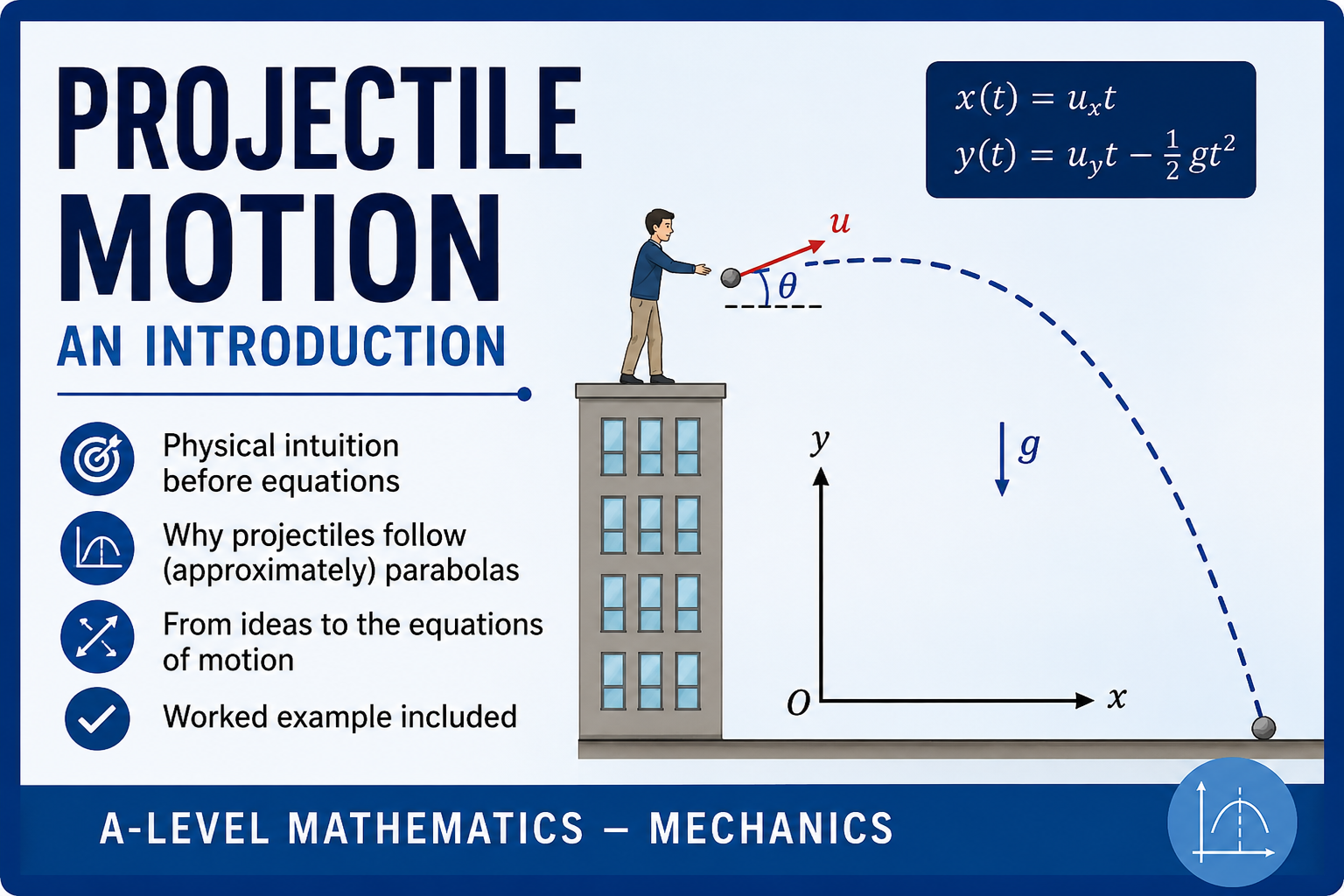
A-Level Mechanics: Introduction to Projectile Motion (20-slide PowerPoint Lesson)
This resource is a complete introductory lesson on projectile motion for A-Level Mathematics (Mechanics).
Rather than beginning immediately with equations, the lesson develops the physical ideas behind projectile motion in a visual and intuitive way. Students are introduced to the concept through a series of thought experiments, including throwing a stone horizontally from a building and Newton’s famous Cannonball thought experiment.
The lesson explains:
• Why projectiles follow curved paths.
• The relationship between parabolas and elliptical orbits.
• Why a parabola is an excellent approximation for ordinary projectile motion.
• The assumptions used in the standard mathematical model (flat Earth, constant gravity, negligible air resistance).
• The force acting on a projectile and the resulting acceleration.
• How projectile motion can be understood as two independent motions occurring simultaneously.
• The choice of reference frame and coordinate axes.
• The vector equations of motion for projectiles.
• The four scalar equations used in A-Level Mechanics.
The PowerPoint contains clear diagrams, progressive visual explanations and a fully worked introductory example involving a projectile launched at an angle.
This lesson is particularly suitable for:
• Edexcel A-Level Mathematics (Mechanics)
• AQA A-Level Mathematics (Mechanics)
• OCR A-Level Mathematics (Mechanics)
• Further Mathematics students requiring a conceptual introduction to projectiles
The resource is designed to help students understand the underlying physics before applying the mathematical techniques, making it ideal as a first lesson on projectile motion.
Contents:
• 20 PowerPoint slides
• Learning objectives
• Visual introduction to projectile motion
• Newton’s Cannonball thought experiment
• Modelling assumptions
• Forces and acceleration
• Independent horizontal and vertical motion
• Vector and scalar equations of motion
• Worked example
Level:
A-Level Mathematics / Further Mathematics
Duration:
Approximately 45–60 minutes
Author:
Dr Miguel Navarro
Something went wrong, please try again later.
This resource hasn't been reviewed yet
To ensure quality for our reviews, only customers who have purchased this resource can review it
Report this resourceto let us know if it violates our terms and conditions.
Our customer service team will review your report and will be in touch.
£5.00