A complete teacher’s guide to Year 6 writing moderation covering the TAF, evidence gathering, standardisation, moderation meetings and preparation checklists.
This resource is designed for Year 6 class teachers, English subject leaders and senior leaders preparing for external moderation visits. It covers the full moderation process from building your evidence portfolio in January through to the external LA visit in the summer term.
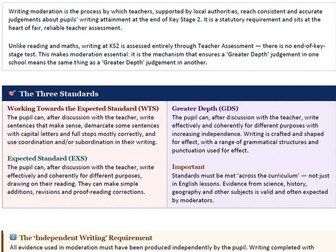
Aligned to the KS2 Teacher Assessment Framework (TAF), it explains the three writing standards (WTS, EXS and GDS) in plain language, sets out exactly what moderators look for, and helps teachers articulate their judgements with confidence.
Includes a detailed standards breakdown table, a Do/Don’t evidence guide, advice on internal standardisation, and a Spring and Summer term preparation checklist.
Suitable for use in staff meetings, INSET days, or as a personal reference guide throughout the year.
A comprehensive, print-ready verbal reasoning worksheet covering one of the most frequently tested 11+ question types - fully differentiated across seven categories, from accessible to genuinely challenging.
Fifty carefully crafted odd-one-out questions, organised into seven themed sections that increase in difficulty. Each question is clearly laid out with a ruled answer box, and a full mark scheme with reasons is included at the back. Ideal for independent practice, tutoring sessions, homework or timed exam simulation.
50 questions across 7 themed sections:
Section 1 - Animals & Living Things (Questions 1–8): classification by animal family, class, habitat and biological process — including some genuinely tricky taxonomy questions
Section 2 - Words & Language (Questions 9–18): synonyms and antonyms, word class, literary terms, geographical vocabulary and legal/document terminology
Section 3 - Numbers & Mathematics (Questions 19–26): prime numbers, square numbers, cube numbers, multiples, and mathematical vocabulary
Section 4 - Colours & Shades (Questions 27–32): colour families and terminology - a classic 11+ category that many pupils underestimate
Section 5 - Music & Arts (Questions 33–38): instruments, musical forms, artistic media and poetic terms
Section 6 - Collective Nouns & Tricky Associations (Questions 39–44): collective nouns, science vocabulary, government and law — some questions require pupils to think carefully about precise category membership
Section 7 - Lateral Thinking (Questions 45–50): the hardest set, requiring pupils to think beyond surface connections - including questions on alloys vs elements, classification of celestial bodies, etymology and game types
Full Mark Scheme
Every question has a clearly stated answer and a full explanation of the reason, so pupils (and parents/tutors) understand not just what the answer is, but why.
A complete, self-contained synonyms and antonyms booklet for 11+ preparation - 60 carefully chosen words across six themed sections, with a study reference section, a timed practice test, and a full mark scheme. Everything a pupil needs to build and test their vocabulary in one polished, print-ready resource.
Synonyms and antonyms questions appear in virtually every 11+ verbal reasoning paper. This booklet addresses them systematically: pupils first study the words in context, then test themselves without support, then check their answers against an inclusive mark scheme that accepts a wide range of correct responses.
Part 1 - Reference Section (study this first)
All 60 words presented in a clear four-column table: word, definition, three synonyms (highlighted in blue) and three antonyms (highlighted in amber). The consistent colour-coding runs throughout the booklet so pupils always know at a glance which column is which. Words are organised into six themed sections:
Section 1 - Feelings & Character: audacious, benevolent, contemptuous, despondent, ebullient, elated, imperious, indignant, melancholy, reticent
Section 2 - Intelligence, Thought & Communication: articulate, astute, cryptic, eloquent, erudite, frivolous, incoherent, lucid, pedantic, verbose
Section 3 - Size, Degree & Intensity: colossal, diminutive, exorbitant, formidable, immense, meagre, moderate, negligible, prodigious, superficial
Section 4 - Movement, Action & Speed: agile, dawdle, hasty, impetuous, laborious, languid, nimble, sluggish, stealthy, vigorous
Section 5 - Morality, Truth & Values: candid, corrupt, devious, exemplary, hypocritical, impartial, magnanimous, scrupulous, treacherous, virtuous
Section 6 - Description, Appearance & Quality: antiquated, barren, dilapidated, exquisite, garish, impeccable, mundane, pristine, resplendent, sinister
Part 2 - Practice Questions (complete under timed conditions)
All 60 words presented in a clean two-column grid - word on the left, blue synonym answer box and amber antonym answer box on the right. Pupils complete this section from memory, with clear write-on lines in each answer cell. The section colour-coding is retained so pupils can see at a glance which theme each word comes from.
Part 3 - Mark Scheme (for parent or tutor use)
Full mark scheme listing the word, its definition, and accepted synonyms and antonyms for every question. The mark scheme explicitly accepts any reasonable answer — not just the words listed in the Reference Section. Total: 120 marks (1 per synonym + 1 per antonym).
Designed for Year 5 and Year 6 pupils preparing for 11+ entrance examinations
GL Assessment and CEM-style verbal reasoning preparation
Independent and grammar school entrance preparation
Tutors delivering structured 11+ vocabulary programmes
High-attaining KS2 pupils requiring extension work in vocabulary and word relationships
A complete, print-ready end of topic assessment for Year 6 Light, including a full pupil paper and a detailed separate mark scheme. Designed to assess the full breadth of the Year 6 light unit - from basic recall through to extended scientific writing - this resource saves hours of planning and is ready to use straight away.
Pupil Paper (40 marks)
Three clearly signposted sections:
Section A - Multiple Choice (10 marks, 1 mark each)
Ten questions testing recall and understanding across the full topic, including: refraction, luminous and non-luminous objects, parts of the eye, how light travels, the visible spectrum, rods and cones, shadows, and the pupil’s response to light.
Section B - Short Answer Questions (20 marks)
Seven questions at increasing levels of demand, requiring pupils to name, explain, describe, and compare. Questions cover: the five parts of the eye, luminous vs non-luminous objects, focal points, the flipping arrow/cylindrical glass experiment, rod and cone cells, the inverted retinal image, and the disappearing coin experiment.
Section C - Extended Writing (10 marks)
One extended response question asking pupils to describe the complete journey of light from a source to the human brain — rewarding use of scientific vocabulary, sequenced explanation, and depth of understanding.
Mark Scheme (Teacher Copy)
Correct answers for all Section A questions, including a note on the spectrum question where two answers are acceptable
Clear point-by-point guidance for every Section B question, with notes on what to accept
A five-band mark descriptor for Section C (Emerging → Greater Depth), with a key vocabulary reward list and worked guidance on what a full-mark response includes
A section-by-section score recording grid
An overall attainment band guide: 0–15 Emerging | 16–24 Developing | 25–32 Expected | 33–40 Greater Depth
This assessment covers:
How light travels (straight lines, speed, luminous sources)
Refraction - definition, experiments, and explanation
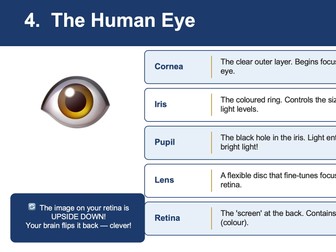
The human eye - structure and function (cornea, iris, pupil, lens, retina)
Rod and cone cells
The visible spectrum and colour vision
Optical illusions linked to refraction
This complete lesson pack takes Year 6 pupils on a journey to the ends of the Earth - exploring the geography of the polar regions, the stories of Scott, Amundsen, and Shackleton, and the extraordinary challenges of survival in the world’s most hostile environments.
The pack combines a fully-resourced teaching PowerPoint with three printable activity sheets covering collaborative group work, differentiated independent writing, and an extension research task.
What’s included?
• Title slide with learning objectives
• Where in the World? - Arctic vs Antarctic comparison cards (location, temperature, wildlife, key features)
• The Race to the Poles - Scott, Amundsen, and Shackleton side-by-side explorer cards
• The Endurance Expedition - illustrated timeline of Shackleton’s survival story
• Survival Challenges - four challenge cards (extreme cold, navigation, food & energy, team dynamics)
• Collaborative Activity instructions - group expedition planning with assigned roles
• Primary Sources - paraphrased voices from the ice with discussion prompts
• Differentiated Independent Writing choices - three challenge levels
• Plenary exit ticket - five recall and reasoning questions
• Extension slide - polar exploration today (climate change, modern expeditions, polar science)
polar exploration
Year 6
KS2
geography
history
Shackleton
Scott
Amundsen
Arctic
Antarctic
explorers
cross-curricular
diary writing
persuasive writing
differentiated
group work
lesson PowerPoint
primary sources
survival
climate change
A complete teach-and-assess bundle for the Year 6 Science light unit, covering everything from how light travels to the structure of the human eye - with a polished end-of-topic assessment and full mark scheme included.
📊 TEACHING POWERPOINT
An interactive lesson presentation covering the full unit:
• What is light? Luminous vs non-luminous objects
• How light travels - straight lines, speed of light, shadows
• Refraction - bending of light, real-life examples (pencil in water, prisms, rainbows)
• The human eye - labelled diagram, cornea, iris, pupil, lens, retina, optic nerve
• How we see colour - rods vs cone cells, colour vision, colour blindness
• Built-in Quiz - three difficulty rounds (Easy / Medium / Hard) with questions and reveal answers, covering recall through to extended explanation
Talk Time discussion prompts and Did You Know? facts are embedded throughout to keep pupils engaged. The quiz can be used as a standalone retrieval activity.
Hands-on investigation sheets requiring only water, a glass, a pencil, and a coin. Each experiment includes a clear equipment list, step-by-step instructions, safety reminders, a Science Bit explanation, and a challenge extension task.
Experiment 1 - The Disappearing / Flipping Arrow
Pupils draw an arrow on paper and observe it flip direction when viewed through a glass of water. Explores how a cylindrical lens creates a focal point that inverts the image. Challenge: test with an upward arrow and predict the outcome.
Experiment 2 - The Bent Pencil Illusion
Pupils observe a pencil appearing to snap at the water surface. Explores how light changes speed between media and why the brain misinterprets bent rays as a straight line. Challenge: vary water depth and glass width.
Experiment 3 - The Magic Disappearing Coin
Pupils step back until a coin vanishes behind a cup rim, then watch it reappear as water is added. Explores how refraction at the water-air boundary redirects light over the rim. Real-world link: why swimming pools look shallower than they are.
END OF TOPIC ASSESSMENT
A fully structured written assessment in three sections:
Section A - Multiple Choice [10 marks]
Ten questions covering refraction, luminous objects, parts of the eye, the visible spectrum, shadows, and the behaviour of light. Ideal for quick retrieval checking.
Section B - Short Answer Questions [20 marks]
Seven questions including: naming the five parts of the eye; comparing luminous and non-luminous objects; defining focal point; explaining the cylindrical glass illusion; comparing rod and cone cells; explaining the retinal image inversion; and a refraction observation task (disappearing coin).
Section C - Extended Writing [10 marks]
One extended question: describe the journey of light from source to the human brain, explaining how the eye works and how we see. Pupils may include a labelled diagram. Marked using a five-band descriptor.
Make light science hands-on and memorable with this beautifully designed set of three practical investigation sheets for Year 6 (ages 10–11). Perfect for a lesson on light, refraction, and optical illusions, this resource guides pupils through three classic experiments using simple household materials - ideal for in-class science or home learning.
What’s included:
A single polished, print-ready instruction sheet covering all three experiments:
The Disappearing / Flipping Arrow - pupils discover how a water-filled glass acts as a lens, flipping an arrow through refraction
The Bent Pencil Illusion - a clear, visual demonstration of light changing speed and direction as it enters water
The Magic Disappearing Coin - a wow-factor experiment showing how refraction can bend light over a physical barrier
Each experiment includes:
A clear "You will need "list
Step-by-step instructions in child-friendly language
An accessible explanation written for Year 6 understanding
An extension question to deepen scientific thinking
light, refraction, Year 6, KS2 science, optical illusions, practical science, investigation, experiments, light and shadow, physics
Bring light science to life with this visually striking, fully structured 15-slide interactive PowerPoint, designed specifically for Year 6 (ages 10–11). Perfect as a whole-lesson teaching tool or a lesson starter series, this presentation guides pupils through everything they need to know about light and the eye and then tests them with a built-in three-round quiz.
What’s covered:
What is light? - luminous vs non-luminous objects, with a paired Talk Time discussion prompt and a Did You Know fact
How does light travel? - straight-line rays, speed of light, ray diagram, and a quick discussion question
Refraction - definition, three experiment cards (the flipping arrow, the bent pencil, the magic coin), and an annotated air/water boundary diagram with incident ray, normal, and refracted ray labelled
The human eye - cornea, iris, pupil, lens, and retina with descriptions; includes the inverted retinal image fun fact
How we see colour - the full ROYGBIV visible spectrum and a rods vs cones comparison card
Key vocabulary slide - eight terms with definitions (refraction, medium, focal point, retina, iris, luminous, rods & cones, optical illusion)
Perfect for:
KS2 Science - Light (Year 6 NC)
Whole-class teaching, lesson starters, or cover lessons
Paired with a question sheet or practical investigation activity
Science subject leaders looking for a high-quality, ready-to-use resource
Celebrate the 2026 FIFA World Cup with this comprehensive, curriculum-mapped bundle covering every year group from Year 1 to Year 6. Perfect for the summer term, World Cup week, or as standalone lesson fillers, every resource has been carefully crafted with clear success criteria, teacher guidance, and differentiation built in. Buy the bundle and save - everything you need, nothing you don’t.
WHAT’S IN THIS BUNDLE?
Geography & PSHE
World Cup Geography PowerPoint - Y5/6 Host nations, climate zones, geography of USA, Canada & Mexico
Activity Pack — Y5/6 4 activities: fact file, map work, climate comparison, dream host nation
Word Bank — Y5/6 Geography, climate, culture, football vocabulary with sentence starters
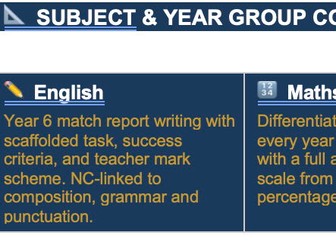
Year 6 English: Match Report Scaffolded writing task with success criteria (Working Towards → Greater Depth)
Year 6 English: Mark Scheme Cross-level teacher guidance with NC links and model answer features
World Cup Maths — Years 1 to 6
Year 1 Maths Worksheet + Answers Counting, adding & subtracting
Year 2 Maths Worksheet + Answers Number, money, time & data
Year 3 Maths Worksheet + Answers Number, money, time & tables
Year 4 Maths Worksheet + Answers Number, money, time, tables & tournament table
Year 5 Maths Worksheet + Answers Number, fractions, money, time
Year 6 Maths Worksheet + Answers Number, statistics, ratio, percentage
Scheme of Work
LKS2 Cross-Curricular Scheme of Work (Y3/4) 6 weeks · 10 subjects · 36+ activities · 100% NC-aligned
WHY BUY THIS BUNDLE?
Saves time - everything planned and ready to print
Every resource includes teacher answers or guidance
Consistent, polished design throughout
Differentiated: Working Towards to Greater Depth
100% National Curriculum aligned across all year groups
Inclusive - framed as a global cultural event
Topical and engaging for pupils following the 2026 tournament
Created by a practising teacher and TES author
Perfect for summer tutoring, 11+ preparation or end-of-year enrichment - a fully polished, exam-style comprehension and creative writing pack pitched at genuine selective school entrance standard.
This pack contains two original reading passages, a full set of layered comprehension questions, three differentiated creative writing tasks, a detailed mark scheme and a five-criterion writing assessment rubric.
Section A - Fiction Comprehension (25 marks)
An original short story extract, The Lighthouse Keeper, about a woman who retreats to a remote lighthouse and unexpectedly discovers her own confidence during an emergency at sea. Questions move through the full range of 11+ skills: retrieval, vocabulary in context, inference, language analysis and character development.
Section B - Non-Fiction Comprehension (25 marks)
An original passage, The Age of the Deep, written in the style of popular science - exploring deep ocean exploration and its implications for the search for life elsewhere in the universe. Questions cover retrieval, explanation in own words, analysis of writer’s craft, audience awareness and a comparative task linking both passages.
Section C - Creative Writing (assessed out of 20)
Three carefully differentiated tasks for pupils to choose from:
A - Narrative: a story beginning with a compelling opening line set on a deserted railway platform
B - Descriptive: a pure atmospheric description of a place at dawn, with no plot required
C - Persuasive: an article arguing that ocean exploration matters more than space exploration, drawing on Passage 2
Includes planning space and 28 ruled writing lines.
Mark Scheme & Assessment Criteria
Full examiner-style guidance for all 17 comprehension questions, including acceptable answers, marking points and examiner notes. A five-criterion writing rubric (vocabulary, structure, grammar/punctuation/spelling, originality, task fulfilment) with a built-in scoring grid for parent or tutor use.
A structured vocabulary programme for pupils preparing for 11+ entrance examinations - 90 carefully chosen words, organised into six themed weeks, with definitions, example sentences and a built-in tracker so pupils can see their progress grow across the summer.
This is not a word list. It is a complete learning programme: every word comes with a clear definition, a model example sentence showing the word used in context, a tick box for when the pupil has mastered it, a “My Sentences” practice section for each week, and a master reference list at the back for self-testing. Everything is print-ready in a professional, colour-coded design.
What’s Included
90 words across 6 themed weeks - 15 words per week:
Week 1 - Feelings, Character & Behaviour: the emotional and moral vocabulary that appears in almost every fiction comprehension passage - words like tenacious, reticent, imperious, remorseful and wistful
Week 2 - Description, Setting & Atmosphere: language for writer’s craft questions and creative writing - including foreboding, ethereal, languid, tumultuous and luminous
Week 3 - Formal & Academic Language: the register of non-fiction comprehension and persuasive writing - including substantiate, empirical, meticulous, plausible and eloquent
Week 4 - Nature, Science & the World: vocabulary drawn from science-linked comprehension passages - including symbiosis, metamorphosis, luminescent, volatile and biodiversity
Week 5 - Literature, Language & the Arts: essential for language-analysis questions - including connotation, euphemism, pathos, motif, hyperbole and protagonist
Week 6 - Society, History & Abstract Ideas: vocabulary for opinion pieces, historical texts and the most demanding comprehension passages - including emancipation, dichotomy, propaganda, sovereignty and oppression
Every word includes:
A clear, accessible definition
A model example sentence showing the word in natural use
A tick box for when the pupil can define it without looking
A numbered row for easy reference
Each week also includes:
A weekly progress tracker (score out of 15 + date completed)
A “My Sentences” practice section - pupils choose 5 words and write their own sentences, the single most effective technique for vocabulary retention
Master Word List
A compact quick-reference page at the back listing all 90 words with definitions and a final tick column - ideal for self-testing by covering the definition and working from memory alone.
Cover Page
Candidate details box, a six-week overview table with a running total out of 90, and a clear “How to Use” guide with evidence-based study strategies.
Everything a primary school needs to meet the September 2026 RSHE statutory deadline - three polished, print-ready documents that would take hours to produce from scratch, all fully aligned to the DfE’s July 2025 guidance.
The DfE’s updated RSHE statutory guidance replaces the 2019 guidance and must be implemented by all schools from 1 September 2026. That means updated policies, a reviewed curriculum and informed parents - all before the new academic year. This bundle gives you all three, ready to use immediately.
Each document is fully editable, clearly signposts where school-specific information is needed (highlighted in yellow), and is written in professional, accurate language that reflects the 2025 guidance precisely.
A complete whole-school PSHE resource on grief, loss and bereavement - covering Years 1 to 6 with nine fully planned lessons, two classroom PowerPoint presentations, eight pupil activity sheets and two parent letter templates. Fully aligned to the DfE’s 2025 statutory RSHE guidance, which makes this content a statutory requirement from September 2026.
This bundle combines the KS1 unit (4 lessons, Years 1–2) and the KS2 unit (5 lessons, Years 3–6) into a complete, coherent whole-school approach. Both units share the same rigorous approach to safeguarding, the same commitment to honest, age-appropriate language, and the same professional design - but each is fully differentiated for its stage. Together they provide seamless progression from the simple introduction of change and loss in Year 1 to the nuanced discussion of empathy, disenfranchised grief and supporting others in Year 6.
✦ What’s in the Bundle
KS1 Unit - Years 1 & 2 (4 lessons)
Lesson 1: Things Change - change, types of loss, feelings
Lesson 2: Feelings About Loss - the five feelings of loss, what helps
Lesson 3: When Someone Dies - honest, gentle introduction to death and bereavement
Lesson 4: Remembering and Being Kind - memory, comfort, kindness to self and others
3 pupil activity sheets (Feelings About Change, Feeling Clouds, My Memory Page)
20-slide PowerPoint with speaker notes
Parent communication letter template
KS2 Unit - Years 3–6 (5 lessons)
Lesson 1: Understanding Loss - many forms of loss beyond death
Lesson 2: The Grief Process - no right way; grief in waves, not stages
Lesson 3: Different Kinds of Loss - bereavement, pet loss, family change, transition; disenfranchised grief (UKS2)
Lesson 4: Supporting Yourself - continuing bonds, memory, self-care
Lesson 5: Supporting Others - helpful and unhelpful responses; empathy vs sympathy
5 pupil activity sheets (Types of Loss, Feeling Waves, Case Study Cards, Self-Care Toolkit, What Would You Say?)
22-slide PowerPoint with speaker notes
Parent communication letter template
Both units include:
Comprehensive teacher guidance with safeguarding section, vocabulary table and recommended reading
Full lesson plans (warm-up, main activities, plenary, differentiation, safeguarding note per lesson)
Pupil-facing activity sheets
A parent and carer communication letter template
Professional navy and gold design throughout
Alignment to DfE RSHE Statutory Guidance July 2025
A complete, sensitively written PSHE unit on grief, loss and bereavement for Years 1 and 2 - fully aligned to the DfE’s 2025 statutory RSHE guidance, which explicitly requires this content in all primary schools from September 2026.
This unit takes children through four carefully sequenced lessons, using picture books, circle time, distancing techniques and structured activities to explore loss and bereavement in a way that is honest, age-appropriate and emotionally safe. Everything you need is included: comprehensive teacher guidance, four full lesson plans, a matching PowerPoint presentation, three pupil activity sheets and a parent communication letter template.
A thorough, carefully crafted PSHE unit on grief, loss and bereavement for Years 3 to 6 - fully aligned to the DfE’s 2025 statutory RSHE guidance and designed to give KS2 pupils the knowledge, vocabulary and skills to understand grief, manage loss and support others.**
Five sequenced lessons move from the broad concept of loss all the way to the practical skill of supporting a grieving friend, covering every aspect of the 2025 statutory requirement. The unit includes extensive teacher guidance, five detailed lesson plans, five pupil activity sheets, a 22-slide PowerPoint presentation with embedded speaker notes, and a parent communication letter template.
Engage your class with this fully curriculum-aligned, print-ready Geography bundle themed around the FIFA World Cup 2026! Covering countries and continents, climate, physical geography and cultural diversity, this pack gives pupils a brilliant context for applying and extending their geographical knowledge and works perfectly as a standalone unit, cross-curricular topic hook or enrichment week resource. Everything is ready to use straight away - no prep required.
What’s included?
10-slide PowerPoint presentation covering:
The three host nations (USA, Canada, Mexico) - location, capitals and host cities
Continents and confederations — who’s playing and where they’re from
Climate comparison of four host cities using key geographical vocabulary
Culture and diversity of each host nation
Key geographical vocabulary display slide
Activities overview and 8-question quiz with plenary reflection
4-page pupil activity pack (Word document, fully editable) including:
Activity 1: Nation Fact File - guided research task
Activity 2: Map It! - five atlas and mapping tasks with reflection questions
Activity 3: Climate Comparison - data table, bar chart activity and analytical questions
Activity 4: Dream World Cup Country - geographical justification and persuasive writing extension
Quiz Answer Sheet - ready for self or peer marking
Curriculum links (KS2 Geography)
Locate the world’s countries using maps
Name and locate the world’s seven continents and five oceans
Describe and understand key aspects of climate zones and human geography
Use geographical vocabulary including hemisphere, latitude, longitude, altitude and climate
Suitable for: Year 5 / Year 6 | Upper KS2
Format: PowerPoint (.pptx) + Word (.docx, fully editable)
Pages/slides: 10 slides + 5-page activity pack
All rights reserved. Not to be shared, uploaded or distributed beyond the purchasing school.
A comprehensive, beautifully designed 3-page word bank to support Year 6 pupils across your World Cup 2026 geography unit. Packed with curriculum-aligned vocabulary, writing frames, data and sentence starters, this resource is perfect as a desk mat, a stuck-in reference sheet, or a writing support tool displayed alongside pupil work.
Designed to reduce teacher workload - simply print, and it’s ready to use.
What’s included?
3 print-ready A4 pages across seven sections:
Geography Vocabulary - 18 key terms with definitions (altitude, hemisphere, latitude, precipitation, Prime Meridian and more)
Host Nations Vocabulary - 12 terms covering USA, Canada and Mexico (including bilingual, melting pot, UNESCO, ancient civilisation)
Climate & Weather Vocabulary - 12 terms (tropical, monsoon, oceanic, highland, subtropical, arid and more)
Sentence Starters & Writing Connectives - comparing, reasoning and adding information, plus 10 ready-to-use geographical sentence frames
Numbers & Data Bank - 16 key facts and statistics to embed in written work (temperatures, populations, distances, team numbers)
Culture & Diversity Vocabulary - 12 terms (diversity, equality, inclusion, indigenous, multicultural, migration and more)
Football & Competition Vocabulary - 12 terms covering tournament structure and all 6 FIFA confederations
Curriculum links
KS2 Geography: locational knowledge, human and physical geography, geographical skills and fieldwork
PSHE / RSE: diversity, equality, culture and identity
English: subject-specific vocabulary, writing to inform and explain
Suitable for: Year 6 | Upper KS2
Subject: Geography / PSHE / English cross-curricular
Format: Word (.docx, fully editable)
Length: 3 pages
This resource works brilliantly alongside:
FIFA World Cup 2026 Geography PowerPoint (Year 5/6)
FIFA World Cup 2026 Activity Pack (Year 5/6)
FIFA World Cup 2026 Classroom Display
A fully ready-to-teach, 10-slide PowerPoint presentation exploring Pride Month with your Year 6 class. Beautifully designed in a bold rainbow colour scheme, this lesson introduces pupils to what Pride is, its history, the meaning of LGBTQ+, why representation matters, and how to be a good ally - all in age-appropriate, curriculum-aligned language.
This resource has been carefully crafted to support confident, sensitive teaching of RSE and PSHE content, with a classroom agreement slide built in so you can establish a safe, respectful space before the lesson begins.
What’s included?
10 fully designed slides covering:
Classroom ground rules / discussion agreement
What is Pride Month? (history, the rainbow flag, what it stands for)
A Little History - from Stonewall 1969 to same-sex marriage in the UK
What does LGBTQ+ mean? - clear, age-appropriate definitions
Why does Pride matter? - celebration, community, mental health and education
What is an ally? - practical actions pupils can take
Five discussion questions for think-pair-share
Key vocabulary display slide (8 definitions)
Plenary reflection slide
Curriculum links
PSHE Association Programme of Study: Relationships / Health & Wellbeing
RSE statutory guidance (DfE, 2020): Families and people who care for me; Respectful relationships
British Values: Mutual respect, tolerance, individual liberty
A warm, fully inclusive Father’s Day writing activity for KS1 - built around a comic strip structure that makes story writing feel accessible and exciting for young writers. Pupils draw and write their own four-panel adventure story about their special person, whether that’s a Dad, Grandad, Stepdad, Uncle or any important figure in their life.
Perfectly scaffolded for Year 1 and Year 2, with enough stretch built in for more confident writers to go further independently. Print and go - no prep needed.
WHY TEACHERS LOVE IT
Fully inclusive - “special person” wording throughout covers all family structures
Comic strip format reduces writing anxiety and gives every child an entry point
Carefully sequenced: draw first, then write - supporting lower-confidence writers
Word bank and sentence starters provide scaffolding without spoon-feeding
Self-assessment criteria focus on KS1 writing essentials: capitals, full stops, making sense
Works brilliantly as a standalone Father’s Day lesson or as part of a personal writing unit
A complete, five-page poetry unit built around an original mentor poem written specifically for this resource. Pupils read and analyse The Quiet Hero, explore the techniques that make it work, then plan and write their own poem about a father figure of their choice.
This is a proper writing lesson - not a fill-in-the-blanks activity. It asks KS2 pupils to think like poets: to choose precise words, to use imagery, to write from specific memory rather than vague generalisation. Fully inclusive wording throughout.
WHY TEACHERS LOVE IT
Includes an original, published-quality mentor poem — no sourcing, no copyright worries
Fully inclusive: “special person” framing covers all family structures
Teaches pupils to write from specific memory, not generic ideas — the planning frame is designed around this
Covers key KS2 poetry objectives: rhyme, rhythm, metaphor, simile, sensory detail, repetition
Analysis tasks build reading comprehension skills alongside writing
Peer assessment and self-reflection are built in — no extra resources needed
Works for the whole of KS2: Year 3–4 use the scaffolding; Year 5–6 can work more independently
A beautifully crafted, ready-to-use writing activity for Year 6, perfect for the lead-up to Father’s Day. Pupils write a personal, descriptive tribute to a father figure of their choice - Dad, Grandad, Stepdad, uncle or another important person in their life, using carefully selected vocabulary, figurative language and precise sensory detail.
This isn’t a generic card-making task. It’s a full, high-quality writing lesson that challenges Year 6 pupils to write with craft and intentionality, producing a piece they’ll be genuinely proud of.
WHAT’S INCLUDED
A Think and Talk warm-up to generate personal, specific memories before writing
A rich vocabulary toolkit across appearance, sound and character — words to stretch, not spoon-feed
Three mentor sentences with analysis prompts, modelling metaphor, sensory detail and inference
Guided figurative language practice tasks (simile, metaphor, sensory sentence)
A clear planning frame with opening, middle and ending guidance — with an exemplar opening sentence
Lined writing pages (250–350 word target)
A peer assessment checklist with six success criteria and space for written feedback
WHY TEACHERS LOVE IT
Fully inclusive — prompts cover all kinds of father figures
Builds on KS2 writing objectives: figurative language, precise vocabulary, structural choices
Teaches pupils to write from specific memory, not vague generalisation
Works brilliantly as a standalone lesson or as a culminating piece after a writing unit
Print and go — no prep needed
FATHER’S DAY
YEAR 6 WRITING
KS2 ENGLISH
DESCRIPTIVE WRITING
PERSONAL WRITING
FIGURATIVE LANGUAGE
CREATIVE WRITING YEAR 6
SATS WRITING
UKS2
END OF YEAR WRITING


 Quick View