Year 6 Science: Light & the Eye - Complete Bundle
Resource Bundle



A complete teach-and-assess bundle for the Year 6 Science light unit, covering everything from how light travels to the structure of the human eye - with a polished end-of-topic assessment and full mark scheme included.
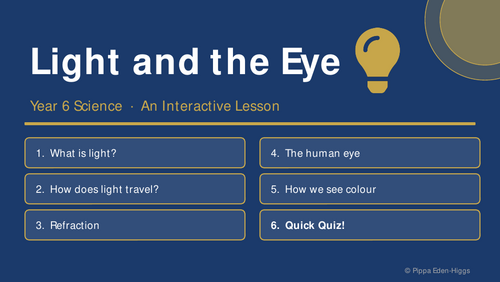
📊 TEACHING POWERPOINT
An interactive lesson presentation covering the full unit:
• What is light? Luminous vs non-luminous objects
• How light travels - straight lines, speed of light, shadows
• Refraction - bending of light, real-life examples (pencil in water, prisms, rainbows)
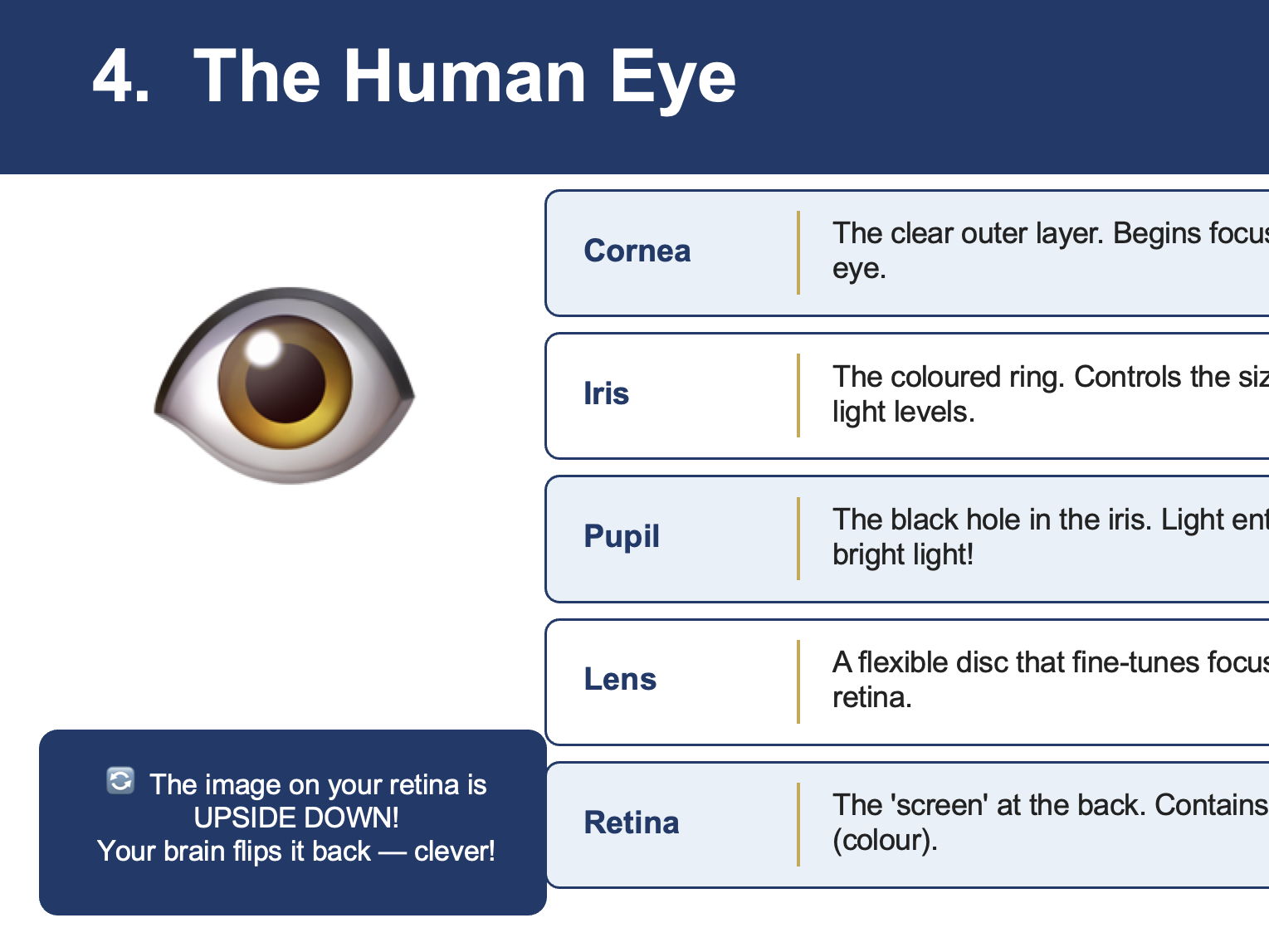
• The human eye - labelled diagram, cornea, iris, pupil, lens, retina, optic nerve
• How we see colour - rods vs cone cells, colour vision, colour blindness
• Built-in Quiz - three difficulty rounds (Easy / Medium / Hard) with questions and reveal answers, covering recall through to extended explanation
Talk Time discussion prompts and Did You Know? facts are embedded throughout to keep pupils engaged. The quiz can be used as a standalone retrieval activity.
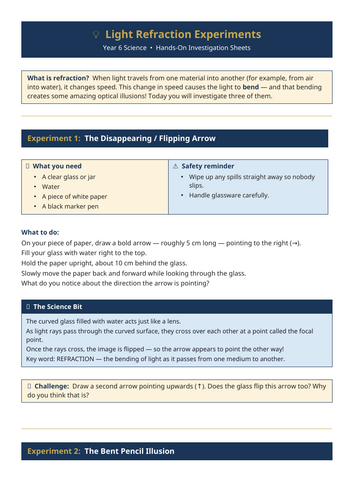
Hands-on investigation sheets requiring only water, a glass, a pencil, and a coin. Each experiment includes a clear equipment list, step-by-step instructions, safety reminders, a Science Bit explanation, and a challenge extension task.
Experiment 1 - The Disappearing / Flipping Arrow
Pupils draw an arrow on paper and observe it flip direction when viewed through a glass of water. Explores how a cylindrical lens creates a focal point that inverts the image. Challenge: test with an upward arrow and predict the outcome.
Experiment 2 - The Bent Pencil Illusion
Pupils observe a pencil appearing to snap at the water surface. Explores how light changes speed between media and why the brain misinterprets bent rays as a straight line. Challenge: vary water depth and glass width.
Experiment 3 - The Magic Disappearing Coin
Pupils step back until a coin vanishes behind a cup rim, then watch it reappear as water is added. Explores how refraction at the water-air boundary redirects light over the rim. Real-world link: why swimming pools look shallower than they are.
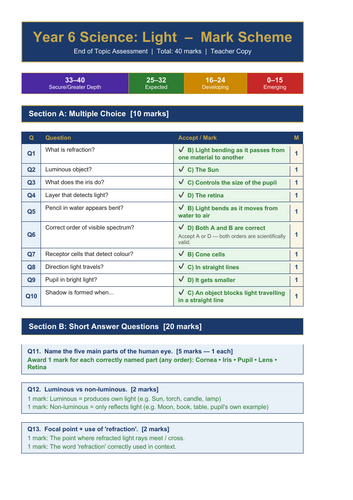
END OF TOPIC ASSESSMENT
A fully structured written assessment in three sections:
Section A - Multiple Choice [10 marks]
Ten questions covering refraction, luminous objects, parts of the eye, the visible spectrum, shadows, and the behaviour of light. Ideal for quick retrieval checking.
Section B - Short Answer Questions [20 marks]
Seven questions including: naming the five parts of the eye; comparing luminous and non-luminous objects; defining focal point; explaining the cylindrical glass illusion; comparing rod and cone cells; explaining the retinal image inversion; and a refraction observation task (disappearing coin).
Section C - Extended Writing [10 marks]
One extended question: describe the journey of light from source to the human brain, explaining how the eye works and how we see. Pupils may include a labelled diagram. Marked using a five-band descriptor.
Something went wrong, please try again later.
This resource hasn't been reviewed yet
To ensure quality for our reviews, only customers who have purchased this resource can review it
Report this resourceto let us know if it violates our terms and conditions.
Our customer service team will review your report and will be in touch.