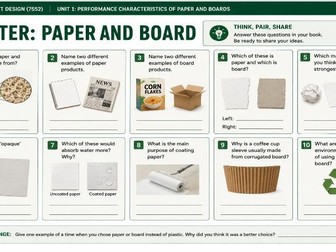
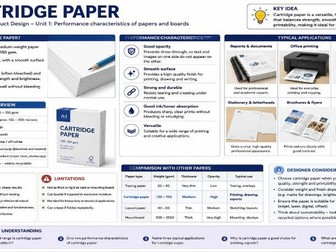
This lesson develops students’ knowledge of the papers and boards specified in the A-Level Product Design course. By the end of it, students should be able to distinguish between the physical properties of a material (characteristics it has regardless of forces applied — e.g. weight, absorbency, translucency, printability) and its mechanical properties (how it behaves under applied forces — e.g. strength, rigidity, resistance to tearing or creasing), and to justify the selection of a specific paper or board for a given application. Selection and justification questions are a staple of the written exam, so students need both the vocabulary and concrete product examples.
Students should leave the lesson able to describe how paper and board are manufactured, explain how they are classified by weight and size, and identify a range of standard papers and boards — their physical and mechanical properties and why each is chosen for particular applications. The specified materials are bleed proof, cartridge, grid, layout and tracing papers, plus corrugated card, duplex board, foil-lined board, foam core board, inkjet card and solid white board.
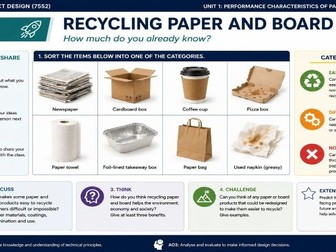
Paper and board are among the most successfully recycled materials in the UK, and this topic sits at the intersection of materials knowledge, manufacturing processes and the environmental/sustainability strand of the A Level specification. Students need to understand both the industrial process itself and its consequences: what recycling saves, what it cannot achieve, and why designers’ material choices (coatings, laminates, adhesives, inks) determine whether a paper product is recyclable at all.
The headline arguments for recycling are resource and energy conservation. Making paper from recovered fibre avoids felling virgin timber, and uses substantially less energy and water than pulping virgin wood. It also diverts material from landfill, where decomposing paper generates methane, a potent greenhouse gas. Recycled fibre is now the single largest source of fibre for UK paper mills, and the UK recovers a high proportion of its paper and card — corrugated packaging in particular achieves very high recovery rates because it is collected in bulk from retail and industry and is easy to reprocess.
This lesson builds directly on addition polymerisation. Students should recall that alkene monomers (containing a C=C double bond) join together under high pressure with a catalyst to form long-chain saturated polymers, with no other product formed. The repeat unit is derived from the monomer by opening the double bond. Naming follows the poly(monomer) convention, e.g. ethene → poly(ethene), chloroethene → poly(chloroethene)/PVC. It is worth having a quick recap question ready, as the structure–property reasoning later in the lesson depends on students picturing polymers as very long covalent chains.
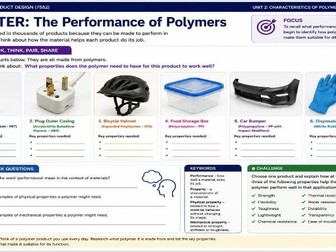
This lesson explains why different polymers behave so differently — why polythene is flexible while melamine is rigid, and why PVC can be either. The central idea is that the bulk (macroscopic) properties of a polymer are determined by its molecular structure and, in particular, by the strength of the intermolecular forces between polymer chains and how easily those chains can move past one another. By the end of the lesson, students should be able to explain how chain length, branching, side groups, cross-linking, crystallinity and chain flexibility affect properties such as strength, flexibility, density and melting behaviour, and how properties can be deliberately modified (e.g. by cold drawing or adding plasticisers).
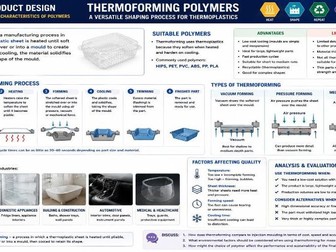
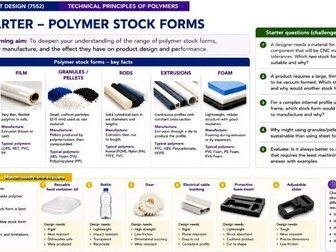
Polymers are supplied to manufacturers in a range of standard, commercially available formats known as stock forms. Designers and manufacturers select a stock form to suit the processing method that will be used, the scale of production and the geometry of the final product. Choosing the correct stock form and standard size minimises processing, reduces waste and keeps costs down, because material bought close to its final form needs less energy and fewer operations to convert into a product. Students should be able to name the main stock forms, link each one to the manufacturing processes that use it, and justify a choice of form and size for a given product.
This is one design and technology cover lesson, that can be taught by a specialist or non specialist. It is based on the design strategy SCAMPER. Students can redesign a lamp and/or another product if they choose
File can be used to teach with and printed out as work booklet for students.
One Design and Technology cover lesson. Can be taught by a specialist or non-specialist teacher. Lesson teaches the design design strategy ‘in the style of’ using existing products as a starting point for designing.
Can be used as teaching presentation or printed as a student workbook.
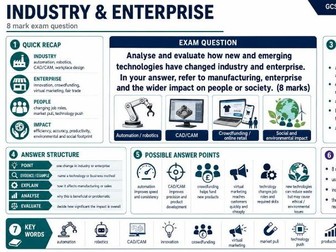
GCSE Design & Technology revision pack on Industry & Enterprise: 12-page PDF of knowledge organisers, 4 & 8 mark exam questions and a model answer.
This visual revision resource covers the new and emerging technologies content of GCSE Design and Technology. It focuses on industry, enterprise, people, and the impact of new technology on manufacturing, products and society. It is designed for the AQA GCSE Design and Technology (8552) specification, section 3.1.1, and also suits Edexcel, OCR and WJEC Eduqas D&T courses. It is pitched at Year 10 but works well for Year 11 exam revision too.
Each topic has a full-page knowledge organiser followed by a matching 4 mark exam question page. This means students learn the content and then practise applying it straight away.
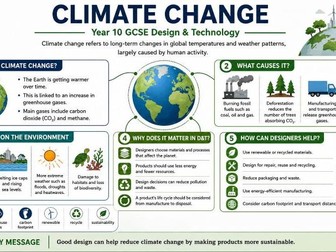
13-page GCSE Design & Technology environment and sustainability revision pack (PDF): knowledge organisers, 4 and 8 mark exam questions and a model answer.
This ready-to-use Year 10 GCSE D&T resource covers the environment, sustainability and responsible design. Each page is a clear, colourful knowledge organiser or exam practice sheet. It is ideal for teaching, revision, homework, cover lessons, intervention and independent study.
What’s included (13 pages, PDF):
Climate Change. What it is, its causes (fossil fuels, deforestation, manufacturing, transport, landfill), its environmental impacts and how designers can help.
Specification: The pack is designed for GCSE Design and Technology core technical principles, specifically the environment, sustainability, energy generation, ecological footprint and the impact of new products. It is well suited to AQA GCSE D&T (8552) and works equally well for Edexcel, OCR and WJEC/Eduqas D&T, as well as KS3 and KS4 sustainability teaching.
How to use it:
Display the pages on the board as lesson starters or teaching slides.
Print them as knowledge organisers for student books or revision folders.
Set the exam questions for timed practice, peer assessment or homework.
Use the model answer and marking criteria to teach extended writing technique.
Key words: GCSE D&T, Design and Technology, sustainability, climate change, finite resources, non-finite resources, renewable energy, non-renewable, carbon footprint, ecological footprint, product life cycle, responsible design, waste disposal, landfill, incineration, recycling, pollution, microplastics, global warming, exam questions, model answer, knowledge organiser, revision, AQA 8552.
File type: One PDF file (13 pages). It opens on any device with a free PDF reader.
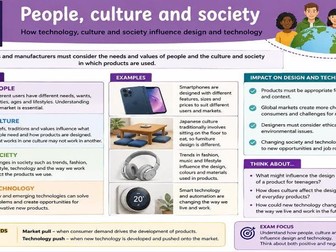
GCSE Design and Technology: People, Culture and Society. Knowledge organisers, 4 & 8 mark exam questions, model answers and mark schemes (PDF).
This 12-page PDF resource covers the People, Culture and Society topic for GCSE Design and Technology. It is designed for Year 10 and fits the AQA GCSE Design and Technology (8552) specification, core technical principles: new and emerging technologies. It is also useful for OCR and Edexcel D&T, where people, culture and society are covered. Every page is full-colour and visual, and it works for teaching, revision, homework, retrieval practice and exam preparation.
What’s included:
Topic overview (1 page): The four key factors (people, culture, society and technology), real-life product examples, the impact on design and technology, discussion questions, and key words including market pull and technology push.
People knowledge organiser and 4 mark question (2 pages): Target markets, needs, wants and abilities of different users, ergonomic products for older users, smart home devices, and automation and changing job roles.
Culture knowledge organiser and 4 mark question (2 pages): Beliefs, traditions and lifestyles, Japanese floor-level furniture, fashion and trends, colours and symbols with different cultural meanings, and halal, vegan and fragrance-free products.
Society knowledge organiser, 4 mark and 8 mark questions (3 pages): Inclusive design, accessibility, designing for disabled and elderly users, respecting religious groups, and accessible public products and services.
8 mark model answer with mark scheme (1 page): A fully worked answer on making products suitable for disabled users, elderly users and religious groups. It shows the analyse-and-evaluate structure with benefits, limitations and a conclusion.
Positive and negative impacts of products on society (3 pages): A knowledge organiser covering quality of life, independence, new jobs, consumer choice, automation and job losses, digital exclusion, cost, overconsumption, social pressure from trends and products becoming outdated. It also includes an 8 mark exam question with banded marking criteria and a 243-word model answer.
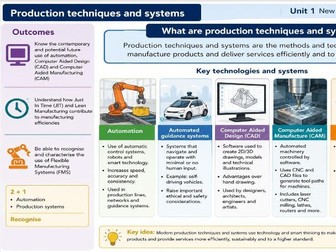
GCSE D&T Production Techniques & Systems revision pack: automation, AGVs, CAD, CAM, lean manufacturing & JIT, plus exam questions and a model answer (PDF).
This 14-page revision and retrieval pack covers Production techniques and systems from the New and emerging technologies section of AQA GCSE Design and Technology (8552). It’s also suitable for other GCSE D&T and Engineering specifications that cover the same content. Every page is a full-colour, single-page information sheet or exam practice sheet in a consistent, student-friendly layout, so it works well for revision lessons, homework, cover work, intervention sessions and independent study.
What’s included (PDF, 14 pages):
Topic overview sheet. Learning outcomes, a definition of production techniques and systems, and a summary of the key technologies: automation, automated guidance systems, CAD, CAM, lean manufacturing and Just In Time (JIT).
Five detailed knowledge organisers, each with a definition, where or how it is used, advantages, disadvantages and limitations, a real-world example, an exam tip, key words with definitions and a key idea:
Automation, covering robotic arms, production lines, communications networks, self-driving vehicles, quality control, and why some products remain handmade
Automated guided systems and AGVs (automated guided vehicles) in factories and warehouses
Computer Aided Design (CAD), covering 2D drawing, 3D modelling and rendering
Computer Aided Manufacture (CAM), covering CNC, tool paths, laser cutters, CNC milling, routers, lathes and embroidery machines
Lean manufacturing, including the 7 wastes, the link to JIT and the Toyota connection
Just In Time (JIT) sheet. Covers how JIT works, its key features, a Toyota Production System example, benefits and limitations, and a “think point” challenge question with space to write.
Five 4-mark exam practice questions, each with an exam tip, key words and writing lines. Topics: automation, CAD, CAM, lean manufacturing and JIT.
One 8-mark extended response question. “Analyse and evaluate” covering automation, CAD/CAM, Flexible Manufacturing Systems (FMS), JIT and lean manufacturing.
8-mark model answer with an efficiency benefit and an evaluation point for each system, an overall judgement, an AQA-style 8-mark level descriptor (0–8 marks), top tips and key words.
How it can be used:
Revision lessons and exam preparation for Year 10 and Year 11
Printable knowledge organisers for exercise books or revision folders
Display on a whiteboard as lesson starters or recap slides
Homework, cover lessons or independent learning
Exam technique practice: developing points for 4-mark questions and writing balanced analysis and evaluation for 8-mark questions
Peer or self-assessment using the model answer and mark scheme
GCSE Design & Technology: Planned Obsolescence, Product Lifespan, Repair & Recycling. 14 printable PDF revision sheets with exam questions and a model answer.
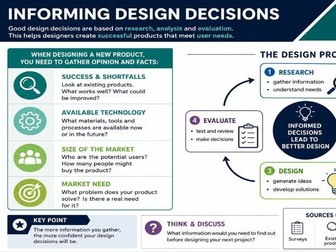
This resource is a set of 14 colourful, information-rich revision posters and exam practice sheets for GCSE Design and Technology. It covers informing design decisions, ethics, environmental responsibility, planned obsolescence, product lifespan, end-of-life options, repair and recycling. It is designed for the core technical principles content of the GCSE D&T specifications, particularly AQA GCSE Design and Technology (8552). It is also suitable for OCR, Pearson Edexcel and WJEC Eduqas courses that cover sustainability, the 6Rs and responsible design.
Knowledge organisers / revision posters
Informing Design Decisions: research, analyse, design, evaluate cycle; success and shortfalls of existing products; available technology; size of the market; market need; sources of information (surveys, existing products, online research, user testing).
Exam practice sheets
Four 4-mark “Explain two reasons…” questions on planned obsolescence, short-term use products, repair and recycling. Each comes with “How to gain 4 marks” guidance and key vocabulary.
An 8-mark extended response question: “Analyse and evaluate whether products should be designed to last as long as possible.” It includes key terms, answer support, sentence starters and a levelled marking criteria grid.
A full model answer for the 8-mark question, annotated to show how each mark level is achieved.
Every sheet includes an Exam Tip and a Think & Discuss prompt. These encourage students to evaluate from the perspective of the manufacturer, the consumer/user and the environment.
How to use it:
Lesson starters or plenaries, displayed on the whiteboard
Printed revision posters or classroom display
Knowledge organisers for homework and independent revision
Exam technique practice for short-answer and extended-response questions
Discussion activities and debates on sustainability and ethics
Intervention, catch-up or cover lessons
Supporting the NEA design process (research and informing design decisions)
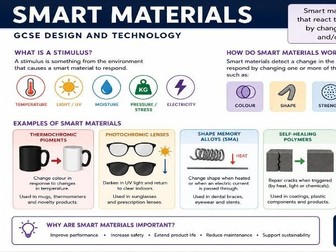
21-page PDF GCSE D&T smart materials pack: thermochromic pigments, photochromic lenses, shape memory alloys and self-healing materials with model answers.
This ready-to-use revision and teaching pack covers smart materials for GCSE Design and Technology. It is designed for Year 10 and fits the core technical principles content on smart and modern materials in the AQA GCSE Design and Technology (8552) specification. It is also suitable for OCR, Pearson Edexcel and WJEC/Eduqas GCSE D&T courses.
The pack uses bright, visual, infographic-style pages. Each smart material follows the same clear structure, so students quickly learn how to link the stimulus, the property change and a suitable product use in exam answers.
How it can be used:
Classroom teaching and lesson starters
Revision posters or classroom display
Homework and independent study
Exam practice and mock preparation using the 4-mark questions
Modelling exam technique with the model answers and marking guides
Cover lessons or intervention sessions
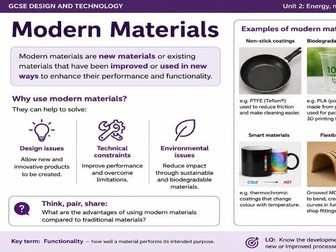
AQA GCSE D&T modern materials: PTFE, biodegradable polymers, smart materials, shape memory alloys, flexible MDF, Polymorph. 4-mark exam Qs + model answers.
This ready-to-teach resource covers modern and smart materials for GCSE Design and Technology. It is designed for the AQA GCSE Design and Technology (8552) specification and is pitched at Year 10. It is also useful for Year 11 revision and for other GCSE D&T exam boards that cover new and modern materials.
The resource has 19 slides, supplied as a PDF, so it opens on any computer, tablet or interactive whiteboard. Every slide uses the same clear, visual layout, and each material is taught in three stages: a knowledge slide, a 4-mark exam question, and a model answer.
What’s included
Modern Materials overview: a definition of modern materials and why designers use them to solve design issues, technical constraints and environmental issues. It also gives an introduction to each example material and the key term functionality.
PTFE (polytetrafluoroethylene / Teflon®): key properties (non-stick, low friction, heat resistant, chemically resistant, electrical insulator), common uses (non-stick pans, cable insulation, bearings, seals, lab equipment) and limitations.
Biodegradable polymers: PLA, PHB/Biopol and PCL. Covers renewable plant-based sources such as corn starch, compostability, reduced reliance on oil-based plastics, and why biodegradable plastics may not break down in landfill.
Shape memory alloys: nitinol (nickel–titanium), how SMAs return to a trained shape when heated, and uses in glasses frames, orthodontic braces and medical stents.
Smart materials: shape memory alloys, thermochromic and photochromic pigments, hydrogels and piezoelectric materials, with the key term stimulus.
Flexible MDF: a manufactured board with routed or machined grooves for smooth curves. Includes uses in shop fittings, curved furniture and exhibition stands, plus its limitations.
Polymorph: a low-temperature thermoplastic (polycaprolactone) that softens at about 60°C. Covers its use in rapid prototyping, ergonomic grips and household repairs.
Exam practice
There are six 4-mark “Explain two reasons…” exam questions. Each one comes with:
What the examiner is looking for
Helpful reminders
A mark breakdown
A full model answer
Other valid points
Why the answer gets 4 marks
A challenge question to stretch higher attainers


 Quick View