Energy Resources and Energy Transfers - Complete Unit WorksheetsQuick View
ryanpkenny

Energy Resources and Energy Transfers - Complete Unit Worksheets

(0)
Empower your KS3 and KS4 students to master the fundamentals of energy with this comprehensive 9-page complete unit covering energy stores, energy transfers, conservation of energy, efficiency, Sankey diagrams, and heat transfer methods. Whether you’re following the British curriculum, GCSE, or IGCSE standards, this complete resource provides everything you need to teach this essential physics topic. Educational Objectives: Understand Energy Stores: Students will develop a clear understanding of the eight types of energy stores (kinetic, gravitational potential, elastic potential, chemical, thermal, nuclear, magnetic, and electrostatic), learning to identify and apply these concepts to real-world systems. Master Energy Transfers: Through structured activities, students will confidently identify and describe the four energy transfer pathways (mechanical work, electrical work, heating, and radiation), understanding how energy moves between stores in various scenarios. Apply Conservation of Energy: Students will explore the principle that energy cannot be created or destroyed, only transferred between stores, developing problem-solving skills through practical scenarios and efficiency calculations. Analyse Energy Flow with Sankey Diagrams: Students will learn to interpret and construct Sankey diagrams, visually representing energy transfers and identifying useful versus wasted energy in systems. Explore Heat Transfer Methods: Students will investigate the three methods of heat transfer (conduction, convection, and radiation), understanding the mechanisms behind each and applying this knowledge to practical situations and exam-style questions.
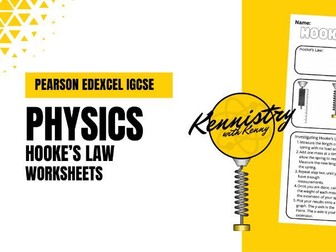
Hooke's Law Practice WorksheetQuick View
ryanpkenny

Hooke's Law Practice Worksheet

(0)
Empower your KS3 and KS4 students to master Hooke’s Law and the relationship between force and extension with this engaging and practical worksheet. Whether you’re following the British curriculum, GCSE, or IGCSE standards, this resource aligns seamlessly with diverse educational needs. Educational Objectives: Understand Hooke’s Law: Students will develop a clear understanding of the linear relationship between force applied to a spring and its extension, learning the fundamental principle that underpins elastic behaviour. Conduct Practical Investigations: Through structured experimental procedures, students will confidently measure spring extensions, calculate weights, and collect systematic data to investigate Hooke’s Law firsthand. Develop Graph Skills: Students will apply their mathematical knowledge to plot force-extension graphs, analyse linear relationships, and interpret graphical data to verify Hooke’s Law experimentally. Key Features: Visual Learning Support: The worksheet includes clear diagrams of spring apparatus and a blank graph grid, helping students visualise the experimental setup and prepare for data plotting. Structured Investigation Guide: Step-by-step instructions guide students through the practical investigation, from measuring initial spring length to plotting results, ensuring systematic and accurate data collection. Comprehensive Data Table: A pre-formatted table with columns for mass, weight, length, and extension helps students organise their measurements and calculations methodically. Versatile Usage: Whether used during practical lessons, for homework analysis, or as revision material, this resource adapts to various curriculum needs and can support both hands-on experiments and theoretical understanding. Enhance your students’ understanding of Hooke’s Law with the “Hooke’s Law Practice Worksheet.” Download it now to inspire confidence and academic success in your science and maths studies!
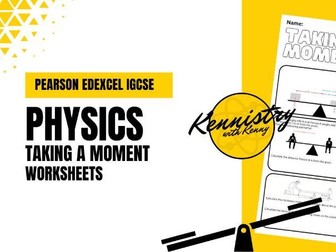
Moments Practice WorksheetQuick View
ryanpkenny

Moments Practice Worksheet

(0)
Empower your KS3 and KS4 students to master the principle of moments and equilibrium with this engaging and comprehensive worksheet. Whether you’re following the British curriculum, GCSE, or IGCSE standards, this resource aligns seamlessly with diverse educational needs. Educational Objectives: Understand Moments and Equilibrium: Students will develop a clear understanding of moments as the turning effect of a force, learning how to calculate moments using the formula M = F × d and applying the principle of moments to balanced systems. Apply to Real-World Scenarios: Through diverse problems involving seesaws, planks, and wheelbarrows, students will confidently apply moments calculations to practical situations, recognising how pivots, forces, and distances interact in everyday contexts. Develop Problem-Solving Skills: Students will systematically analyse equilibrium problems, identify centre of gravity positions, and work through multi-step calculations requiring the application of the principle of moments. Key Features: Visual Learning Support: The worksheet includes clear diagrams of balanced systems, a formula triangle for moments, and illustrations of centre of gravity concepts, helping students visualise the relationship between force, distance, and turning effect. Diverse Problem Contexts: Four varied problems cover seesaw balance, plank equilibrium with a person pushing, and wheelbarrow mechanics, providing students with multiple contexts to practise and reinforce their understanding. Progressive Difficulty: Problems range from straightforward moment calculations to more complex scenarios requiring students to balance multiple forces and apply the principle of moments to determine unknown distances or forces. Versatile Usage: Whether integrated into your teaching lesson, assigned as homework, or used for revision, this resource adapts to various curriculum needs. Enhance your students’ understanding of moments with the “Moments Practice Worksheet.” Download it now to inspire confidence and academic success in your science and maths studies!
Force Diagrams and Resultant Forces Practice WorksheetQuick View
ryanpkenny

Force Diagrams and Resultant Forces Practice Worksheet

(0)
Empower your KS3 and KS4 students to master force diagrams, Newton’s 1st Law, and resultant force calculations with this comprehensive and visually engaging worksheet. Whether you’re following the British curriculum, GCSE, or IGCSE standards, this resource aligns seamlessly with diverse educational needs. Educational Objectives: Understand Newton’s 1st Law: Students will develop a clear understanding of balanced and unbalanced forces, exploring how objects behave when forces are equal or unequal through visual representations and real-world scenarios. Master Force Diagram Drawing: Through guided practice, students will confidently draw force diagrams for various scenarios including stationary objects, moving objects, and terminal velocity situations such as skydivers and aircraft. Calculate Resultant Forces: Students will apply vector addition skills to calculate resultant forces in multiple directions, determining both magnitude and direction whilst understanding the physical implications of their answers. Key Features: Visual Learning Support: The worksheet uses engaging graphics including apples, cars, skydivers, parachutes, and aircraft to help students visualise force concepts and connect abstract ideas to real-world contexts. Progressive Difficulty: Page 1 introduces force diagram drawing and Newton’s 1st Law concepts with scaffolded examples, whilst page 2 challenges students with eight increasingly complex resultant force calculations. Terminal Velocity Application: Students explore the concept of terminal velocity through skydiver scenarios, understanding how balanced forces relate to constant velocity motion in real-world contexts. Comprehensive Practice: Eight resultant force problems provide extensive practice with vector addition, including balanced forces, unbalanced forces in single directions, and two-dimensional force scenarios. Enhance your students’ understanding of forces with the “Force Diagrams and Resultant Forces Practice Worksheet.” Download it now to inspire confidence and academic success in your science and maths studies!
Calculating Acceleration Practice WorksheetQuick View
ryanpkenny

Calculating Acceleration Practice Worksheet

(0)
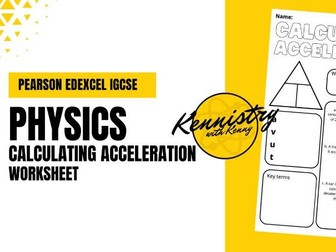
Empower your KS3 and KS4 students to master the fundamentals of calculating acceleration with this engaging and scaffolded worksheet. Whether you’re following the British curriculum, GCSE, or IGCSE standards, this resource aligns seamlessly with diverse educational needs. Educational Objectives: Understand Acceleration Concepts: Students will develop a clear understanding of acceleration and deceleration through defining key terms and exploring real-world applications. Master the Acceleration Equation: Through progressive exercises, students will confidently use and rearrange the acceleration formula (a = (v-u)/t) to solve for acceleration, final velocity, and time. Apply to Real-World Contexts: Students will apply their knowledge to practical scenarios involving cars and trains, enhancing their problem-solving skills and connecting physics to everyday experiences. Key Features: Visual Learning Support: The worksheet includes a formula triangle to help students visualise the relationship between acceleration, velocity, initial velocity, and time, supporting different learning styles. Scaffolded Practice: Three carefully structured problems guide students from calculating acceleration to rearranging the formula for different variables, building confidence progressively. Versatile Usage: Whether integrated into your teaching lesson, assigned as homework, or used for revision, this resource adapts to various curriculum needs. Video Support Available: Enhance student learning with an accompanying YouTube video walkthrough that guides students through the problems step by step. Enhance your students’ proficiency in calculating acceleration with the “Calculating Acceleration Practice Worksheet.” Download it now to inspire confidence and academic success in your science and maths studies!
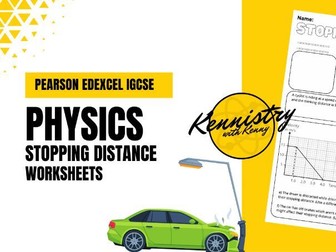
Stopping Distance Practice WorksheetQuick View
ryanpkenny

Stopping Distance Practice Worksheet

(0)
Empower your KS3 and KS4 students to master the concepts of thinking distance, braking distance, and total stopping distance with this engaging and comprehensive worksheet. Whether you’re following the British curriculum, GCSE, or IGCSE standards, this resource aligns seamlessly with diverse educational needs. Educational Objectives: Understand Stopping Distance Components: Students will develop a clear understanding of the relationship between thinking distance, braking distance, and total stopping distance, recognising how these combine to determine vehicle safety. Apply Mathematical Skills: Through calculation exercises and graph analysis, students will confidently apply their mathematical knowledge to solve real-world stopping distance problems and extract data from velocity-time graphs. Analyse Factors Affecting Safety: Students will critically evaluate how human factors (such as distraction) and vehicle conditions (such as brake quality) impact stopping distances, connecting physics concepts to road safety awareness. Key Features: Visual Learning Support: The worksheet includes clear visual representations of the stopping distance equation and definition spaces to help students organise their understanding of key concepts. Graph-Based Learning: A velocity-time graph provides opportunities for students to practise data extraction, calculate reaction time and distances, and visualise the relationship between velocity and stopping distance. Real-World Application: Problems involving cyclists and cars, combined with questions about distraction and brake conditions, help students connect physics principles to everyday road safety scenarios. Versatile Usage: Whether integrated into your teaching lesson, assigned as homework, or used for revision, this resource adapts to various curriculum needs. Enhance your students’ understanding of stopping distance with the “Stopping Distance Practice Worksheet.” Download it now to inspire confidence and academic success in your science and maths studies!
Calculating Weight worksheetQuick View
ryanpkenny

Calculating Weight worksheet

(0)
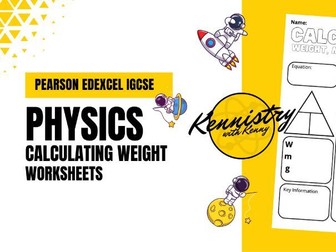
Empower your KS3 and KS4 students to master the relationship between weight, mass, and gravitational field strength with this comprehensive and scaffolded worksheet. Whether you’re following the British curriculum, GCSE, or IGCSE standards, this resource aligns seamlessly with diverse educational needs. Educational Objectives: Understand Key Concepts: Students will develop a clear understanding of the distinction between weight and mass, and how gravitational field strength affects weight in different locations. Master the Weight Equation: Through progressive exercises, students will confidently use and rearrange the weight formula (W = mg) to solve for weight, mass, and gravitational field strength. Apply to Real-World and Space Contexts: Students will apply their knowledge to practical scenarios on Earth and different planets, enhancing their problem-solving skills and understanding of how gravity varies across the universe. Key Features: Visual Learning Support: The worksheet includes a formula triangle and definition spaces to help students visualise the relationship between weight, mass, and gravitational field strength, supporting different learning styles. Scaffolded Practice: Page 1 introduces the concept with three foundational problems, whilst pages 2 and 3 provide structured practice with a table format that guides students through identifying variables, selecting formulae, and solving systematically. Extensive Practice: Ten varied problems cover calculating weight on Earth and other planets, finding mass from weight, and determining gravitational field strength, building confidence progressively through repetition. Versatile Usage: Whether integrated into your teaching lesson, assigned as homework, or used for revision, this resource adapts to various curriculum needs. Enhance your students’ proficiency in calculating weight with the “Calculating Weight Practice Worksheet.” Download it now to inspire confidence and academic success in your science and maths studies!
Calculating Momentum Practice WorksheetQuick View
ryanpkenny

Calculating Momentum Practice Worksheet

(0)
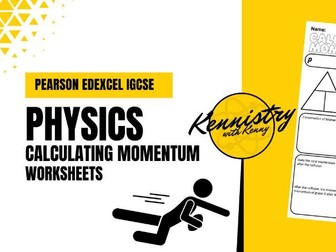
Empower your KS3 and KS4 students to master momentum calculations and the principle of conservation of momentum with this comprehensive and scaffolded worksheet. Whether you’re following the British curriculum, GCSE, or IGCSE standards, this resource aligns seamlessly with diverse educational needs. Educational Objectives: Master the Momentum Equation: Students will develop a clear understanding of momentum as the product of mass and velocity, confidently using and rearranging the formula (p = mv) to solve for momentum, mass, and velocity. Apply Conservation of Momentum: Through collision problems involving gliders and ice skaters, students will understand and apply the principle of conservation of momentum in real-world scenarios, recognising that total momentum remains constant in closed systems. Develop Problem-Solving Skills: Students will systematically identify variables, select appropriate formulae, and work through structured calculations, building their analytical skills and mathematical confidence. Key Features: Visual Learning Support: The worksheet includes a formula triangle and definition spaces to help students visualise the relationship between momentum, mass, and velocity, supporting different learning styles. Scaffolded Practice: Page 1 introduces basic momentum calculations with three problems and a conservation of momentum challenge, whilst page 2 provides a structured table format that guides students through identifying variables, selecting formulae, and solving systematically. Progressive Difficulty: Problems range from straightforward momentum calculations to more complex scenarios involving formula rearrangement and conservation of momentum applications, including collision problems with directional considerations. Versatile Usage: Whether integrated into your teaching lesson, assigned as homework, or used for revision, this resource adapts to various curriculum needs. Enhance your students’ proficiency in calculating momentum with the “Calculating Momentum Practice Worksheet.” Download it now to inspire confidence and academic success in your science and maths studies!
Forces and Momentum Practice WorksheetQuick View
ryanpkenny

Forces and Momentum Practice Worksheet

(0)
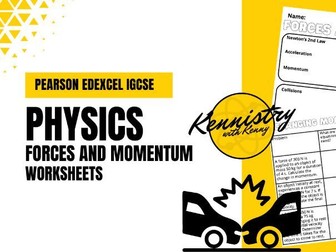
Empower your KS3 and KS4 students to master the relationship between forces and momentum with this comprehensive and challenging worksheet. Whether you’re following the British curriculum, GCSE, or IGCSE standards, this resource aligns seamlessly with diverse educational needs. Educational Objectives: Understand Key Concepts: Students will develop a clear understanding of Newton’s 2nd Law, acceleration, momentum, and collisions, recognising how forces cause changes in momentum and how this principle applies to real-world safety scenarios. Calculate Changes in Momentum: Through progressive exercises, students will confidently apply the relationship between force, time, and change in momentum (F = Δp/Δt), connecting Newton’s 2nd Law to momentum concepts. Apply to Real-World Safety Contexts: Students will analyse collision scenarios, including airbag safety systems, understanding how extending collision time reduces force and enhances passenger protection. Key Features: Conceptual Foundation: Page 1 provides definition spaces for Newton’s 2nd Law, acceleration, momentum, and collisions, alongside a contextualised airbag problem that links momentum calculations to real-world safety applications. Structured Problem-Solving: Page 2 features a table format titled “Changing Momentum Practice” that guides students through identifying equations, variables, and systematic calculations for complex multi-step problems. Progressive Difficulty: Problems advance from calculating momentum and forces to determining final velocities and deceleration times, requiring students to combine multiple physics concepts including Newton’s 2nd Law, momentum, and kinematics. Versatile Usage: Whether integrated into your teaching lesson, assigned as homework, or used for revision, this resource adapts to various curriculum needs and challenges higher-ability students. Enhance your students’ understanding of forces and momentum with the “Forces and Momentum Practice Worksheet.” Download it now to inspire confidence and academic success in your science and maths studies!
Newton's 2nd Law Practice WorksheetQuick View
ryanpkenny

Newton's 2nd Law Practice Worksheet

(0)
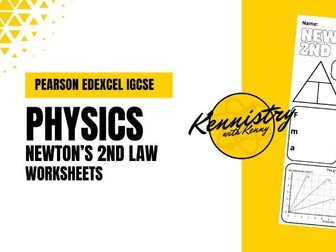
Empower your KS3 and KS4 students to master Newton’s 2nd Law and the relationship between force, mass, and acceleration with this comprehensive and scaffolded worksheet. Whether you’re following the British curriculum, GCSE, or IGCSE standards, this resource aligns seamlessly with diverse educational needs. Educational Objectives: Understand Newton’s 2nd Law: Students will develop a clear understanding of the fundamental principle that force equals mass times acceleration, learning how changes in force or mass affect an object’s motion. Master the F=ma Equation: Through progressive exercises, students will confidently use and rearrange the formula (F = ma) to solve for force, mass, and acceleration in various real-world scenarios. Apply Graph Analysis Skills: Students will interpret acceleration-force graphs and velocity-time graphs, extracting data to calculate forces and understanding the relationship between these variables graphically. Key Features: Visual Learning Support: The worksheet includes a formula triangle and definition spaces to help students visualise the relationship between force, mass, and acceleration, supporting different learning styles. Scaffolded Practice: Page 1 introduces the concept with three foundational problems and a graph-based trolley problem, whilst page 2 provides a structured table format that guides students through identifying equations, variables, and solving systematically. Graph-Based Learning: Two different graph types (acceleration vs force, and velocity vs time) provide opportunities for students to practise data extraction and apply F=ma in graphical contexts, enhancing their analytical skills. Versatile Usage: Whether integrated into your teaching lesson, assigned as homework, or used for revision, this resource adapts to various curriculum needs. Enhance your students’ understanding of Newton’s 2nd Law with the “Newton’s 2nd Law Practice Worksheet.” Download it now to inspire confidence and academic success in your science and maths studies!
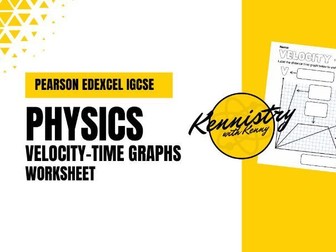
Velocity-Time Graphs Practice WorksheetQuick View
ryanpkenny

Velocity-Time Graphs Practice Worksheet

(0)
Empower your KS3 and KS4 students to master velocity-time graphs and their interpretation with this engaging and visual worksheet. Whether you’re following the British curriculum, GCSE, or IGCSE standards, this resource aligns seamlessly with diverse educational needs. Educational Objectives: Understand Graph Components: Students will develop a clear understanding of velocity-time graph features, learning to identify and label the axes and recognise different motion patterns represented by various graph shapes. Interpret Graph Gradients: Through guided analysis, students will confidently understand that the gradient of a velocity-time graph represents acceleration, connecting mathematical concepts to physical motion. Calculate Distance from Graphs: Students will apply their knowledge to understand that the area under a velocity-time graph represents the total distance travelled, developing crucial graph analysis skills for GCSE physics. Key Features: Visual Learning Support: The worksheet presents a comprehensive velocity-time graph with multiple motion phases, helping students visualise different types of motion including acceleration, constant velocity, and deceleration in a single diagram. Scaffolded Labelling Activity: Students label key features of the graph including axes, motion phases, and graph characteristics, building confidence through structured practice before tackling calculations. Conceptual Understanding: Two key concept boxes guide students to articulate what the gradient represents and how to calculate total distance, reinforcing the mathematical-physical connection essential for exam success. Versatile Usage: Whether integrated into your teaching lesson, assigned as homework, or used for revision, this resource adapts to various curriculum needs and provides a foundation for more advanced kinematics work. Enhance your students’ graph analysis skills with the “Velocity-Time Graphs Practice Worksheet.” Download it now to inspire confidence and academic success in your science and maths studies!
Calculating Speed Practice WorksheetQuick View
ryanpkenny

Calculating Speed Practice Worksheet

(1)
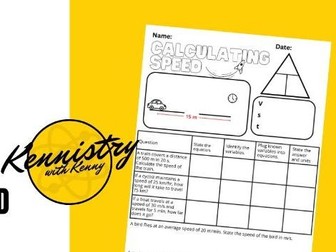
Empower your KS3 and KS4 students to conquer the intricacies of calculating speed with this engaging and adaptable worksheet. Whether you’re following the British curriculum, GCSE, or IGCSE standards, this resource aligns seamlessly with diverse educational needs. Educational Objectives: Master Calculating Speed: Students will build a solid foundation in calculating speed, a fundamental skill in physics and mathematics. Apply Speed Concepts: Through interactive exercises, students will apply their knowledge to solve real-world problems, enhancing their practical skills. Key Features: Scaffolded Learning: This worksheet is crafted across multiple tasks, allowing students to progressively grasp the complexities of speed calculation. Versatile Usage: Whether integrated into your teaching lesson, assigned as homework, or used for revision, this resource adapts to various curriculum needs. Clear and Comprehensive: With its clarity and comprehensive approach, students can confidently build their understanding of speed calculations. Elevate your students’ proficiency in calculating speed with the “Calculating Speed Worksheet.” Download it now to instill confidence and excellence in your science and math studies!
Distance Time Graphs WorksheetsQuick View
ryanpkenny

Distance Time Graphs Worksheets

(1)
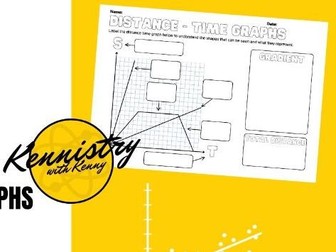
Description: Empower your KS3 and KS4 students to master the art of interpreting distance-time graphs with this versatile and scaffolded worksheet. Whether you’re following the British curriculum, GCSE, or IGCSE standards, this resource aligns seamlessly with diverse educational needs. Educational Objectives: Recognize Motion on Distance-Time Graphs: From stationary to constant speed, acceleration, deceleration, and even traveling backward, students will develop a keen eye for motion patterns. Calculate Speed with Confidence: Through engaging exercises, students will confidently calculate speed using the gradient of distance-time graphs. Key Features: Scaffolded Learning: This resource is divided into three tasks, allowing students to progressively build the skills needed to meet their learning objectives. Versatile Usage: Whether it’s part of your teaching lesson, homework, or revision material, this worksheet adapts to your curriculum needs. Clear and Comprehensive: With its clarity and comprehensiveness, students can create valuable revision materials while reinforcing their understanding of complex graph concepts. Enhance your students’ graph analysis skills with the “Distance-Time Graphs Worksheet.” Download it now to inspire confidence and academic success in your science and math studies!
GCSE / IGCSE Physics - SpeedQuick View
ryanpkenny

GCSE / IGCSE Physics - Speed

(0)
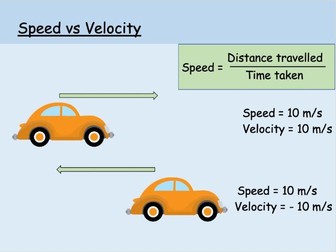
This PPT is a basic introduction to the speed and velocity equation along with lots of practice questions from other resources. This resource is designed around the Edexcel IGCSE specification however is appropriate for use with GCSE and KS3 students. This resource also includes a Target Sheet for the unit 1.1 of the Edexcel IGCSE Physics course. Target sheets have been a very effective way to track pupils progress and ensure they are mastering all parts of the specification. Target sheets are part of a system along with scaffolds that encourage students to link the specification points with their learning. This leans on the theory of metacognition to promote long lasting learning. This lesson uses resources from the CGP Edexcel IGCSE Physics 9-1 Revision cards as well as an older version of the CGP Physics essential formula practice book. I do not own the copyright to the CGP materials but the rest of the powerpoint is created by me.