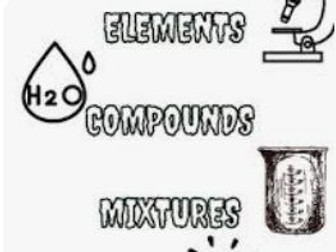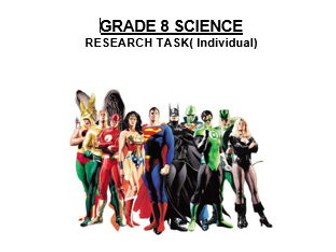
Drawing SuperHero Task – Elements, Compounds & Alloys
Subject: Grade 8 Science (Chemistry / Materials Science)
Core Objective:
Students apply their knowledge of chemical substances by designing an original superhero whose powers, weapons, and defenses are based on the real properties of 2 elements, 2 compounds, and 2 alloys
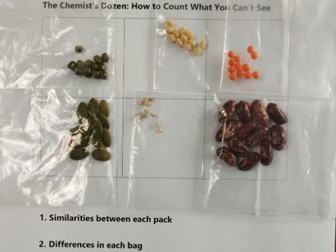
The Chemist’s Dozen: How to Count What You Can’t See
A Concrete-to-Abstract Lesson for IGCSE Chemistry (Grades 9–10)
I created this worksheet to help students bridge the gap between the tangible and the abstract when introducing the mole concept and Avogadro’s number.
The activity uses simple packs of beans—each containing exactly 12 seeds—to represent the idea of a fixed counting unit (like a dozen). Students physically count, weigh, and compare different bean packs before I ever introduce the term “mole.” This hands-on foundation allows them to discover key ideas on their own:
• Number is independent of mass and size — a dozen mung beans looks and weighs differently from a dozen soybeans, but the count is the same.
• Counting by weighing — if you know the mass of one pack, you can determine the mass of a single bean without counting it individually.
• The “pack” as a unit — just as a dozen is a fixed number, a mole is a fixed number (6.022 × 10²³), and the mass of one pack becomes the molar mass.
The worksheet includes structured observation prompts, a step-by-step lesson flow, and Higher Order Thinking Skills (HOTS) questions that push students to analyze, evaluate, and extend the analogy—from comparing packs to tackling reverse problems like determining the mass of a single lentil without opening its pack.
This approach has worked well in my classroom to make the mole concept feel intuitive before introducing the formal definition. Thought I’d share in case it’s useful for other chemistry educators teaching this tricky but foundational topic.
#ChemistryTeaching #IGCSE #MoleConcept #ActiveLearning #STEMEducation
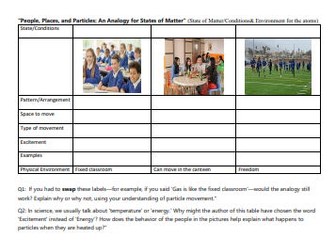
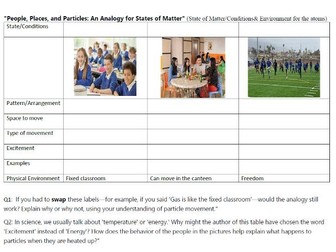
Title: People, Places, and Particles: An Analogy for States of Matter
Core Idea:
You use a familiar school environment (classroom, canteen) and student behavior to model the three states of matter – solid, liquid, gas. The analogy links:
Fixed classroom → Solid (fixed pattern, little movement)
Can move in the canteen → Liquid (more freedom, movement around others)
“Freedom” (implied gas) → Gas (fast, independent movement)
Your table captures four key scientific ideas through analogy:
State/Conditions → Pattern/Arrangement → Space to move → Type of movement → Excitement
Help your students visualize the invisible! This worksheet uses a simple but powerful school-based analogy (students in a classroom vs. the canteen vs. outside) to help them understand the behavior of particles in solids, liquids, and gases. Students analyze images and environments to deduce arrangement, movement, and energy. A great hook for MYP Science or any middle school chemistry unit.
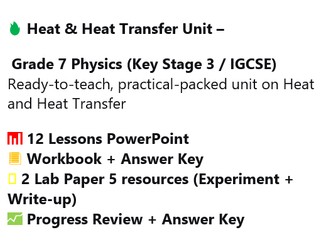
Looking for a ready to teach , Power Point , worksheet, practical, and Assessment & Answer Key.
I have put together;
Lesson Structure
12 Lesson Power Point
Workbook & Answer Key
2 Lab Paper 5 resources & Answer Key
1 Assessment(Progress Review) & Answer Key
Perfect for building understanding from temperature scales to conduction, convection, radiation, evaporation, insulation, and change of state — with plenty of hands-on labs, graph plotting, group work Feel free to use, adapt, and share! If you find these helpful and want to support me, please subscribe to my YouTube channel -Einstein Pillai Sankaran
I did not just study Science, I learned how to communicate it , teach it and connect it to education, innovation and real world problem.
Master Measurement with this complete Unit 3 bundle! Includes engaging PPTs, detailed lesson plans, and differentiated worksheets with answer keys for History, Fundamental, and Derived Quantities. Stop spending hours on lesson prep! This all-in-one, ready-to-use resource package for Unit 3: Measurement is designed to save you time and energize your classroom. It provides a structured and engaging journey through the core concepts of measurement, from its ancient roots to modern scientific units.
What’s Included in This Comprehensive Bundle?
Interactive PowerPoint Presentation: A visually engaging slideshow that breaks down complex topics into student-friendly chunks. Covers:
The History of Measurement: A fascinating look at ancient methods (cubits, feet) to the development of standardized systems (Metric & Imperial).
Fundamental Quantities & Units: Clear explanations of the 7 base SI units (meter, kilogram, second, etc.) and their importance.
Derived Quantities: How units like speed (m/s), area (m²), and density (kg/m³) are built from the fundamental base.
Detailed Lesson Plans: Step-by-step guides for multiple lessons, complete with learning objectives, suggested activities, discussion points, and seamless integration with the PPT and worksheets. Perfect for new teachers or for refreshing your existing curriculum.