


The Chemist’s Dozen: How to Count What You Can’t See
A Concrete-to-Abstract Lesson for IGCSE Chemistry (Grades 9–10)
I created this worksheet to help students bridge the gap between the tangible and the abstract when introducing the mole concept and Avogadro’s number.
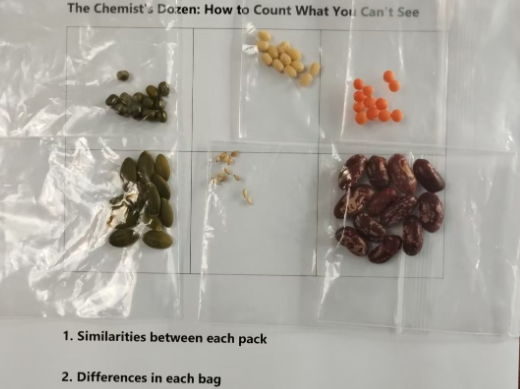
The activity uses simple packs of beans—each containing exactly 12 seeds—to represent the idea of a fixed counting unit (like a dozen). Students physically count, weigh, and compare different bean packs before I ever introduce the term “mole.” This hands-on foundation allows them to discover key ideas on their own:
• Number is independent of mass and size — a dozen mung beans looks and weighs differently from a dozen soybeans, but the count is the same.
• Counting by weighing — if you know the mass of one pack, you can determine the mass of a single bean without counting it individually.
• The “pack” as a unit — just as a dozen is a fixed number, a mole is a fixed number (6.022 × 10²³), and the mass of one pack becomes the molar mass.
The worksheet includes structured observation prompts, a step-by-step lesson flow, and Higher Order Thinking Skills (HOTS) questions that push students to analyze, evaluate, and extend the analogy—from comparing packs to tackling reverse problems like determining the mass of a single lentil without opening its pack.
This approach has worked well in my classroom to make the mole concept feel intuitive before introducing the formal definition. Thought I’d share in case it’s useful for other chemistry educators teaching this tricky but foundational topic.
#ChemistryTeaching #IGCSE #MoleConcept #ActiveLearning #STEMEducation
Something went wrong, please try again later.
This resource hasn't been reviewed yet
To ensure quality for our reviews, only customers who have downloaded this resource can review it
Report this resourceto let us know if it violates our terms and conditions.
Our customer service team will review your report and will be in touch.
$0.00