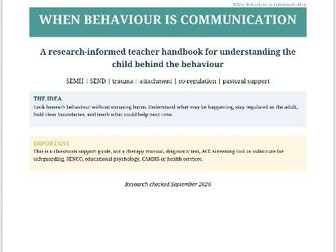
A practical, compassionate guide designed to help teachers, teaching assistants, SENCOs and pastoral staff understand what may be happening underneath a child’s behaviour.
Rather than focusing only on how to stop behaviour, this handbook encourages staff to consider the child’s perspective, possible psychological factors and the support that may help them feel safer, calmer and more able to learn.
The resource combines accessible psychology with realistic classroom strategies and warm, child-friendly language that teachers can actually use in the moment.
Includes:
ACEs explained sensitively, including protective factors and why ACE scores should not be used to label individual children
attachment-informed classroom practice without diagnosing or categorising pupils
trauma-informed and relational approaches
co-regulation and adult self-regulation strategies
low-arousal communication techniques
guidance for creating a calmer, more predictable classroom
evidence-aware growth mindset strategies
anxiety and worry
anger and explosive behaviour
shutdown, freeze and withdrawal
bullying, rejection and friendship difficulties
bereavement and grief
low mood and loss of motivation
perfectionism and fear of mistakes
sensory overload
school avoidance and attendance anxiety
responses following frightening or traumatic experiences
impulsivity and difficulties stopping before acting
change, transitions and loss of control
demand avoidance and understanding “won’t” versus “can’t right now”
separation anxiety and clinginess
reassurance-seeking and adult dependence
lying, taking things and connection-seeking behaviour
practical restorative conversations after incidents
ready-to-use phrases for difficult classroom situations
boundaries without shame
a quick-response behaviour flowchart
“same behaviour, different possible needs” guidance
individual child support and co-regulation planning sheets
safeguarding and referral guidance
research and professional sources
The central message throughout the resource is simple:
Behaviour gives us information, but it does not automatically tell us why a child is struggling.
This handbook aims to help adults respond with curiosity before judgement, maintain clear and safe boundaries, and give children the support and language they need to cope differently next time.
Suitable for KS1, KS2 and wider primary settings, particularly SEMH, SEND, pastoral provision, behaviour support, inclusion teams and staff CPD.
Please note: This is a classroom support resource and is not intended to replace therapy, diagnosis, safeguarding procedures or professional mental-health support.
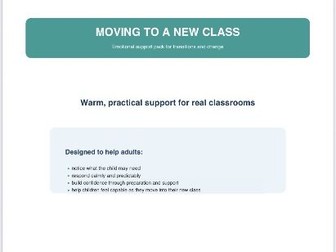
A practical SEMH and SEND transition resource designed to help children manage changes, unfamiliar routines and new situations with greater confidence.
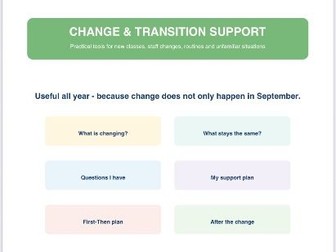
Change can be difficult for many pupils, particularly those who benefit from predictability, preparation and clear visual support. This pack helps children understand what is changing, identify what will stay the same, ask questions, plan useful support and reflect afterwards.
It is designed to make transitions feel more predictable, manageable and less overwhelming.
Includes:
What Is Changing? worksheet
What Will Stay the Same? activity
Questions I Have page
My Support Plan
First–Then–Next planning sheet
After the Change reflection page
Adult planning sheet
Perfect for:
Moving class
New teachers or support staff
Supply teachers
Timetable changes
School trips
New interventions
Room changes
Starting a new group
Unexpected routine changes
SEND and SEMH support
Nurture and pastoral work
The resource can be used with individual pupils, small groups or as part of wider transition planning.
Suitable for approximately ages 7–11 / KS2.
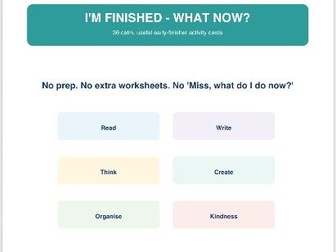
A practical early finisher activity pack designed to give children meaningful, independent tasks when they complete their work.
Instead of repeatedly hearing “What do I do now?”, pupils can choose from a range of calm, purposeful activities covering reading, writing, maths, creativity, organisation and kindness.
The activities are designed to require little or no extra preparation, making them ideal for busy classrooms.
Includes:
36 printable early finisher activity cards
Reading challenges
Writing prompts
Maths and thinking activities
Creative tasks
Classroom organisation activities
Kindness and reflection tasks
“Finished? Check First!” classroom poster
Teacher guidance for introducing and managing the routine
Perfect for:
Early finishers
Independent learning
Continuous provision
Morning work
Classroom challenge areas
Mixed-attainment classes
Supply or cover lessons
Quiet extension activities
The cards can be printed, cut out and laminated, displayed on a classroom choice board or rotated throughout the year.
Suitable for approximately ages 7–11 / KS2.
A simple, reusable classroom resource designed to reduce interruptions, encourage independence and keep pupils meaningfully occupied once their main task is complete.
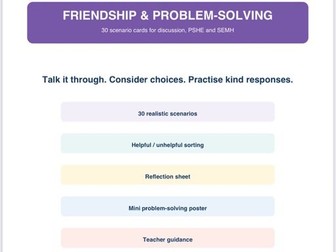
A practical friendship, social skills and problem-solving resource containing 30 relatable scenarios to help children explore difficult social situations in a safe and supportive way.
The scenarios encourage pupils to consider different perspectives, discuss possible responses and develop skills including communication, empathy, compromise, kindness and conflict resolution.
Situations include friendship disagreements, being left out, sharing, rumours, apologising, losing, taking turns, managing unkind comments and asking adults for help.
Includes:
30 printable friendship scenario cards
Helpful or unhelpful response activity
Problem-solving reflection sheet
STOP–THINK–CHOOSE strategy poster
Teacher guidance
Perfect for PSHE, SEMH interventions, nurture groups, circle time, social-skills work, behaviour support and small-group discussion.
Suitable for approximately ages 7–11 / KS2.
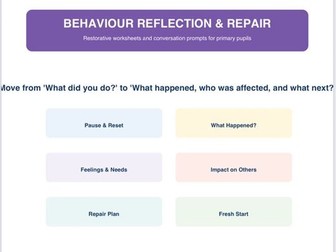
A restorative behaviour reflection resource designed to help children understand what happened after a difficult incident, recognise feelings and needs, consider the impact on others and plan how to move forward.
The emphasis is on reflection, repair and learning, rather than simply asking children to write down what they did wrong.
Pupils are supported to think about what happened before an incident, how they were feeling, who was affected and what could help them make a different choice next time.
Includes:
Pause and Reset activity
What Happened? reflection sheet
Feelings and Needs activity
Who Was Affected? worksheet
Repair Plan
Next Time I Can… activity
Restorative conversation prompts
Adult support and follow-up notes
Ideal for SEMH settings, behaviour support, restorative practice, nurture groups, pastoral interventions and individual pupil reflection.
Suitable for approximately ages 7–11 / KS2.
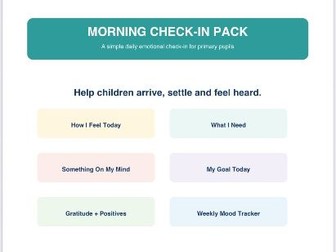
A calm, practical SEMH morning check-in resource designed to help children identify how they are feeling, communicate what they need and prepare for the school day.
The pack gives pupils a simple, low-pressure way to express emotions, worries and support needs while helping adults notice patterns and identify children who may benefit from a check-in.
Includes:
• How I Feel Today activity
• What I Need Today page
• Something On My Mind worksheet
• Daily goal setting
• Gratitude and positive-thinking activity
• Weekly mood tracker
• Teacher/adult notes
• Guidance for using morning check-ins effectively
Ideal for morning work, nurture groups, SEMH provision, pastoral support, SEND, regulation work and individual pupil check-ins.
Suitable for approximately ages 7–11 / KS2.
A simple and supportive emotional regulation toolkit designed to help children recognise their feelings, notice physical signs of dysregulation and choose appropriate calming strategies.
Rather than telling children simply to “calm down”, the resource gives them practical tools they can learn, practise and gradually use more independently.
Includes:
Feelings identification
Recognising physical signs of emotions
Calm-choice strategy sheet
Breathing activities
5–4–3–2–1 grounding activity
Return-to-learning plan
Calm Corner expectations poster
Adult guidance
Ideal for creating a calm corner, supporting individual pupils, SEMH interventions, nurture provision, SEND support and whole-class emotional-regulation teaching.
Suitable for approximately ages 7–11 / KS2.
 Quick View

 Quick View
 Quick View
 Quick View
 Quick View
 Quick View
 Quick View