C2 Bonding, Structure and Properties of Matter: Topic WorkbookQuick View
itsnatalierose

C2 Bonding, Structure and Properties of Matter: Topic Workbook

(0)
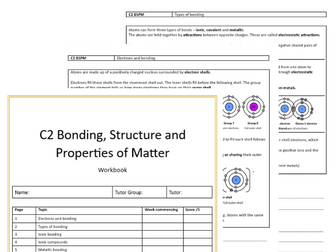
AQA GCSE Chemistry and Combined Science Unit 2: Bonding, Structure and Properties of Matter Topic Workbook What is included in this resource: PDFs of the booklet with and without answers. Lesson summaries. Engaging diagrams in full colour. 5 hinge questions per page. Why this resource? This booklet summarises the C2 topic into 16 pages, ideal for supporting students with SEN, to provide work for absent students, as homework, starter activities, or for some comprehension practise to hit those literacy goals! This includes 16 worksheets for everything from electrons and bonding to uses of nanoparticles: electrons and bonding types of bonding ionic bonding ionic compounds metallic bonding covalent bonding simple covalent molecules polymers giant covalent lattices allotropes of carbon states of matter and the particle model melting and boiling points electrical conductivity hardness, malleability and ductility bulk and surface properties: sizes of particles uses of nanoparticles
C2 L12: Bulk and Surface Properties of Matter (Nanoparticles and Bulk Materials)Quick View
itsnatalierose

C2 L12: Bulk and Surface Properties of Matter (Nanoparticles and Bulk Materials)

(0)
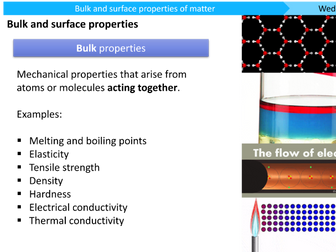
AQA GCSE Chemistry Unit 2: Bonding, Structure and Properties of Matter **Lesson 12: Bulk and Surface Properties of Matter ** What is included in this resource: Lesson powerpoint Topic map Starter activity for retrieval practice Learning objectives and specification references Lesson content Opportunities for formative assessment Why this resource? This lesson explores the triple only content from C2; nanoparticles and bulk materials. We differentiate between bulk and surface properties of matter, the diameters of coarse, fine and nanoparticles, and compare the properties between them. Students will then practise calculating surface area to volume ratios of nanoparticles and evaluate the use of nanoparticles for specific purposes. This lesson follows on from C2 L11: Structure and Properties. All lessons are designed with the Ofsted framework in mind: minimal clutter on the slides, clear flow between the lesson sequence, a topic map to show how this lesson fits in with the rest of the topic, and lesson objectives that get referred back to at each interval in the lesson with questions to check for understanding of every learning objective.
C2 L10 States of Matter and the Particle ModelQuick View
itsnatalierose

C2 L10 States of Matter and the Particle Model

(0)
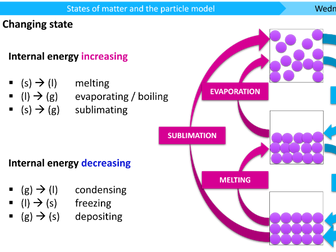
AQA GCSE Chemistry and Combined Science Unit 2: Bonding, Structure and Properties of Matter Lesson 10: States of Matter and the Particle Model What is included in this resource: Lesson powerpoint Topic map Starter activity for retrieval practice Learning objectives and specification references Lesson content Opportunities for formative assessment Why this resource? This lesson teaches students about the 3 states of matter and the interconversions between them. We delve into predicting states of matter using data, explaining why substances change state at different temperatures in terms of energy transfer and bonding, and describing the limitations of the particle model. There are curricular ties to P3 internal energy and previous lessons on bonding. This lesson follows on from C2 L9: Giant Covalent Molecules. All lessons are designed with the Ofsted framework in mind: minimal clutter on the slides, clear flow between the lesson sequence, a topic map to show how this lesson fits in with the rest of the topic, and lesson objectives that get referred back to at each interval in the lesson with questions to check for understanding of every learning objective.
C2 L11: Structure and PropertiesQuick View
itsnatalierose

C2 L11: Structure and Properties

(0)
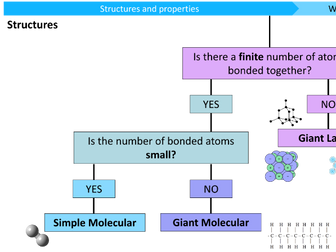
AQA GCSE Chemistry and Combined Science Unit 2: Bonding, Structure and Properties of Matter Lesson 11: Structure and Properties What is included in this resource: Lesson powerpoint Topic map Starter activity for retrieval practice Learning objectives and specification references Lesson content Opportunities for formative assessment Why this resource? This lesson is the final lesson in the sequence, penultimate for triple scientists, and connects bonding, structure and properties in a way that simplifies all substances into the 3 categories: giant lattices, giant molecules and simple molecules. From this the characteristic properties of each type of substances are explored and explained, allowing students to make predictions about the properties of unseen elements and compounds based on their position in the periodic table. Students will be able to explain and make predictions about electrical conductivity, hardness, malleability and ductility, building their confidence when approaching ‘explain’ the properties exam questions. This lesson follows on from C2 L10: States of Matter and the Particle Model. All lessons are designed with the Ofsted framework in mind: minimal clutter on the slides, clear flow between the lesson sequence, a topic map to show how this lesson fits in with the rest of the topic, and lesson objectives that get referred back to at each interval in the lesson with questions to check for understanding of every learning objective.
C2 L9: Giant Covalent MoleculesQuick View
itsnatalierose

C2 L9: Giant Covalent Molecules

(0)
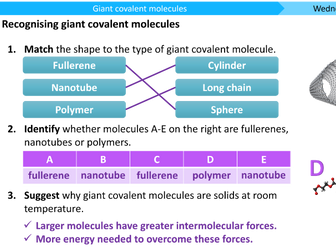
AQA GCSE Chemistry and Combined Science Unit 2: Bonding, Structure and Properties of Matter Lesson 9: Giant Covalent Molecules What is included in this resource: Lesson powerpoint Topic map Starter activity for retrieval practice Learning objectives and specification references Lesson content Opportunities for formative assessment Why this resource? This lesson prepares students to recognise giant covalent molecules, describe their properties and draw monomers, polymers and repeat units for addition polymers. For students on the combined science pathway, this is their only opportunity to explore polymers. For students on the triple pathway, this will be explored in further detail in units 7 and 10. This lesson follows on from C2 L8: Giant Covalent Lattices. All lessons are designed with the Ofsted framework in mind: minimal clutter on the slides, clear flow between the lesson sequence, a topic map to show how this lesson fits in with the rest of the topic, and lesson objectives that get referred back to at each interval in the lesson with questions to check for understanding of every learning objective.
C2 L8: Giant Covalent LatticesQuick View
itsnatalierose

C2 L8: Giant Covalent Lattices

(0)
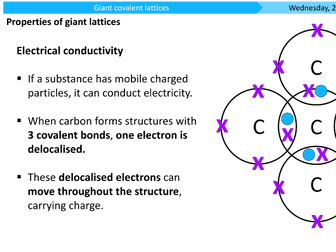
AQA GCSE Chemistry and Combined Science Unit 2: Bonding, Structure and Properties of Matter Lesson 8: Giant Covalent Lattices What is included in this resource: Lesson powerpoint Topic map Starter activity for retrieval practice Learning objectives and specification references Lesson content Opportunities for formative assessment Why this resource? This lesson prepares students to describe and compare the bonding in giant covalent lattices; specifically the allotropes of carbon, and silicon dioxide. We then go on to explain how the structure and bonding of giant covalent lattices leads to their respective properties. This lesson follows on from C2 L7: Simple Molecules. All lessons are designed with the Ofsted framework in mind: minimal clutter on the slides, clear flow between the lesson sequence, a topic map to show how this lesson fits in with the rest of the topic, and lesson objectives that get referred back to at each interval in the lesson with questions to check for understanding of every learning objective.
C2 L7: Simple Covalent MoleculesQuick View
itsnatalierose

C2 L7: Simple Covalent Molecules

(0)
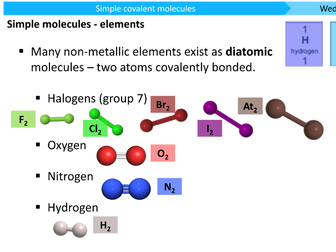
AQA GCSE Chemistry and Combined Science Unit 2: Bonding, Structure and Properties of Matter Lesson 7: Simple Covalent Molecules What is included in this resource: Lesson powerpoint Topic map Starter activity for retrieval practice Learning objectives and specification references Lesson content Opportunities for formative assessment Why this resource? This lesson explores simple covalent molecules in terms of their identifying characteristics, bonding, forces and relative melting and boiling points. It also categorises non-metallic elements as diatomic or monoatomic, and why sulfur and phosphorous are represented like monoatomic elements despite forming polyatomic simple molecules. This lesson follows on from C2 L6: Covalent Bonding. All lessons are designed with the Ofsted framework in mind: minimal clutter on the slides, clear flow between the lesson sequence, a topic map to show how this lesson fits in with the rest of the topic, and lesson objectives that get referred back to at each interval in the lesson with questions to check for understanding of every learning objective.
C2 L6: Covalent BondingQuick View
itsnatalierose

C2 L6: Covalent Bonding

(0)
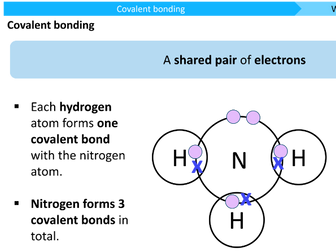
AQA GCSE Chemistry and Combined Science Unit 2: Bonding, Structure and Properties of Matter Lesson 6: Covalent Bonding What is included in this resource: Lesson powerpoint Topic map Starter activity for retrieval practice Learning objectives and specification references Lesson content Opportunities for formative assessment Why this resource? This lesson defines covalent bonding, explains how they are formed, how they are represented in dot and cross diagrams and how molecular formulae can be determined from a model or diagram. This lesson follows on from C2 L5: Metallic Bonding. All lessons are designed with the Ofsted framework in mind: minimal clutter on the slides, clear flow between the lesson sequence, a topic map to show how this lesson fits in with the rest of the topic, and lesson objectives that get referred back to at each interval in the lesson with questions to check for understanding of every learning objective.
C2 L5: Metallic BondingQuick View
itsnatalierose

C2 L5: Metallic Bonding

(0)
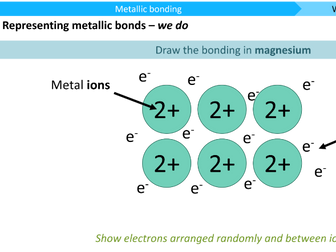
AQA GCSE Chemistry and Combined Science Unit 2: Bonding, Structure and Properties of Matter Lesson 5: Metallic Bonding What is included in this resource: Lesson powerpoint Topic map Starter activity for retrieval practice Learning objectives and specification references Lesson content Opportunities for formative assessment Why this resource? This lesson explores metallic bonding in detail, including how metallic bonding arises, how the bonding is represented, and how the bonding in pure metals and alloys can be compared. This lesson follows on from C2 L4: Ionic Compounds. All lessons are designed with the Ofsted framework in mind: minimal clutter on the slides, clear flow between the lesson sequence, a topic map to show how this lesson fits in with the rest of the topic, and lesson objectives that get referred back to at each interval in the lesson with questions to check for understanding of every learning objective.
C2 L4: Ionic CompoundsQuick View
itsnatalierose

C2 L4: Ionic Compounds

(0)
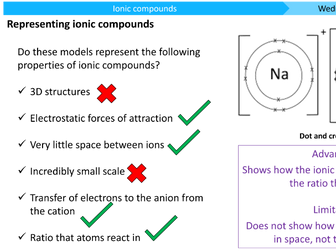
AQA GCSE Chemistry and Combined Science Unit 2: Bonding, Structure and Properties of Matter Lesson 4: Ionic Compounds What is included in this resource: Lesson powerpoint Topic map Starter activity for retrieval practice Learning objectives and specification references Lesson content Opportunities for formative assessment Why this resource? This lesson explores how ionic compounds can be visualised and described as giant structures, the various representations they are given and the limitations of the models, in addition to deriving empirical formulae - a slight deviation to the specification that prepares students for A Level but, more importantly, serves to explain why the formula of an ionic compound does not give the exact number of each ion present. This lesson follows on from C2 L3: Ionic Bonding. All lessons are designed with the Ofsted framework in mind: minimal clutter on the slides, clear flow between the lesson sequence, a topic map to show how this lesson fits in with the rest of the topic, and lesson objectives that get referred back to at each interval in the lesson with questions to check for understanding of every learning objective.
C2 L3: Ionic BondingQuick View
itsnatalierose

C2 L3: Ionic Bonding

(0)
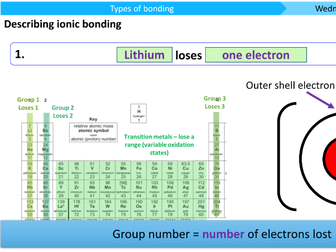
AQA GCSE Chemistry and Combined Science Unit 2: Bonding, Structure and Properties of Matter Lesson 3: Ionic Bonding What is included in this resource: Lesson powerpoint Topic map Starter activity for retrieval practice Learning objectives and specification references Lesson content Opportunities for formative assessment Why this resource? This lesson explores how ionic bonding occurs between metals and non-metals, how the bonding is represented in dot and cross diagrams, and how the formulae of ionic compounds can be determined from ionic charge. The lesson prepares students for every type of past paper question there has been from AQA with regard to ionic bonding, providing structure and explanation for all learners. This lesson follows on from C2 L2: Types of Bonding. All lessons are designed with the Ofsted framework in mind: minimal clutter on the slides, clear flow between the lesson sequence, a topic map to show how this lesson fits in with the rest of the topic, and lesson objectives that get referred back to at each interval in the lesson with questions to check for understanding of every learning objective.
C2 L2: Types of BondingQuick View
itsnatalierose

C2 L2: Types of Bonding

(0)
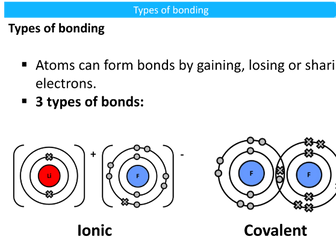
AQA GCSE Chemistry and Combined Science Unit 2: Bonding, Structure and Properties of Matter Lesson 2: Types of Bonding What is included in this resource: Lesson powerpoint Topic map Starter activity for retrieval practice Learning objectives and specification references Lesson content Opportunities for formative assessment Why this resource? This lesson serves as a precursor to lessons that delve into the 3 types of bonding in more detail. The aim is to give students an overview and an early comparison of the types of bonding; ionic, covalent, metallic. By the end of the lesson students will recognise, describe and predict the types of bonding based on the elements involved. This lesson follows on from C2 L1: Electrons and Bonding. All lessons are designed with the Ofsted framework in mind: minimal clutter on the slides, clear flow between the lesson sequence, a topic map to show how this lesson fits in with the rest of the topic, and lesson objectives that get referred back to at each interval in the lesson with questions to check for understanding of every learning objective.
C2 L1: Electrons and BondingQuick View
itsnatalierose

C2 L1: Electrons and Bonding

(0)
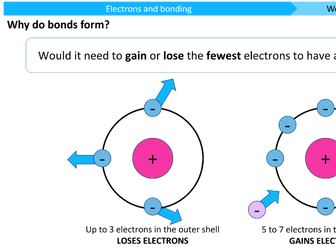
AQA GCSE Chemistry and Combined Science Unit 2: Bonding, Structure and Properties of Matter Lesson 1: Electrons and Bonding What is included in this resource: Lesson powerpoint Topic map Starter activity for retrieval practice Learning objectives and specification references Lesson content Opportunities for formative assessment Why this resource? This lesson serves as a bridge between content covered in unit 1 and the start of unit 2, designed to help students to make connections between what they have already learned and how it links to the new unit. This lesson recaps electron configurations, why atoms form bonds and how the electron configurations of atoms and ions can be predicted and drawn. All lessons are designed with the Ofsted framework in mind: minimal clutter on the slides, clear flow between the lesson sequence, a topic map to show how this lesson fits in with the rest of the topic, and lesson objectives that get referred back to at each interval in the lesson with questions to check for understanding of every learning objective.
GUESS WHO: C2 Bonding, Structure and Properties of Matter EditionQuick View
itsnatalierose

GUESS WHO: C2 Bonding, Structure and Properties of Matter Edition

(0)
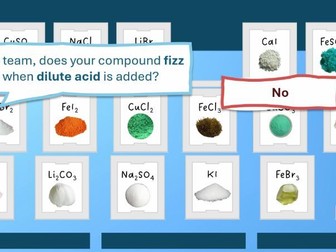
AQA GCSE Chemistry and Combined Science Unit 2: Bonding, Structure and Properties of Matter What is included in this resource: Virtual ‘guess who’ inspired board complete with the formula and images of 18 substances covered in the topic. How to play description. Video tutorial on how to play. Example questions for students to ask each other to support lower ability students. Card randomiser. 1, 2 or 3 player options. Why this resource? Inspired by the board game Guess Who, this powerpoint based game is a nice way to end the topic, and a way to sneak some mastery learning in! Either choose 1 player and display it on your board in your classroom, or (what I did!) book a computer room and send it to the students to play against each other while circulating to check for understanding. To play you simply have to open the powerpoint as a slide show, one person asks a question and another gives an answer (for example, is it a simple covalent molecule?) then click the tiles to put them down or lift them back up until one element or compound remains. Either choose one yourself or use the randomiser to choose one for you!