This lesson is aimed at year 7 class to teach them about William Shakespeare, his theatre and the key terminology that we when studying his plays and for their mini and main assessments.
This resource is designed to help pupils (and you as a teacher) identify the gaps in pupils knowledge on the lead up to mocks/exams so you know where revision and classwork should be focused.
It comprises of various different tasks:
checklists
fill in gaps
answering questions
I used this in lesson recently and it was eyeopening for the work we still have left to do before their GCSEs begin.
This unit is designed to be used an Unseen poetry for KS3 (Y9) but could also be used for GCSE (Y9 or Y10) with focus on building confidence using analysis of poetry. It builds to them being able to try by themselves without my guidance.
Some lessons can be split into two - there are two lesson on powerpoint or condensed into one depending on class.
Intro lesson
poetic devices
approaching poetry
Things i have stolen
Analysing language in detail
The Man He Killed
Practice Assessment
Desert Places
I will be uploading new poems individually as i update the SOW this half-term.
This SOW of work is for a year 7 (could be used for low ability KS3) with a focus on descriptive writing.
This follows on from a reading unit on a monster calls but is mostly unlinked to the novel.
Lessons include:
introduction
senses
vocabulary
sentence starters
sentence variety
figurative language
show don’t tell
structure
mini assessment
main assessment
This lesson is an introduction to poetry for KS3 class.
It focues on the meaning of poetry and poetic devices with a small practice poem at the end of the powerpoint to get them used to annotating and analysing poems.
This is a new and updated SOW I have used for English language paper 1 to teach my year 11s this final part of the paper.
It covers the new AQA paper with the changes to question 3 and 4.
There is also an assessment attached on the woman in black.
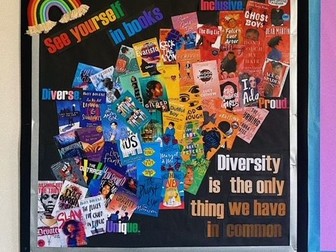
These are the resources I used to create diverse display in my classroom.
This display is catered to all the different minorities within our school community with books that reflect issues such as:
LGBTQ+
Mental Health
Racism
Disabilities
Gender Inequality
Suicide
I wanted students to have a display that reflected them as both individuals and a collective.
They key phrases are: see yourself in books and diversity is the only thing we have in common.
This SOW is designed to be used with KS3 (year nine) or as an introduction topic to KS4 classes.
It covers reading and writing across and entire term with some lessons dedicated to just reading the book.
This resource has been developed over the past half-term and covers the entirety of AQA English Language Paper 1: Section A (Reading).
This uses an extract from JAck the Ripper and the Zodiac Killer and focuses on the key skills and building up to answer questions/construct answers.
This SOW is an updated version of the SOW I already have posted on mythology - this one is not focused entirely on Greek Myths. It is designed to inform them of different myths (the main focus is gender - how women and men are presented in the myths) and leads to writing different non-fiction texts.
This covers the texts:
Letters
Articles
Speeches
This covers the myths of:
Medusa
Midas
Witches
Minotaur
This SOW has been designed with a Y9 KS3 class in mind with langauge skills as the focus - it follows the same format as AQA English Langauge Paper 1 Section A (Reading). This could be beneficial to use with a low ability GCSE class or as an introduction to the langauge questions.
It covers:
-Question 1: Retrieval (4 marks)
-Question 2: Language Analysis (8 marks)
-Question 3: Structure Analysis (8 marks)
-Question 4: Evaluation (20 marks)
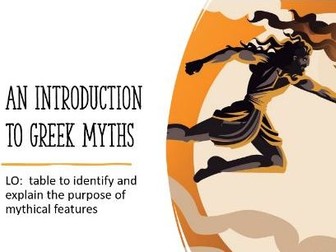
This is a creative writing unit leading to a writing assessment inspired by Greek Myths.
This covers myths such as:
The creation story (all three)
Pandora and Prometheus
Lycaon, Deucalion and Pyrrha
King Midas
Echo and Narcissus
Medusa
Theseus and the Minotaur
This also covers topics such as:
Creative writing techniques
Heroes
Villains
Setting a story
Writing a myth
Planning
Assessment
A comprehensive unit of work that was enjoyed by a year eight group last year. Any of the writing tasks can be used as a formative or mini-assessment should it be required.
This SOW is a new one I have been using with Year 11s. We read the book last year and went over characters. This year we have been focusing on etxracts. We read through an extract every lesson, spend a lesson going over context, analysis and starting to explore the essay. The next lesson we continue with the analysis as a class and they start putting answers together.
Covers a range of extracts and questions
I created this short sequence of lessons to go alongside the Gothic unit for KS3 (we study in year eight). A lot of the stories we were studying were traditional Gothic: Frankenstein, Dracula, The Monkey’s Paw e.c.t
I had a lower ability set and wanted to make some lessons that appealed to their interests and the books we could provide in the library.
This contains:
An Introduction lesson - this covers: what children’s Gothic is and why it’s a popular genre with some trailers to watch.
The witches by Roald Dhal
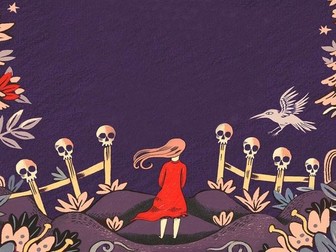
The Graveyard Book by Neil Gaiman
Goosebumps by R. L. Stine
Skulduggery Pleasant by Derek Landy
This SOW if designed for year sevens but could be adapted for KS2 or even used with year eight lower ability groups.
This is a SOW designed to last over a term with both a reading and writing assessment. This is all about teaching key skills and vocabulary and setting pupils up for the year.
AQA English Language Paper 2 June 2022 (Camping) In Class Moderation.
In this resource, I have put together some moderation for classwork to be done as an DIRT lesson after a mock/assessment on the June 2022 Language Paper 2 Section A.
This contains four model answers for each question (2-4) with a mark scheme for pupils to use and annotation tasks to follow.
This unit is aimed at KS3 (I use this with my year sevens to introuduce them to non-fiction writing.
Each topic has multiple lessons with a mini-assessment on letter writing and a assessment on speeches. (I gave my pupils a choice of speech topics, we created five as a class that they could chose from with topics such as: should woman footballs be paid the same as men? Are school uniforms a positive influence on students?)
The major topics are:
Introduction to non-fiction writing
Bristol Bus Boycott - Letter Writing
Speeches
Travel Writing
This is a knowledge organiser for the novel Noughts and Crosses.
It contains information on the plot, chracters, context and key words that link to the novel. There is also subject terminology and an example paragraph written in the style of a GCSE answer.
This would be appropriate for either KS3 or KS4.
This is a context lesson focusing on gender in Elizabethan England.
This is two lessons in one.
The first focuses on gender and stereotypes. It covers qualities expected in men and women in contemporary times and then what would be expected in Elizabethan times.
The next lesson focuses on the specifics for gender in Elizabethan times focusing on what it was like to be a woman.
There is an information and worksheet attached at the end of the powerpoint - this has information to highlight and questions to answer based on the information.
There is also a task to focus on the differences between lower and upper class woman at the time.
There are two youtube links - one to traditional elizabethan music for entry to the classroom and the other to a video that tells us what life was like for an Elizabethan woman.
A unit of work designed for KS3 on love poetry - this unit it designed to explore the darker aspects of love and other emotions we associate with love and not just joy.
Including lessons on the following poems:
Sonnet 18
Valentine
Havisham
Advice to a Discarded Lover
These are designed to have two lessons per poem with a mini-assessment on Sonnet 18 and a main assessmrnt on Advice to a Discarded Lover.
My class really enjoyed looking at these poems!


 Quick View
 Quick View
 Quick View