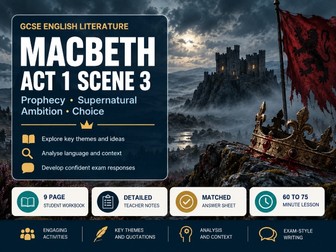
AQA GCSE Macbeth Act 1 Scene 3 Lesson WorkbookQuick View
SamMicheal26

AQA GCSE Macbeth Act 1 Scene 3 Lesson Workbook

(0)
Editable AQA GCSE Macbeth lesson pack for Act 1 Scene 3, guiding students from prophecy and close reading to an analytical paragraph. A 18 slide presentation/powerpoint and workbook and teacher notes and answer sheet. This editable GCSE English Literature lesson pack turns Macbeth Act 1 Scene 3 into a focused 60–75 minute close-reading lesson on prophecy, the supernatural and Macbeth’s emerging ambition. Students begin with an original atmospheric heath image and use visible details to infer mood, power and uncertainty. They then decode the witches’ greetings, unpack Banquo’s paradoxes and track Macbeth’s changing response through his physical “start”, his private contradictions and his claim that chance may crown him “without my stir”. A structured Macbeth–Banquo comparison and a fate-versus-choice discussion give students ideas to rehearse before writing. The 9-page Student Workbook gradually moves from retrieval and scene knowledge to guided AO2 analysis, whole-play links and one developed extract-to-whole-text paragraph. Clear models, sentence openings and planning prompts support mixed-attainment GCSE classes without labelling students by ability. Detailed Teacher Notes provide a timed lesson sequence, suggested wording, misconceptions, checking questions, SEND/EAL adaptations and extension routes. The matched Answer Sheet mirrors every section and includes acceptable interpretations, a full model paragraph and practical marking guidance. The pack is designed for AQA GCSE English Literature 8702 and reflects the verified Paper 1 requirement to write about a Shakespeare extract and the play as a whole. It is also adaptable for other GCSE specifications teaching Macbeth; no claim is made that the practice question is an official exam-board item. All four documents are editable Word files. The original image is a movable and replaceable picture object; its painted details are flat rather than layered. The lesson works as a complete standalone resource with no PowerPoint required. macbeth act 1 scene 3, macbeth witches lesson, macbeth prophecy worksheet, gcse macbeth workbook, aqa gcse english literature macbeth, macbeth supernatural analysis, macbeth ambition lesson, extract to whole text macbeth, macbeth banquo comparison, macbeth exam paragraph
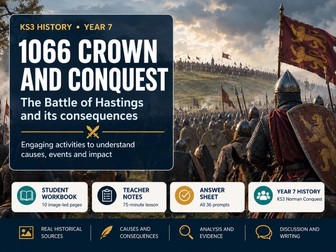
KS3 History Battle of Hastings 1066 Image Led Workbook and Lesson PlanQuick View
SamMicheal26

KS3 History Battle of Hastings 1066 Image Led Workbook and Lesson Plan

(0)
A complete Year 7 KS3 History workbook and lesson plan exploring why William won the Battle of Hastings through images, evidence and judgement. A complete 25 presentation slide for lesson plan and workbook. A complete Year 7 KS3 History workbook and lesson plan exploring why William won the Battle of Hastings through images, evidence and judgement. This 75-minute lesson turns the familiar story of 1066 into a focused historical enquiry. Students begin with three original claimant portraits, weighing the rival cases of Harold Godwinson, William of Normandy and Harald Hardrada. They then build the chronology of a pressured year, read a tactical reconstruction of Hastings and compare the strengths and limits of the English and Norman armies. The lesson moves from close observation to evidence testing. Pupils work with concise evidence files, question the Norman viewpoint of important surviving accounts and sort explanations including preparation, leadership, troop types, tactics, timing, mistakes and chance. A short role-based discussion gives each pupil a clear perspective before the class moves into planning and independent writing. The final outcome is a developed answer to the question: Why did William win the Battle of Hastings? The Student Workbook contains ten purposeful pages with a starter, key knowledge, visual analysis, chronological reasoning, guided comparison, group discussion, planning support, extended writing space and an exit ticket. Detailed Teacher Notes provide a full sequence, a 60-minute route, prompts, misconceptions, literacy and EAL support, print guidance and extensions. The Answer Sheet mirrors every numbered prompt and includes alternatives, cautious historical wording, a model response and assessment guidance. Four original historical artworks are separate Word picture objects. Teachers can move, resize, crop, recolour, replace or delete them. Their internal artwork is flat rather than layered, while questions, labels, tables and writing spaces remain editable Word content. The pack aligns with the Key Stage 3 History programme and Medieval Britain 1066-1509. The calm printable layout supports mixed-attainment classes, literacy needs, slower processing and purposeful whole-class discussion • battle of hastings 1066 lesson • ks3 history norman conquest • year 7 battle of hastings workbook • why did william win hastings • 1066 succession crisis lesson • harold godwinson william hardrada • norman conquest source analysis • battle of hastings causes worksheet • ks3 medieval history lesson plan • battle of hastings image analysis
AQA GCSE Macbeth Act 2 Scene 2 LessonQuick View
SamMicheal26

AQA GCSE Macbeth Act 2 Scene 2 Lesson

(0)
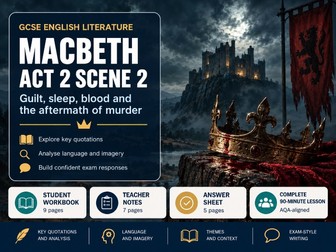
AQA GCSE Macbeth Act 2 Scene 2 lesson for Years 10–11, with a guided workbook, visual inference, close analysis and model answers. A 18 slide presentation for your lesson plan and worksheets included. This AQA GCSE English Literature lesson helps Years 10–11 students move beyond simply saying that Macbeth feels guilty after Duncan’s murder. The focused Act 2 Scene 2 sequence turns the offstage crime into a study of dramatic tension, conscience and the changing relationship between Macbeth and Lady Macbeth. Students begin with an original, text-free evidence-room illustration, separating observation from inference before testing their ideas against the play. A scene spine secures the action, then short quotation tasks explore fragmented dialogue, night sounds, the inability to say “Amen”, the sleep motif and the contrast between Neptune’s ocean and “a little water”. A paired claim-and-reply task asks whether Lady Macbeth controls the scene or whether guilt controls both characters. The nine-page Student Workbook builds gradually towards an original extract-to-whole-play practice response. Students connect the scene to Macbeth’s earlier choice, Banquo’s ghost, the couple’s growing isolation and Lady Macbeth’s sleepwalking, then plan and begin an analytical answer. Scaffolding includes clear model first steps, a vocabulary bank, comparison lenses, sentence prompts and generous writing space without visible ability labels. Seven pages of practical Teacher Notes provide a 90-minute delivery sequence, suggested wording, checking questions, misconceptions, flexible support, extension routes, print guidance and curriculum alignment. The five-page Answer Sheet mirrors every question from 1.1 to 9.4, gives acceptable alternatives and includes a developed model response. All four teaching and seller documents are editable DOCX files. The visual is a flat movable and replaceable Word picture object; all prompts, quotations, tables and response areas remain native editable Word content. The pack is designed around AQA GCSE English Literature 8702, where Macbeth is a set Shakespeare text studied as a whole and Paper 1 asks students to connect an extract to the play. It can also be adapted for other GCSE courses • macbeth act 2 scene 2 • macbeth guilt lesson • aqa gcse macbeth lesson • macbeth sleep imagery • macbeth blood imagery • macbeth lady macbeth relationship • gcse english literature macbeth • macbeth extract analysis • macbeth analytical writing • macbeth murder aftermath
An Inspector Calls: Sheila’s Changing VoiceQuick View
SamMicheal26

An Inspector Calls: Sheila’s Changing Voice

(0)
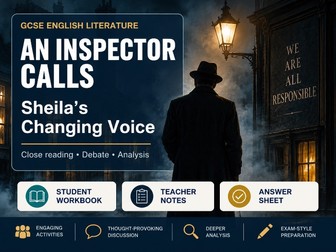
Explore Sheila’s changing voice in An Inspector Calls: a guided GCSE lesson with close reading, paired debate and supported analytical writing. Help students move beyond “Sheila becomes a better person” and explain how Priestley makes her increasingly willing to question her family. This focused Years 10–11 lesson asks students to weigh the evidence for change while keeping her earlier misuse of power in view. A full 15-slide presentation for teachers to use and worksheets and teacher notes. Students rank signs of change, trace the order of key revelations and investigate five short quotation fragments. A paired delivery task explores the Act 2 wall metaphor, before a structured debate tests whether Sheila has fully broken away from her family’s values. A worked paragraph and planning prompts then lead into two independent analytical paragraphs and purposeful editing. The eight-page workbook offers a clear route from first thoughts to qualified judgement. Six pages of practical teacher guidance provide a timed sequence, suggested wording, misconceptions and flexible support; the six-page answer guide mirrors every question and develops alternative interpretations alongside model writing. Designed for a 90-minute lesson or two shorter sessions after students have read the play, the pack supports AQA GCSE English Literature 8702 skills and can also be adapted for other GCSE courses. A shorter revision route is explained in the notes. All teaching documents are editable Word files, with clean white student pages and generous response space. Class copies of the play are recommended for reading around the fragments; a full text is not supplied. Independently produced; not endorsed by AQA. an inspector calls sheila, sheila birling lesson, sheila character development, an inspector calls gcse, aqa english literature 8702, priestley dramatic methods, sheila changing voice, inspector calls analytical writing, gcse literature workbook, sheila birling revision
Romeo and Juliet Creative Quote Worksheets GCSEQuick View
SamMicheal26

Romeo and Juliet Creative Quote Worksheets GCSE

(0)
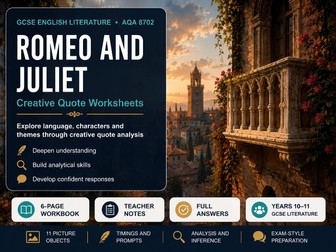
Opening Six editable GCSE English Literature worksheets help Years 10-11 explore Romeo, Juliet, Mercutio and Tybalt through quotations and images. Overview Six editable GCSE English Literature worksheets help Years 10-11 explore Romeo, Juliet, Mercutio and Tybalt through quotations and images. The resource turns visual interpretation into purposeful quotation work, so students move from noticing a detail to testing an idea against Shakespeare’s language. Classroom use Students begin with a four-character portrait gallery, then examine Romeo’s light imagery and impulsiveness, Juliet’s identity and choices, and the different forms of conflict represented by Mercutio and Tybalt. A symbol studio asks students to create a memorable object-to-quotation link, while the final two-scene comparison turns visual changes in light, setting and human presence into a whole-play judgement. The sequence works well as a 90-minute guided lesson, two shorter lessons, a revision carousel, intervention, cover work, homework or one-to-one tuition. Teaching support Detailed Teacher Notes provide timings, live prompts, checking questions, likely misconceptions, visual-task guidance, SEND/EAL adaptations and extension routes. The full Answer Sheet mirrors every numbered task and also covers the unnumbered gallery, symbol and scene prompts. It offers likely answers, reasonable alternatives, teacher-judgement notes, model captions, responsibility guidance and a model director’s note. This keeps discussion purposeful while reducing preparation and live-marking time. Files and editability The student material is a six-page Word workbook with eleven separate picture objects across portraits, a still life and paired scenes. The pictures can be moved, resized, cropped, replaced or deleted in Word; the raster artwork itself is flat rather than layered. Questions, tables, labels and response areas remain native editable Word content. The companion Teacher Notes and Answer Sheet are also editable DOCX files. Specification This is an exam-board-neutral GCSE Shakespeare resource for Years 10-11. It develops whole-text knowledge, supported personal response, quotation selection and analysis of language and dramatic choices. Teachers can adapt the assessment wording to their centre’s specification. No endorsement by Tes or an awarding organisation is claimed.
AQA 2026 Paper 2 Q5: Convincing ArgumentsQuick View
SamMicheal26

AQA 2026 Paper 2 Q5: Convincing Arguments

(0)
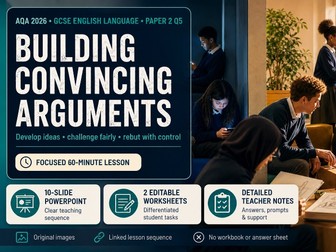
Focused GCSE English Language lesson for AQA Paper 2 Q5: argument development, counterargument and rebuttal, with PPT and worksheets. Students often know a list of persuasive techniques but still struggle to make a viewpoint sound convincing. This focused 60-minute lesson moves them beyond feature spotting and into the reasoning that strengthens Paper 2 Question 5: a clear claim, an explained reason, a specific example and a meaningful impact. Using an original screen-free-afternoon speech task, the 10-slide PowerPoint guides a mixed-attainment Year 10 or Year 11 class through audience, purpose and form, argument chains, fair counterarguments and direct rebuttals. Original text-free images are used as discussion and planning stimuli rather than decoration, helping students generate points before they write. Two linked editable Word worksheets support the full sequence. The first develops arguments through visual inference, guided reasoning and paired oral rehearsal. The second provides a concise speech plan, independent writing space and a two-pass AO5/AO6 editing check. Detailed teacher notes include a timed lesson route, suggested wording, checking questions, misconceptions, indicative responses and practical support for literacy needs, EAL, dyslexia, 1:1 tuition and higher-attaining students. The lesson is aligned to AQA GCSE English Language 8700 and the updated Paper 2 materials for first examination in 2026. All practice wording and examples are original; no protected exam question or candidate response is reproduced. The PowerPoint and Word files are editable. The embedded PNG illustrations can be moved, resized, cropped, replaced or deleted, but the painted details inside each image are not layered. Ideal for a focused classroom lesson, revision, intervention, resit preparation or a one-off writing clinic when students need to develop ideas rather than simply name techniques. aqa english language paper 2 question 5, aqa 2026 english language, writing to persuade, convincing arguments lesson, counterargument and rebuttal, viewpoint writing gcse, paper 2 q5 powerpoint, gcse english speech writing, ao5 ao6 writing, english language intervention
Germany at War 1939-45 GCSE History LessonQuick View
SamMicheal26

Germany at War 1939-45 GCSE History Lesson

(0)
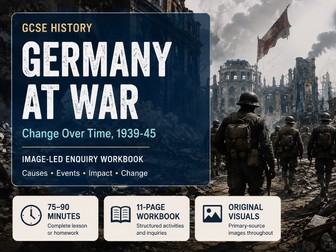
AQA GCSE History lesson tracing how rationing, labour pressure, bombing and displacement transformed German civilian life from 1939 to 1945. Help students move beyond a static list of wartime hardships with a carefully sequenced enquiry into how civilian life changed between 1939 and 1945. Beginning with five realistic reconstruction images, students test their first impressions against a secure chronology and build an increasingly precise explanation of rationing, labour pressure, bombing and displacement. The lesson develops through a visual comparison, an evidence board and a collaborative Civilian Life Change Commission in which students judge when wartime pressure became a genuine transformation of everyday life. Guided modelling then shows them how to turn accurate knowledge into an AQA-style explanation before they plan, write and improve their own 8-mark response. Warm student-facing instructions, vocabulary support, worked first steps and generous writing space make the material accessible to mixed-attainment Year 10 and 11 classes. Detailed teaching guidance, misconceptions, historical-sensitivity notes, indicative answers and a full model response make delivery and marking straightforward while leaving teachers free to adapt the editable Word files. The five original reconstruction images are inserted as separate Word picture objects and supplied as individual PNG assets. They can be moved, resized, cropped, recoloured, replaced or deleted; the artwork itself is flat rather than layered. All questions, captions, tables and response areas remain native editable Word content. germany at war gcse history, wartime nazi germany lesson, aqa history 8145 germany, german civilians second world war, bombing rationing labour shortages, germany 1939 1945 revision, gcse history change continuity, nazi germany home front, second world war history workbook, aqa germany exam practice
A Christmas Carol Scrooge Transformation LessonQuick View
SamMicheal26

A Christmas Carol Scrooge Transformation Lesson

(0)
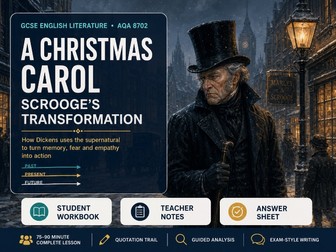
GCSE A Christmas Carol lesson tracing Scrooge’s transformation through the ghosts, with workbook, teacher notes and model answers. Scrooge’s change is easy to reduce to a before-and-after list. This complete GCSE English Literature lesson helps students see the more interesting journey: warning, memory, empathy, feared consequence and finally action. Designed for Years 10–11 and aligned to AQA English Literature 8702, the 75–90 minute lesson asks students to rank evidence of genuine change, follow the supernatural teaching sequence, examine a precise Stave Four turning point and decide which visitor contributes most to Scrooge’s redemption. Context on poverty, social responsibility and redemption is woven into interpretation rather than taught as a detached fact sheet. The substantial, unbranded Student Workbook builds gradually towards an original extract-to-whole-text practice question. Warm explanations, a quotation trail, vocabulary support, sentence starters, a model paragraph, planning space and an independent response make the lesson usable with a mixed-attainment class. Detailed Teacher Notes provide timings, teacher wording, checking questions, misconceptions, responsive support and extension routes. The matching Answer Sheet mirrors every numbered task and adds acceptable alternatives, model wording, a developed response and practical marking guidance. All four documents are editable DOCX files. The short Dickens quotations are from the public-domain novella and have been checked against a reliable full text. The resource is independently produced and is not endorsed by AQA. • a christmas carol scrooge transformation • scrooge character development lesson • a christmas carol ghosts lesson • a christmas carol gcse workbook • aqa english literature 8702 • scrooge redemption essay • a christmas carol supernatural • a christmas carol exam question • dickens social responsibility lesson • a christmas carol revision resource
Macbeth Act 1 Scenes 1–2 GCSE LessonQuick View
SamMicheal26

Macbeth Act 1 Scenes 1–2 GCSE Lesson

(0)
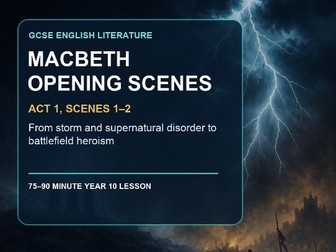
A complete GCSE Macbeth lesson on Act 1, Scenes 1–2, exploring the witches, battlefield violence and Macbeth’s first presentation. Give students a purposeful way into Macbeth by treating the opening as a puzzle: why does Shakespeare move from three witches in a storm to a report that celebrates spectacular battlefield violence? Designed for a 75–90 minute Year 10 GCSE English Literature lesson, this pack guides students through Act 1, Scenes 1–2 before asking them to judge whether Macbeth’s first presentation is heroic, disturbing or deliberately both. Students stage the storm, unpack “Fair is foul”, sequence the battle report, analyse a focused cluster of short quotations and test competing interpretations in a paired hero-or-threat debate. The unbranded Student Workbook uses warm explanations, vocabulary support, sentence starters, guided quote lenses, realistic writing space and a gradual move into an original GCSE-style response. Detailed Teacher Notes provide a timed sequence, suggested wording, checking questions, misconceptions, adaptations and extension routes. The matching Answer Sheet mirrors every numbered task with indicative answers, acceptable alternatives, a model paragraph, a full model response and quick marking guidance. The lesson is aligned to AQA GCSE English Literature 8702 and supports AO1, AO2 and selective AO3 work. All four documents are editable DOCX files, making it straightforward to adjust timing, scaffolding or the final writing task for your class. macbeth act 1 scene 1, macbeth act 1 scene 2, macbeth opening scenes, macbeth first impressions, macbeth brave macbeth analysis, macbeth fair is foul lesson, gcse macbeth lesson, aqa macbeth workbook, macbeth hero or villain, macbeth battlefield imagery
Romeo and Juliet Act 1 Scenes 1-2 LessonQuick View
SamMicheal26

Romeo and Juliet Act 1 Scenes 1-2 Lesson

(0)
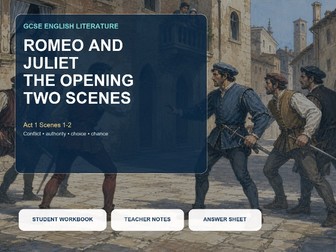
A complete GCSE Romeo and Juliet lesson on Act 1 Scenes 1-2, with visual analysis, close reading, guided writing and full answers. Help students see that the opening of Romeo and Juliet is doing far more than introducing the feud. This complete GCSE English Literature lesson follows the rapid movement from comic provocation to street violence, the Prince’s uneasy attempt to restore order, Romeo’s private language of darkness and the chance encounter that sends him towards the Capulet feast. Students work through four original, text-free visual stimuli, sequence the brawl, compare Benvolio and Tybalt, weigh the Prince’s authority, explore Romeo’s oxymorons and debate whether Scene 2 is driven more by choice or chance. The sequence then turns those ideas into an evidence board, a supported analytical paragraph and an independent GCSE-style response. The calm, printable Student Workbook includes models, sentence starters, vocabulary, paired discussion and generous response space. Detailed Teacher Notes provide a 75-90 minute route, a 60-minute alternative, teacher wording, checks, misconceptions, support, adaptations and extensions. Matching guidance answers every numbered prompt and includes a model paragraph and indicative marking points. The four supplied PNG illustrations are also placed inside Word as separate picture objects. Teachers can move, resize, crop, recolour, replace or delete each picture, while all quotations, prompts, tables and writing areas remain native editable Word content. The PNG artwork itself is flat rather than layered. Designed for Year 10 and suitable for mixed-attainment GCSE classes studying AQA English Literature 8702, while remaining easy to adapt for other specifications. The original practice wording supports AO1, AO2 and AO3 without reproducing a live exam question or implying AQA endorsement. romeo and juliet act 1 scene 1, romeo and juliet act 1 scene 2, romeo and juliet opening scenes, gcse english literature shakespeare, romeo and juliet conflict lesson, romeo and juliet visual worksheet, aqa 8702 romeo and juliet, shakespeare analytical writing, romeo and juliet editable workbook, romeo and juliet full lesson
AQA A-level Psychology Research Methods: Designing ExperimentsQuick View
SamMicheal26

AQA A-level Psychology Research Methods: Designing Experiments

(0)
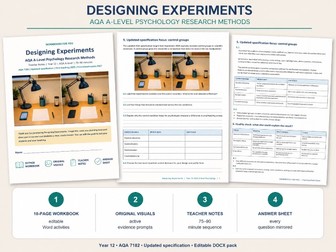
A 10-page Year 12 AQA A-level Psychology mini workbook on designing experiments, control groups and scenario-based research-methods practice. A 10-page Year 12 AQA A-level Psychology mini workbook on designing experiments, control groups and scenario-based research-methods practice. It is aligned to the updated AQA 7182 specification taught from September 2025, with first A-level assessment in 2027. Students work through one coherent enquiry: whether visible smartphone notifications affect proofreading accuracy. They turn the idea into a precise aim and hypothesis, operationalise the IV and DV, compare laboratory, field, natural and quasi-experiments, and justify independent-groups, repeated-measures or matched-pairs designs. Original text-free visuals are used as active evidence prompts for comparing conditions, interpreting a field setting and reasoning about matched pairs. The lesson gives particular attention to control groups, which are explicitly named in the updated specification. Students distinguish a comparison group from other procedural controls, then apply random allocation, standardisation, randomisation and counterbalancing appropriately. A design-clinic activity asks pairs to diagnose a deliberately flawed study before repairing its validity, reliability, ethics and conclusion. The final pages move into original AQA-style scenario practice and an independent study proposal. Detailed Teacher Notes provide a 75-90 minute sequence, live questions, checking points, misconceptions, support and extension. The Answer Sheet mirrors every question and includes indicative mark guidance, model hypotheses, acceptable alternatives and teacher-judgement notes. Best suited to Year 12 induction, first teaching of research methods, retrieval and application practice, a cover lesson, tutoring or a focused revision session. The Student Workbook is unbranded and uses one shared route with warm scaffolding rather than visible ability labels.
Painting with Words: Year 8 Creative Writing LessonQuick View
SamMicheal26

Painting with Words: Year 8 Creative Writing Lesson

(0)
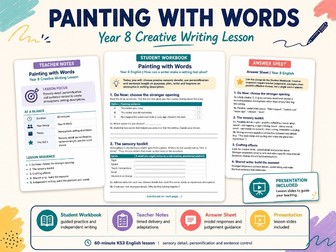
A complete Year 8 English creative writing lesson on using sensory detail, personification and sentence control to create atmosphere. Help Year 8 students make a setting feel alive with this complete, printable creative writing lesson. “Painting with Words” gives students a clear route from noticing sensory detail to drafting and improving an atmospheric description. • Designed for a 60-minute KS3 English lesson. • Builds confident use of precise vocabulary, personification and varied sentence lengths. • Includes a substantial Student Workbook, detailed Teacher Notes and a practical Answer Sheet. • Uses an original rain-soaked railway-platform stimulus - no copyrighted extract needed. • Includes an editable PPX teacher presentation to model and teach each lesson stage. The Student Workbook moves through a short retrieval starter, sensory-detail collection, word upgrades, guided sentence crafting, shared writing, independent 150-200 word description and self/peer editing. It is clean, supportive and unbranded for easy classroom printing. Teacher Notes include a timed lesson plan, suggested teacher wording, checking questions, misconceptions, adaptations for literacy needs, dyslexia, EAL and slower processing, plus extension routes. The Answer Sheet mirrors workbook question numbers and includes indicative answers, teacher judgement guidance and a model paragraph. Files included • Teacher Notes.docx • Student Workbook.docx • Answer Sheet.docx • Teacher Presentation.pptx year 8 creative writing, ks3 english lesson, descriptive writing worksheet, creating atmosphere, sensory detail lesson, personification lesson, sentence length writing, setting description, english writing workbook, creative writing powerpoint
GCSE Creative Writing Narrative Openings - Image Prompt Workbook for Year 11Quick View
SamMicheal26

GCSE Creative Writing Narrative Openings - Image Prompt Workbook for Year 11

(0)
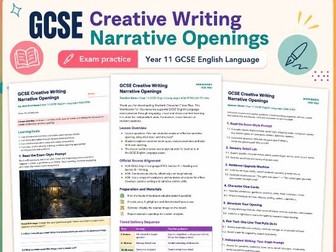
A visual Year 11 creative-writing pack with image prompts, sensory labs, sentence upgrading, character clues and guided drafting. A complete, exam-focused GCSE English Language creative-writing lesson for Year 11, aligned to AQA Paper 1 Writing practice. This edition uses original illustrated stimulus pages to help students choose a story route, gather sensory details, upgrade sentences, invent character clues, plan structure, draft 220-300 words and edit for effect. The pack includes a colourful Student Workbook, detailed Teacher Notes, a full Answer Sheet with model wording and judgement guidance. The visual assets are used as stimulus only; all instructions, questions and writing spaces remain editable in Word. year 11 creative writing gcse creative writing image prompt descriptive writing worksheet narrative opening lesson creative writing visual prompts sentence upgrade worksheet sensory detail writing character clues writing task aqa language paper 1 preparation guided creative writing booklet
AQA GCSE English Language Paper 1 creative writing activityQuick View
SamMicheal26

AQA GCSE English Language Paper 1 creative writing activity

(0)
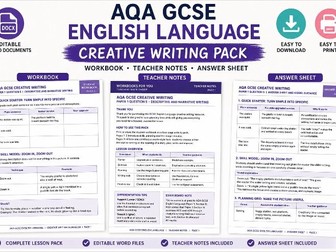
QA GCSE English Language Paper 1 Question 5 creative writing pack with worsheet activity (4 pages), with teacher notes, model answers and differentiated support for Year 10–11. Suitable for revision lessons, intervention sessions, tuition, homework or independent study. This is Ideal For: GCSE English Language Year 10 English Year 11 English AQA Paper 1 Revision Creative Writing Intervention Tuition Sessions Homework Tasks Cover Lessons Independent Study
A colourful GCSE Macbeth quote worksheet packQuick View
SamMicheal26

A colourful GCSE Macbeth quote worksheet pack

(0)
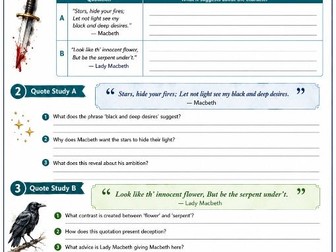
This is a student-friendly Macbeth quotation workbook with four guided worksheet pages and matching answer guidance. It is suitable for GCSE English Literature revision, classroom teaching, 1:1 tutoring, cover or homework, and can fit a 60-minute lesson or be split across shorter sessions. Included: editable Student Workbook, Teacher Notes, Answer Sheet, TES Listing copy and preview page images. The resource focuses on close quotation analysis, student discussion, sentence starters and short analytical writing. It is designed with AQA GCSE English Literature skills in mind, especially responding to texts, using quotations and analysing language, though it can be adapted for other GCSE exam boards. macbeth quotes worksheet, macbeth gcse revision, macbeth key quotations, gcse english literature macbeth, macbeth ambition worksheet, macbeth guilt worksheet, macbeth supernatural worksheet, macbeth tragedy worksheet, shakespeare quotation analysis, aqa macbeth revision
A fun GCSE Macbeth character workbook using wanted-postersQuick View
SamMicheal26

A fun GCSE Macbeth character workbook using wanted-posters

(0)
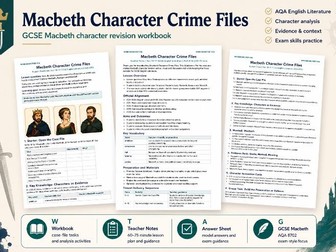
A fun GCSE Macbeth character workbook using wanted-poster case files to revise Macbeth, Lady Macbeth, Banquo and Macduff. • This editable GCSE English Literature resource helps students revise Macbeth characters through a crime-file / detective-case format while still building serious analytical writing skills. • The Student Workbook includes a character lineup, a Macbeth wanted-poster page, accusation cards, evidence-board tasks, pair/group discussion and an independent analytical paragraph. • The Teacher Notes include lesson aims, official alignment, timed delivery, teacher prompts, misconceptions, support/adaptation and extension guidance. • The Answer Sheet mirrors the workbook and includes likely answers, acceptable alternatives, teacher judgement notes and a model paragraph. • Best for Year 10 or Year 11 Macbeth revision, character consolidation, intervention, cover work with guidance, or a more engaging lesson after students know the plot. Files Included • Student Workbook.docx • Teacher Notes.docx • Answer Sheet.docx macbeth characters worksheet, macbeth revision workbook, macbeth wanted poster, macbeth character analysis, gcse macbeth revision, lady macbeth worksheet, banquo macbeth revision, macduff worksheet, aqa macbeth gcse, macbeth crime file
Planning Child-Centred Play- GCSE childcareQuick View
SamMicheal26

Planning Child-Centred Play- GCSE childcare

(0)
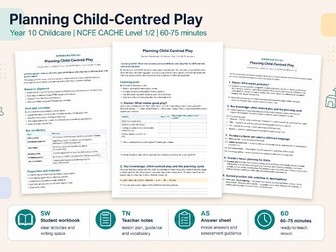
Year 10 Childcare lesson pack on planning child-centred play using observation, development links, safety, inclusion and review. A complete, editable Year 10 Childcare / early years lesson pack on planning child-centred play. The resource supports NCFE CACHE Level 1/2 Child Development and Care in the Early Years-style teaching, especially play activities, practitioner role, observations and the planning cycle. Students work through a warm, guided workbook that builds from accessible ranking and vocabulary tasks to a realistic observation scenario and an independent play plan. The fictional Aisha scenario is original and gives students a practical way to link child interests, holistic development, adult role, safety, inclusion and review. Included files: • Teacher Notes.docx with timed delivery, prompts, misconceptions, checking questions, support, adaptations and extension routes • Student Workbook.docx with a substantial guided lesson booklet and writing space • Answer Sheet.docx matching every workbook heading and question number child centred play, childcare lesson, child development and care, ncfe cache childcare, early years planning cycle, play activities childcare, childcare workbook, year 10 childcare, observations in early years, practitioner role play
Care Values in Practice | BTEC Health and Social Care presentationQuick View
SamMicheal26

Care Values in Practice | BTEC Health and Social Care presentation

(0)
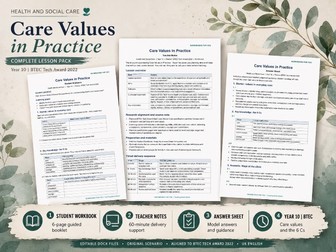
A complete Year 10 BTEC Health and Social Care lesson on applying the 6 Cs and care values to a realistic clinic scenario. This editable 60-minute Health and Social Care resource helps Year 10 students understand and apply care values in practice, with a particular focus on the 6 Cs: care, compassion, competence, communication, courage and commitment. Students work through a realistic clinic scenario, identify weak moments in care, practise value + evidence + impact explanations, redesign staff actions, and complete an independent written response. The pack is designed for Pearson BTEC Tech Award Health and Social Care 2022 Component 2 revision or teaching, but it can also support introductory KS4 health and social care lessons. Files included • Student Workbook: unbranded, printable guided lesson booklet with starter, key knowledge, scenario work, pair task, independent writing and exit review. • Teacher Notes: branded delivery guide with lesson overview, timings, prompts, misconceptions, support/adaptation and extension routes. • Answer Sheet: branded indicative answers, acceptable alternatives, judgement notes, model wording and mark guidance. Presentation 10 slide related to the handbook/worksheets health and social care care values, btec health and social care component 2, 6 cs lesson, care values worksheet, pearson btec tech award hsc, year 10 health and social care, person centred care lesson, dignity and respect care values, health social care scenarios, btec care values revision
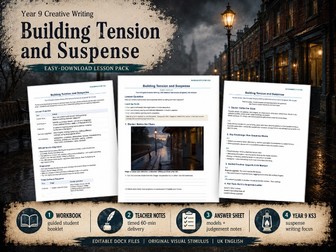
Year 9 Creative Writing: Building Tension and SuspenseQuick View
SamMicheal26

Year 9 Creative Writing: Building Tension and Suspense

(0)
Complete Year 9 creative-writing lesson on building tension and suspense, with workbook, teacher notes, answers and previews. A complete 60-minute KS3 English creative-writing lesson for Year 9, focused on building tension and suspense before anything dramatic happens. Pupils explore viewpoint, pacing, withheld information, foreshadowing and precise sensory detail before planning, drafting and improving a suspenseful opening inspired by an original deserted railway-platform image. The pack includes detailed Teacher Notes, a substantial unbranded Student Workbook, a matching Answer Sheet, a keyword-led TES listing and three professional preview images. The workbook is structured enough to support mixed-attainment classes while still moving pupils towards independent writing. Included Files • Teacher Notes.docx: timed delivery, prompts, misconceptions, support, adaptations and extension routes. • Student Workbook.docx: guided lesson booklet with stimulus, examples, planning, independent writing and review. • Answer Sheet.docx: matching question-by-question guidance, model wording and teacher judgement notes. • year 9 creative writing • building tension and suspense • ks3 suspense writing • creative writing lesson year 9 • descriptive writing suspense • narrative writing ks3 • viewpoint and pacing writing • withheld information writing • english creative writing workbook • ks3 english writing lesson
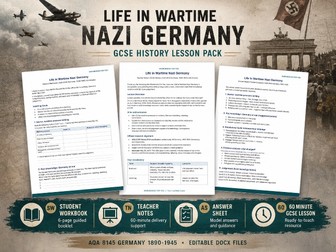
Life in Wartime Nazi GermanyQuick View
SamMicheal26

Life in Wartime Nazi Germany

(0)
GCSE History lesson pack on how World War Two affected ordinary Germans under Nazi rule, aligned to AQA Germany 1890-1945. A complete GCSE History lesson pack on life in wartime Nazi Germany, focused on how the Second World War affected ordinary Germans through bombing, rationing, labour shortages, refugees/displacement and Nazi control of morale. Designed for Years 10-11, this editable pack supports AQA GCSE History 8145 Germany, 1890-1945: Democracy and dictatorship, especially the specification focus on the impact of war on the economy and German people. It can also be used for GCSE-style revision on consequences, change, significance and judgement. Included files: • Teacher Notes with lesson overview, timings, prompts, misconceptions, support and extension routes. • Student Workbook with starter, key knowledge, vocabulary, evidence cards, consequence chains, pair judgement task, independent GCSE-style writing and exit ticket. • Answer Sheet with likely answers, acceptable alternatives, model paragraph, judgement notes and mark guidance. gcse history nazi germany, wartime nazi germany lesson, germany 1890 1945 revision, aqa gcse history germany, second world war germany home front, nazi germany bombing rationing, gcse history consequence lesson, life under nazi rule lesson, nazi germany student workbook, world war two gcse history
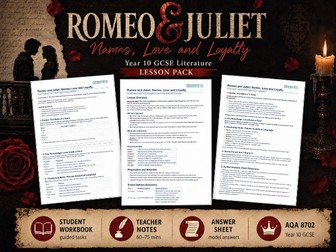
Romeo and Juliet: Names, Love and Loyalty | Year 10 GCSE Literature LessonQuick View
SamMicheal26

Romeo and Juliet: Names, Love and Loyalty | Year 10 GCSE Literature Lesson

(0)
A complete Year 10 Romeo and Juliet lesson on names, love and loyalty in Act 2 Scene 2, with workbook, teacher notes and answers. A substantial GCSE English Literature lesson pack for Year 10 students studying Shakespeare’s Romeo and Juliet. This resource focuses on Act 2 Scene 2 and explores how Shakespeare presents love as powerful but dangerous when Romeo and Juliet challenge their family names. The pack is designed for a 60-75 minute lesson, revision session, cover lesson or extended homework task. It builds from accessible ideas about names and identity into close language analysis, whole-play links and a GCSE-style planning task. Included • Student Workbook with twelve guided sections, vocabulary support, analytical prompts, tables, writing space and a GCSE-style question. • Detailed Teacher Notes with lesson sequence, prompts, checking questions, misconceptions, support and extension routes. • Answer Sheet with likely answers, acceptable alternatives, model wording, model paragraph and mark guidance. • Three TES preview images created from genuine finished pages. Best fit • Year 10 GCSE English Literature • AQA 8702 Romeo and Juliet study • Act 2 Scene 2 / balcony scene • Love, family loyalty, identity, names, conflict and tragedy • Extract-to-whole-text preparation • romeo and juliet balcony scene lesson • romeo and juliet act 2 scene 2 worksheet • romeo and juliet names love loyalty • gcse romeo and juliet lesson year 10 • aqa english literature 8702 romeo and juliet • romeo and juliet family loyalty worksheet • romeo and juliet analysis workbook • romeo and juliet extract to whole text • romeo and juliet love and conflict lesson • shakespeare gcse student workbook