KS3 Science Literacy & Writing | EAL/SENDQuick View
GradeGrove

KS3 Science Literacy & Writing | EAL/SEND

(0)
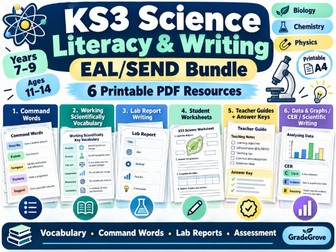
Support KS3 Science EAL/SEND learners with this comprehensive Science Literacy & Writing Bundle for Years 7–9 / ages 11–14. This bundle includes 6 printable PDF resources combining student worksheets, teacher guidance and answer keys. It is designed to help learners understand scientific vocabulary, decode command words and develop clearer, more independent scientific writing. The Command Words resources teach 16 high-frequency science instruction words, including state, identify, describe, explain, compare, calculate, predict, interpret, evaluate and justify. Students move from visual glossaries and matching activities to Biology, Chemistry and Physics applications, data interpretation, assessment and improvement of weak answers. The Working Scientifically Vocabulary resources develop key enquiry language such as independent, dependent and control variables, fair tests, data, graphs, trends, anomalies, accuracy, precision, repeatability, reproducibility, hazards and risks. The student workbook includes baseline assessment, visual vocabulary, practical scenarios, sentence stems, retrieval practice and final assessment. The Lab Report Writing Frames guide students through a clear investigation route: Plan → Prepare → Record → Explain → Evaluate Learners practise aims, predictions, variables, equipment, methods, safety, data, graphs, conclusions, Claim–Evidence–Reasoning and evaluation. Three levels of support are included: Guided, Supported and Independent. Included: • Command Words Student Worksheets • Command Words Teacher Guide + Answers • Working Scientifically Student Workbook • Working Scientifically Teacher Guide + Answer Key • Lab Report Writing Frames Student Worksheets • Lab Report Teacher Answer Guide Perfect for: • KS3 Science • EAL / ESL learners • SEND students • lower-attaining learners • mixed-ability classes • intervention and catch-up • practical preparation • revision, homework and cover work Skills covered: scientific vocabulary • command words • variables • fair tests • data & graphs • mean • trends & anomalies • predictions • conclusions • CER • evaluation • hazards & risks • scientific writing This bundle supports a clear progression: Understand the question → Learn the language → Apply the vocabulary → Write scientifically → Assess progress Printable A4 PDFs • UK English • Student + Teacher versions • Answer keys included
KS3 Lab Report Writing Frames | EAL/SENDQuick View
GradeGrove

KS3 Lab Report Writing Frames | EAL/SEND

(0)
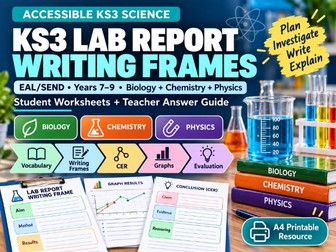
KS3 Science Lab Report Writing Frames | EAL/SEND Help your KS3 Science students (Years 7–9) develop confidence in writing clear, accurate and well-structured scientific lab reports. This 34-page printable resource pack provides step-by-step writing frames, scientific vocabulary support, visual organisers and differentiated activities to help EAL/SEND learners plan investigations, record results and explain their findings. Designed for Biology, Chemistry and Physics, the resource supports pupils from highly guided writing through to more independent scientific explanations. What’s included? Student Worksheets – 23 pages Scientific vocabulary and visual writing support Aim, hypothesis and prediction writing frames Independent, dependent and control variables Equipment lists and practical method writing Laboratory safety: hazards, risks and control measures Data collection tables and calculating mean values Identifying anomalous results Graph plotting with the SALT checklist Observation versus scientific inference Claim–Evidence–Reasoning (CER) conclusion writing Evaluation and improvement activities Reusable full lab report templates Biology and Physics application activities Final self-assessment checklist Teacher Answer Guide – 11 pages Worked scientific examples and model answers Completed data tables and calculations Model graph with labelled axes CER conclusion examples Common scientific misconceptions EAL/SEND questioning prompts Three-stage formative assessment rubric Guidance for gradually reducing writing support Differentiated support for EAL/SEND Activities use three progressive levels of scaffolding: Level 1 – Guided: Word banks, fill-in-the-blank sentences and visual prompts. Level 2 – Supported: Sentence starters, structured writing and guided scientific explanations. Level 3 – Independent: Extended scientific responses using clear success criteria. Students can move between support levels according to their needs. Scientific investigation example The pack includes a worked Chemistry investigation exploring how water temperature affects the time taken to dissolve sugar. Students practise recording repeated measurements, calculating averages, plotting graphs and supporting scientific conclusions with numerical evidence. The example dataset is illustrative and is clearly identified as such. Perfect for KS3 Science lessons (Years 7–9) EAL/ESL learners developing scientific English SEND learners needing structured writing support Science literacy intervention Small-group and individual support Practical investigation follow-up activities Homework, revision and catch-up sessions Resource details Format: Printable PDF files Page size: A4 portrait Language: British English Age range: 11–14 years Subjects: Biology, Chemistry and Physics Total: 34 pages across two PDF files
KS3 Lab Safety & Equipment | EAL/SENDQuick View
GradeGrove

KS3 Lab Safety & Equipment | EAL/SEND

(0)
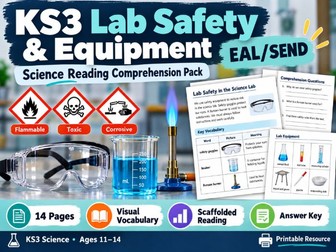
Support your KS3 Science EAL/SEND learners with this clear and accessible Lab Safety & Equipment reading comprehension pack. This printable resource helps students understand essential laboratory safety rules through visual vocabulary, scaffolded reading passages, sentence starters and structured activities. It covers PPE, hazard symbols, glassware safety and Bunsen burner safety. Students practise key vocabulary including hazard, corrosive, flammable, toxic, goggles, beaker and Bunsen burner, followed by vocabulary matching activities. The pack also includes short reading sections with guided comprehension questions on PPE, hazard symbols, glassware and Bunsen burner safety, making the content easier to access for learners who need additional language or literacy support. Students can then apply their learning through: • Hazard symbol activities • Safety scenarios • Sentence starters • Safety poster challenge • Fill-in-the-blank review • True or False activity • Teacher answer key The resource is designed as a printable KS3 Science booklet for students aged 11–14, with clear layouts and structured response areas suitable for EAL and SEND learners. Includes: 14 printable pages with student activities and teacher answers. Ideal for: KS3 Science • EAL/ESL • SEND • Lab Safety • Intervention • Cover Lessons • Homework • Science Vocabulary
KS3 Science Command Words | EAL WorksheetQuick View
GradeGrove

KS3 Science Command Words | EAL Worksheet

(0)
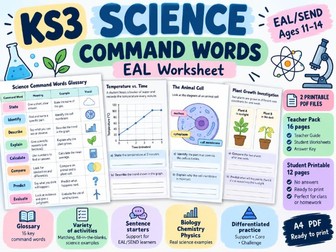
KS3 Science Command Words | EAL/SEND Worksheets & Study Guide Help your KS3 Science students (ages 11–14) understand and confidently use essential scientific command words with this accessible, printable teaching resource. Designed to support EAL (English as an Additional Language) and SEND learners, this resource combines clear vocabulary explanations, visual learning aids, guided practice and differentiated activities. Students learn how to recognise scientific command words, understand what each question is asking and structure their answers appropriately. What’s Included? 2 printable PDF files: PDF 1 – Complete Teacher Pack (16 pages) Teacher Guide with teaching instructions. Student worksheets and vocabulary activities. Teacher Answer Key with model answers. PDF 2 – Student Printable (12 pages) Student activities ready for classroom printing. No teacher answers included. Ideal for independent practice, revision and homework. Both PDFs include the same student activities. The second file is provided for convenient printing. Key Learning Activities Command Words Glossary: 16 essential scientific command words with student-friendly definitions. Vocabulary Matching: Match command words to their meanings. Fill-in-the-Blank Exercises: Reinforce scientific vocabulary through structured practice. Graphic Organisers: Categorise command words and understand their purpose. Sentence Starters: Support students in constructing clear scientific answers. Science Applications: Apply command words through Biology, Chemistry and Physics examples. Differentiated Practice: Support, Core and Challenge activities. Self-Assessment: Encourage students to reflect on their understanding. Skills Covered Students practise using scientific command words such as: State • Identify • Describe • Explain • Compare • Contrast • Predict • Calculate • Evaluate The activities help learners distinguish between describing observations, explaining scientific processes, interpreting information and evaluating evidence. Suitable For KS3 Science – Years 7, 8 and 9. EAL/ESL learners developing scientific English. SEND learners who benefit from structured language support. Mixed-ability science classrooms. Vocabulary intervention and revision sessions. How to Use This Resource Use the worksheets as a starter activity, vocabulary lesson, independent task, revision exercise or homework assignment. The teacher guide and answer key support preparation and marking, while the separate student PDF makes classroom printing straightforward. File Information Format: PDF Page size: A4 Language: British English Files included: 2 PDFs Complete Teacher Pack: 16 pages Student Printable: 12 pages Digital download: Ready to print Help students understand the question before they answer it!
KS3 Working Scientifically EAL & SENDQuick View
GradeGrove

KS3 Working Scientifically EAL & SEND

(0)
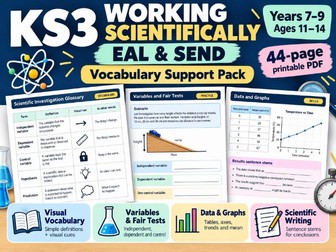
Support KS3 students in developing the essential vocabulary and language needed for Working Scientifically. This 44-page printable A4 pack is designed for EAL, SEND and lower-attaining learners in Years 7–9 (ages 11–14). The resource provides structured, accessible support for students who may understand scientific concepts but need additional help with the academic language used when planning, carrying out, recording and evaluating scientific investigations. It can be used across Biology, Chemistry and Physics for intervention, catch-up, practical preparation, revision or cover work. The pack develops key vocabulary including independent, dependent and control variables, hypothesis, prediction, fair test, method, data, evidence, conclusion, anomaly, accuracy, precision, repeatability, reproducibility, random error, systematic error, trend, mean, hazard and risk. Activities include: initial baseline assessment scientific vocabulary glossaries visual vocabulary cards word-to-definition matching variables and fair-test practice practical investigation scenarios measurement and apparatus vocabulary graph and data skills accuracy, precision and reliability activities random and systematic error vocabulary sentence stems for predictions, results, conclusions and evaluations scientific writing frame results tables and mean calculations hazards and risks retrieval quiz final assessment progress tracker and self-assessment full teacher answer key The resource uses simple definitions, memory cues, reduced language load and sentence scaffolds while retaining accurate KS3 scientific terminology. It is suitable for individual students, small-group intervention or whole-class differentiation. Format: 44-page A4 printable PDF Age: 11–14 Key Stage: KS3 Subject: Science Suitable for: EAL, SEND, intervention, catch-up and revision.
KS3 AI Literacy | 30 Daily ActivitiesQuick View
GradeGrove

KS3 AI Literacy | 30 Daily Activities

(0)
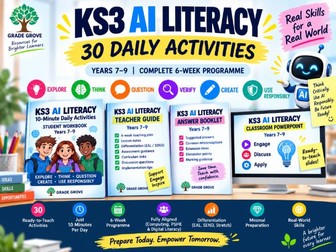
30 ready-to-use KS3 AI Literacy activities for Years 7-9, covering generative AI, bias, deepfakes, privacy, AI safety and responsible AI use. Teach essential AI literacy and digital literacy skills in just 10 minutes a day with this complete 6-week classroom programme. Designed for KS3 students in Years 7-9, this resource provides 30 structured daily activities that help students understand artificial intelligence, question AI-generated information, recognise bias and misinformation, evaluate digital content, protect personal data and develop responsible AI habits. The activities are short, accessible and classroom-ready, making the resource suitable for Computing, Digital Literacy, PSHE, tutor/form time, enrichment, intervention and cross-curricular learning. What’s Included Student Workbook - 30 printable daily activities, baseline and final assessments, reflection activities, progress tracker and key vocabulary Teacher Guide - 6-week teaching plan, curriculum connections, differentiation, assessment guidance and teaching notes Answer Booklet - suggested answers, acceptable responses, extension ideas, teacher notes and common misconceptions Classroom PowerPoint - ready-to-project slides aligned with the 30 student activities START HERE Guide - quick-start instructions for teachers 30 activities | 6 weeks | 10 minutes a day | Years 7-9 | Print & Go Topics Covered Week 1 - AI Basics What AI is, AI vs automation, AI in everyday life, how AI learns and why data matters. Week 2 - Generative AI Generative AI, chatbots, AI-generated answers, hallucinations and why confident AI responses are not always correct. Week 3 - AI Detective Fact-checking, evidence, reliable sources, suspicious information and verification skills. Week 4 - Bias & Algorithms AI bias, biased data, recommendation algorithms, filter bubbles and personalised online feeds. Week 5 - Deepfakes, Media & Privacy Deepfakes, AI-generated and edited media, verification strategies, personal information and data privacy. Week 6 - Responsible AI AI in education, help vs cheating, responsible AI use, better prompting, AI ethics and creating a personal AI code. Learning Objectives Students will develop their ability to: Explain artificial intelligence and generative AI Recognise AI in everyday life Understand how data influences AI systems Identify potential AI hallucinations Evaluate AI-generated information Check evidence and reliable sources Recognise AI bias Understand recommendation algorithms and filter bubbles Identify potential deepfakes and manipulated media Protect personal information Use AI responsibly for schoolwork Write better prompts Discuss AI ethics Develop responsible AI habits Perfect For KS3 Computing | Digital Literacy | AI Literacy | PSHE | Online Safety | Media Literacy | Tutor Time | Form Time | Enrichment | Intervention | Years 7-9
KS3 Science Command Words | FREE EAL/SENDQuick View
GradeGrove

KS3 Science Command Words | FREE EAL/SEND

(0)
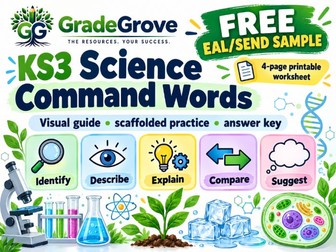
Help KS3 Science students understand what exam and classroom questions are really asking with this FREE EAL/SEND-friendly Command Words sample. This 4-page printable worksheet introduces five essential science command words using clear definitions, visual cues, sentence starters and scaffolded practice. Designed for KS3 students aged 11–14, including EAL/ESL and SEND learners, this free resource can be used independently as a starter, vocabulary activity, intervention task, revision exercise or homework. What’s Included? • Visual Command Word Guide – student-friendly definitions, visual cues and sentence starters • Matching Activity – match each command word to its meaning • Command Word Recognition – identify what different science questions are asking • Guided Science Practice – accessible Biology, Chemistry and Physics examples • EAL Vocabulary Support – simple definitions and structured writing frames • Describe vs Explain Support – helps students understand this common distinction • Answer Key & Model Answers – including examples of how to improve a scientific response Command Words Covered Identify • Describe • Explain • Compare • Suggest Students are supported to move from: Learn → Recognise → Apply → Check Sentence starters and writing frames help learners structure answers using patterns such as: “This happens because…” “Both…” “…but…” “It may be because…” Perfect For • KS3 Science – Years 7, 8 and 9 • EAL / ESL learners • SEND students • Mixed-ability classrooms • Science vocabulary intervention • Starter or plenary activities • Revision and homework • Independent learning File Information • 4 pages • A4 PDF • British English • Printable / no prep • Includes answer key • FREE digital download Want More Practice? This free sample gives students a useful introduction to scientific command words and provides a preview of the GradeGrove KS3 Science Command Words EAL/SEND approach. The complete resource provides a wider range of command words, additional scaffolded activities, differentiated practice, sentence starters, science applications and teacher answer guidance. Download the FREE sample and help students understand the question before they answer it! GradeGrove — The Resources. Your Success.