


KS3 Science Lab Report Writing Frames | EAL/SEND
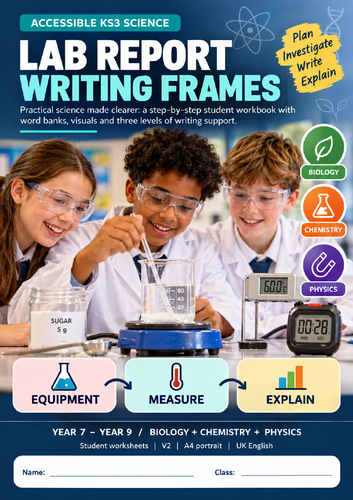
Help your KS3 Science students (Years 7–9) develop confidence in writing clear, accurate and well-structured scientific lab reports.
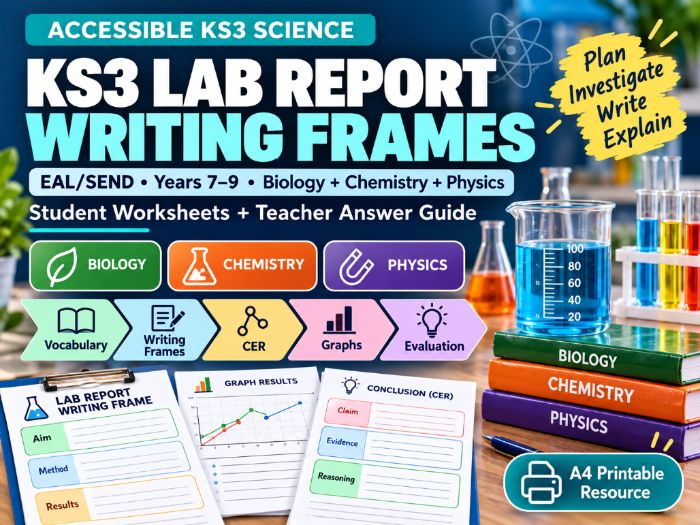
This 34-page printable resource pack provides step-by-step writing frames, scientific vocabulary support, visual organisers and differentiated activities to help EAL/SEND learners plan investigations, record results and explain their findings.
Designed for Biology, Chemistry and Physics, the resource supports pupils from highly guided writing through to more independent scientific explanations.
What’s included?Student Worksheets – 23 pages
- Scientific vocabulary and visual writing support
- Aim, hypothesis and prediction writing frames
- Independent, dependent and control variables
- Equipment lists and practical method writing
- Laboratory safety: hazards, risks and control measures
- Data collection tables and calculating mean values
- Identifying anomalous results
- Graph plotting with the SALT checklist
- Observation versus scientific inference
- Claim–Evidence–Reasoning (CER) conclusion writing
- Evaluation and improvement activities
- Reusable full lab report templates
- Biology and Physics application activities
- Final self-assessment checklist
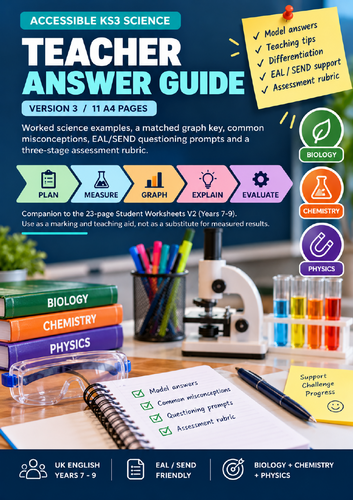
Teacher Answer Guide – 11 pages
- Worked scientific examples and model answers
- Completed data tables and calculations
- Model graph with labelled axes
- CER conclusion examples
- Common scientific misconceptions
- EAL/SEND questioning prompts
- Three-stage formative assessment rubric
- Guidance for gradually reducing writing support
Activities use three progressive levels of scaffolding:
Level 1 – Guided: Word banks, fill-in-the-blank sentences and visual prompts.
Level 2 – Supported: Sentence starters, structured writing and guided scientific explanations.
Level 3 – Independent: Extended scientific responses using clear success criteria.
Students can move between support levels according to their needs.
Scientific investigation exampleThe pack includes a worked Chemistry investigation exploring how water temperature affects the time taken to dissolve sugar.
Students practise recording repeated measurements, calculating averages, plotting graphs and supporting scientific conclusions with numerical evidence.
The example dataset is illustrative and is clearly identified as such.
Perfect for
KS3 Science lessons (Years 7–9)
EAL/ESL learners developing scientific English
SEND learners needing structured writing support
Science literacy intervention
Small-group and individual support
Practical investigation follow-up activities
Homework, revision and catch-up sessions
Resource details
Format: Printable PDF files
Page size: A4 portrait
Language: British English
Age range: 11–14 years
Subjects: Biology, Chemistry and Physics
Total: 34 pages across two PDF files
Something went wrong, please try again later.
This resource hasn't been reviewed yet
To ensure quality for our reviews, only customers who have purchased this resource can review it
Report this resourceto let us know if it violates our terms and conditions.
Our customer service team will review your report and will be in touch.
£3.00