Beginner Italian Active Recall FlashcardsQuick View
Aistl05

Beginner Italian Active Recall Flashcards

(0)
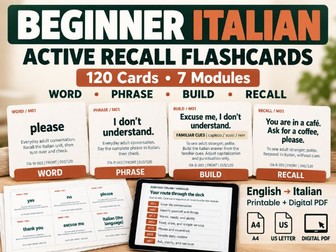
120 English-to-Italian active-recall flashcards for adult beginners, practising practical vocabulary, phrases and everyday responses across 7 modules. This structured beginner Italian resource is designed for English-speaking adult learners and can support independent study, tutoring or supplementary language practice. The resource uses a progressive four-stage retrieval system: WORD — learners retrieve an individual Italian unit. PHRASE — learners produce a complete Italian expression. BUILD — learners reconstruct an answer from familiar Italian cues. RECALL — learners respond to an English situation independently, without Italian hints. Learning objectives Learners practise retrieving selected practical beginner Italian vocabulary and expressions from English prompts, producing complete model phrases, constructing responses from familiar language and recalling functional responses independently. The sequence also draws attention to written details such as accents, apostrophes, articles, negation and selected polite forms where these occur in the deck. Resource contents The resource contains 120 cards across 7 modules: • 40 WORD cards • 30 PHRASE cards • 30 BUILD cards • 20 RECALL cards The seven modules cover entering a conversation; identifying yourself and things; wants, needs and ability; food, drink and simple service; places and essentials; simple daily routine; and asking, clarifying and retrieving. Also included are: • A4 printable PDF deck • US Letter printable PDF deck • Linked digital PDF deck • 5-page Quick Start • 4-page Printing Guide • 3-page README Printable use Both printable decks contain the same cards and use a six-cards-per-sheet landscape layout. The A4 version is designed for 210 × 297 mm paper and the US Letter version for 8.5 × 11 inch paper. The Printing Guide provides a two-page calibration procedure before printing the complete double-sided deck and explains cutting and troubleshooting. Digital use The linked digital PDF allows learners to retrieve an answer before selecting REVEAL, compare their response with the supplied model, use TRY AGAIN, or proceed using NEXT CARD. A module menu links to all seven modules. A PDF viewer supporting internal page links is required for the interactive navigation. Teaching and independent study uses The resource can be used for individual retrieval practice, tutoring, revision, independent study or supplementary beginner Italian work. Learners can work sequentially through the deck and manually revisit cards they miss. The resource uses one controlled model answer per card. Other natural Italian answers may exist; the supplied form is used to maintain the progression of the deck. This is primarily a written resource. It does not include audio, automatic checking or automated spaced repetition and is not intended as complete A1 coverage, a complete grammar course or a full pronunciation course.
Beginner French Active Recall FlashcardsQuick View
Aistl05

Beginner French Active Recall Flashcards

(0)
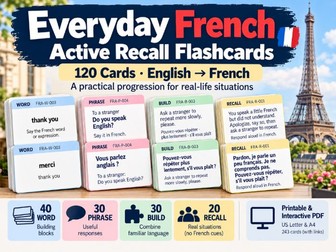
120 English-to-French active recall flashcards for beginner learners to practise useful vocabulary, phrases and practical spoken responses. This resource provides structured written retrieval practice through a four-stage progression: WORD → PHRASE → BUILD → RECALL Learners first retrieve useful words and small expressions, then produce practical phrases, combine previously introduced language, and finally respond to everyday situations without French cues. Learning objectives Learners practise retrieving French from English prompts, producing useful responses from memory, combining familiar language into longer responses, and applying previously introduced language to practical situations. The deck also reinforces features presented within the cards, including noun/article combinations, apostrophes, selected verb forms, written negation and polite vous forms in relevant contexts. Resource contents The complete resource contains 120 cards across seven modules: • 40 WORD cards – vocabulary and small expressions • 30 PHRASE cards – useful responses • 30 BUILD cards – supported combination of familiar language • 20 RECALL cards – situational retrieval without French cues Modules cover: • Enter the conversation • Identify yourself and things • Wants, needs, and ability • Food, drink, and service • Places and essentials • Simple daily routine • Ask, clarify, and retrieve Suggested use Learners read the English prompt, say their French response aloud from memory, and then compare it with the supplied model answer. Cards can be used for independent study, tutoring, retrieval practice and repeated language review. Learners can work through a module in sequence and repeat cards that they find difficult. The supplied model is one controlled French response; the accompanying guidance notes that another response can sometimes also be natural. Printable resources A4 and US Letter versions are supplied separately. Each printable PDF contains 42 landscape pages, including two calibration pages and 40 pages containing the complete 120-card deck. Six cards are arranged per sheet, with fronts and backs designed for duplex printing. A separate Printing Guide explains setup, calibration, cutting and troubleshooting. Digital resource A 243-page interactive PDF is also included. Internal links provide a module directory plus REVEAL, TRY AGAIN and NEXT CARD navigation. A compatible PDF reader supporting internal links is required. Also included are Quick Start, Printing Guide and README PDFs. Please note: this is written practice. There is no audio, automatic answer scoring or spaced-repetition software. The resource is a focused beginner practice tool and is not presented as a complete French course or full grammar programme.
Everyday Spanish Active Recall CardsQuick View
Aistl05

Everyday Spanish Active Recall Cards

(0)
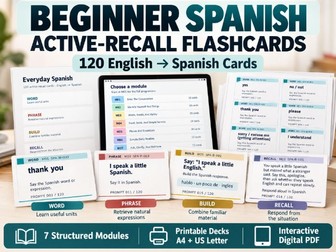
120 English-to-Spanish active-recall cards for practising everyday vocabulary, phrases, constructed responses and spoken situational recall. This structured Spanish resource provides learners with a seven-module progression designed around active retrieval rather than simply reading Spanish answers. The resource contains four progressively demanding card types: WORD – 40 cards Learners retrieve useful Spanish words and expressions from English prompts. Noun cards introduce the article together with the noun where applicable. PHRASE – 30 cards Learners retrieve complete Spanish expressions from an English intention and any relevant context. BUILD – 30 cards Learners construct complete Spanish responses using cues drawn from language introduced earlier in the resource. RECALL – 20 cards Learners respond aloud to realistic English-language situations without Spanish hints, combining previously practised words and phrases. The seven modules are: M01 – Enter The Conversation M02 – Identify Yourself And Things M03 – Wants, Needs, And Ability M04 – Food, Drink, And Simple Service M05 – Places And Essentials M06 – Simple Daily Routine M07 – Ask, Clarify, And Retrieve The resource is designed to develop increasingly independent retrieval. Learners begin with individual language units, move into complete expressions and supported construction, and finally produce responses from situational prompts. A suggested study routine is to read the prompt, produce the Spanish response aloud before checking it, compare the response with the supplied model answer, and retry difficult cards. Included resources • 243-page interactive Digital PDF • 42-page A4 printable deck • 42-page US Letter printable deck • 5-page Quick Start guide • 4-page Printing Guide • 3-page README • 120 cards across 7 modules The interactive PDF provides internal links for REVEAL, TRY AGAIN, NEXT CARD and module navigation. The A4 and US Letter editions are designed for double-sided printing, with six cards per sheet side. Calibration pages and detailed printing instructions are included. The resource can be used for independent study, tutoring, homeschool language learning, retrieval practice or supplementary Spanish study. Learners can work sequentially from M01 or revisit individual modules and difficult cards. Please note that the digital version is an interactive PDF rather than an app. It does not provide audio, automatic marking or automated spaced repetition.
Indonesian Active Recall FlashcardsQuick View
Aistl05

Indonesian Active Recall Flashcards

(0)
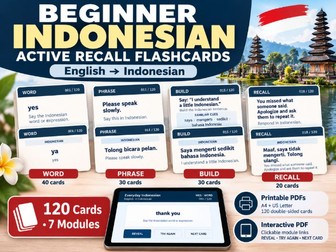
120 English–Indonesian flashcards for early beginners, practising vocabulary, phrases, sentence building and spoken responses through active recall. This Indonesian language resource provides a structured set of 120 cards across seven modules. Learners work from English prompts towards Indonesian responses, progressing through four retrieval stages: WORD, PHRASE, BUILD and RECALL. Learning objectives Learners practise retrieving useful Indonesian vocabulary and expressions, producing complete phrases, constructing sentences from familiar language and responding to simple situations without Indonesian language prompts. The resource focuses on practical standard Indonesian for early beginners and uses controlled vocabulary with gradual sentence building. Resource contents The 120 cards comprise: • 40 WORD cards • 30 PHRASE cards • 30 BUILD cards • 20 RECALL cards • 7 structured modules The modules cover entering a conversation; identifying yourself and things; wants, needs and ability; food, drink and simple service; places and essentials; simple daily routines; and asking, clarifying and retrieving. In WORD activities, learners see an English meaning and retrieve the Indonesian word or expression. In PHRASE, learners produce a complete Indonesian expression from an English intention or context. In BUILD, familiar Indonesian cues support construction of a requested sentence, with support reducing as learners progress. In RECALL, learners respond to an English-language situation without Indonesian hints. The resource can support independent study, tutoring, homeschool learning or Indonesian language practice. Learners can repeat difficult cards and revisit missed items after completing a module. Files included • A4 printable PDF • US Letter printable PDF • Interactive Digital PDF • 5-page Quick Start • 4-page Printing Guide • 3-page README / File Guide The printable versions contain double-sided cards with six cards per landscape sheet. Calibration pages are provided so users can test front/back alignment before printing the full deck. The interactive PDF contains clickable module links and REVEAL, TRY AGAIN and NEXT CARD navigation. It should be opened in a PDF reader that supports internal links. Digital resource supplied as PDF files. No physical cards are included.
Vietnamese Active Recall FlashcardsQuick View
Aistl05

Vietnamese Active Recall Flashcards

(0)
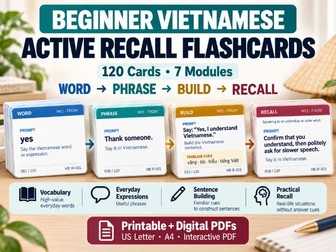
120 Vietnamese flashcards for practising beginner vocabulary, everyday expressions, sentence building and active recall across seven structured modules. This language-learning resource develops Vietnamese retrieval through a progressive WORD → PHRASE → BUILD → RECALL sequence. Learners first practise high-value words and lexical chunks, then retrieve useful everyday expressions. BUILD activities require them to construct sentences from familiar language, while RECALL tasks ask them to respond to practical situations without Vietnamese answer cues. Learning objectives include: • retrieve beginner Vietnamese vocabulary and useful expressions • reproduce complete tone-marked Vietnamese spelling • construct sentences from previously introduced language • respond to controlled everyday situations in Vietnamese • develop increasingly independent language retrieval The complete resource contains 120 cards: 40 WORD, 30 PHRASE, 30 BUILD and 20 RECALL cards. Support is gradually reduced as learners progress. The seven modules are: M01 — Enter the Conversation M02 — Identify Yourself and Things M03 — Wants, Needs, and Ability M04 — Food, Drink, and Simple Service M05 — Places and Essentials M06 — Simple Daily Routine M07 — Ask, Clarify, and Retrieve Vietnamese is presented with full tone marks. The accompanying Quick Start guide also introduces Vietnamese spelling and tones, controlled use of pronouns/address terms, contextual language choices and the way support is reduced through the deck. The resource can be used for independent study, tutoring, language practice and retrieval/revision activities. The suggested study routine asks learners to read the English prompt, say the answer aloud before revealing it, compare it with the controlled answer and retry missed items. Files included: • US Letter printable PDF • A4 printable PDF • Interactive digital PDF • Quick Start PDF • Printing Guide PDF • README PDF The printable decks are designed for landscape, double-sided printing and include calibration pages for checking alignment before printing the full deck. The digital deck can be used on a phone, tablet or computer and includes internal PDF navigation for Reveal, Try Again and Next Card. It can also be navigated by ordinary scrolling or swiping. Please note: no audio, native-speaker recordings, romanization, app, Anki deck, spaced-repetition software, self-grading or online account is included.
Russian Vocabulary Practice WorkbookQuick View
Aistl05

Russian Vocabulary Practice Workbook

(0)
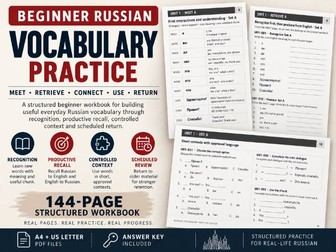
A 144-page Russian vocabulary workbook for adult and older-teen beginners, using active recall, controlled context and cumulative review. This structured Russian vocabulary resource helps learners build and retrieve useful everyday vocabulary rather than simply rereading or recognising word lists. The workbook follows a five-part learning cycle: MEET → RETRIEVE → CONNECT → USE → RETURN. Learners first meet vocabulary with its Cyrillic form, stress support, core English meaning and a useful contextual chunk. They then practise recognition and productive recall, connect vocabulary to controlled phrases, use it in short contexts and return to previously learned material after a delay. The resource is designed for learners who can already decode basic printed Cyrillic slowly. It does not teach the complete Russian alphabet and does not use regular Roman-letter transliteration. Book 1 is not required. Stress marks are provided during supported learning and deliberately removed in later exercises to develop independent recognition. Vocabulary is introduced through practical beginner themes including first interactions, people and relationships, food and drink, daily actions and routines, with later practice returning to previously studied material rather than relying only on unit-by-unit recognition. Activities include Russian-to-English recognition, English-to-Russian productive recall, vocabulary-to-phrase connection tasks, controlled contextual practice, delayed retrieval, unit checks and cumulative mixed review. Learners can mark missed targets for later return and retesting. The workbook focuses on vocabulary development rather than teaching complete Russian grammar systems. Where a word changes form in an approved phrase or exercise, point-of-need support is provided without turning the activity into a full case or conjugation lesson. A complete answer key is included, allowing learners to check their work after attempting the exercises. The workbook also includes a baseline self-check so learners can identify uncertain vocabulary before beginning the structured practice. Suitable for independent study, tutoring, homeschool language learning and supplementary Russian vocabulary practice. It is particularly appropriate for adult and older-teen beginners who already have basic Cyrillic decoding ability and want systematic practice with vocabulary retrieval and use. Included files: 144-page A4 PDF 144-page US Letter PDF Read Me & Print Guide The educational content of the A4 and US Letter editions is identical. The resource is a digital download; no physical item is supplied. It can be printed in black and white or grayscale, single- or double-sided. Please note: No audio is included, and the workbook does not provide regular Roman transliteration or teach the complete Cyrillic alphabet.
Beginner Japanese Vocabulary WorkbookQuick View
Aistl05

Beginner Japanese Vocabulary Workbook

(0)
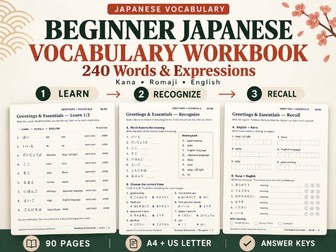
A 90-page beginner Japanese vocabulary workbook teaching 240 essential words and expressions through Kana, Romaji, English, recognition and active recall practice. Designed for beginner Japanese learners, this structured printable resource moves beyond simply reading vocabulary lists. Learners first meet vocabulary with Kana, Romaji and English meanings, then progressively reduce support through recognition, recall, application and review activities. The workbook itself describes this progression as Learn → Recognize → Recall → Apply/Read → Review. The resource covers 240 beginner Japanese words and expressions. Native Japanese vocabulary is presented primarily in Hiragana, with conventional loanwords in Katakana. Romaji is used as temporary reading support and is reduced during later recognition, recall and mixed-review activities. Kanji is not taught in this workbook. Learners practise vocabulary across practical beginner themes including greetings and essentials, questions and useful words, people and family, numbers and quantities, time and calendar vocabulary, home and daily life, food and drinks, common verbs, transport and places, shopping and money, body and health, school and work, common adjectives and colours, and nature and everyday nouns. The resource includes vocabulary such as greetings, weekdays, household objects, food and drink, everyday verbs and useful descriptive language. Activities include matching Japanese vocabulary to English meanings, choosing the correct Kana, English-to-Kana recall, Kana-to-English recall and confidence checking. Later pages move into cumulative and mixed-category practice, including Kana recognition, Katakana loanword recognition, category sorting and mixed Japanese-to-English and English-to-Kana retrieval. The workbook can support Japanese lessons, tutoring, homeschool learning, revision and independent study. Teachers can select individual pages for vocabulary introduction, retrieval practice or review, while learners can also work through the complete sequence independently. Learning objectives Learners practise: recognising essential beginner Japanese vocabulary written in Kana connecting Japanese words with their English meanings using Romaji as temporary reading support retrieving Kana from English prompts retrieving meanings from Japanese prompts distinguishing and recognising familiar Katakana loanwords reviewing vocabulary across mixed categories identifying vocabulary that needs further practice Files included Two printable PDF versions are supplied: A4 PDF — 90 pages US Letter PDF — 90 pages Both versions contain the same learning material. Answer keys are included for the workbook exercises, including the later application activities. This is a digital printable resource. No physical product is supplied.
Thai Sentence Building Workbook for AdultsQuick View
Aistl05

Thai Sentence Building Workbook for Adults

(0)
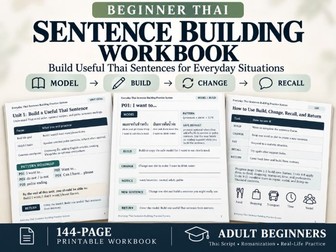
A structured Thai sentence-building workbook for adult beginners, practising useful everyday sentence patterns for real-life communication and self-study. Designed for learners who already know some Thai words or phrases but struggle to combine them into their own sentences. Learners work with reusable Thai sentence frames and gradually adapt them for practical everyday situations. The workbook uses a structured MODEL, BUILD, CHANGE, SAY, RECALL and RETURN approach. Learners see a model sentence, build from a controlled frame, change elements to create new meanings, respond to realistic situations and return to previous patterns with reduced support. The resource contains 11 practical units, 54 sentence patterns and 263 practice tasks. Topics include food and drink, shopping and payment, transport and directions, time, preferences, communication repair, social situations and everyday life in Thailand. Learners practise Thai word order, wants and needs, possession, negation, practical questions, polite requests and sentence endings. Activities encourage learners to adapt known sentence structures and build useful sentences independently. Thai script is presented as the main target-language form, with romanisation and tone labels provided as reading support. No audio is included. The download includes a 144-page workbook in both A4 and US Letter PDF formats, plus an 18-page Answer Guide with unit answers, sentence examples, alternative answers and quick-reference support. Suitable for adult independent study, tutoring, one-to-one language teaching and structured beginner Thai practice. The resource focuses on practical sentence production rather than Thai alphabet instruction.
Russian Cases in Real Sentences WorkbookQuick View
Aistl05

Russian Cases in Real Sentences Workbook

(0)
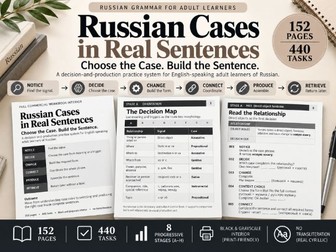
A 152-page Russian cases workbook for English-speaking adult learners, with 440 structured tasks for choosing, forming and using cases in complete sentences. This structured Russian grammar resource helps learners move from understanding case rules to selecting and producing the correct case in meaningful Russian sentences. Rather than practising endings in isolation, the workbook uses a decision-first approach. Learners identify the relationship being expressed, choose the appropriate case, build the required word form, connect the elements of the phrase and finally produce complete sentences. The practice system follows six recurring processes: NOTICE, DECIDE, CHANGE, CONNECT, PRODUCE and RETRIEVE. Learners first identify relevant signals, then make case decisions from meaning or grammatical triggers before working with morphology. The workbook also encourages learners to distinguish case-selection errors from errors involving endings. The resource develops practice with Russian case relationships including direct objects, static location and destination, origin, possession, purpose and absence, recipients, companions and spatial relationships, and topics. Learners work with the accusative, genitive, dative, instrumental and prepositional cases, with the nominative used as a control and comparison form. Practice also incorporates adjective and noun agreement, animacy, prepositions, pronouns and number. The vocabulary is deliberately controlled and recycled around practical adult contexts such as work, travel, people, documents, books, places, meetings and everyday objects. The workbook progresses through eight stages (A-H). Early stages introduce relationships and controlled single-pattern practice. Later stages require learners to distinguish competing meanings, connect multiple grammatical features, complete mixed checkpoints without case labels, retrieve earlier decisions after a delay and ultimately produce original sentences from meaning. The resource contains 152 pages and 440 registered tasks. Practice is presented in standard Cyrillic with no transliteration, making it appropriate for learners who can already read the Russian alphabet rather than absolute beginners who still require transliteration support. Suitable for adult independent study, tutoring, one-to-one Russian teaching and structured grammar practice. The resource is particularly useful when the learning objective is not simply recognising case rules, but choosing and applying the appropriate Russian case within complete sentences. Included formats: A4 PDF – 152 pages US Letter PDF – 152 pages The A4 and US Letter files contain the same workbook content in two page sizes for convenient printing or PDF-based study.
Japanese Reading Practice for BeginnersQuick View
Aistl05

Japanese Reading Practice for Beginners

(0)
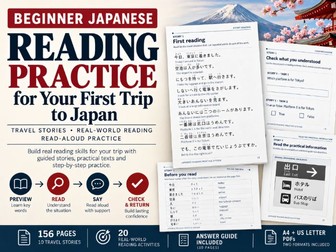
A 156-page Japanese reading workbook for beginners, using travel stories and practical reading tasks to develop real-world reading skills. Designed for learners who can already read Hiragana and Katakana slowly and know some beginner Japanese, this structured workbook develops reading comprehension through travel-based situations in Japan. Learners do not need advanced grammar, fast reading skills or strong Kanji knowledge. The resource follows a consistent reading pathway: Preview → Read → Find → Say → Check → Return Learners preview essential vocabulary, read for the main situation, check their understanding, work with practical information, read selected Japanese aloud and later return to earlier material with reduced support. The emphasis is on finding relevant information rather than translating every word. The workbook contains 10 travel stories set around situations in Tokyo, Ueno, Yokohama, Enoshima, Osaka and Kyoto, finishing with a return journey to the airport. Reading contexts include arriving in Tokyo, finding a hotel, reading opening times, ordering from a restaurant menu, comparing trains and navigating travel information. Activities include: Japanese story reading essential vocabulary previews reading comprehension questions practical reading tasks signs and notices maps and directions menus and prices timetables and transport information read-aloud practice retrieval and return activities learner self-checks Furigana support is used for supported Kanji. Earlier stories provide more assistance, with support reduced after important words and signs have been encountered repeatedly. The aim is recognition rather than requiring learners to memorise every Kanji before continuing. Read-aloud sections provide temporary phrase/chunk support before learners read the natural Japanese version. The workbook does not use English-style pronunciation spellings or Romaji. This resource can be used for independent study, tutoring, homeschool learning or supplementary Japanese reading practice, particularly for learners preparing to use basic Japanese while travelling. Included files: 156-page A4 PDF 156-page US Letter PDF This is a digital printable resource. The purchaser may print copies for their own personal study; redistribution and resale are not permitted.
Russian Sentence Building PracticeQuick View
Aistl05

Russian Sentence Building Practice

(0)
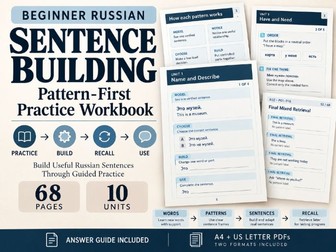
A 68-page Russian sentence-building workbook for learners who can read basic Cyrillic and know some beginner vocabulary. This structured practice resource helps learners move from familiar Russian words to complete sentences through guided sentence patterns, controlled practice and independent retrieval. The workbook uses a pattern-first progression, moving learners from words to patterns, sentences and recall. Activities gradually reduce support so learners practise building and retrieving useful Russian sentences rather than relying only on model examples. Practice includes a range of structured activities such as choosing correct sentences, changing sentence forms, ordering sentence components, correcting forms, building sentences and retrieving previously practised language independently. The resource contains 10 units, progressing from basic sentence building towards mixed retrieval. Topics shown in the workbook include: naming and describing people, things and places saying what happens, including present-tense and negative sentences forming yes/no and information questions expressing wants and abilities talking about what you have and need expressing likes talking about locations and destinations final mixed retrieval practice Reference pages and supporting tables are included to help learners understand and apply the sentence patterns. The workbook also includes a 10-page Answer Guide for checking completed practice. This is not a complete Russian grammar course. It is designed as focused sentence-building practice for learners who already have some beginner Russian vocabulary and can decode basic Cyrillic. Roman transliteration is not provided. Suitable for independent study, tutoring, homeschool learning and supplementary Russian language practice. It can also be used to provide structured consolidation for learners who know individual vocabulary but need more practice turning that knowledge into complete sentences. Included files: 68-page A4 printable PDF 68-page US Letter printable PDF The resource is supplied as a digital download and can be printed for workbook practice or used digitally.
Beginner German: 120 Active Recall CardsQuick View
Aistl05

Beginner German: 120 Active Recall Cards

(0)
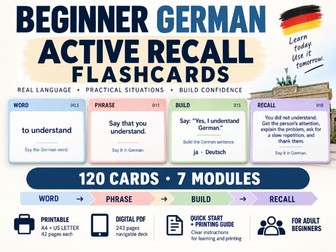
120 German flashcards for adult beginners covering everyday vocabulary, useful expressions, sentence construction and practical communication. This structured resource uses a 4-step active recall system to develop independent German language retrieval. LEARNING OBJECTIVES Recall essential German vocabulary. Practise everyday expressions. Construct simple German sentences. Respond to practical communication situations. RESOURCE CONTENTS 120 flashcards across 7 modules WORD → PHRASE → BUILD → RECALL A4 printable PDF (42 pages) US Letter printable PDF (42 pages) Interactive digital PDF (243 pages) Quick Start Guide Printing Guide and README The printable versions include double-sided layouts and cutting guides. The interactive PDF provides answer reveal and navigation links. Suitable for adult beginners, independent study and supplementary tutoring. All six files are supplied as PDFs. No audio or automated assessment included. Personal-use only.
Beginner Korean Active Recall FlashcardsQuick View
Aistl05

Beginner Korean Active Recall Flashcards

(0)
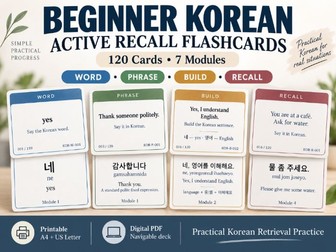
120 Korean active-recall flashcards for adult beginners, practising vocabulary, useful phrases, sentence building and practical language retrieval. This self-study Korean resource provides a structured progression from supported vocabulary and phrase retrieval to sentence construction and responses to practical situations. The resource uses four card types: WORD – learn essential Korean building blocks PHRASE – retrieve useful Korean chunks BUILD – construct Korean using familiar language RECALL – produce Korean in response to practical situations Support decreases through the sequence, with RECALL cards removing Korean hints. The 120 cards are organised into seven modules: Enter the Conversation Identify Yourself and Things Wants, Needs, Ability, and Preference Food, Drink, and Simple Service Places and Essentials Simple Daily Routine Ask, Clarify, and Retrieve Learners practise language for functions including basic conversation, identifying objects, introductions, wants and needs, requesting help, food and drink interactions, places, everyday routines and clarification. Hangul is the primary written form. Romanization provides temporary reading support for beginners and is intentionally reduced later in the deck. The accompanying guidance explains that romanization is a reading aid rather than a complete pronunciation guide. Resource contents include: • 120-card A4 printable PDF deck • 120-card US Letter printable PDF deck • 120-card navigable Digital PDF deck • Quick Start guide • Printing Guide • README The printable decks include duplex calibration pages and cut guides. The digital deck provides REVEAL, TRY AGAIN and NEXT CARD controls and module navigation where supported. The resource can be used for independent study, tutoring, retrieval practice and structured beginner Korean revision. Learners are encouraged to say answers aloud before checking the model response and return to difficult cards for further retrieval practice. This is a PDF-based educational resource rather than an app, audio course, SRS or self-grading program. It is not designed as a Hangul alphabet course or complete Korean grammar course.
Beginner Thai Active Recall FlashcardsQuick View
Aistl05

Beginner Thai Active Recall Flashcards

(0)
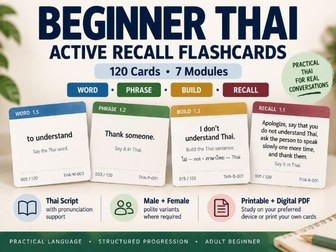
120 beginner Thai flashcards for practising practical vocabulary, phrases, sentence building and contextual recall through structured active retrieval. This self-study language resource is designed primarily for adult beginners learning practical everyday Thai. The deck uses a four-stage learning sequence: WORD → PHRASE → BUILD → RECALL Learners first establish essential language building blocks, retrieve useful Thai phrases, construct sentences from familiar language, and finally produce Thai in practical situations with reduced support. Learning objectives The resource supports learners in: • retrieving essential beginner Thai vocabulary • producing useful everyday phrases • constructing Thai sentences from familiar language • responding to practical communicative situations • working with Thai script alongside temporary pronunciation support • using appropriate male or female polite variants where provided Resource contents The deck contains 120 cards: • 40 WORD cards • 30 PHRASE cards • 30 BUILD cards • 20 RECALL cards Cards are arranged across seven modules: Enter the Conversation Identify Yourself and Things Wants, Needs, Ability, and Preference Food, Drink, and Simple Service Places and Essentials Simple Daily Routine Ask, Clarify, and Retrieve Pronunciation and tone support is deliberately stronger earlier in the sequence and decreases as learners move toward sentence construction and contextual recall. Thai script remains the main target-language representation. Suggested use The resource can be used for independent study, tutoring or structured language practice. Learners are instructed to say their answer aloud before checking the supplied model answer and to revisit difficult cards later. The resource provides controlled model answers while acknowledging that other natural Thai expressions may also be possible in real conversation. Files included Six PDF files are supplied: • A4 printable 120-card deck • US Letter printable 120-card deck • Navigable digital 120-card deck • 5-page Quick Start guide • 4-page Printing Guide • 3-page README The printable decks contain six cards per sheet side with duplex calibration pages and cut guides. The digital PDF provides reveal and card-navigation controls where supported. This is a digital PDF resource. It does not include audio, an app, Anki/SRS functionality, self-grading or an online account.
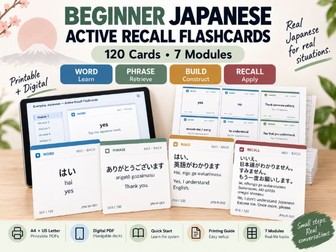
Beginner Japanese Active Recall CardsQuick View
Aistl05

Beginner Japanese Active Recall Cards

(0)
120 Japanese active recall flashcards for adult beginners, practising essential words, useful phrases, sentence building and real-life retrieval. This structured Japanese self-study resource develops productive beginner language through four progressively demanding card types: WORD cards establish essential building blocks. PHRASE cards practise retrieval of useful Japanese chunks. BUILD cards require learners to construct sentences from familiar language. RECALL cards present practical situations and require independent Japanese retrieval. Support decreases deliberately through this sequence, moving learners from controlled language towards less-supported production. The 120 cards are organised into seven modules covering entering a conversation; identifying yourself and things; wants, needs, ability and preference; food, drink and simple service; places and essentials; simple daily routines; and asking, clarifying and retrieving information. Japanese script is primary throughout the resource. Kana readings support kanji where required, while romaji is used as temporary beginner support and intentionally reduced as learners progress. The cards can be used for short independent retrieval sessions. Learners read the prompt, say their answer aloud and then check the supplied model answer. BUILD activities reuse previously introduced language, while RECALL tasks provide increasingly independent practice through contextual situations. The download includes: • 120-card A4 printable PDF deck • 120-card US Letter printable PDF deck • Navigable digital PDF deck • Quick Start guide • Printing Guide • README The printable decks contain six cards per sheet side, cut guides and duplex calibration pages. The Printing Guide provides setup and troubleshooting instructions for double-sided printing. The digital deck can be used for screen-based independent study and includes REVEAL, TRY AGAIN, NEXT CARD and module navigation links where supported. This resource is primarily designed for adult/general beginner learners and independent self-study. It can also support tutoring or supplementary language practice, but the included licence is for the purchaser’s personal use and does not grant redistribution or shared-library rights. The resource is not intended as a complete grammar, kana or kanji course.
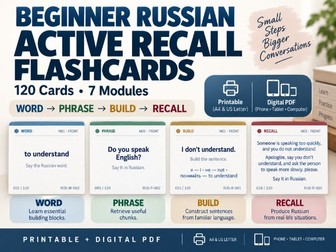
Beginner Russian Active Recall FlashcardsQuick View
Aistl05

Beginner Russian Active Recall Flashcards

(0)
120 Russian flashcards for adult beginners, practising vocabulary, useful phrases, sentence construction and contextual recall through active retrieval. This self-study resource develops practical beginner Russian through a four-stage learning sequence: WORD → PHRASE → BUILD → RECALL Learners first retrieve essential vocabulary, then practise useful phrases, construct sentences from familiar Russian, and finally respond to everyday situations without Russian hints. Support is intentionally reduced as the resource progresses. Learning objectives Learners practise retrieving beginner Russian vocabulary and phrases, constructing short controlled sentences, and producing useful Russian responses from familiar everyday contexts. The resource uses Cyrillic as the primary target script. Transliteration provides temporary support and is progressively reduced, while learner stress marks support pronunciation awareness. Resource contents The resource contains 120 cards across seven modules, comprising: • 40 WORD cards • 30 PHRASE cards • 30 BUILD cards • 20 RECALL cards The modules cover: • Enter the Conversation • Identify and Describe the Immediate World • Express Wants, Needs, Ability and Preference • Handle Food, Drink and Simple Service Encounters • Find Places and Essentials • Describe a Simple Present-Time Routine • Ask, Clarify and Retrieve in Real Life The progression moves from supported vocabulary and phrase retrieval toward sentence construction and contextual production. BUILD activities ask learners to assemble previously introduced language, while RECALL activities present short real-life situations and ask learners to produce an appropriate Russian model answer. Teaching and study uses The cards are designed primarily for adult independent study and short, repeatable retrieval-practice sessions. They may also be used as supplementary Russian-language practice material where the learning level and content are appropriate. Learners are instructed to say answers aloud before checking the model answer and to revisit difficult cards. A Quick Start Guide explains the study sequence, Cyrillic/transliteration approach and suggested study routine. Files included • A4 printable PDF deck • US Letter printable PDF deck • Digital PDF deck • Quick Start Guide PDF • Printing Guide PDF • README PDF The printable versions contain six cards per sheet side, front/back layouts, cutting guides and calibration pages for duplex printing. The digital version provides one card side per page with internal navigation where supported by the PDF reader. Format: PDF Status: Printable and digital Physical product: None The resource does not include audio, automated marking or an integrated spaced-repetition system.
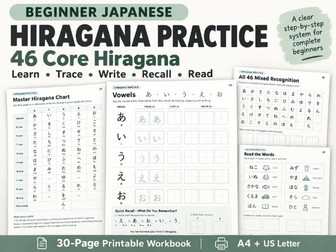
Beginner Japanese Hiragana Practice WorkbookQuick View
Aistl05

Beginner Japanese Hiragana Practice Workbook

(0)
A 30-page printable Hiragana workbook for beginner Japanese learners to recognise, write, recall and read all 46 core Hiragana characters. This structured practice resource takes learners from their first Hiragana characters through to independent recognition, written recall and simple word reading. The workbook uses a gradual model → trace → copy → write → recall system. Learners initially receive Romaji support, which is gradually reduced as they develop direct recognition of Hiragana. Learning objectives Learners practise how to: recognise all 46 core Hiragana connect Hiragana characters with their sounds trace and copy character forms write Hiragana independently from sound prompts recall characters without relying on the reference chart distinguish visually similar characters read simple beginner words written in Hiragana identify characters that need further review What is included? The 30-page workbook includes: introduction and guidance for using the practice system complete 46-character Hiragana reference chart handwriting warm-up guided practice for vowels and the K, S, T, N, H, M, Y, R and W rows plus final ん model, tracing, copying and independent writing activities quick recall exercises throughout the learning sequence cumulative recognition and writing checks mixed practice across previously learned characters focused comparison of easily confused Hiragana Hiragana-to-sound and sound-to-Hiragana activities beginner word-reading activities mixed recognition, writing and reading review final recognition and writing challenges mastery tracking and targeted review pages answer keys for self-checking. The later activities deliberately move away from row-order practice. For example, the mixed-recognition work requires learners to recognise characters in a shuffled sequence, while the reading section introduces words such as ねこ, いぬ, えき, うみ, くるま, さかな and やま. Suitable for Designed primarily for complete beginners, teens and adults, the workbook can be used for Japanese lessons, tutoring, homeschool learning, revision or independent study. Teachers can use individual pages for focused character practice and review, while independent learners can work through the complete sequence. Files included Two printable PDF versions are supplied: A4 PDF — 30 pages US Letter PDF — 30 pages This is a digital printable resource. For the handwriting activities, the workbook recommends printing at 100% / Actual Size where possible. Please note: the resource practises character recognition, tracing, copying, independent writing, recall and simple reading. Formal stroke order is not taught.
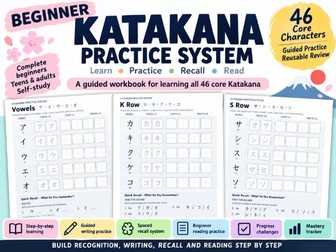
Beginner Katakana Practice WorkbookQuick View
Aistl05

Beginner Katakana Practice Workbook

(0)
A 30-page beginner Katakana workbook for learning, recognising, writing, recalling and reading all 46 core Katakana characters. Ideal for Japanese learners, independent study, tutoring and classroom practice. This structured Japanese writing resource takes learners through the 46 core Katakana in manageable groups, beginning with the vowels and progressing through the K, S, T, N, H, M, Y, R and W rows plus final ン. A master Katakana chart provides a reference while learners build familiarity with each character. The core practice pages use a consistent MODEL → TRACE ×2 → COPY ×1 → WRITE ×3 sequence. Support is gradually reduced so learners move from seeing and tracing each character towards independent writing and recall. Romaji is provided as initial support and is deliberately reduced as the workbook progresses. Formal stroke order is not taught. The workbook then moves beyond tracing into recognition, recall, mixed practice, character discrimination and beginner reading. Later sections include Reading Essentials, mixed application activities and final challenges. Learners encounter beginner Katakana words including words for ice cream, camera, hotel, tomato, tennis, curry, cake, coffee, taxi, television, radio, bus and bread. A Mastery Tracker supports targeted review: learners can identify characters that are secure, almost there or still need practice rather than simply completing the workbook once. Answer keys are included on the final two pages for the review, reading and challenge activities. Learning objectives include: recognise the 46 core Katakana characters connect Katakana characters with their sounds practise character formation through tracing, copying and independent writing recall Katakana without constant reference to a chart distinguish easily confused characters read simple beginner Katakana words identify areas requiring further review Resource contents: 30-page printable workbook; introductory guidance and practice instructions; master Katakana chart; recognition warm-up; guided practice for all 46 core characters; Quick Recall activities; cumulative recognition and writing practice; confusion-pair work; beginner reading activities; mixed application; final recognition and writing challenges; two-page Mastery Tracker; and answer keys. Files included: two PDF versions containing the same 30-page resource A4 and US Letter for convenient printing. The A4 edition has been formatted at 210 × 297 mm, and the product’s main handwriting grids are approximately 19.4 mm square. This resource is particularly suitable for complete beginners, teens and adult learners, and can be used for Japanese lessons, tutoring, homework, revision or self-directed study.
Beginner Japanese Kanji Practice WorkbookQuick View
Aistl05

Beginner Japanese Kanji Practice Workbook

(0)
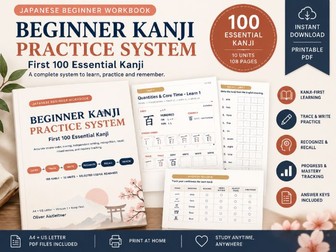
Beginner Japanese kanji practice workbook covering 100 essential kanji with stroke order, tracing, writing, recognition, recall and review activities. Help beginner Japanese learners move beyond simply looking at kanji and build active recognition and writing skills through a structured practice sequence. This 108-page printable workbook introduces 100 beginner kanji across 10 progressive units. Each kanji is presented with a core meaning, selected useful readings, a verified beginner example word and a visual stroke-order guide. Learners then move from supported tracing and copying to independent writing, recognition and recall practice. The practice system follows six stages: • Learn – connect each kanji with its core meaning, selected readings and an example word • Trace – follow progressive stroke-order frames • Write – move from copying to independent kanji writing • Recognize – identify meanings and readings without relying on the learning panel • Recall – retrieve kanji from English meaning cues • Review – revisit kanji through cumulative mixed practice What is included: • 100 beginner kanji • 10 structured learning units • Step-by-step stroke-order guides • Kanji tracing practice • Independent writing grids • Selected on and kun readings • Beginner example words with kana support • Meaning recognition activities • Reading recognition activities • Kanji recall exercises • Cumulative mixed reviews • Mastery tracking • Answer Key The ten units progress from numbers and quantities to time, people, learning, directions, movement, everyday actions, travel, nature and common descriptions. Suitable for: • Beginner Japanese learners • Independent study • Japanese tutors and their students • Homeschool language learning • Supplementary Japanese practice • Homework and revision • Adult learners Files included: • A4 printable PDF – 108 pages • US Letter printable PDF – 108 pages Both versions contain the same learning material, allowing teachers and learners to print using their preferred paper format. Important: This is a kanji-first beginner practice resource. Selected readings are provided for practical beginner use and are not intended as exhaustive dictionary entries. Romaji is not used as the learning target. This is a digital printable resource. No physical product is supplied.
Russian Cyrillic Reading Practice WorkbookQuick View
Aistl05

Russian Cyrillic Reading Practice Workbook

(0)
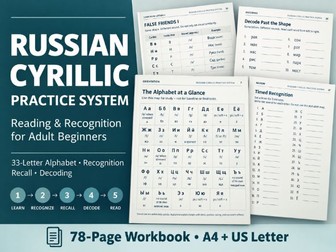
78-page Russian Cyrillic reading and recognition workbook for adult beginners, teaching all 33 letters through recognition, recall, decoding and reading practice. This structured printable resource is designed for learners beginning Russian who need to become confident reading print Cyrillic before moving further into beginner Russian vocabulary. Rather than focusing primarily on alphabet tracing, the workbook follows a progressive learning sequence: LEARN → RECOGNIZE → RECALL → DECODE → READ Learners begin with manageable groups of Cyrillic letters and gradually move towards mixed recognition and unsupported reading. The resource specifically addresses potentially confusing Cyrillic/Latin look-alike letters such as В, Н, Р, С, У and Х, helping learners avoid automatically applying familiar Latin-letter values. Learning objectives include: recognise all 33 letters of the modern Russian Cyrillic alphabet distinguish uppercase and lowercase print forms associate letters with concise beginner sound cues distinguish visually similar and potentially confusing letters understand the basic functions of the soft and hard signs recall Cyrillic forms and values without relying on an alphabet map blend letters and syllables for controlled decoding decode short Russian words directly from Cyrillic progress towards unsupported word reading Resource contents include: introductory baseline activities complete Cyrillic alphabet reference maps familiar-letter teaching and practice Cyrillic/Latin “false friend” discrimination new-letter recognition activities limited writing reinforcement soft-series vowel guidance hard and soft sign practice uppercase/lowercase recognition visual discrimination and mixed-letter scanning letter-to-sound and sound-to-letter recall timed recognition practice cumulative alphabet checkpoints controlled syllable and word decoding progressive removal of reading support word-reading activities independent Cyrillic reading practice cumulative mastery activities final assessments mastery tracker targeted review guidance six pages of answers The workbook uses English explanations and approximate sound cues as learning aids while making clear that these are not substitutes for full Russian pronunciation instruction. It is suitable for adult learners, tutors, language teachers and homeschool educators who want structured beginner practice in Russian Cyrillic recognition and decoding. It can be used for guided tuition, supplementary language study, homework, intervention/revision or independent practice. Files included: 2 PDF editions containing the same 78-page educational resource: A4 PDF US Letter PDF This is a printable digital resource. It teaches print Cyrillic recognition and reading; it is not a full Russian grammar course or a Russian cursive-handwriting course.