 Quick View
Marie Curie Reading Comprehension KS1 KS2 | Differentiated Activity Pack
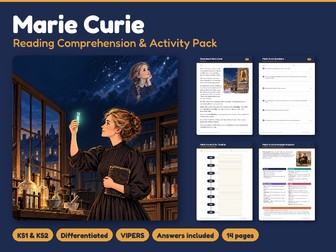
Marie Curie reading comprehension and activity pack for KS1 and KS2: everything you need to teach the inspiring life of the first woman to win a Nobel Prize, ready to print on A4. Two original reading texts at different levels let the whole class learn about the same significant individual at the right level of challenge, with beautiful full-colour illustrations and a full answer key.
What’s included (14 pages):
• Teacher notes with curriculum links and ideas for use.
• KS1 reading text (Years 1–2): a short, clear, illustrated biography of Marie Curie with key words in bold.
• KS1 comprehension questions: true or false, gap fill with a word bank, sequencing events, a short written answer and a drawing task.
• KS2 reading text (Years 3–6): a two-page biography covering her childhood in Warsaw, the secret ‘Flying University’, her pact with her sister Bronia, her studies in Paris, the discovery of polonium and radium, her two Nobel Prizes and her X-ray cars in the First World War, with a glossary.
• 12 KS2 VIPERS questions with marks (vocabulary, infer, predict, explain, retrieve and sequence/summarise), clearly labelled so you can target specific reading skills.
• Vocabulary matching activity: atom, element, radioactivity, X-rays, Nobel Prize, governess, pitchblende and physics.
• Timeline cut-and-stick: eight event cards and a timeline sheet with the key years of her life.
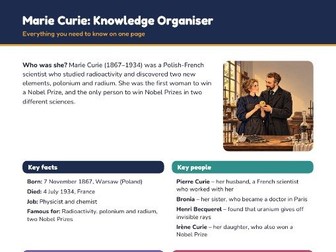
• One-page knowledge organiser for revision or display.
• Diary writing task: ‘The Night the Shed Glowed’, with planning boxes and a word bank.
• Full answer key for every activity.
Why teachers use it:
• It supports the KS1 history requirement to learn about the lives of significant individuals in the past who have contributed to national and international achievements.
• It covers the KS2 reading domains through VIPERS questions, perfect for guided or whole-class reading.
• Differentiation is built in: KS1 and KS2 versions of the same story mean mixed-age and mixed-ability classes can work on one topic together.
• It is ideal for International Women’s Day (8 March), British Science Week, Women’s History Month or any topic on scientists, inventors and women in science.
• All text is original, accurate and written for children, with dates checked against reliable sources. Activity pages print well in black and white.
Ideas for using it:
• Use the KS1 text and questions as a complete history lesson.
• Use the KS2 text across two guided reading sessions, then the VIPERS questions as an independent task.
• Finish the topic with the diary writing task and display the knowledge organiser on your working wall.
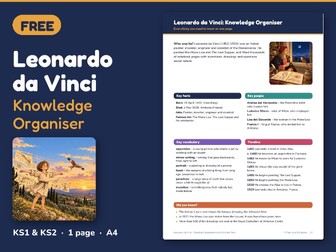
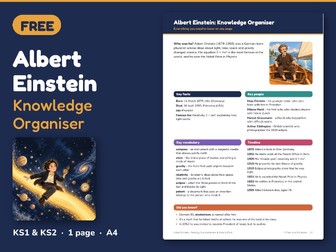
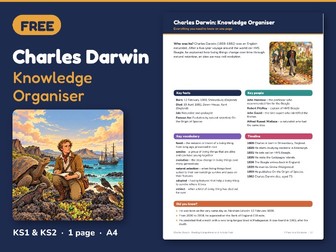
Looking for a taster first? Download the free Marie Curie Knowledge Organiser from my shop.