


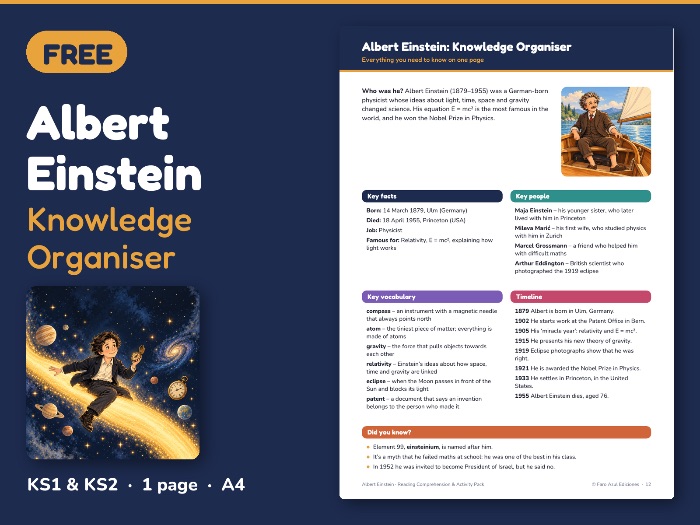
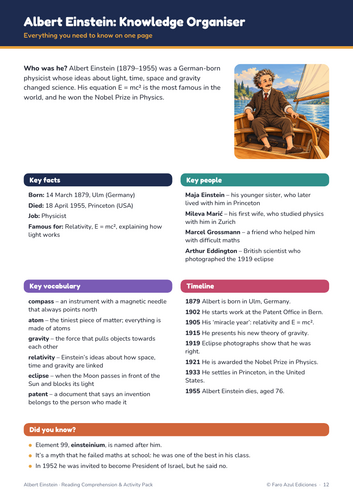
Albert Einstein knowledge organiser for KS1 and KS2: a free, one-page summary of the life and big ideas of the world’s most famous scientist. Ready to print on A4, it gives pupils everything they need to know about Albert Einstein at a glance, illustrated with an original full-colour picture.
This Albert Einstein knowledge organiser is ideal for history lessons on significant individuals, science lessons about famous scientists, guided reading, homework support, revision before an assessment or a display on your working wall.
What’s on the page:
• Who was he? A short, child-friendly introduction to Albert Einstein (1879–1955), the German-born physicist whose ideas about light, time, space and gravity changed science.
• Key facts: when and where he was born and died, his job and what he is famous for, including relativity and E = mc².
• Key people: his sister Maja, Mileva Marić, his friend Marcel Grossmann and Arthur Eddington, the British scientist who photographed the 1919 eclipse.
• Key vocabulary with simple definitions: compass, atom, gravity, relativity, eclipse and patent.
• A timeline of his life, from his birth in Ulm in 1879 to his ‘miracle year’, the eclipse that proved him right, his Nobel Prize and his new life in the United States.
• Did you know? Three fascinating facts to spark curiosity and discussion, including the myth that he failed maths at school.
Why teachers use it:
• It supports the KS1 history requirement to learn about the lives of significant individuals in the past who have contributed to national and international achievements.
• It links to KS2 science topics on forces and gravity, Earth and space, and light.
• It works across the primary years: younger pupils can share it with an adult, while older pupils can use it independently to research, retrieve information and summarise.
• It is perfect for British Science Week or Einstein’s birthday on 14 March.
• All text is original, accurate and written for children, with dates checked against reliable sources.
Ideas for using it in class:
• Give it out at the start of a topic as a “what we will learn” sheet, then return to it at the end.
• Ask pupils to turn three facts into quiz questions for a partner.
• Use the timeline to practise chronology and the language of time (before, after, during).
• Start a class discussion: Einstein said imagination is more important than knowledge. Do you agree?
Want more? The full Albert Einstein Reading Comprehension & Activity Pack includes two differentiated reading texts (KS1 and KS2), true/false, gap-fill and sequencing questions, 12 KS2 VIPERS questions with marks, a vocabulary matching activity, a timeline cut-and-stick, a letter-writing task and a full answer key. You can find it in my shop.
If you find this free resource useful, a quick review would be hugely appreciated. Thank you!
Something went wrong, please try again later.
This resource hasn't been reviewed yet
To ensure quality for our reviews, only customers who have downloaded this resource can review it
Report this resourceto let us know if it violates our terms and conditions.
Our customer service team will review your report and will be in touch.
£0.00