Volcanoes KS3 Bundle – Complete Unit | 6 Lessons, 2 Knowledge Organisers, Scheme of WorkQuick View
mulloverthings

Volcanoes KS3 Bundle – Complete Unit | 6 Lessons, 2 Knowledge Organisers, Scheme of Work

8 Resources
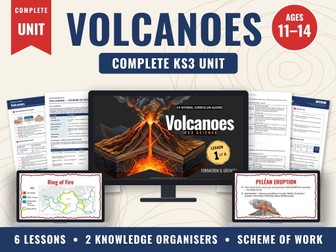
Complete KS3 volcanoes unit: six lessons, two knowledge organisers and a scheme of work. Editable PowerPoint and Word, A4 PDFs, mark schemes. The complete Volcanoes KS3 unit: six lessons, two knowledge organisers and the scheme of work. Every lesson comes with editable slides with teacher notes, guided notes, a reading, digital versions for Google Classroom or Teams, and a mark scheme for every written task. The unit finishes with a hands-on engineering challenge that works as the end-of-unit assessment. The lessons Formation & Growth: hot spots, rifts and subduction zones; growth by intrusion and extrusion. Plenary: the Volcano Recipe. Locations & Distribution: mapping plate boundaries and explaining the Ring of Fire. Volcanic Materials: plutons, lava types and pyroclasts; intrusive or extrusive? Types & Eruptions: four volcano shapes, six eruption types and the Eruption Detective plenary. Prediction & Effects: Mount St Helens, four monitoring methods, and the harm and benefits of eruptions. Lava Diversion Challenge (two to three lessons): pupils design, budget, build and test a barrier to protect Grindavík, then report to the town council. Also included Knowledge Organiser, Lessons 1–5: A4 front and back with key facts, 35 key terms and a self-quiz Knowledge Organiser, Lesson 6: engineering reference, build checklist and a unit retrieval quiz Scheme of Work: enquiry questions, objectives, 5E sequences and UK National Curriculum mapping for Science and Geography Across the unit Every lesson follows a 5E sequence and closes with a plenary marked with State, Describe, Explain. Every written task has a mark scheme. Plenaries run in exercise books or as a Google Form or Microsoft Form. The Lesson 4 forms mark themselves. Each lesson zip has a Read Me covering prep, the three folders and the digital plenary. Written for UK classrooms: UK spelling, metric units and A4 PDFs throughout. Why the bundle Save 42%
Volcanoes KS3 Knowledge Organiser – Lessons 1–5 | A4 Front & Back with Self-QuizQuick View
mulloverthings

Volcanoes KS3 Knowledge Organiser – Lessons 1–5 | A4 Front & Back with Self-Quiz

(0)
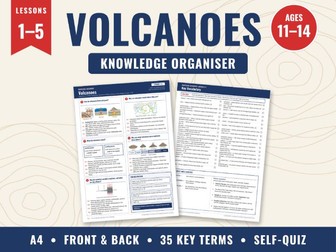
KS3 volcanoes knowledge organiser for Lessons 1–5: key facts, 35 key terms and a self-quiz on one A4 sheet, front and back. Print-ready PDF. One A4 sheet, front and back, that covers Lessons 1–5 of the Volcanoes KS3 scheme of work. Hand it out on day one. Pupils use it to prepare for each lesson, check their notes and revise for the end-of-unit assessment. Front: the five lessons at a glance A numbered panel for each lesson: how volcanoes form and grow, where they are found, volcanic materials, volcano types and eruptions, and prediction and effects Four key facts and a diagram on each panel A Big Picture flow panel linking the five lessons into one story Back: practise and check A self-quiz strip for quick retrieval practice 35 key terms with tick boxes, so pupils can track what they know Say It Like a Scientist: five extended questions, one per lesson, answered in three parts: State, Describe, Explain Ways to use it A day-one handout that stays in exercise books for the whole unit Homework: learn five terms a night and tick them off Starter retrieval: pupils quiz a partner on the key terms Revision before the end-of-unit assessment What you get A flattened, print-ready A4 PDF (2 pages), built from the content and vocabulary of Lessons 1–5. Good to know Written for UK classrooms: UK spelling, metric units and State, Describe, Explain throughout. The Lesson 6 knowledge organiser for the Lava Diversion Challenge comes with Lesson 6. This organiser is included in the Volcanoes KS3 bundle.
Volcanoes KS3 – Lesson 5: Prediction & Effects | Slides, Notes, Text, Mark SchemeQuick View
mulloverthings

Volcanoes KS3 – Lesson 5: Prediction & Effects | Slides, Notes, Text, Mark Scheme

(0)
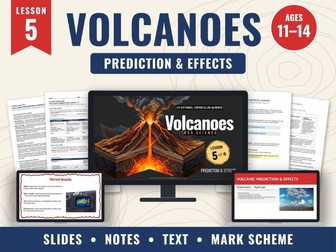
KS3 volcanoes lesson: predicting eruptions (Mount St Helens) and their effects. Editable PowerPoint, guided notes, reading, mark scheme. Lesson 5 of 6 in the Volcanoes KS3 scheme of work. On 18 May 1980, volcanologist David Johnston was 10 km from Mount St Helens when it erupted. What did scientists know, and what were they missing? Pupils learn the four ways volcanologists monitor a volcano, weigh up the damage eruptions cause against the benefits they leave behind, then make an evacuation call from monitoring data. Enquiry question How do scientists use data to predict volcanic eruptions — and what are the consequences when they get it right or wrong? Learning objectives Identify at least three monitoring methods volcanologists use to predict eruptions. Describe the negative effects of a volcanic eruption on communities and climate. Explain at least two ways volcanic activity provides long-term benefits. How the lesson runs Engage: archive footage of David Johnston at Mount St Helens in 1980. Explore: Think, Pair, Share. He had earthquake data, gas readings and a visible bulge. What was missing, and was his decision reasonable? Explain: four monitoring methods (gas emissions, seismic activity, thermal imaging and ground deformation) and why scientists combine them. Then the effects: volcanic ash, pyroclastic flows and the global cooling after Pinatubo in 1991. Elaborate: what volcanoes leave behind: fertile soils, building materials, diamonds and scientific insight. Think, Pair, Share on how the land recovers. Evaluate: three monitoring readings from an active volcano. Should the authorities evacuate? Pupils answer with State, Describe, Explain. What’s included (10 files) Editable Teacher slides, PowerPoint: 17 slides with teacher notes throughout Guided notes, Word: 2 pages Informational text, Word: 2 pages with Check Your Understanding questions For print (PDF) Slides, guided notes and informational text Mark scheme: 4 pages, covering every written task including the plenary Digital (Google Classroom or Microsoft Teams) Digital guided notes: 8 slides. Pupils type in blue boxes. Digital informational text, Word Plenary link sheet: Google Form and Microsoft Form versions Key vocabulary volcanologist, sulphur dioxide, seismic activity, thermal imaging, ground deformation, tiltmeter, pyroclastic flow, volcanic ash, kimberlite pipe Curriculum links KS3 Science: working scientifically (analysis and evaluation of data) KS3 Geography: human and physical geography (people and their environment); rocks, weathering and soils Good to know Videos are linked from the slides, not embedded. The plenary forms are not self-marking. Mark them with the mark scheme. Written for UK classrooms: UK spelling, metric units and A4 PDFs throughout. A Read Me in the zip covers setup. Part of a full unit
Volcanoes KS3 – Lesson 4: Types & Eruptions | Slides, Notes, Text, Mark SchemeQuick View
mulloverthings

Volcanoes KS3 – Lesson 4: Types & Eruptions | Slides, Notes, Text, Mark Scheme

(0)
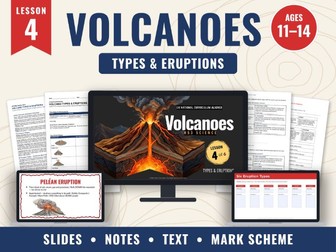
KS3 volcanoes lesson: four volcano types and six eruption types, from Icelandic to Plinian. Editable PowerPoint, guided notes, reading, mark scheme. Lesson 4 of 6 in the Volcanoes KS3 scheme of work. Why are some volcanoes more explosive than others? Pupils learn the four volcano shapes and the six eruption types, then rank the eruptions from quietest to most violent using gas content and lava viscosity as evidence. The lesson closes with Eruption Detective: six real eruptions, six sets of clues. Enquiry question Why are some volcanoes more explosive than others? Learning objectives Describe the four volcano shapes and the eruption types associated with each. Rank the six eruption types from quietest to most explosive using gas content and lava viscosity as evidence. How the lesson runs Engage: active, dormant or extinct? A thumbs vote on Mount Rainier. Explore: what does a volcano’s shape tell us about how it erupted? Explain: shield volcanoes, cinder cones, composite volcanoes and lava domes, then the six eruption types from Icelandic to Plinian, each with a real example (Laki 1783, Parícutin 1943, Mont Pelée 1902, Pinatubo 1991 and more). Elaborate: Think, Pair, Share on steepness versus violence, then a mini-whiteboard Venn diagram comparing two volcano types. Evaluate: Eruption Detective. Pupils read clues A–F, find the lava, gas and shape evidence, and name each eruption type. What’s included (12 files) Editable Teacher slides, PowerPoint: 21 slides with teacher notes throughout Guided notes, Word: 2 pages Informational text, Word: 2 pages with Check Your Understanding questions Eruption Detective clue card, Word (optional) For print (PDF) Slides, guided notes and informational text Eruption Detective clue card: two per A4 page Mark scheme: 4 pages, including answers for all six Eruption Detective clues Digital (Google Classroom or Microsoft Teams) Digital guided notes: 7 slides. Pupils type in blue boxes. Digital informational text, Word Plenary link sheet: Google Form and Microsoft Form versions Key vocabulary active, dormant, extinct, shield volcano, cinder cone, composite volcano (stratovolcano), lava dome, viscosity, caldera, Icelandic, Hawaiian, Strombolian, Vulcanian, Peléan, Plinian Curriculum links KS3 Science: Earth and atmosphere (the rock cycle and the formation of igneous rocks) Good to know The plenary forms in this lesson mark themselves, so you see scores as soon as pupils submit. Pupils can answer Eruption Detective in their exercise books, so the print card is optional. Written for UK classrooms: UK spelling, metric units and A4 PDFs throughout. A Read Me in the zip covers setup. Part of a full unit Lesson 4 of 6. The Volcanoes KS3 bundle has all six lessons, both knowledge organisers and the scheme of work for less. The scheme of work is free in my shop.
Volcanoes KS3 – Lesson 2: Locations & Distribution | Slides, Notes, Text, Mark SchemeQuick View
mulloverthings

Volcanoes KS3 – Lesson 2: Locations & Distribution | Slides, Notes, Text, Mark Scheme

(0)
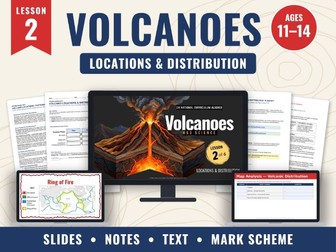
KS3 volcanoes lesson on where volcanoes form: plate boundaries, hot spots and the Ring of Fire. Editable PowerPoint, guided notes, reading, mark scheme. Lesson 2 of 6 in the Volcanoes KS3 scheme of work. Why do volcanoes cluster in some places and not others? Pupils map hot spots, rifts and subduction zones, then use the pattern to explain why the Ring of Fire holds about 75% of the world’s volcanoes. Enquiry question Why are volcanoes concentrated in specific regions of the Earth, and what does their location tell us about what is happening beneath the surface? Learning objectives Identify three tectonic settings where volcanoes form and explain the geological mechanism at each. Analyse a global map to describe the pattern of volcanic distribution and connect it to plate boundary locations. Argue from evidence why a specific volcanic region formed where it did. How the lesson runs Engage: 30 seconds of silent study of a world volcano map. What do pupils notice? Explore: pupils colour-code plate boundary types onto a world map as the pattern builds. Explain: plate movement cause and effect, then three map slides that layer hot spots, rifts and subduction zones until the Ring of Fire appears. Elaborate: Think, Pair, Share on the safest place to set up a volcano research camp, then a mini-whiteboard task: why are the island chains of Japan, Indonesia and the Aleutians curved? Evaluate: a State, Describe, Explain plenary on why the Ring of Fire concentrates so many volcanoes. What’s included (10 files) Editable Teacher slides, PowerPoint: 12 slides with teacher notes throughout Guided notes, Word: 2 pages Informational text, Word: 1 page with Check Your Understanding questions For print (PDF) Slides, guided notes and informational text Mark scheme: 3 pages, covering every written task including the plenary Digital (Google Classroom or Microsoft Teams) Digital guided notes: 6 slides. Pupils type in blue boxes. Digital informational text, Word Plenary link sheet: Google Form and Microsoft Form versions Key vocabulary Ring of Fire, plate boundary, divergent boundary, convergent boundary, subduction zone, continental collision, island arc Curriculum links KS3 Geography: physical geography (plate tectonics); geographical skills (maps, atlases and globes) KS3 Science: working scientifically (analysis of data) Good to know You’ll need coloured pencils or highlighters (at least three colours) for the mapping task. The plenary forms are not self-marking. Mark them with the mark scheme. Written for UK classrooms: UK spelling, metric units and A4 PDFs throughout. A Read Me in the zip covers setup. Part of a full unit Lesson 2 of 6. The Volcanoes KS3 bundle has all six lessons, both knowledge organisers and the scheme of work for less. The scheme of work is free in my shop.
Volcanoes KS3 – Lesson 1: Formation & Growth | Slides, Notes, Text, Mark SchemeQuick View
mulloverthings

Volcanoes KS3 – Lesson 1: Formation & Growth | Slides, Notes, Text, Mark Scheme

(0)
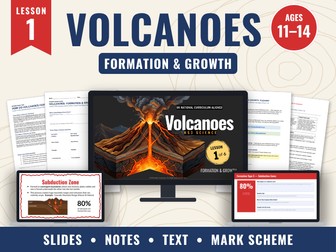
KS3 volcanoes lesson: how volcanoes form at subduction zones, rift zones and hot spots, and grow. Editable PowerPoint, guided notes, reading, mark scheme. Lesson 1 of 6 in the Volcanoes KS3 scheme of work. Pupils learn the three ways a volcano forms (subduction zones, rift zones and hot spots) and the two ways a volcano grows (intrusion and extrusion). Enquiry question How do forces beneath the Earth’s crust constantly work to construct and transform the surface? Learning objectives Differentiate between three volcanic formation processes by describing the geological movement at each location. Explain the difference between volcanic growth through intrusion and extrusion. How the lesson runs Engage: shake a can of fizzy drink and ask what happens when you pull the tab. Pupils link the built-up pressure to trapped magma. Explore: pupils study a cross-section of the Earth’s layers and vote on which layer magma rises from. Explain: one slide each on hot spots, rift zones and subduction zones, with a diagram, a real example (the Hawaiian Islands, the Mid-Atlantic Ridge, Mount St Helens) and the share of the world’s volcanoes each one forms. Pupils fill in the guided notes as you teach. Elaborate: two Think, Pair, Share tasks. Pupils describe a formation type for a partner to guess, then argue whether intrusion or extrusion adds more strength to a volcano. Evaluate: the Volcano Recipe plenary. Pupils write the ingredients and step-by-step directions for one formation type in their exercise books. An optional short clip of Kīlauea closes the lesson if time allows. What’s included (10 files) Editable Teacher slides, PowerPoint: 16 slides, with teacher notes throughout Guided notes, Word: 2 pages Informational text, Word: 1 page with five Check Your Understanding questions For print (PDF) Slides, guided notes and informational text Mark scheme: 3 pages, covering the guided notes, all five text questions, model answers for both Think, Pair, Share tasks, model recipes for the plenary and the common weak answers to push back on Digital (Google Classroom or Microsoft Teams) Digital guided notes: 9 slides. Pupils type in blue boxes. Digital informational text, Word Plenary link sheet: Google Form and Microsoft Form versions Key vocabulary magma, lava, asthenosphere, lithosphere, tectonic plates, subduction zone, rift zone, hot spot, convergent boundary, divergent boundary, intrusion, extrusion Curriculum links KS3 Science: Earth and atmosphere (the structure of the Earth) KS3 Geography: physical geography (plate tectonics) Good to know Videos are linked from the slides, not embedded. The plenary forms are not self-marking. Mark them with the mark scheme. Written for UK classrooms: UK spelling, metric units and A4 PDFs throughout. A Read Me in the zip covers setup. Part of a full unit
Volcanoes KS3 – Lesson 6: Lava Diversion Engineering Challenge | Slides, Lab, Mark SchemeQuick View
mulloverthings

Volcanoes KS3 – Lesson 6: Lava Diversion Engineering Challenge | Slides, Lab, Mark Scheme

(0)
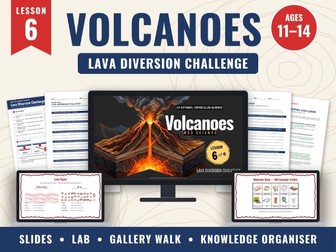
KS3 volcanoes engineering challenge: pupils design, budget and test a lava diversion barrier. Editable PowerPoint, lab sheet, mark scheme. Lesson 6 of 6 in the Volcanoes KS3 scheme of work: the end-of-unit engineering challenge. A fissure has opened 2 km above the Icelandic town of Grindavík, and the residents won’t leave without a defence plan. Your pupils are the engineers. Each team designs a barrier on a 100-credit budget, gets the blueprint signed off, builds it, then tests it against two lava types they haven’t seen yet. They finish by reporting to the town council with evidence from their own trials. It runs over two or three 50–60 minute lessons. Enquiry question How can engineers use knowledge of lava behaviour to protect communities from volcanic hazards? Learning objectives Analyse the properties of different lava flows, viscosity and speed, to determine how they threaten a community. Design, test and budget a structural barrier system that diverts volcanic hazards away from vulnerable structures. How the challenge runs Lesson 1, the briefing: the official brief, the two lava types, the constraints (a 100-credit budget, a mitigation zone and an 8 cm exclusion zone around the buildings) and the materials shop. Teams design a labelled blueprint with flow arrows. You sign it off before they can buy anything. Lesson 2, build and test: a 20-minute build window, then Trial A (Pāhoehoe: fast and runny) and Trial B (ʻAʻā: slow, thick and heavy). Pupils log where the flow hits, where it breaks through and which buildings survive. Two short videos show real lava-diversion engineering. Lesson 3 (or the end of Lesson 2), analysis: a financial post-mortem (remaining credits + 10 points per surviving building), a Gallery Walk of other teams’ designs and a State, Describe, Explain report to the Grindavík Town Council. What’s included (14 files) Editable Teacher slides, PowerPoint: 22 slides with teacher notes throughout, including a teacher-only setup slide with both lava recipes, tray setup and pacing for two or three lessons Lab sheet, Word: blueprint, shopping list, Build & Test Log and success rating Gallery Walk sheet and plenary sheet, Word For print (PDF) Slides, lab sheet (2 pages), Gallery Walk sheet and plenary sheet Mark scheme: 2 pages covering the plenary and suggested Gallery Walk responses Digital Typed-response Word versions of the lab sheet, Gallery Walk and plenary. Pupils draw the blueprint on paper or add a photo of it. Plenary link sheet: Google Form and Microsoft Form versions Knowledge organiser (A4, 2 pages) Engineering reference with real case studies, a build checklist and a 12-question retrieval quiz covering the whole unit Key vocabulary viscosity, mitigation zone, exclusion zone, structural barrier, budget constraint, design iteration
Volcanoes KS3 – Lesson 3: Volcanic Materials | Slides, Notes, Text, Mark SchemeQuick View
mulloverthings

Volcanoes KS3 – Lesson 3: Volcanic Materials | Slides, Notes, Text, Mark Scheme

(0)
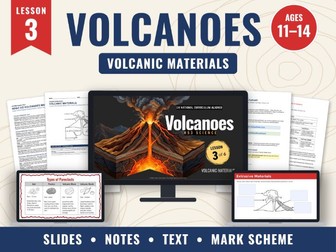
KS3 volcanoes lesson on volcanic materials: plutons, lava types, pyroclasts, intrusive vs extrusive. Editable PowerPoint, guided notes, mark scheme. Lesson 3 of 6 in the Volcanoes KS3 scheme of work. Pupils learn to read a rock’s story from its features. They sort volcanic materials into intrusive and extrusive: the four plutons, the two main lava types and the pyroclasts from fine ash to volcanic bombs. Enquiry question How can the characteristics of volcanic material tell us the story of how it was formed? Learning objectives Describe the four types of intrusive plutons and explain how their shapes differ. Classify extrusive volcanic materials by their physical properties and ability to travel. How the lesson runs Engage: pumice or granite? Pupils predict which rock formed in the air and which formed underground. Explore: a short clip of an ʻaʻā lava flow at Leilani Estates, Hawaiʻi (2018). Would a concrete wall stop it? Explain: pahoehoe and ʻaʻā lava, the four plutons (sill, laccolith, dyke, batholith) and the four types of pyroclast. Pupils fill in the guided notes as you teach. Elaborate: Think, Pair, Share comparing two plutons, then a mini-whiteboard task and Four Corners debate: which volcanic material is the greatest threat to a city 80 km away? Evaluate: a State, Describe, Explain plenary. A geologist finds two rock samples; pupils decide which is intrusive and which is extrusive, and why. What’s included (10 files) Editable Teacher slides, PowerPoint: 12 slides with teacher notes throughout Guided notes, Word: 2 pages Informational text, Word: 1 page with Check Your Understanding questions For print (PDF) Slides, guided notes and informational text Mark scheme: 4 pages, covering every written task including the plenary Digital (Google Classroom or Microsoft Teams) Digital guided notes: 7 slides. Pupils type in blue boxes. Digital informational text, Word Plenary link sheet: Google Form and Microsoft Form versions Key vocabulary extrusive, intrusive, pluton, sill, laccolith, dyke, batholith, pahoehoe, ʻaʻā, pyroclast, ash, pumice, volcanic block, volcanic bomb Curriculum links KS3 Science: Earth and atmosphere (the rock cycle and the formation of igneous rocks) KS3 Geography: physical geography (rocks, weathering and soils) Good to know Hand samples of pumice and granite are a bonus, not a requirement. The slides use photos. Videos are linked from the slides, not embedded. The plenary forms are not self-marking. Mark them with the mark scheme. Written for UK classrooms: UK spelling, metric units and A4 PDFs throughout. A Read Me in the zip covers setup. Part of a full unit Lesson 3 of 6. The Volcanoes KS3 bundle has all six lessons, both knowledge organisers and the scheme of work for less. The scheme of work is free in my shop.
Volcanoes KS3 Scheme of Work – FREE | 6 Lessons, 5E Sequence, NC MappingQuick View
mulloverthings

Volcanoes KS3 Scheme of Work – FREE | 6 Lessons, 5E Sequence, NC Mapping

(0)
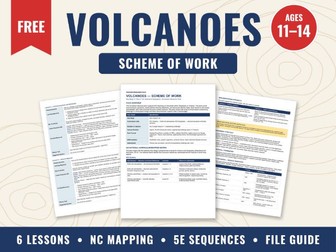
Free KS3 volcanoes scheme of work: six lessons with enquiry questions, 5E sequences and Science and Geography curriculum mapping. Word and PDF. A free, ready-to-use scheme of work for a six-lesson KS3 volcanoes unit, for Science or Geography. Use it to plan your own unit, show your head of department how the sequence fits the national curriculum, or see exactly what the Volcanoes KS3 lessons cover before you buy. What’s inside (9 pages, Word + PDF) Pack overview: key stage, curriculum links, lesson length, formats, differentiation and assessment UK National Curriculum mapping: KS3 Science and KS3 Geography programme-of-study references matched to the lessons that cover them Lesson-by-lesson plans for all six lessons: enquiry question, learning objectives, key vocabulary, a 5E sequence (Engage, Explore, Explain, Elaborate, Evaluate), resources and the plenary task Two delivery pathways: in-person with printed guided notes, or digital and hybrid through Google Classroom, Microsoft Teams or your VLE Assessment strategy: a plenary in every lesson, and the Lava Diversion engineering challenge as the end-of-unit assessment File guide listing every resource in the unit The six lessons Volcano Formation and Growth Volcano Locations and Distribution Volcanic Materials Volcano Types and Eruptions Volcanic Prediction and Effects Lava Diversion Engineering Challenge (two to three lessons) Good to know The Word version is fully editable, so you can add your own school’s assessment points and dates. Written for UK classrooms: UK spelling, State, Describe, Explain plenaries and KS3 references throughout. Every lesson in it is available in my shop, individually or as the Volcanoes KS3 bundle. If it helps your planning, a quick review would mean a lot.