


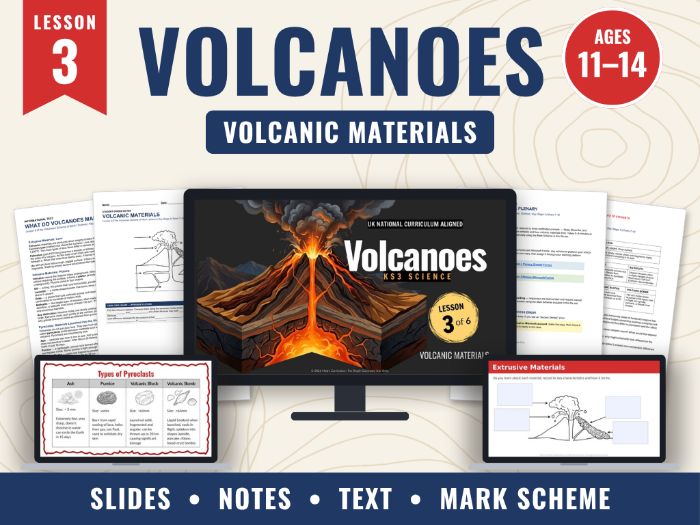
KS3 volcanoes lesson on volcanic materials: plutons, lava types, pyroclasts, intrusive vs extrusive. Editable PowerPoint, guided notes, mark scheme.
Lesson 3 of 6 in the Volcanoes KS3 scheme of work. Pupils learn to read a rock’s story from its features. They sort volcanic materials into intrusive and extrusive: the four plutons, the two main lava types and the pyroclasts from fine ash to volcanic bombs.
Enquiry question
How can the characteristics of volcanic material tell us the story of how it was formed?
Learning objectives
- Describe the four types of intrusive plutons and explain how their shapes differ.
- Classify extrusive volcanic materials by their physical properties and ability to travel.
How the lesson runs
- Engage: pumice or granite? Pupils predict which rock formed in the air and which formed underground.
- Explore: a short clip of an ʻaʻā lava flow at Leilani Estates, Hawaiʻi (2018). Would a concrete wall stop it?
- Explain: pahoehoe and ʻaʻā lava, the four plutons (sill, laccolith, dyke, batholith) and the four types of pyroclast. Pupils fill in the guided notes as you teach.
- Elaborate: Think, Pair, Share comparing two plutons, then a mini-whiteboard task and Four Corners debate: which volcanic material is the greatest threat to a city 80 km away?
- Evaluate: a State, Describe, Explain plenary. A geologist finds two rock samples; pupils decide which is intrusive and which is extrusive, and why.
What’s included (10 files)
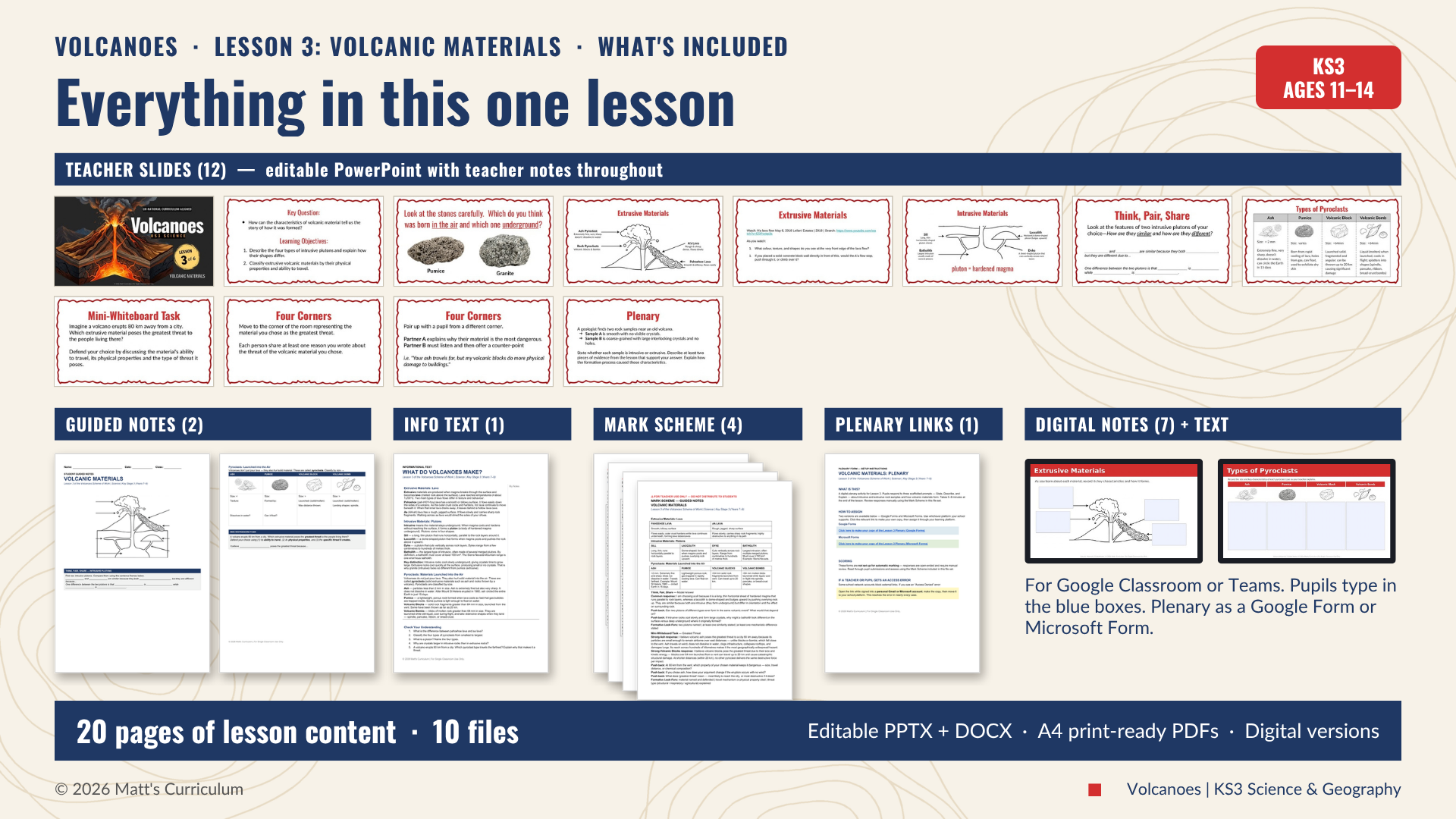
Editable
- Teacher slides, PowerPoint: 12 slides with teacher notes throughout
- Guided notes, Word: 2 pages
- Informational text, Word: 1 page with Check Your Understanding questions
For print (PDF)
- Slides, guided notes and informational text
- Mark scheme: 4 pages, covering every written task including the plenary
Digital (Google Classroom or Microsoft Teams)
- Digital guided notes: 7 slides. Pupils type in blue boxes.
- Digital informational text, Word
- Plenary link sheet: Google Form and Microsoft Form versions
Key vocabulary
extrusive, intrusive, pluton, sill, laccolith, dyke, batholith, pahoehoe, ʻaʻā, pyroclast, ash, pumice, volcanic block, volcanic bomb
Curriculum links
- KS3 Science: Earth and atmosphere (the rock cycle and the formation of igneous rocks)
- KS3 Geography: physical geography (rocks, weathering and soils)
Good to know
- Hand samples of pumice and granite are a bonus, not a requirement. The slides use photos.
- Videos are linked from the slides, not embedded.
- The plenary forms are not self-marking. Mark them with the mark scheme.
- Written for UK classrooms: UK spelling, metric units and A4 PDFs throughout.
- A Read Me in the zip covers setup.
Part of a full unit
Lesson 3 of 6. The Volcanoes KS3 bundle has all six lessons, both knowledge organisers and the scheme of work for less. The scheme of work is free in my shop.
Something went wrong, please try again later.
This resource hasn't been reviewed yet
To ensure quality for our reviews, only customers who have purchased this resource can review it
Report this resourceto let us know if it violates our terms and conditions.
Our customer service team will review your report and will be in touch.
$5.00