


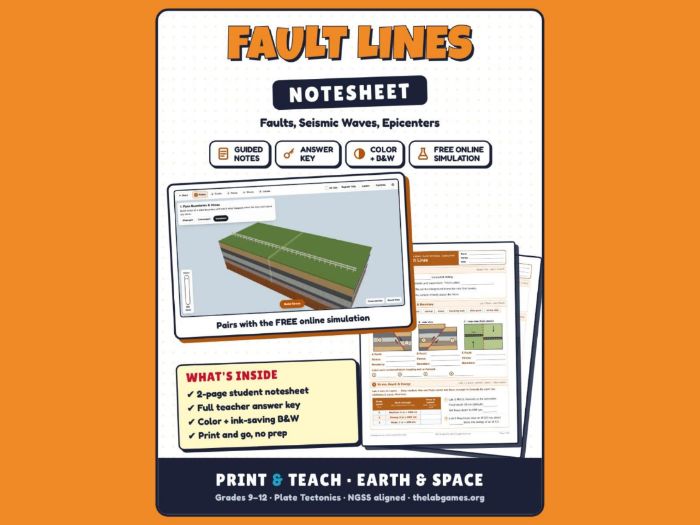
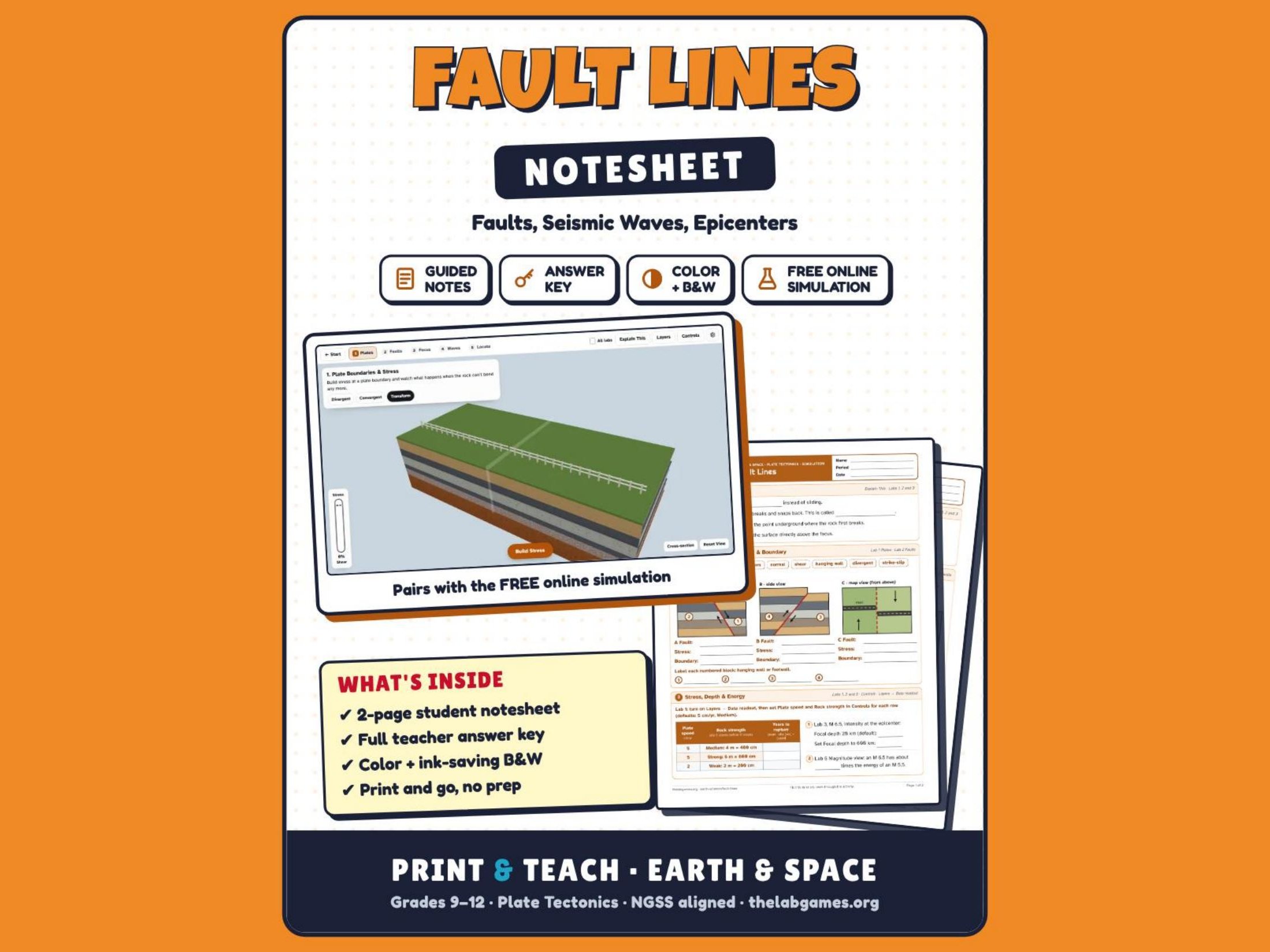
Help students see how stress breaks rock and how scientists track the earthquake that follows. In this roomy, student-friendly 2-page simulation notesheet, students fill in the background on elastic rebound, focus and epicenter, then name the fault, stress and plate boundary for three drawn fault blocks and label the hanging wall and footwall. They work out how many years a locked fault takes to rupture, compare the shaking from a shallow and a deep earthquake, and compare the energy of two magnitudes. On page 2 they race P, S, Love and Rayleigh waves to a town, describe how each wave moves the ground, find the shadow zones that show the outer core is liquid, turn S - P lag times into distances on a travel-time graph, and compare intensity on bedrock and soft sediment. A marked AP Environmental Science block covers tsunamis, liquefaction and early-warning time.
It pairs with Fault Lines, a free online simulation at thelabgames.org where students build stress at plate boundaries, slip faults, race seismic waves through Earth, locate an epicenter, and plan for earthquake hazards. Use it in class, for absent-student makeups, or on sub days. A complete teacher key is included.
What’s Included
- Student notesheet (2 pages) in full color AND black & white
- Teacher answer key (red answers) in full color AND black & white
What Students Do
- Background fill-in: locked faults bend, elastic rebound, focus (hypocenter) and epicenter
- Name Each Fault: fault type, stress type and plate boundary for a normal, a reverse and a strike-slip fault, plus hanging wall and footwall labels
- Stress, Depth & Energy: years to rupture from rock strength and plate speed, epicenter intensity for a 20 km and a 600 km deep earthquake, and the energy step between magnitudes
- Seismic Waves: arrival times at a town 120 km away, particle motion for each wave, which waves shake hardest, and the S-wave and P-wave shadow zones
- Locate the Epicenter: S - P lags turned into distances on a travel-time graph, why three stations are needed, and intensity on bedrock versus soft sediment
- AP Environmental Science: which faults make tsunamis, which ground can liquefy, and seconds of earthquake early warning
Skills & Standards
- Plate boundaries, tension, compression and shear, normal, reverse and strike-slip faults, hanging wall and footwall, elastic rebound, focus and epicenter, focal depth, P, S, Love and Rayleigh waves, shadow zones, liquid outer core, S - P lag, travel-time graphs, triangulation, magnitude and energy, Modified Mercalli intensity, tsunamis, liquefaction, early warning
- Supports NGSS HS-ESS1-5, HS-ESS2-1, HS-ESS2-3, HS-ESS3-1
- Grades 9–12 Earth and Space Science, with an AP Environmental Science extension
Great For
- Plate tectonics and earthquake units
- Absent-student makeups
- Sub plans
- Computer lab days
- Test review
Something went wrong, please try again later.
This resource hasn't been reviewed yet
To ensure quality for our reviews, only customers who have downloaded this resource can review it
Report this resourceto let us know if it violates our terms and conditions.
Our customer service team will review your report and will be in touch.
$0.00