


Extension task resource for Year 5 Science: Martian descent forces. Calculate parachute surface area to balance mass and air resistance. National Curriculum aligned.
.
What’s Included
.
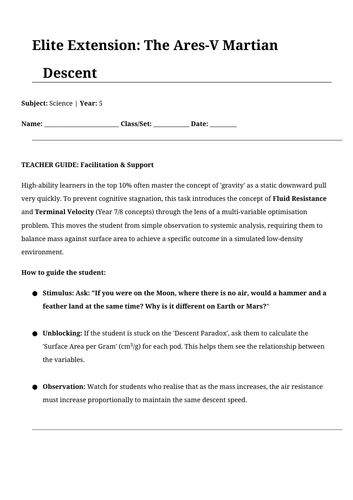
- Teacher Guide: Facilitation and support notes on introducing fluid resistance and terminal velocity concepts to high-ability learners.
- The Mission Briefing: A professional scenario for the Ares-V Colony requiring aeronautical engineering to land medical supplies on Mars.
- Martian Physics Table: A structured framework for pupils to investigate the non-linear relationship between pod mass and parachute surface area.
- Ares-V Commander Report: A formal conclusion task where students synthesise their findings on atmospheric resistance into a professional report.
.
How to Use It
.
- Before writing, Display: The Mission Briefing. Immerse gifted and talented learners in the aeronautical engineer role to establish a professional purpose for the task.
- During the lesson, Deploy: The Martian Physics Table. Guide students to calculate surface area per gram to identify the relationship between variables in low-density environments.
- As a plenary, Assign: The Ares-V Commander Report. Challenge pupils to explain why mass and air resistance do not always scale 1:1, promoting disciplinary oracy.
.
Curriculum Coverage
.
- KS2 National Curriculum — Science (Year 5): Deepen substantive knowledge of the effects of gravity and air resistance through a professional aeronautical lens.
- Working Scientifically (Key Stage 2): Master attainment targets for the control of variables and data interpretation by calculating ratios and predicting descent speeds.
.
File Includes
.
Editable Word document (.docx) included.
.
Full Pedagogical Rationale and FAQs Available at:
.
magiteacher.com/resources/year-5-science-forces-and-gravity-greater-depth-extension-tasks-3?utm_source=tes&utm_medium=referral&utm_content=description
Something went wrong, please try again later.
This resource hasn't been reviewed yet
To ensure quality for our reviews, only customers who have downloaded this resource can review it
Report this resourceto let us know if it violates our terms and conditions.
Our customer service team will review your report and will be in touch.
£0.00