Edexcel A-level PE 1.1.1-1.1.3 Muscles, Bones and Movement | Lesson, Workbook, Test & CoverQuick View
AllanaMcLean

Edexcel A-level PE 1.1.1-1.1.3 Muscles, Bones and Movement | Lesson, Workbook, Test & Cover

(0)
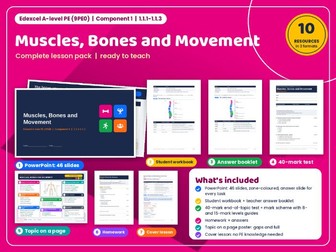
A complete, ready-to-teach pack for Pearson Edexcel A-level PE (9PE0) Component 1: Scientific Principles of Physical Education, specification section 1.1.1-1.1.3: Muscles, Bones and Movement. What’s covered: • Bones: The bones of the shoulder, hip, elbow, leg and knee, ankle and foot, wrist and hand, and the regions of the vertebral column • Movements produced: Flexion, extension, abduction, adduction, horizontal flexion and extension, rotation, circumduction, plantar and dorsi flexion, inversion, eversion, supination, pronation • Muscles: The muscles for each region in the specification and the movements they produce • Types of contraction: Isotonic/concentric, isotonic/eccentric and isometric; how each produces movement or stability • The stretch-shortening cycle: Eccentric pre-stretch, amortisation and concentric contraction • Muscle roles: Agonist, prime mover, antagonist, fixator and synergist, and how one muscle takes on different roles What’s included (10 resources): • PowerPoint lesson: 46 zone-coloured slides with a starter, teaching slides, diagrams, independent tasks, exam practice and a 15-mark challenge, with an answer slide for every task • Student workbook that follows the lesson, plus a teacher answer booklet • End-of-topic test (40 marks) with a full mark scheme, including an 8-mark and a 15-mark question with levels guides • Homework (30 marks, 45 to 60 minutes) with answers: retrieval, apply it, an 8-mark exam question and stretch and challenge • Topic on a page revision poster, in gaps and full versions • Cover lesson for a non-specialist, with timings and staff answers Explain answers model PEE (Point, Example, Explanation), Describe answers use the W’s, and every evaluative point gives a clear judgement and its value. Fictional performers throughout. Supplied in Word, PowerPoint and PDF, so you can edit, print or project.
Edexcel A-level PE 1.3.5-1.3.6 The Neuromuscular System and Muscle ContractionQuick View
AllanaMcLean

Edexcel A-level PE 1.3.5-1.3.6 The Neuromuscular System and Muscle Contraction

(0)
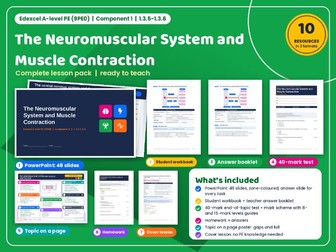
A complete, ready-to-teach pack for Pearson Edexcel A-level PE (9PE0) Component 1: Scientific Principles of Physical Education, specification section 1.3.5-1.3.6: The Neuromuscular System and Muscle Contraction. What’s covered: • The CNS and the motor unit: Central nervous system, motor neurones, motor units and neuromuscular end plates • Inside a muscle: Muscle fibres, myofibrils and sarcomeres; the protein filaments actin and myosin; the roles of troponin and tropomyosin • Neuromuscular transfer: From a nervous impulse to a muscular response; the all-or-none law • Sliding filament theory: How actin and myosin slide past each other to shorten the sarcomere • The five stages of contraction: Resting, excitation, contraction, recharge and relaxing • Wave summation and gradation: Wave summation and gradation of contraction What’s included (10 resources): • PowerPoint lesson: 46 zone-coloured slides with a starter, teaching slides, diagrams, independent tasks, exam practice and a 15-mark challenge, with an answer slide for every task • Student workbook that follows the lesson, plus a teacher answer booklet • End-of-topic test (40 marks) with a full mark scheme, including an 8-mark and a 15-mark question with levels guides • Homework (28 marks, 45 to 60 minutes) with answers: retrieval, apply it, an 8-mark exam question and stretch and challenge • Topic on a page revision poster, in gaps and full versions • Cover lesson for a non-specialist, with timings and staff answers Explain answers model PEE (Point, Example, Explanation), Describe answers use the W’s, and every evaluative point gives a clear judgement and its value. Fictional performers throughout. Supplied in Word, PowerPoint and PDF, so you can edit, print or project.
Edexcel A-level PE 1.3.1-1.3.4 Muscle Fibre Types and Recruitment | Lesson, Workbook, Test & CoverQuick View
AllanaMcLean

Edexcel A-level PE 1.3.1-1.3.4 Muscle Fibre Types and Recruitment | Lesson, Workbook, Test & Cover

(0)
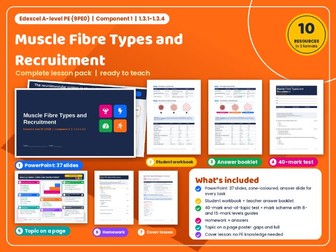
A complete, ready-to-teach pack for Pearson Edexcel A-level PE (9PE0) Component 1: Scientific Principles of Physical Education, specification section 1.3.1-1.3.4: Muscle Fibre Types and Recruitment. What’s covered: • The neuromuscular system: The anatomy, physiology and function of the neuromuscular system during physical activity • Fibre types: Characteristics and anatomical make-up of slow twitch (type I), fast oxidative glycolytic (IIa) and fast glycolytic (type IIx, formerly IIb) • Structure and suitability: How the structure of each fibre type facilitates its physiology and affects its suitability for particular activities • Recruitment patterns: Fibre recruitment for endurance and power-based events • Training and recruitment: How specific training enables athletes to gain control over the recruitment pattern What’s included (10 resources): • PowerPoint lesson: 37 zone-coloured slides with a starter, teaching slides, diagrams, independent tasks, exam practice and a 15-mark challenge, with an answer slide for every task • Student workbook that follows the lesson, plus a teacher answer booklet • End-of-topic test (40 marks) with a full mark scheme, including an 8-mark and a 15-mark question with levels guides • Homework (27 marks, 45 to 60 minutes) with answers: retrieval, apply it, an 8-mark exam question and stretch and challenge • Topic on a page revision poster, in gaps and full versions • Cover lesson for a non-specialist, with timings and staff answers Explain answers model PEE (Point, Example, Explanation), Describe answers use the W’s, and every evaluative point gives a clear judgement and its value. Fictional performers throughout. Supplied in Word, PowerPoint and PDF, so you can edit, print or project.
Edexcel A-level PE 1.1.4-1.1.7 Levers, Newton’s Laws and Stability | Complete Lesson PackQuick View
AllanaMcLean

Edexcel A-level PE 1.1.4-1.1.7 Levers, Newton’s Laws and Stability | Complete Lesson Pack

(0)
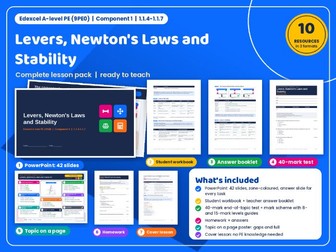
A complete, ready-to-teach pack for Pearson Edexcel A-level PE (9PE0) Component 1: Scientific Principles of Physical Education, specification section 1.1.4-1.1.7: Levers, Newton’s Laws and Stability. What’s covered: • Lever systems: The components of an anatomical lever; how the body uses 1st, 2nd and 3rd class levers in physical activity and sport • Mechanical advantage: The mechanical advantages and disadvantages of each class of lever • Newton’s three laws: Law of Inertia, Law of Acceleration and Law of Action and Reaction, in sporting contexts • Stability: The principles of stability in relation to the centre of mass, and its implications in physical activities • Force and resultant force: Calculating force and resultant force: a mass of 1 kg exerts a force of 9.81 N (down) What’s included (10 resources): • PowerPoint lesson: 42 zone-coloured slides with a starter, teaching slides, diagrams, independent tasks, exam practice and a 15-mark challenge, with an answer slide for every task • Student workbook that follows the lesson, plus a teacher answer booklet • End-of-topic test (40 marks) with a full mark scheme, including an 8-mark and a 15-mark question with levels guides • Homework (29 marks, 45 to 60 minutes) with answers: retrieval, apply it, an 8-mark exam question and stretch and challenge • Topic on a page revision poster, in gaps and full versions • Cover lesson for a non-specialist, with timings and staff answers Explain answers model PEE (Point, Example, Explanation), Describe answers use the W’s, and every evaluative point gives a clear judgement and its value. Fictional performers throughout. Supplied in Word, PowerPoint and PDF, so you can edit, print or project.
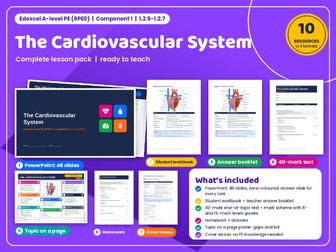
Edexcel A-level PE 1.2.5-1.2.7 The Cardiovascular System | Lesson, Workbook, Test & CoverQuick View
AllanaMcLean

Edexcel A-level PE 1.2.5-1.2.7 The Cardiovascular System | Lesson, Workbook, Test & Cover

(0)
A complete, ready-to-teach pack for Pearson Edexcel A-level PE (9PE0) Component 1: Scientific Principles of Physical Education, specification section 1.2.5-1.2.7: The Cardiovascular System. What’s covered: • Structure of the heart: Atria, ventricles, valves, septum, atrioventricular (AV) and sinoatrial (SA) nodes, myocardium • Blood and blood vessels: Blood; arteries, veins and capillaries • Circulation and the cardiac cycle: The cardiac cycle; systemic and pulmonary circulation • Heart rates, SV and Q: Heart rates (resting, working, maximum, heart rate reserve and recovery), stroke volume, cardiac output, end diastolic and end systolic volumes • Venous return and vascular shunting: How blood returns to the heart; redistribution of blood flow in exercise • Bradycardia: What it is, why it may be beneficial and how, anatomically and physiologically, it may occur What’s included (10 resources): • PowerPoint lesson: 46 zone-coloured slides with a starter, teaching slides, diagrams, independent tasks, exam practice and a 15-mark challenge, with an answer slide for every task • Student workbook that follows the lesson, plus a teacher answer booklet • End-of-topic test (40 marks) with a full mark scheme, including an 8-mark and a 15-mark question with levels guides • Homework (28 marks, 45 to 60 minutes) with answers: retrieval, apply it, an 8-mark exam question and stretch and challenge • Topic on a page revision poster, in gaps and full versions • Cover lesson for a non-specialist, with timings and staff answers Explain answers model PEE (Point, Example, Explanation), Describe answers use the W’s, and every evaluative point gives a clear judgement and its value. Fictional performers throughout. Supplied in Word, PowerPoint and PDF, so you can edit, print or project.
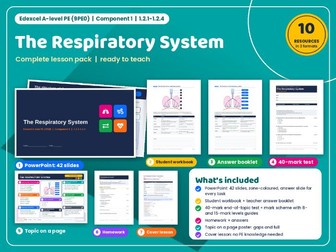
Edexcel A-level PE 1.2.1-1.2.4 The Respiratory System | Lesson, Workbook, Test & CoverQuick View
AllanaMcLean

Edexcel A-level PE 1.2.1-1.2.4 The Respiratory System | Lesson, Workbook, Test & Cover

(0)
A complete, ready-to-teach pack for Pearson Edexcel A-level PE (9PE0) Component 1: Scientific Principles of Physical Education, specification section 1.2.1-1.2.4: The Respiratory System. What’s covered: • Working together: How the respiratory, cardiovascular and circulatory systems function individually and in conjunction with each other • Structure and function: The larynx, pharynx, trachea, bronchus, bronchiole and alveoli • Mechanics of ventilation: Inspiration and expiration: the cause and effect process and the role of pressure gradients • Partial pressure and diffusion: How O2 and CO2 move at the alveoli and at the muscles • Volumes and capacities: Tidal volume, IRV, ERV, residual volume, vital capacity, inspiratory capacity, functional residual capacity, total lung capacity What’s included (10 resources): • PowerPoint lesson: 42 zone-coloured slides with a starter, teaching slides, diagrams, independent tasks, exam practice and a 15-mark challenge, with an answer slide for every task • Student workbook that follows the lesson, plus a teacher answer booklet • End-of-topic test (40 marks) with a full mark scheme, including an 8-mark and a 15-mark question with levels guides • Homework (28 marks, 45 to 60 minutes) with answers: retrieval, apply it, an 8-mark exam question and stretch and challenge • Topic on a page revision poster, in gaps and full versions • Cover lesson for a non-specialist, with timings and staff answers Explain answers model PEE (Point, Example, Explanation), Describe answers use the W’s, and every evaluative point gives a clear judgement and its value. Fictional performers throughout. Supplied in Word, PowerPoint and PDF, so you can edit, print or project.
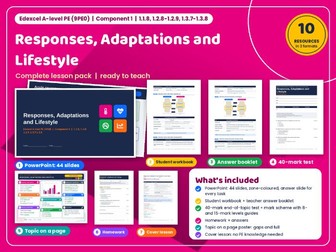
Edexcel A-level PE 1.1.8, 1.2.8-1.2.9, 1.3.7-1.3.8 Responses, Adaptations and LifestyleQuick View
AllanaMcLean

Edexcel A-level PE 1.1.8, 1.2.8-1.2.9, 1.3.7-1.3.8 Responses, Adaptations and Lifestyle

(0)
A complete, ready-to-teach pack for Pearson Edexcel A-level PE (9PE0) Component 1: Scientific Principles of Physical Education, specification section 1.1.8, 1.2.8-1.2.9, 1.3.7-1.3.8: Responses, Adaptations and Lifestyle. What’s covered: • Musculoskeletal responses: How the muscular and skeletal systems respond, acutely, structurally and functionally, to warming up and immediate activity • Cardiovascular and cardiorespiratory responses: How the heart, blood and lungs respond, acutely, structurally and functionally, to warming up and immediate activity • Neuromuscular responses: How the neuromuscular system responds, acutely, structurally and functionally, to warming up and immediate activity • Unhealthy lifestyle: What makes a lifestyle unhealthy and its effects on the cardiovascular and cardiorespiratory systems • Chronic adaptations: Adaptations of the cardiorespiratory, cardiovascular, muscular-skeletal and neuromuscular systems to training What’s included (10 resources): • PowerPoint lesson: 44 zone-coloured slides with a starter, teaching slides, diagrams, independent tasks, exam practice and a 15-mark challenge, with an answer slide for every task • Student workbook that follows the lesson, plus a teacher answer booklet • End-of-topic test (40 marks) with a full mark scheme, including an 8-mark and a 15-mark question with levels guides • Homework (28 marks, 45 to 60 minutes) with answers: retrieval, apply it, an 8-mark exam question and stretch and challenge • Topic on a page revision poster, in gaps and full versions • Cover lesson for a non-specialist, with timings and staff answers Explain answers model PEE (Point, Example, Explanation), Describe answers use the W’s, and every evaluative point gives a clear judgement and its value. Fictional performers throughout. Supplied in Word, PowerPoint and PDF, so you can edit, print or project.
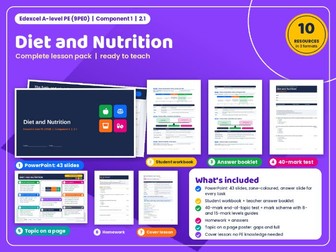
Edexcel A-level PE 2.1 Diet and Nutrition | Lesson, Workbook, Test & CoverQuick View
AllanaMcLean

Edexcel A-level PE 2.1 Diet and Nutrition | Lesson, Workbook, Test & Cover

(0)
A complete, ready-to-teach pack for Pearson Edexcel A-level PE (9PE0) Component 1: Scientific Principles of Physical Education, specification section 2.1: Diet and Nutrition. What’s covered: • Dietary manipulation: Dietary manipulation for performance pre-, during and post-physical activity • Optimal weight and energy balance: Optimal weight for performance; energy balance, energy intake and expenditure • Electrolytes and hydration: Electrolytes; hypotonic, hypertonic and isotonic solutions and their importance in maintaining hydration and performance • Supplementation: The role and use of supplementation to enhance energy stores, hydration, recovery, metabolic process and delay fatigue • Contemporary supplements: Supplements performers use today: how they work, benefits and risks • Strategies for food, fuel and fluid: CHO loading, two-hour window of opportunity, protein intake, pre-, during and post-event hydration What’s included (10 resources): • PowerPoint lesson: 43 zone-coloured slides with a starter, teaching slides, diagrams, independent tasks, exam practice and a 15-mark challenge, with an answer slide for every task • Student workbook that follows the lesson, plus a teacher answer booklet • End-of-topic test (40 marks) with a full mark scheme, including an 8-mark and a 15-mark question with levels guides • Homework (29 marks, 45 to 60 minutes) with answers: retrieval, apply it, an 8-mark exam question and stretch and challenge • Topic on a page revision poster, in gaps and full versions • Cover lesson for a non-specialist, with timings and staff answers Explain answers model PEE (Point, Example, Explanation), Describe answers use the W’s, and every evaluative point gives a clear judgement and its value. Fictional performers throughout. Supplied in Word, PowerPoint and PDF, so you can edit, print or project.
Edexcel A-level PE 1.4.9-1.4.14 Fatigue and Recovery | Lesson, Workbook, Test & CoverQuick View
AllanaMcLean

Edexcel A-level PE 1.4.9-1.4.14 Fatigue and Recovery | Lesson, Workbook, Test & Cover

(0)
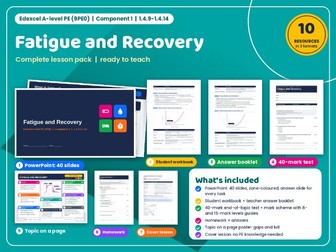
A complete, ready-to-teach pack for Pearson Edexcel A-level PE (9PE0) Component 1: Scientific Principles of Physical Education, specification section 1.4.9-1.4.14: Fatigue and Recovery. What’s covered: • Fatigue: Energy depletion, dehydration and the build-up of waste products; the role of lactic acid in performance • and 1.4.13 EPOC and the stages of recovery: EPOC and the stages of recovery, applied to sporting contexts • The fast component: Re-phosphorylation; the speed and rate of phosphogen replenishment • The slow component: Oxidation of lactate (removal of lactate and H+); the two-hour window (rehydration, physical cooling, thermoregulation); the 48-hour window (myoglobin, protein, glycogen and CHO); EIMD and DOMS • Priming exercise: How the energy systems respond acutely to warming up and priming exercise What’s included (10 resources): • PowerPoint lesson: 40 zone-coloured slides with a starter, teaching slides, diagrams, independent tasks, exam practice and a 15-mark challenge, with an answer slide for every task • Student workbook that follows the lesson, plus a teacher answer booklet • End-of-topic test (40 marks) with a full mark scheme, including an 8-mark and a 15-mark question with levels guides • Homework (28 marks, 45 to 60 minutes) with answers: retrieval, apply it, an 8-mark exam question and stretch and challenge • Topic on a page revision poster, in gaps and full versions • Cover lesson for a non-specialist, with timings and staff answers Explain answers model PEE (Point, Example, Explanation), Describe answers use the W’s, and every evaluative point gives a clear judgement and its value. Fictional performers throughout. Supplied in Word, PowerPoint and PDF, so you can edit, print or project.
Edexcel A-level PE 2.3 Injury Prevention and Rehabilitation | Lesson, Workbook, Test & CoverQuick View
AllanaMcLean

Edexcel A-level PE 2.3 Injury Prevention and Rehabilitation | Lesson, Workbook, Test & Cover

(0)
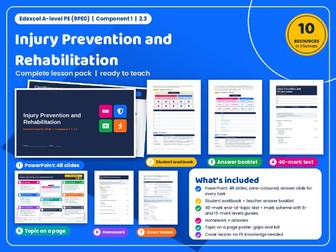
A complete, ready-to-teach pack for Pearson Edexcel A-level PE (9PE0) Component 1: Scientific Principles of Physical Education, specification section 2.3: Injury Prevention and Rehabilitation. What’s covered: • Classifying injuries: The different classifications of common sporting injuries: acute and overuse; hard and soft tissue • Acute injuries: Cruciate ligament injury; soft tissue damage, sprain, Achilles tendon injury, fracture, dislocation • Overuse injuries: Strain, shin splints (periostitis), tendonitis (including tennis elbow and golfer’s elbow), stress fractures • Prevention of injuries: Conditioning, muscle balance, technique, protective equipment, managing risks • RICE and POLICE: POLICE: Protection, Optimal Loading, Ice, Compression, Elevation. RICE: Rest, Ice, Compression, Elevation. Advantages and disadvantages • Rehabilitation and return to play: Contemporary recovery methods (ultrasound, physiotherapy, hyperbaric chambers, oxygen tents, compression garments, ice baths, nutrition, climate chambers, cryotherapy) and timescales for return to play; advantages and disadvantages What’s included (10 resources): • PowerPoint lesson: 48 zone-coloured slides with a starter, teaching slides, diagrams, independent tasks, exam practice and a 15-mark challenge, with an answer slide for every task • Student workbook that follows the lesson, plus a teacher answer booklet • End-of-topic test (40 marks) with a full mark scheme, including an 8-mark and a 15-mark question with levels guides • Homework (31 marks, 45 to 60 minutes) with answers: retrieval, apply it, an 8-mark exam question and stretch and challenge • Topic on a page revision poster, in gaps and full versions • Cover lesson for a non-specialist, with timings and staff answers Explain answers model PEE (Point, Example, Explanation), Describe answers use the W’s, and every evaluative point gives a clear judgement and its value. Fictional performers throughout. Supplied in Word, PowerPoint and PDF, so you can edit, print or project.
Edexcel A-level PE 3.1-3.2 Coaching, Skill Classification and Transfer | Complete Lesson PackQuick View
AllanaMcLean

Edexcel A-level PE 3.1-3.2 Coaching, Skill Classification and Transfer | Complete Lesson Pack

(0)
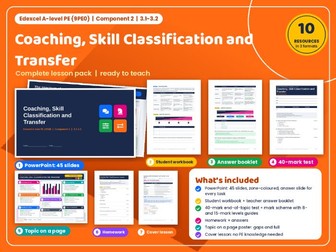
A complete, ready-to-teach pack for Pearson Edexcel A-level PE (9PE0) Component 2: Psychological and Social Principles of Physical Education, specification section 3.1-3.2: Coaching, Skill Classification and Transfer. What’s covered: • Coaching styles: Coaching styles to improve the performance of learners: command, reciprocal, guided discovery and problem solving • Tactics and strategies: The development of tactics and strategies in a competition or performance to optimise outcome • Dissecting and analysing a skill: Preparation, execution and recovery phases leading to the result; technical strengths and weaknesses; comparing with a higher-level performer • Skill classification: Gross/fine, internally/externally paced, discrete/serial/continuous; the open/closed continuum and the sporting environment, decision making and practice structure • Transfer of skills: Uses of transfer; positive/negative, proactive/retroactive, bilateral and zero; the effect of one skill on another as a result of practice or experience What’s included (10 resources): • PowerPoint lesson: 45 zone-coloured slides with a starter, teaching slides, diagrams, independent tasks, exam practice and a 15-mark challenge, with an answer slide for every task • Student workbook that follows the lesson, plus a teacher answer booklet • End-of-topic test (40 marks) with a full mark scheme, including an 8-mark and a 15-mark question with levels guides • Homework (29 marks, 45 to 60 minutes) with answers: retrieval, apply it, an 8-mark exam question and stretch and challenge • Topic on a page revision poster, in gaps and full versions • Cover lesson for a non-specialist, with timings and staff answers Explain answers model PEE (Point, Example, Explanation), Describe answers use the W’s, and every evaluative point gives a clear judgement and its value. Fictional performers throughout. Supplied in Word, PowerPoint and PDF, so you can edit, print or project.
Edexcel A-level PE 2.6-2.7 Projectile Motion and Fluid Mechanics | Lesson, Workbook, Test & CoverQuick View
AllanaMcLean

Edexcel A-level PE 2.6-2.7 Projectile Motion and Fluid Mechanics | Lesson, Workbook, Test & Cover

(0)
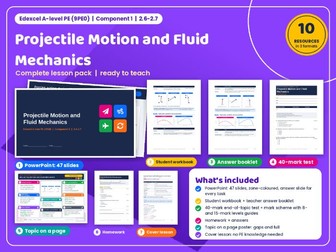
A complete, ready-to-teach pack for Pearson Edexcel A-level PE (9PE0) Component 1: Scientific Principles of Physical Education, specification section 2.6-2.7: Projectile Motion and Fluid Mechanics. What’s covered: • Projectile motion: Projectile motion in refining technique; forces acting during flight: gravity, air resistance and lift forces • Horizontal displacement: Velocity of release, height of release, angle of release • Technology and technique: Technique modification through technology used by the performer and coach to improve performance • Fluid mechanics: Aerodynamics and hydrodynamics; factors affecting fluid friction and air resistance: velocity, drag force, mass, streamlining and surface characteristics of body • Lift forces: Upward and downward lift forces, angle of attack and the Bernoulli effect • Spin: Topspin, backspin, sidespin; the Magnus effect and its impact on flight path and bounce • Fluid mechanics and technology: Advances in technique modification, clothing/suits and equipment/apparatus What’s included (10 resources): • PowerPoint lesson: 47 zone-coloured slides with a starter, teaching slides, diagrams, independent tasks, exam practice and a 15-mark challenge, with an answer slide for every task • Student workbook that follows the lesson, plus a teacher answer booklet • End-of-topic test (40 marks) with a full mark scheme, including an 8-mark and a 15-mark question with levels guides • Homework (29 marks, 45 to 60 minutes) with answers: retrieval, apply it, an 8-mark exam question and stretch and challenge • Topic on a page revision poster, in gaps and full versions • Cover lesson for a non-specialist, with timings and staff answers Explain answers model PEE (Point, Example, Explanation), Describe answers use the W’s, and every evaluative point gives a clear judgement and its value. Fictional performers throughout. Supplied in Word, PowerPoint and PDF, so you can edit, print or project.
Edexcel A-level PE 2.4-2.5 Linear and Angular Motion | Lesson, Workbook, Test & CoverQuick View
AllanaMcLean

Edexcel A-level PE 2.4-2.5 Linear and Angular Motion | Lesson, Workbook, Test & Cover

(0)
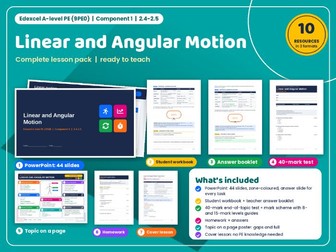
A complete, ready-to-teach pack for Pearson Edexcel A-level PE (9PE0) Component 1: Scientific Principles of Physical Education, specification section 2.4-2.5: Linear and Angular Motion. What’s covered: • Linear motion: Factors associated with linear motion; definitions, equations, calculations and units of measurement in a sporting context • Calculations: Distance and displacement, speed and average speed, velocity and acceleration: speed = distance/time (s = d/t); velocity = displacement/time or distance/time (m/s); acceleration = (final velocity - initial velocity)/time taken (m/s²) • Graphs of motion: Plot, label and interpret distance/time, speed/time and velocity/time graphs • Angular motion: How angular motion is applied in a sporting context: rotation about an axis • Moment of inertia: Factors affecting it (mass and distribution of mass from the axis of rotation); effects of increasing or decreasing it, for the whole body or a specific joint • Angular momentum: Conservation of angular momentum during flight; moment of inertia and its relationship with angular velocity What’s included (10 resources): • PowerPoint lesson: 44 zone-coloured slides with a starter, teaching slides, diagrams, independent tasks, exam practice and a 15-mark challenge, with an answer slide for every task • Student workbook that follows the lesson, plus a teacher answer booklet • End-of-topic test (40 marks) with a full mark scheme, including an 8-mark and a 15-mark question with levels guides • Homework (30 marks, 45 to 60 minutes) with answers: retrieval, apply it, an 8-mark exam question and stretch and challenge • Topic on a page revision poster, in gaps and full versions • Cover lesson for a non-specialist, with timings and staff answers Explain answers model PEE (Point, Example, Explanation), Describe answers use the W’s, and every evaluative point gives a clear judgement and its value. Fictional performers throughout. Supplied in Word, PowerPoint and PDF, so you can edit, print or project.
Edexcel A-level PE 1.4.1-1.4.8 Energy Systems and the Energy Continuum | Complete Lesson PackQuick View
AllanaMcLean

Edexcel A-level PE 1.4.1-1.4.8 Energy Systems and the Energy Continuum | Complete Lesson Pack

(0)
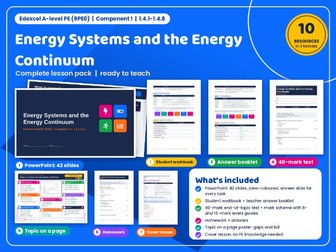
A complete, ready-to-teach pack for Pearson Edexcel A-level PE (9PE0) Component 1: Scientific Principles of Physical Education, specification section 1.4.1-1.4.8: Energy Systems and the Energy Continuum. What’s covered: • Concepts of energy: Energy in physical activity and sport; how it is regenerated, how depletion occurs and the recovery process • Forms of energy and ATP: Mechanical, electrical, potential, chemical and kinetic energy; ATP in muscular contraction; PC, glycogen and fat for ATP re-synthesis • The three energy pathways: Characteristics and physiology of the ATP-PC, glycolytic and aerobic pathways • Comparing the pathways: Ease and speed of ATP production, force of contraction, intensity and duration, regeneration of ATP • The energy continuum: The principle of the continuum and the joint, collaborative role of the three pathways • Running events: Positioning athletic running events on the energy continuum What’s included (10 resources): • PowerPoint lesson: 42 zone-coloured slides with a starter, teaching slides, diagrams, independent tasks, exam practice and a 15-mark challenge, with an answer slide for every task • Student workbook that follows the lesson, plus a teacher answer booklet • End-of-topic test (40 marks) with a full mark scheme, including an 8-mark and a 15-mark question with levels guides • Homework (29 marks, 45 to 60 minutes) with answers: retrieval, apply it, an 8-mark exam question and stretch and challenge • Topic on a page revision poster, in gaps and full versions • Cover lesson for a non-specialist, with timings and staff answers Explain answers model PEE (Point, Example, Explanation), Describe answers use the W’s, and every evaluative point gives a clear judgement and its value. Fictional performers throughout. Supplied in Word, PowerPoint and PDF, so you can edit, print or project.
Edexcel A-level PE 2.2.10-2.2.13 Periodisation, Training Methods and EnvironmentQuick View
AllanaMcLean

Edexcel A-level PE 2.2.10-2.2.13 Periodisation, Training Methods and Environment

(0)
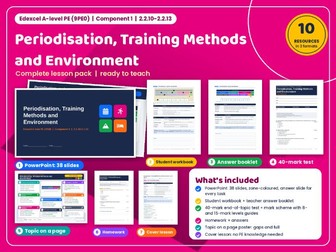
A complete, ready-to-teach pack for Pearson Edexcel A-level PE (9PE0) Component 1: Scientific Principles of Physical Education, specification section 2.2.10-2.2.13: Periodisation, Training Methods and Environment. What’s covered: • Periodisation: Macro, meso and micro cycles; the preparation phase (general and specific), competition phase and transition phase • Aerobic and mixed methods: Interval, circuits, cross, continuous, fartlek: appropriateness, advantages and disadvantages • Strength, speed and power methods: Weights (free weights and machines), resistance (pulleys, parachutes), assisted (bungees, downhill), plyometrics, SAQ, functional stability • Flexibility training: Static, ballistic and proprioceptive neuromuscular facilitation (PNF) • Environment: Preparation for performance at altitude, in heat and in humidity • Recovery: Strategies for speeding up recovery: cooling down, massage, ice baths, compression clothing What’s included (10 resources): • PowerPoint lesson: 38 zone-coloured slides with a starter, teaching slides, diagrams, independent tasks, exam practice and a 15-mark challenge, with an answer slide for every task • Student workbook that follows the lesson, plus a teacher answer booklet • End-of-topic test (40 marks) with a full mark scheme, including an 8-mark and a 15-mark question with levels guides • Homework (29 marks, 45 to 60 minutes) with answers: retrieval, apply it, an 8-mark exam question and stretch and challenge • Topic on a page revision poster, in gaps and full versions • Cover lesson for a non-specialist, with timings and staff answers Explain answers model PEE (Point, Example, Explanation), Describe answers use the W’s, and every evaluative point gives a clear judgement and its value. Fictional performers throughout. Supplied in Word, PowerPoint and PDF, so you can edit, print or project.
Edexcel A-level PE 2.2.5-2.2.9 Fitness Components, Principles and Intensity | Complete Lesson PackQuick View
AllanaMcLean

Edexcel A-level PE 2.2.5-2.2.9 Fitness Components, Principles and Intensity | Complete Lesson Pack

(0)
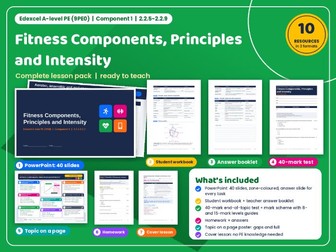
A complete, ready-to-teach pack for Pearson Edexcel A-level PE (9PE0) Component 1: Scientific Principles of Physical Education, specification section 2.2.5-2.2.9: Fitness Components, Principles and Intensity. What’s covered: • Aerobic and anaerobic components: VO2max, maximal and ‘submaximal’ aerobic fitness, anaerobic capacity, localised muscular endurance, exercise economy • Strength, speed and skill components: Maximal strength, strength, power, speed, agility, coordination, reaction time, balance, flexibility • Principles of training: Individual needs, specificity, progressive overload, FITT, overtraining, reversibility • Measuring intensity: % of one repetition maximum (RM), Rate of Perceived Exertion (RPE), % of functional threshold, target HR, work to rest ratios • Target heart rate: Understanding and use of Karvonen’s theory • Contemporary technologies: Technologies used by the performer and coach to monitor fitness and performance What’s included (10 resources): • PowerPoint lesson: 40 zone-coloured slides with a starter, teaching slides, diagrams, independent tasks, exam practice and a 15-mark challenge, with an answer slide for every task • Student workbook that follows the lesson, plus a teacher answer booklet • End-of-topic test (40 marks) with a full mark scheme, including an 8-mark and a 15-mark question with levels guides • Homework (28 marks, 45 to 60 minutes) with answers: retrieval, apply it, an 8-mark exam question and stretch and challenge • Topic on a page revision poster, in gaps and full versions • Cover lesson for a non-specialist, with timings and staff answers Explain answers model PEE (Point, Example, Explanation), Describe answers use the W’s, and every evaluative point gives a clear judgement and its value. Fictional performers throughout. Supplied in Word, PowerPoint and PDF, so you can edit, print or project.
Edexcel A-level PE 2.2.1-2.2.4 Fitness Testing | Lesson, Workbook, Test & CoverQuick View
AllanaMcLean

Edexcel A-level PE 2.2.1-2.2.4 Fitness Testing | Lesson, Workbook, Test & Cover

(0)
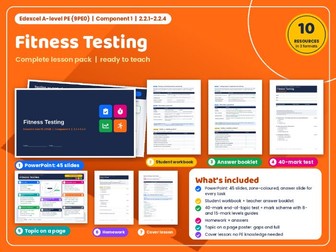
A complete, ready-to-teach pack for Pearson Edexcel A-level PE (9PE0) Component 1: Scientific Principles of Physical Education, specification section 2.2.1-2.2.4: Fitness Testing. What’s covered: • Preparation and training: Preparation and training methods in relation to maintaining and improving physical activity and performance: why and how we test • Aerobic and threshold tests: Functional thresholds, lactate threshold / anaerobic threshold / maximum steady state, gas analysis, multi-stage fitness test, step tests, yo-yo test, Cooper minute run • Anaerobic and power tests: Wingate test, MAOD, RAST, Cunningham and Faulkner, jump tests, Margaria-Kalaman • Strength, agility and speed tests: Strength tests, agility tests, sprint tests < 100 m • Using the data: Interpret, calculate and present data (tables and graphs) based on fitness test results • Determinants of running performance: Determinants of movement / running performance and their application to sprint, endurance and intermittent activities What’s included (10 resources): • PowerPoint lesson: 45 zone-coloured slides with a starter, teaching slides, diagrams, independent tasks, exam practice and a 15-mark challenge, with an answer slide for every task • Student workbook that follows the lesson, plus a teacher answer booklet • End-of-topic test (40 marks) with a full mark scheme, including an 8-mark and a 15-mark question with levels guides • Homework (29 marks, 45 to 60 minutes) with answers: retrieval, apply it, an 8-mark exam question and stretch and challenge • Topic on a page revision poster, in gaps and full versions • Cover lesson for a non-specialist, with timings and staff answers Explain answers model PEE (Point, Example, Explanation), Describe answers use the W’s, and every evaluative point gives a clear judgement and its value. Fictional performers throughout. Supplied in Word, PowerPoint and PDF, so you can edit, print or project.
Edexcel A-level PE 3.5-3.6 Guidance and Feedback | Lesson, Workbook, Test & CoverQuick View
AllanaMcLean

Edexcel A-level PE 3.5-3.6 Guidance and Feedback | Lesson, Workbook, Test & Cover

(0)
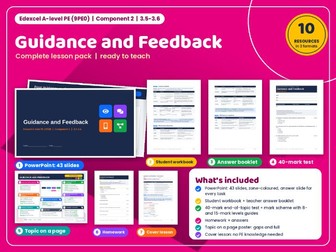
A complete, ready-to-teach pack for Pearson Edexcel A-level PE (9PE0) Component 2: Psychological and Social Principles of Physical Education, specification section 3.5-3.6: Guidance and Feedback. What’s covered: • Guidance methods: Visual (demonstration, visual materials), verbal (direct, indirect, prompting), manual and mechanical (physical support and aids, restrictions, forced responses): types, purpose and effectiveness • Technology and guidance: Uses of technology to underpin guidance: to measure, monitor and evaluate performance • Purposes of feedback: Types, purposes and effectiveness of feedback as motivation, reinforcement, and detection and correction of errors • Types of feedback: Positive/negative, knowledge of performance, knowledge of results, concurrent/terminal, intrinsic/extrinsic • Technology and feedback: Uses of technology to support types of feedback to optimise performance • Open and closed loop control: Input, executive system, effector system, output (and feedback in closed loop); when each loop could be used What’s included (10 resources): • PowerPoint lesson: 43 zone-coloured slides with a starter, teaching slides, diagrams, independent tasks, exam practice and a 15-mark challenge, with an answer slide for every task • Student workbook that follows the lesson, plus a teacher answer booklet • End-of-topic test (40 marks) with a full mark scheme, including an 8-mark and a 15-mark question with levels guides • Homework (29 marks, 45 to 60 minutes) with answers: retrieval, apply it, an 8-mark exam question and stretch and challenge • Topic on a page revision poster, in gaps and full versions • Cover lesson for a non-specialist, with timings and staff answers Explain answers model PEE (Point, Example, Explanation), Describe answers use the W’s, and every evaluative point gives a clear judgement and its value. Fictional performers throughout. Supplied in Word, PowerPoint and PDF, so you can edit, print or project.
Edexcel A-level PE 3.3-3.4 Learning Theories and Practice | Lesson, Workbook, Test & CoverQuick View
AllanaMcLean

Edexcel A-level PE 3.3-3.4 Learning Theories and Practice | Lesson, Workbook, Test & Cover

(0)
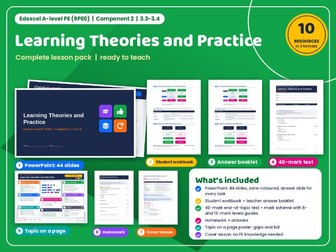
A complete, ready-to-teach pack for Pearson Edexcel A-level PE (9PE0) Component 2: Psychological and Social Principles of Physical Education, specification section 3.3-3.4: Learning Theories and Practice. What’s covered: • The associative theories: Classical and operant conditioning; reinforcement (positive, negative, punishment); the stimulus-response (S-R) bond and its use in skill learning • Thorndike’s three laws: Effect, exercise and readiness, and their application to practical situations • Fitts and Posner’s stages of learning: Cognitive, associative and autonomous: characteristics, coaching requirements and the type and role of feedback at each stage • Practice and performance: Practice methods and structure as a coach and for a performer, and their impact on performance • Practice methods and structure: Part, progressive part, whole, whole-part-whole; massed, distributed, fixed and variable What’s included (10 resources): • PowerPoint lesson: 44 zone-coloured slides with a starter, teaching slides, diagrams, independent tasks, exam practice and a 15-mark challenge, with an answer slide for every task • Student workbook that follows the lesson, plus a teacher answer booklet • End-of-topic test (40 marks) with a full mark scheme, including an 8-mark and a 15-mark question with levels guides • Homework (29 marks, 45 to 60 minutes) with answers: retrieval, apply it, an 8-mark exam question and stretch and challenge • Topic on a page revision poster, in gaps and full versions • Cover lesson for a non-specialist, with timings and staff answers Explain answers model PEE (Point, Example, Explanation), Describe answers use the W’s, and every evaluative point gives a clear judgement and its value. Fictional performers throughout. Supplied in Word, PowerPoint and PDF, so you can edit, print or project.
Edexcel A-level PE 4.1.1-4.1.2 Personality and Attitudes | Lesson, Workbook, Test & CoverQuick View
AllanaMcLean

Edexcel A-level PE 4.1.1-4.1.2 Personality and Attitudes | Lesson, Workbook, Test & Cover

(0)
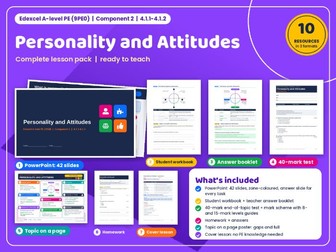
A complete, ready-to-teach pack for Pearson Edexcel A-level PE (9PE0) Component 2: Psychological and Social Principles of Physical Education, specification section 4.1.1-4.1.2: Personality and Attitudes. What’s covered: • Trait (innate) theory: Introvert/extrovert, neurotic/stable (Eysenck); Cattell’s 16 Personality Factors • Interactionist theory: Behaviour = function (personality, environment) • Personality structure: Hollander’s and Martens’ personality structure • Applying the theories: Applying personality theories to different sporting situations • Wood’s Triadic Model: Ideas/cognitions, emotions/affects (the spec prints ‘effects’) and actions/behaviour • Attitudes and behaviour: How attitudes are formed and shape behaviour • Changing attitudes: Negative to positive: creating cognitive dissonance (Festinger) What’s included (10 resources): • PowerPoint lesson: 42 zone-coloured slides with a starter, teaching slides, diagrams, independent tasks, exam practice and a 15-mark challenge, with an answer slide for every task • Student workbook that follows the lesson, plus a teacher answer booklet • End-of-topic test (40 marks) with a full mark scheme, including an 8-mark and a 15-mark question with levels guides • Homework (29 marks, 45 to 60 minutes) with answers: retrieval, apply it, an 8-mark exam question and stretch and challenge • Topic on a page revision poster, in gaps and full versions • Cover lesson for a non-specialist, with timings and staff answers Explain answers model PEE (Point, Example, Explanation), Describe answers use the W’s, and every evaluative point gives a clear judgement and its value. Fictional performers throughout. Supplied in Word, PowerPoint and PDF, so you can edit, print or project.
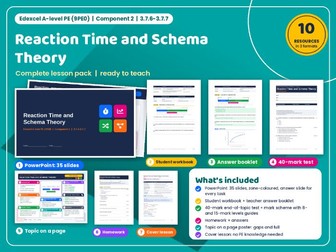
Edexcel A-level PE 3.7.6-3.7.7 Reaction Time and Schema Theory | Lesson, Workbook, Test & CoverQuick View
AllanaMcLean

Edexcel A-level PE 3.7.6-3.7.7 Reaction Time and Schema Theory | Lesson, Workbook, Test & Cover

(0)
A complete, ready-to-teach pack for Pearson Edexcel A-level PE (9PE0) Component 2: Psychological and Social Principles of Physical Education, specification section 3.7.6-3.7.7: Reaction Time and Schema Theory. What’s covered: • Reaction and response time: Measuring reaction and response times using appropriate technology; simple and choice reaction time • Hick’s law and data: Hick’s law; plotting, interpreting and analysing reaction and response time data • Psychological refractory period: The PRP; implications for a coach and performer in optimising performance • Schema theory: An organised package of information in the LTM that updates and modifies motor programmes; recall and recognition schemas • Schema sources and implications: Initial conditions, response specifications, sensory consequences and movement outcomes; implications for a coach and performer What’s included (10 resources): • PowerPoint lesson: 35 zone-coloured slides with a starter, teaching slides, diagrams, independent tasks, exam practice and a 15-mark challenge, with an answer slide for every task • Student workbook that follows the lesson, plus a teacher answer booklet • End-of-topic test (40 marks) with a full mark scheme, including an 8-mark and a 15-mark question with levels guides • Homework (28 marks, 45 to 60 minutes) with answers: retrieval, apply it, an 8-mark exam question and stretch and challenge • Topic on a page revision poster, in gaps and full versions • Cover lesson for a non-specialist, with timings and staff answers Explain answers model PEE (Point, Example, Explanation), Describe answers use the W’s, and every evaluative point gives a clear judgement and its value. Fictional performers throughout. Supplied in Word, PowerPoint and PDF, so you can edit, print or project.