A practical one-page guide to help schools begin developing their 2026–27 Inclusion Strategy. Ideal as a starter activity for SENCOs and inclusion leaders or as an overview to share with SLT, governors and trustees before beginning the full strategy-writing process.
Designed as a quick starting point, the resource helps schools organise their initial thinking and identify the areas that need to be considered as the strategy is developed.
It can be used to support an early leadership discussion, help establish next steps and provide a simple structure for beginning the process.
Suitable for headteachers, SENCOs, SEND and inclusion leaders, senior leaders, governors and trustees.
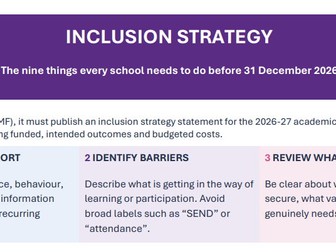
The DfE has provided schools with an Inclusion Strategy template. The harder part is deciding what should go into it.
Writing Your Inclusion Strategy is a practical workbook for headteachers, SENCOs and senior leaders who want to develop a meaningful Inclusion Strategy for their own school, not simply complete a template.
The workbook takes you through the thinking behind the strategy: understanding your cohort, identifying the barriers pupils experience, reviewing what is already in place, choosing priorities, planning activity and funding, agreeing intended outcomes and deciding how implementation and impact will be reviewed.
Designed to be used, not simply read.
Work through it independently, use it to structure an SLT planning session, or take individual sections into discussions with governors, trustees, phase leaders and other colleagues.
The workbook includes practical planning tools throughout, alongside illustrative worked examples showing how evidence can be developed into barriers, priorities, activity and outcomes.
It also includes worked examples for primary, secondary and small/rural school contexts, helping leaders see how the process can be applied without suggesting that every school should arrive at the same strategy.
The final sections bring the work together through a strategy-on-a-page, detailed priority planners and a website-ready structure for the published Inclusion Strategy.
Particularly useful for
Headteachers, SENCOs, SEND and inclusion leaders, SLT, governors and trustees in mainstream schools preparing their 2026–27 Inclusion Strategy.
Guidance checked against current DfE Inclusion Strategy and Inclusive Mainstream Fund guidance.
Adaptive Teaching for Mainstream Schools
A ready-to-use professional development presentation for schools exploring adaptive teaching and SEND within the mainstream classroom.
The presentation begins with the SEND Code of Practice and the relationship between high-quality teaching and special educational provision before moving into practical approaches teachers can use within everyday classroom practice, using the EEF 5 a day SEND Recommendations.
The presentation covers
The SEND Code of Practice and the definition of special educational provision
The importance of making high-quality teaching ordinarily available to pupils
What adaptive teaching means in practice
Taking account of prior knowledge, skills, barriers and misconceptions
Flexible grouping
Cognitive and metacognitive strategies
Explicit instruction
Effective use of technology
Scaffolding
Practical classroom examples for each approach
Questions for staff and whole-school reflection.
Examples include temporary and purposeful grouping, pre-teaching vocabulary, chunking tasks, checklists and prompts, worked examples, teacher modelling, visualisers, writing frames, knowledge organisers and strategies for supporting classroom routines.
The final section provides reflection questions that can be used to support professional discussion about whether adaptive teaching is understood and used consistently across a school.
Suitable for
Whole-school staff meetings
SEND CPD
SENCO-led professional development
Teacher development
ECT development
Teaching assistant development
Inclusion-focused training
Mainstream primary and secondary schools.
The presentation can be used as a complete staff-development session or adapted by the SENCO or school leader to suit the context of their school.
13-slide editable PowerPoint presentation.
Created by Ordinary Classrooms Educational Consultancy
#Getting to Know Your New Class
10 Inclusive Transition Questions for Teachers
A simple, practical transition resource to help teachers think carefully about the pupils they are about to teach.
Designed for use at the beginning of a new school year, during transition meetings or when taking over a new class, this two-page resource encourages teachers to look beyond names, labels and paperwork and focus on the information that will genuinely help pupils settle, participate and learn.
The first page provides 10 inclusive transition questions to guide professional conversations and help teachers identify what they need to know before pupils arrive.
The second page provides space to capture the most useful information under three straightforward headings:
What do I need to know before day one?
What worked last year?
What does the pupil say helps?
A final Keep / Adapt / Check prompt supports teachers in turning transition information into practical classroom decisions.
This resource can be used:
During staff transition meetings
Between previous and new class teachers
Alongside SENCO or pastoral discussions
As part of September INSET
When a pupil joins a class during the school year
To support inclusive classroom planning
The emphasis is on making good use of what is already known about a pupil, avoiding unnecessary repetition and helping teachers start the year with a clearer understanding of the children in front of them.
Suitable for primary and secondary teachers, SENCOs, pastoral leaders and teaching teams.
Format: 2-page PDF.
Produced by Ordinary Classrooms Educational Consultancy Ltd
Designed for Designated Safeguarding Leads, headteachers, senior leaders and safeguarding governors/trustees**, this practical briefing takes the substantive changes in KCSIE 2026 and translates them into clear implications for school practice.
The resource focuses on the areas leaders are most likely to need to review for September, including changes affecting staff responsibilities, safeguarding terminology and thresholds, child-on-child abuse, online safety, information sharing, filtering and monitoring, safer recruitment and wider safeguarding assurance.
Rather than reproducing the guidance, the briefing helps leaders answer the more useful questions:
What has actually changed?
What does my school need to review?
Who needs to know?
What evidence should we have in place?
Throughout the pack, Ordinary Classrooms School Action prompts turn the revised guidance into practical next steps, making the resource useful for DSL preparation, leadership discussion, policy review and governor or trustee assurance.
The pack also includes an implementation checklist and key questions to support schools in checking that the changes have moved beyond policy updates into day-to-day safeguarding practice.
Please note
This resource is designed to support schools in understanding and implementing the changes within KCSIE 2026. It does not replace the statutory guidance itself, local safeguarding partnership procedures or professional safeguarding advice. Schools should always refer directly to the current version of Keeping Children Safe in Education and other relevant Department for Education guidance when reviewing their policies, procedures and practice.
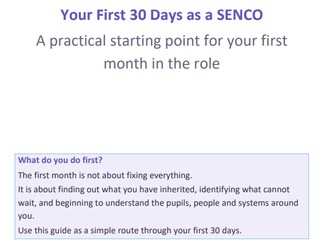
A practical guide for teachers who are new to the SENCO role.
Your First 30 Days as a SENCO takes you through the first month in manageable stages, helping you identify what needs attention first, understand the pupils and systems you have inherited, and begin establishing a workable SENCO routine.
Designed specifically for brand-new SENCOs working in schools in England
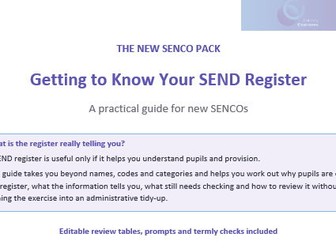
Getting to Know Your SEND Register
A practical, editable resource for new SENCOs who need to understand what the SEND register is telling them and how to review it confidently.
The SEND register is often one of the first things a new SENCO inherits. It can be tempting to treat it as a spreadsheet to tidy, but the register should help you understand the pupils behind the names, the evidence informing identification and the provision currently in place.
This resource takes new SENCOs through that process step by step.
The resource includes
An explanation of what the SEND register is for
A whole-school SEND register overview
SEN Support and EHC plan analysis
Pupil-by-pupil SEND register review
Questions to ask before identifying a pupil as having SEN
Guidance on the four broad areas of need
Checks linking SEND identification to classroom and additional provision
Parent/carer and pupil voice prompts
Questions to use before adding a pupil to SEN Support
Guidance for reviewing whether SEN Support is still required
A termly SEND register review
Action-planning tools
A final section completion checklist.
Designed specifically for new SENCOs
The resource does not assume that you already know how to review a SEND register.
Each section explains:
What you are looking at
Why it matters
What questions to ask
What should prompt further investigation
What to do with the information you find.
The emphasis throughout is on understanding before changing.
A pupil should not be added to SEN Support simply because they are low attaining, have a diagnosis or display challenging behaviour. Equally, a pupil should not be removed simply because their attainment has improved. The resource helps new SENCOs consider the evidence, provision and pupil response behind those decisions.
Editable and reusable
The pack is supplied as an editable Word document, allowing SENCOs to:
Type directly into the review tables
Add additional rows
Adapt the resource for their school
Use the termly review section repeatedly
Print individual pages where required.
Suitable for
Newly appointed SENCOs
Teachers preparing to take on the SENCO role
SENCOs who have inherited an existing SEND register
Schools supporting a colleague who is new to SEND leadership
SENCO induction and mentoring.
The resource is written for schools in England and should be used alongside current statutory SEND guidance, local authority arrangements and school policies.
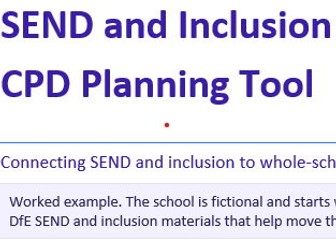
This practical planning tool helps schools connect the new DfE SEND and inclusion training materials to existing whole-school improvement priorities.
The starting point is the school’s own evidence about learners, teaching and current practice. From there, leaders can identify where SEND and inclusion sit within priorities already being addressed through teaching and learning, attendance, behaviour, literacy, curriculum, safeguarding or wider school development.
The resource then supports schools to select professional development that will strengthen this work. The new DfE SEND and inclusion materials can be used alongside existing CPD, EEF guidance and other evidence-informed resources. They are not treated as a programme to complete. Schools choose the material that is relevant to an agreed priority and consider how learning will move into classroom practice.
The planning tool follows the improvement process from identifying the priority through to implementation and review. It helps leaders consider what staff already know, where practice is less consistent, what change they want to see, how professional learning will be introduced and revisited, and what evidence will be used to evaluate impact.
A completed worked example is also included. It shows how a fictional mainstream school might use the DfE materials to support an existing teaching and learning priority, with the impact reviewed through the school’s usual improvement cycle.
The resource is designed for SENCOs, inclusion leads, senior leaders, headteachers and colleagues responsible for professional development. It can be used individually, with a leadership team or as part of school improvement and CPD planning.
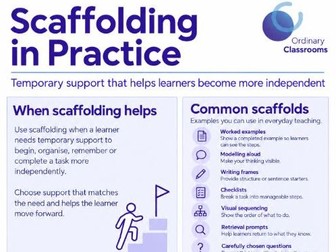
A one-page poster to support teachers and teaching assistants in using scaffolding effectively in the classroom.
The resource introduces common scaffolds, the principle of least help first and the importance of gradually reducing support as learners become more independent.
The resource can be used as a classroom reference, displayed in a staffroom, shared with teaching assistants or used as a prompt during professional development and discussions about ordinary provision.
It is designed to support inclusive classroom practice in mainstream schools and may be particularly useful for SENCOs, teachers, teaching assistants and school leaders developing a shared approach to scaffolding.


 Quick View