Quick Reading and Inference Comprehension – Setting and AtmosphereQuick View
elasticbandy

Quick Reading and Inference Comprehension – Setting and Atmosphere

(0)
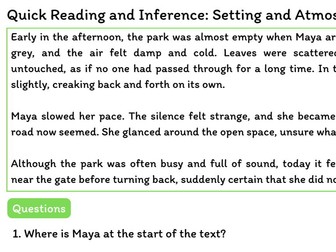
A short, focused reading and inference resource designed to help pupils explore how writers create setting and atmosphere using language and detail. This resource includes an original, age-appropriate reading extract set in a park and a series of questions that move from retrieval to inference and explanation. Pupils are encouraged to infer mood and atmosphere and support their ideas with evidence from the text. Suitable for Year 7 and upper KS2 pupils, and ideal for use as homework, cover work, starters or independent reading practice. The reading text uses age-appropriate vocabulary and includes statutory spellings to support spelling consolidation alongside reading comprehension and inference skills. What’s included: One original reading extract Comprehension and inference questions Vocabulary synonyms task linked to words from the text Full answer sheet with marking guidance This resource is low-prep, easy to mark, and supports the development of inference skills without relying on any prior text knowledge.
Quick Reading and Inference Comprehension – Actions and MotivationQuick View
elasticbandy

Quick Reading and Inference Comprehension – Actions and Motivation

(0)
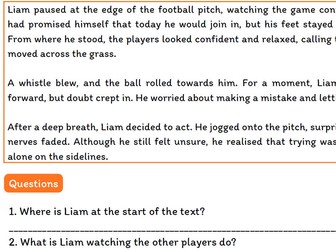
A short, focused reading and inference resource designed to help pupils explore how a character’s actions reveal motivation and decision-making. This resource includes an original, age-appropriate reading extract and a range of questions that guide pupils from retrieval to inference and explanation. Pupils are encouraged to consider why a character behaves in a certain way and how actions can show changes in attitude or confidence. Suitable for Year 7 and upper KS2 pupils, and ideal for use as homework, cover work, starters or independent reading practice. The reading text uses age-appropriate vocabulary and includes statutory spellings to support spelling consolidation alongside reading comprehension and inference skills. What’s included: One original reading extract Comprehension and inference questions Vocabulary synonyms task linked to words from the text Full answer sheet with marking guidance This resource is low-prep, easy to mark, and supports the development of inference skills without relying on any prior text knowledge.
Quick Reading and Inference Bundle – Character, Setting and MotivationQuick View
elasticbandy

Quick Reading and Inference Bundle – Character, Setting and Motivation

(0)
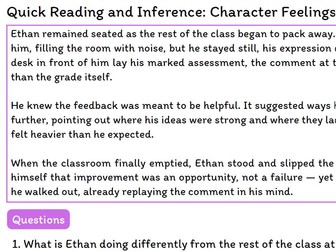
A complete bundle of three short, focused reading and inference resources designed to develop pupils’ inference skills across different reading focuses. Each resource includes an original, age-appropriate reading extract and a structured set of questions that move from retrieval to inference and explanation. Together, the three resources allow pupils to practise inferring meaning from character feelings, setting and atmosphere, and actions and motivation. Suitable for Year 7 and upper KS2 pupils, and ideal for use as homework, cover work, starters or independent reading practice. The texts use age-appropriate vocabulary and include a range of statutory spellings to support spelling consolidation alongside reading comprehension and inference skills. What’s included Quick Reading and Inference: Character Feelings Quick Reading and Inference: Setting and Atmosphere Quick Reading and Inference: Actions and Motivation Each resource includes: One original reading extract Comprehension and inference questions A vocabulary synonyms task linked to words from the text A full answer sheet with marking guidance
Year 9 Reading and Inference – Character Perspective (Pre-GCSE Skills)Quick View
elasticbandy

Year 9 Reading and Inference – Character Perspective (Pre-GCSE Skills)

(0)
A short, high-challenge reading and inference resource designed specifically for Year 9 pupils, bridging KS3 reading skills and pre-GCSE analytical thinking. This resource uses an original, age-appropriate text that requires pupils to infer a character’s perspective, attitudes and internal conflict through subtle language choices rather than explicit emotion. Questions move from retrieval to inference and explanation, encouraging pupils to select evidence and consider writer intention. Ideal for developing confident inference skills before GCSE English Language. Suitable for use as homework, independent practice, cover work or reading starters. The reading text includes challenging vocabulary and statutory spellings, alongside a focused vocabulary task to support academic language development. What’s included One original reading extract (Year 9 appropriate) Inference questions focused on character perspective Pre-GCSE style explanation questions Vocabulary synonyms task using higher-level vocabulary Full answer sheet with marking guidance
Year 9 Reading and Inference – Actions, Decisions and Consequences (Pre-GCSE Skills)Quick View
elasticbandy

Year 9 Reading and Inference – Actions, Decisions and Consequences (Pre-GCSE Skills)

(0)
A challenging reading and inference resource designed for Year 9 pupils, focusing on how a character’s actions and decisions reveal consequences and responsibility. This resource uses an original, age-appropriate text that requires pupils to infer meaning from behaviour rather than explicit explanation. Questions encourage pupils to track changes in attitude, consider motivation, and explain the impact of choices, supporting the transition from KS3 reading skills to GCSE-style thinking. Ideal for developing thoughtful, analytical responses before GCSE English Language. Suitable for homework, independent practice, cover lessons or reading starters. The text includes challenging vocabulary and statutory spellings, alongside a targeted vocabulary task to support academic language development. What’s included One original reading extract (Year 9 appropriate) Inference questions focused on actions and consequences Questions requiring explanation and evaluation Vocabulary synonyms task using higher-level vocabulary Full answer sheet with marking guidance
Year 9 Reading and Inference Bundle – Pre-GCSE Skills (Character, Setting & Decisions)Quick View
elasticbandy

Year 9 Reading and Inference Bundle – Pre-GCSE Skills (Character, Setting & Decisions)

(0)
A high-challenge bundle of three reading and inference resources designed specifically for Year 9 pupils, bridging KS3 reading skills and pre-GCSE analytical thinking. Each resource uses an original, age-appropriate text and focuses on a different inference strand, requiring pupils to interpret meaning through language choices, behaviour, setting and symbolism, rather than relying on explicit explanation. Together, the resources develop confident inference, evidence selection and explanation skills in preparation for GCSE English Language. Ideal for use throughout Year 9 as pupils transition from KS3 to GCSE-style reading. Suitable for homework, independent practice, cover lessons, reading starters or intervention work. The texts include challenging vocabulary and statutory spellings, alongside focused vocabulary tasks to support academic language development. What’s included Quick Reading and Inference: Character Perspective (Year 9) Focus on internal conflict, reflection and viewpoint Quick Reading and Inference: Setting, Mood and Symbolism (Year 9) Focus on atmosphere, symbolism and writer’s intention Quick Reading and Inference: Actions, Decisions and Consequences (Year 9) Focus on motivation, responsibility and the impact of choices Each resource includes: One original reading extract (Year 9 appropriate) Structured inference questions moving from retrieval to explanation Vocabulary synonyms task using higher-level vocabulary Full answer sheet with marking guidance
English SPaG Homework – Capital Letters & Full StopsQuick View
elasticbandy

English SPaG Homework – Capital Letters & Full Stops

(0)
A clear, printable English SPaG homework worksheet focusing on the accurate use of capital letters and full stops. This resource is designed to help pupils apply punctuation rules correctly, including identifying missing capital letters, removing incorrect capital letters, and writing clear, complete sentences. Suitable for upper primary (Year 6), KS3 / Year 7, and for use as homework, cover work or independent practice. What’s included: 15-question SPaG homework task 10 fix-the-sentence questions 4 write-your-own sentence tasks Clear learning objective and skills-based success criteria Full answer sheet with marking guidance This resource is low-prep, easy to mark, and ideal for reinforcing key sentence punctuation skills.
English SPaG Homework Bundle – Capital Letters, Commas in Lists & Sentence TypesQuick View
elasticbandy

English SPaG Homework Bundle – Capital Letters, Commas in Lists & Sentence Types

(0)
A complete bundle of three clear, printable English SPaG homework worksheets focusing on core sentence and punctuation skills. This bundle is designed to support pupils in applying key grammar and punctuation rules accurately through practice and consolidation tasks. Each worksheet follows the same consistent structure and is intended for independent work, assuming prior teaching of the skills. Suitable for upper primary (Year 6), KS3 / Year 7, and for use as homework, cover work or independent practice. What’s included: English SPaG Homework – Capital Letters & Full Stops English SPaG Homework – Commas in Lists English SPaG Homework – Sentence Types (Simple, Compound and Complex) Each worksheet includes: 12 - 15 question SPaG homework task A mix of fix-the-sentence and write-your-own sentence questions Clear learning objective and skills-based success criteria Full answer sheet with marking guidance This bundle is low-prep, easy to mark, and ideal for reinforcing essential sentence punctuation and grammar skills across upper primary and KS3.
English SPaG Homework – Sentence Types (Simple, Compound and Complex)Quick View
elasticbandy

English SPaG Homework – Sentence Types (Simple, Compound and Complex)

(0)
A clear, printable English SPaG homework worksheet focusing on identifying and writing simple, compound and complex sentences. This resource is designed to help pupils recognise different sentence types and apply their understanding by rewriting and creating sentences using appropriate conjunctions. It is intended as a practice and consolidation task, assuming prior teaching of sentence types. Suitable for upper primary (Year 6), KS3 / Year 7, and for use as homework, cover work or independent practice. What’s included: 12-question SPaG homework task Identification of simple, compound and complex sentences Sentence rewriting tasks Write-your-own sentence tasks Clear learning objective and skills-based success criteria Full answer sheet with marking guidance This resource is low-prep, easy to mark, and ideal for reinforcing sentence structure and punctuation skills.
Quick Reading and Inference Comprehension – Character FeelingsQuick View
elasticbandy

Quick Reading and Inference Comprehension – Character Feelings

(0)
A short, focused reading and inference resource designed to help pupils practise inferring a character’s feelings using evidence from the text. This resource includes an original, age-appropriate reading extract and a range of questions that move from retrieval to inference and explanation. It is designed as a quick task that can be completed independently. Suitable for Year 7 and upper KS2 pupils, and ideal for use as homework, cover work, starters or independent reading practice. The reading text uses age-appropriate vocabulary and includes statutory spellings to support spelling consolidation alongside reading comprehension skills. What’s included: One original reading extract Comprehension and inference questions Vocabulary synonyms task linked to words from the text Full answer sheet with guidance This resource is low-prep, easy to mark, and supports the development of inference skills without relying on any prior text knowledge.
Year 9 Reading and Inference – Setting, Mood and Symbolism (Pre-GCSE Skills)Quick View
elasticbandy

Year 9 Reading and Inference – Setting, Mood and Symbolism (Pre-GCSE Skills)

(0)
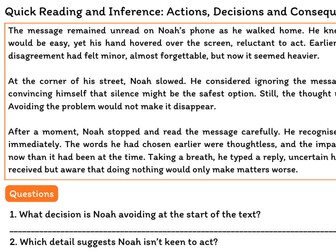
A challenging reading and inference resource designed for Year 9 pupils, focusing on how writers use setting, mood and symbolism to create meaning. This resource uses an original, age-appropriate text set in a school corridor after hours. Pupils are required to move beyond simple description and infer mood, atmosphere and symbolic meaning through language choices and detail. Questions are structured to support pre-GCSE thinking without using exam-heavy terminology. Ideal for developing confident inference and analytical skills in preparation for GCSE English. Suitable for use as homework, independent practice, cover work or reading starters. The text includes challenging vocabulary and statutory spellings, alongside a focused vocabulary task to support academic language development. What’s included One original reading extract (Year 9 appropriate) Inference questions focused on setting and mood Symbolism question requiring explanation and interpretation Vocabulary synonyms task using higher-level vocabulary Full answer sheet with marking guidance
English SPaG Homework – Commas in ListsQuick View
elasticbandy

English SPaG Homework – Commas in Lists

(0)
A clear, printable English SPaG homework worksheet focusing on the correct use of commas in lists. This resource helps pupils identify lists in sentences and apply commas accurately to separate items. Pupils practise correcting sentences with missing commas and writing their own sentences that include lists. Suitable for upper primary (Year 6), KS3 / Year 7, and for use as homework, cover work or independent practice. What’s included: 15-question SPaG homework task 10 fix-the-sentence questions 4 write-your-own sentence tasks Clear learning objective and skills-based success criteria Full answer sheet with marking guidance This resource is low-prep, easy to mark, and ideal for reinforcing accurate punctuation in sentence writing.
Metaphor Repair Task – Whole Class Feedback Worksheet (KS3 English)Quick View
elasticbandy

Metaphor Repair Task – Whole Class Feedback Worksheet (KS3 English)

(0)
A ready-to-use “Whole Class Feedback” worksheet designed to help KS3 pupils improve their metaphor writing. This sheet tackles common misconceptions (e.g., using adjectives instead of nouns), provides clear models, and includes three engaging repair tasks: Task 1: Choose the best noun to form a vivid metaphor Task 2: Transform similes into expanded metaphors Task 3: Select the best metaphor for a theme and explain why Perfect for low–mid ability groups, cover lessons, intervention, and feedback lessons. Clear, accessible layout with pupil-friendly examples. Ideal for Years 7–9. What’s included: ✔ Whole-class feedback explanation ✔ 3 scaffolded repair tasks ✔ Model examples ✔ Colourful, visual layout ✔ Great for literacy, creative writing & descriptive techniques Format: PDF (A4)
Drama Christmas Advert Design Task (KS2/KS3)Quick View
elasticbandy

Drama Christmas Advert Design Task (KS2/KS3)

(0)
This Christmas Drama activity asks pupils to design and advertise their own magical festive product. The worksheet guides them through each step of the creative process, including: Product name Advertising slogan What the product does Who it is for Special features A labelled product design illustration An example is included to model expectations and support pupils with generating detailed, imaginative ideas. This makes the task accessible for lower-ability students while still offering opportunities for more confident pupils to extend their work. This resource is suitable for use in Drama, English, Art/Design crossover lessons, form activities, enrichment sessions, or as a fully independent cover lesson. It works particularly well in the final weeks of term. What’s Included: PDF version of the worksheet (ready to print) Editable PowerPoint (.pptx) version for teachers who want to customise sections or add their own examples Suggested Uses: Christmas Drama lesson Advertising and design task Creative writing Independent cover work Group or individual design projects Recommended Age Range: Upper KS2 and KS3 (ages 9–14)
Dulce et Decorum Est – Supported Analysis Worksheet (KS3/KS4)Quick View
elasticbandy

Dulce et Decorum Est – Supported Analysis Worksheet (KS3/KS4)

(0)
This resource provides a high-support, structured set of analysis questions for Dulce et Decorum Est by Wilfred Owen. It is designed for students who need step-by-step guidance when analysing poetry, including those in lower-ability GCSE classes or upper KS3. The worksheet includes: The full poem for annotation Success criteria written in pupil-friendly statements (e.g., “I can explain the effect on the reader”) Highly structured questions on key language techniques: Metaphor Sibilance Plosive sounds Semantic field Irony Oxymoron Each question prompts students to explain: What the technique is Which specific words create it The effect on the reader How it links to conflict, fear, suffering, or war Why the poet uses the technique The resource also includes a clear Key Context section summarising essential WWI information, including trench conditions, gas attacks, propaganda, and the meaning of “Dulce et decorum est pro patria mori.” This context supports students in developing deeper, more accurate explanations. The sheet concludes with a Challenge task on imagery through adjectives, allowing more confident pupils to push their analysis further. This worksheet is suitable for: KS3 poetry units GCSE English Literature support Differentiated tasks Homework Cover lessons Targeted intervention or revision
Cirque du Freak Chapter 6 – VIPERS Comprehension Reading Questions (KS3)Quick View
elasticbandy

Cirque du Freak Chapter 6 – VIPERS Comprehension Reading Questions (KS3)

(0)
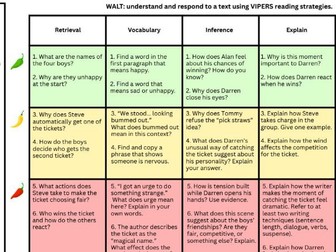
This structured KS3 reading resource is based on Chapter 6 of Cirque du Freak and uses VIPERS question stems to build comprehension, vocabulary, and inference skills. Page 1 includes the full text extract from Chapter 6 with a clear layout, making it easy for pupils to annotate as they read. Page 2 contains the full task instructions and five categories of questions (Retrieval, Vocabulary, Inference, Explain, Summarise), each offering a range of difficulty levels. A chilli challenge allows pupils to self-differentiate by choosing both a comfortable question and a more challenging one. The sheet also includes a prediction question to develop forward-thinking and justification skills. CDF Chapter 6 This worksheet can be used for: KS3 English lessons Homework Reading intervention Guided reading Independent cover work Assessing comprehension using VIPERS strategies The questions cover: Retrieval of key events Word meaning (e.g., urge, bummed out, magical, context clues) Inference about characters’ feelings (e.g., Alan, Darren, Tommy) Explanation of tension and techniques used by the writer Summarising key moments Predicting next events based on evidence The resource provides substantial support for emerging or reluctant readers while still offering challenge for more confident pupils.
Drama Starter Cards – “Let’s…” Action Prompts for KS2/KS3Quick View
elasticbandy

Drama Starter Cards – “Let’s…” Action Prompts for KS2/KS3

(0)
This resource contains a set of 16 printable Drama prompt cards using the repeated stem “Let’s…”, ideal for movement work, improvisation starters, drama games, or fast-paced warm-ups. Each card provides a simple action that pupils can interpret physically, verbally, or creatively. Prompts include a mix of everyday actions (e.g., “Let’s… bake a cake!”), imaginative tasks (e.g., “Let’s… run from a dinosaur!”), seasonal moments (e.g., “Let’s… build a snowman!”), and expressive physical challenges (e.g., “Let’s… walk a tightrope!”). All cards are clearly presented over two printable A4 pages. Let’s… Drama Cards (2) These cards can be used for: Drama starters and warm-ups Transition tasks Pair or group improvisation Physical theatre activities Pantomime-style actions Cover lessons Quick, engaging tasks for KS2–KS3 You can print, cut out, and laminate the cards for long-term classroom use.
Oracy Skills Lesson Pack – Speaking Skills & Tongue Twisters (KS3)Quick View
elasticbandy

Oracy Skills Lesson Pack – Speaking Skills & Tongue Twisters (KS3)

(0)
This resource provides a complete KS3 oracy skills package, perfect for English, Drama or Speaking & Listening lessons. Page 1 contains a structured ranking task in which pupils evaluate four core oracy skills — clarity, expression, confidence and eye contact — deciding which are most valuable for effective speaking. They justify their choices twice: once at the start, and again after discussion or practice, encouraging metacognition and growth. A reflection section supports self-assessment of progress and targets for future speaking tasks, such as podcasts. A clear success criteria checklist is also included. Oracy Skills KS3 Page 2 includes a curated selection of tongue-twisters such as Unique New York, The Baker’s Butter Blunder and Bobby Bippy Bought a Bat. These can be used for warm-ups, clarity practice, articulation drills, or confidence-building activities. These are ideal for group work, paired practice or whole-class starters. Oracy Skills KS3 This resource works well for: KS3 English speaking and listening Drama warm-ups Oracy-focused lessons Preparation for podcasts, presentations or debates Starter or plenary activities Cover lessons Form time literacy enrichment
Different types of triangles (Curriculum Cymraeg)Quick View
elasticbandy

Different types of triangles (Curriculum Cymraeg)

(19)
Triangle lesson explaining the different types of triangles. Powerpoint included making use of Curriculum Cymraeg (for those of you in Wales!) to find different types of triangles within the pictures. Also included triangle hunt worksheet for around the classroom/school. Could hunt for triangular windows or the shape of house roofs etc.
Choosing appropriate units of measure (km/m/cm/mm)Quick View
elasticbandy

Choosing appropriate units of measure (km/m/cm/mm)

(5)
A simple worksheet I gave to my kids to introduce choosing appropriate units of measure. I gave a sheet out between groups of 4 and they had to discuss and decide which unit of measure would be best for each picture. I gave my LA the second sheet and they had to cut out the pictures and stick them into the correct box that they thought they should go in with a TA. They all had to explain why they chose the units they did. I also got them to guess how far it was from Lands End to John O'Groats before showing them on google maps. Had some interesting answers!
KS3 English Emotive Vocabulary Mat with Rule of Three Punctuation GuideQuick View
elasticbandy

KS3 English Emotive Vocabulary Mat with Rule of Three Punctuation Guide

(0)
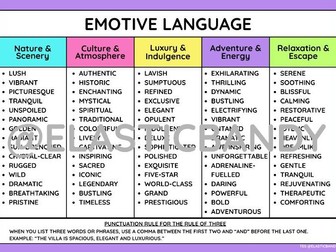
A one-page, student-friendly word mat to help pupils improve persuasive and descriptive writing. Includes: 60+ emotive words, grouped into 5 categories (Nature, Culture, Luxury, Adventure, Relaxation) Mix of accessible and ambitious vocabulary Reminder of the Rule of Three punctuation rule at the bottom Clear, printable design for books or classroom display Perfect for: Persuasive writing (e.g. travel brochures, speeches) GCSE English Language Paper 2 Creative and descriptive writing KS3 vocabulary building and scaffolding Format: PDF (printable as A4)