

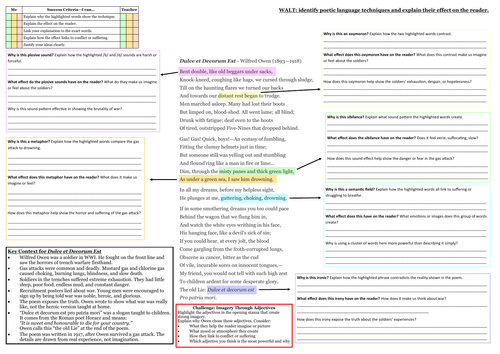

I originally made this worksheet for a high-attaining Year 9 class studying Dulce et Decorum Est, but it would also work well as a supported GCSE poetry task.
The questions break the analysis down step by step, so pupils are not just being asked to “analyse the poem” with no guidance. They are directed towards particular techniques and then asked to explain the words Owen has used, the effect on the reader, and how this links to ideas about war, conflict and suffering.
The worksheet covers:
- metaphor
- sibilance
- plosive sounds
- semantic field
- irony
- oxymoron
There is also a short context section covering trench conditions, gas attacks, propaganda and the meaning of the Latin quotation at the end of the poem.
I would recommend this for higher-attaining KS3 pupils, particularly Year 9, or for GCSE classes who need a more structured approach to poetry analysis. It may be too demanding for lower-attaining KS3 pupils to complete independently.
Useful for classwork, cover, homework, revision or as a differentiated poetry task.
Something went wrong, please try again later.
In today's world, this worksheet is a bit challenging for lower ability pupils. I would say it is suitable for National 5 (Scotland) rather than a lower S3 set.
Report this resourceto let us know if it violates our terms and conditions.
Our customer service team will review your report and will be in touch.
£2.00