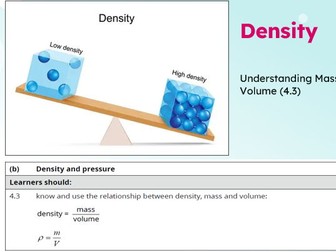
This lesson covers spec point 4.3 — knowing and using ρ = m/V to calculate density, mass and volume of regular objects.
PowerPoint includes:
Retrieval starter with questions reviewing prior knowledge and answers revealed
Direct Instruction (I Do) — clear explanation of density with worked examples and formula triangle
Guided Practice (We Do) — scaffolded problems worked through together
Independent Practice (You Do) — exam-style questions of increasing difficulty
Review and Reflect exit ticket with traffic light self-assessment
Activity Sheet includes:
10 exam-style questions using Edexcel command words, ranging from recall to extended writing
Stretch question for higher ability students
Full mark scheme for teacher use
This lesson is part of the complete Unit 4 resource pack, available separately at a discounted bundle price.
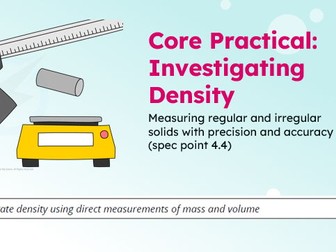
This lesson covers spec point 4.4 — investigating the density of regular and irregular objects using direct measurement and the Eureka can method.
PowerPoint includes:
Retrieval starter reviewing density calculations from Lesson 1
Direct Instruction (I Do) — step-by-step method for both regular and irregular objects
Guided Practice (We Do) — class demonstration with prediction and discussion
Independent Practice (You Do) — students carry out the practical in pairs
Review and Reflect — sources of error and evaluation discussion
Activity Sheet includes:
Results tables for regular and irregular objects
Reference table of common material densities
Part C analysis questions for regular objects
Part D analysis questions for the Eureka can method
Stretch comparison question
Full mark scheme for teacher use
This lesson is part of the complete Unit 4 resource pack, available separately at a discounted bundle price.
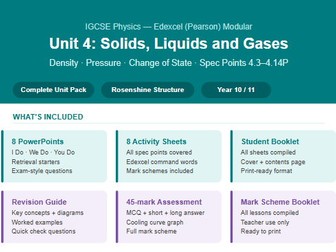
IGCSE Physics — Unit 4: Solids, Liquids and Gases | Complete Unit Resource Pack | Edexcel (Pearson) Modular
This is a fully complete, exam-ready resource pack for Unit 4 of the Pearson Edexcel International GCSE Physics (Modular) specification, covering spec points 4.3–4.14P. Every resource has been built specifically for the modular specification and is ready to use from day one.
What’s included:
8 PowerPoint Lesson Decks — each lesson is structured using the Rosenshine Principles of Instruction, with a clear I Do, We Do, You Do framework embedded throughout. Every lesson opens with a retrieval starter to activate prior knowledge and address misconceptions before new content is introduced. New material is introduced in small steps with clear worked examples (I Do), followed by scaffolded guided practice (We Do), building to independent exam-style practice (You Do). Lessons close with a review and reflect phase to consolidate learning.
8 Student Activity Sheets — one per lesson, covering all spec points including all three core practicals (4.4, 4.11P, 4.14P). Questions use Edexcel command words throughout and are pitched at the full range of ability, including stretch questions. Each sheet includes a full mark scheme.
Student Activity Booklet — all 8 activity sheets compiled into a single print-ready booklet with cover page and contents. Ideal for exercise book replacement or folder inserts.
Mark Scheme Booklet — all mark schemes compiled separately for teacher use.
Revision Guide — a visually rich student revision booklet covering all 8 topics. Each topic includes a concise summary, key equations, a fully worked example and quick check questions. Includes diagrams for particle arrangements, pressure, heating curves and more. Answers included at the back.
End of Unit Assessment — a 45-mark, 50-minute exam-style paper covering the full unit. Includes 5 multiple choice questions, short answer and extended writing questions, a cooling curve graph interpretation question, and answer lines throughout. A full mark scheme is included.
Topics covered:
Density of regular and irregular objects (4.3 & 4.4)
Pressure on solids (4.5)
Pressure in fluids (4.6 & 4.7)
Particle theory and changes of state (4.8P–4.10P)
Core practical: investigating change of state / stearic acid cooling curve (4.11P)
Specific heat capacity (4.12P & 4.13P)
Core practical: specific heat capacity of aluminium (4.14P)
Designed for: Pearson Edexcel International GCSE Physics (Modular) — 4XPH1, Unit 1. Suitable for Year 10 or Year 11 depending on your scheme of work.
Specification compliance: All resources are checked against the modular specification. No off-spec content (e.g. no percentage error questions). Practical skills are assessed through written questions in line with the examination approach.
Can be used for the linear course too.
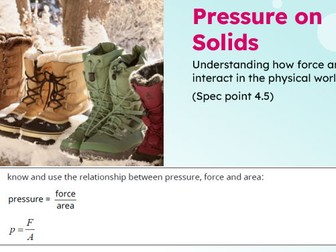
This lesson covers spec point 4.5 — knowing and using p = F/A to calculate pressure, force and area, and explaining real-world pressure scenarios.
PowerPoint includes:
Retrieval starter reviewing density and units from previous lessons
Direct Instruction (I Do) — pressure equation introduced with real-world examples including knives, snowshoes and caterpillar tracks
Guided Practice (We Do) — three worked problems with scaffolding and formula triangle
Independent Practice (You Do) — exam-style questions of increasing difficulty
True/False misconception check with reasoning reveal
Review and Reflect exit ticket
Activity Sheet includes:
9 exam-style questions using Edexcel command words
Questions covering calculation, explanation and application to real-world contexts
Stretch question linking pressure in solids to fluid pressure
Full mark scheme for teacher use
This lesson is part of the complete Unit 4 resource pack, available separately at a discounted bundle price.
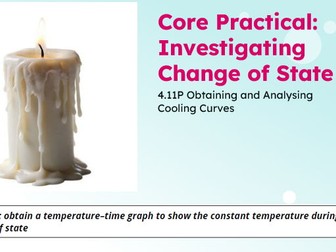
This two-lesson resource covers spec point 4.11P — obtaining a temperature-time graph to show constant temperature during a change of state, and identifying the freezing point of stearic acid.
PowerPoint includes:
Retrieval starter reviewing particle theory and energy changes from Lesson 5
Direct Instruction (I Do) — aim, method and safety explained clearly with equipment diagram
Guided Practice (We Do) — class synchronisation of first readings, prediction of plateau position
Lesson 1 Independent Practice — students carry out the cooling experiment in pairs, recording every 30 seconds
Lesson 2 Independent Practice — students plot their cooling curve, circle the plateau and evaluate their results
Sources of error analysis and command word matching activity
Review and Reflect exit ticket
Activity Sheet includes:
Lesson 1 data collection table (0–900 seconds, pre-filled time column)
Lesson 2 blank cooling curve graph grid (ready to plot)
6 analysis questions covering graph interpretation, particle explanation, sources of error and evaluation
Stretch prediction question
Full mark scheme for teacher use
This lesson is part of the complete Unit 4 resource pack, available separately at a discounted bundle price.
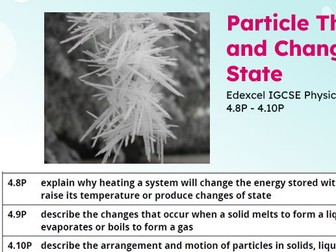
This lesson covers spec points 4.8P, 4.9P and 4.10P — describing particle arrangement and motion in solids, liquids and gases, and explaining heating curves in terms of kinetic and potential energy.
PowerPoint includes:
Retrieval starter reviewing changes of state and particle theory from prior learning
Direct Instruction (I Do) — particle models for all three states, energy changes during heating explained clearly
Guided Practice (We Do) — heating curve analysis worked through as a class
Independent Practice (You Do) — exam-style questions including heating curve interpretation
Misconception check on particle size during expansion
Review and Reflect exit ticket
Activity Sheet includes:
6 exam-style questions using Edexcel command words
Embedded heating curve diagram (water, ice to steam) with labelled sections A→E for students to interpret
Completion table linking graph sections to particle behaviour and energy changes
Stretch question on kinetic and potential energy during boiling
Full mark scheme for teacher use
This lesson is part of the complete Unit 4 resource pack, available separately at a discounted bundle price.
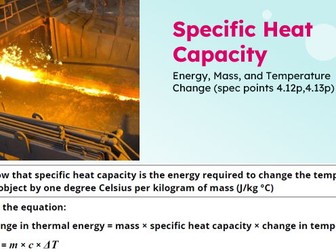
This lesson covers spec points 4.12P and 4.13P — defining specific heat capacity, and using ΔQ = mcΔT to calculate energy, mass, specific heat capacity and temperature change.
PowerPoint includes:
Retrieval starter reviewing change of state and energy from previous lessons
Direct Instruction (I Do) — SHC defined, equation introduced with two fully worked examples including rearranging for mass
Guided Practice (We Do) — three scaffolded problems of increasing difficulty
Independent Practice (You Do) — four exam-style questions including a mystery metal identification problem
High/low SHC misconception check with true/false reasoning reveal
Real-world application — Qatar beach sand vs sea context question
Review and Reflect exit ticket
Activity Sheet includes:
SHC reference table (water, sand, aluminium, copper, iron, lead)
8 exam-style questions using Edexcel command words
Questions covering calculation, rearrangement, explanation and real-world application
Stretch question using the Qatar beach/sand context
Full mark scheme for teacher use
This lesson is part of the complete Unit 4 resource pack, available separately at a discounted bundle price.
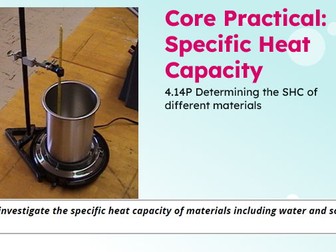
This two-lesson resource covers spec point 4.14P — investigating the specific heat capacity of aluminium using an immersion heater and joulemeter, calculating c from experimental results, and evaluating the method.
PowerPoint includes:
Retrieval starter requiring students to state and rearrange ΔQ = mcΔT
Direct Instruction (I Do) — apparatus explained including role of oil, insulation and joulemeter
Guided Practice (We Do) — assembly checklist, zeroing procedure and prediction of error direction
Lesson 1 Independent Practice — students carry out the experiment, recording mass, temperatures and energy
Lesson 2 Independent Practice — students calculate c, compare to accepted value of 900 J/kg°C and evaluate
Temperature lag concept explained with graph
Sources of error analysis and terminology matching activity
Review and Reflect exit ticket
Activity Sheet includes:
Lesson 1 data collection table
Calculation scaffold box: c = ΔQ ÷ (m × ΔT) = ___ ÷ (___ × ___) with comparison to accepted value
Lesson 1 analysis questions covering calculation, oil in holes, insulation and systematic error
Lesson 2 data analysis questions including temperature lag and larger block misconception
Stretch question on effect of block size on calculated c
Full mark scheme for teacher use
This lesson is part of the complete Unit 4 resource pack, available separately at a discounted bundle price.
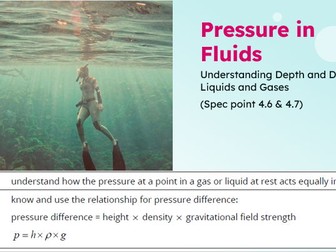
This lesson covers spec points 4.6 and 4.7 — explaining why pressure in a fluid acts equally in all directions, and using p = hρg to calculate pressure difference.
PowerPoint includes:
Retrieval starter reviewing pressure on solids from Lesson 3
Direct Instruction (I Do) — particle explanation of fluid pressure, p = hρg introduced with worked examples
Guided Practice (We Do) — scaffolded calculations including rearranging for depth and density
Independent Practice (You Do) — exam-style questions of increasing difficulty
Real-world application questions including dams and submarines
Review and Reflect exit ticket
Activity Sheet includes:
9 exam-style questions using Edexcel command words
Questions covering calculation, explanation and extended writing
Stretch question requiring multi-step calculation and reasoning
Full mark scheme for teacher use
This lesson is part of the complete Unit 4 resource pack, available separately at a discounted bundle price.
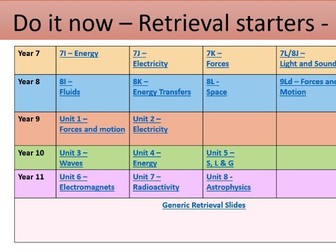
Set of slides for retrieval starters for Physics.
For years 7-11. The key stage 3 content follows the units for exploring science and is labelled that way.
The year 9-11 section is based on the Edexcel IGCSE Phyics qualification, but could be used for other exam boards.


 Quick View