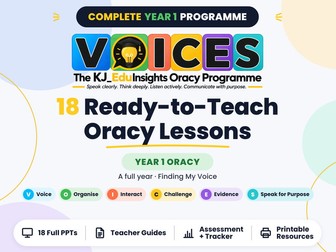
A complete, ready-to-teach Year 1 oracy programme: 18 lessons with editable PowerPoints, teacher guides, 117 pages of printables, a pupil talk book, built-in assessment and an Excel tracker. Everything you need to teach speaking and listening across the whole year.
Teach speaking and listening with confidence all year.
VOICES Finding My Voice is a complete Year 1 oracy programme. It gives you 18 short, fully resourced lessons that teach children to listen, take turns, speak clearly, give reasons and adapt how they speak for their audience. Assessment is built in, from a Lesson 1 baseline to a Lesson 18 showcase.
Each lesson takes 25–30 minutes and sits inside a normal subject such as English, maths, science or PSHE, so it fits into your timetable. Teach one lesson roughly every two weeks, with short daily routines in between to keep the skills going.
THE SIX VOICES STRANDS
Voice: volume, pace, clarity and expression
Organise: ideas in an order a listener can follow
Interact: listen, take turns and respond
Challenge: ask why and how, and disagree kindly
Evidence: give a reason with “because”
Speak for Purpose: think about who is listening
THE YEAR AT A GLANCE
Autumn, Build the Speaker: good listening, choosing your voice, speaking clearly, taking turns, putting ideas in order, giving a reason
Spring, Build the Thinker: asking why and how, listening for the important part, adding detail, speaking to a group, responding to others, disagreeing kindly
Summer, Build the Communicator: using expression, giving instructions, choosing helpful words, building a group answer, practising for an audience, the Year 1 VOICES Showcase
EVERY LESSON FOLLOWS THE SAME ROUTINE
Notice → Model → Rehearse → Apply → Reflect
Children spot the skill, watch you model it with a think-aloud, practise it safely with a partner, then use it for a real purpose.
WHAT’S INCLUDED (72 files)
18 editable PowerPoint lessons, 11 slides each, with full scripts in the speaker notes
18 four-page teacher guides with timings, scripts, what to listen for at each level, and an observation grid
117 pages of lesson resources: picture cards, sentence stems, display cards and talk-tool strips. These come as separate files for each lesson and in one bookmarked pack
My Talk Book: a 38-page pupil book with two pages per lesson. Children talk first, then draw, trace a sentence starter and colour a face for each success step
Lesson cards and a termly planner with between-lesson routines
Year 1 Assessment Pack, with four assessment points: Baseline, Checkpoint, Mid-Year and Final Showcase
Moderation exemplars at WT, E, ES and AE
Excel class tracker with drop-downs, a class dashboard and individual pupil profiles
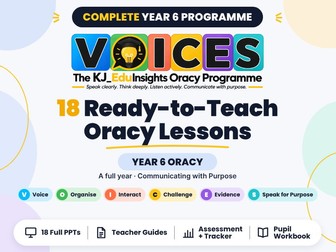
Oracy is becoming a new strand of the English national curriculum, with equal status to reading and writing. VOICES gives your Year 6 team a complete, fully resourced way to teach speaking and listening explicitly, starting this year.
Pupils learn to speak, listen and reason with purpose. Across the year they practise:
controlling their delivery and structuring ideas in real time
building defensible claims
probing and challenging fairly
weighing evidence and changing their minds for good reasons
chairing discussions
presenting to a real audience at an end-of-year showcase
WHAT’S INCLUDED
Teaching
18 ready-to-teach 45-minute lessons across Autumn, Spring and Summer
Editable PowerPoint for every lesson, with speaker notes on every slide
A 7-page Teacher Guide per lesson: script, model think-aloud, answers, common misconceptions, a 40-minute version and an observation grid
One-page Lesson Cards and a Termly Planner with daily transfer routines
A Curriculum Topic Bank of alternative discussion prompts from science, history, geography and reading
Pupil resources
56-page Pupil Workbook with Notice, Rehearse and Apply pages for every lesson
Toolkit Posters, Talk Desk Mats and Home Talk Cards for families
Assessment
Four assessment points built into the lessons: baseline, checkpoint, mid-year and final showcase
Clear WT / E / ES / AE descriptors for Year 6
Automatic Class Assessment Tracker (Excel), with a dashboard, pupil profiles and a Lesson Log
Model Standards and Year 6 moderation exemplars at every level
Observation Sheets, My VOICES Profiles and a Year 6 to Year 7 Transition Profile
End-of-year showcase
Running order, audience question cards, parent invitation and certificates
Whole-school leadership
Teacher Handbook and a Year 1–6 Curriculum Map
Implementation and CPD Pack: a 12-week launch plan, four staff CPD sessions, learning-walk tools and an audit
Classroom Display Pack and a Parent and Family Information Sheet
WHY TEACHERS CHOOSE VOICES
No specialist oracy training needed. Every lesson follows the same five steps: Notice, Model, Rehearse, Apply, Reflect.
It assesses the quality of talk, not confidence, accent or how much a pupil speaks.
It includes practical support for EAL, SEND and reluctant speakers, while keeping the thinking challenging.
It gives leaders clear evidence of oracy teaching and pupil progress across the year.
TRY BEFORE YOU BUY
Download Lesson 1 free and see the full lesson format: [https://www.tes.com/teaching-resource/resource-13610440]
[https://www.tes.com/teaching-resources/shop/kayj_10] VOICES covers Years 1–6. Year 6 is available now, and other year groups are coming soon.
LICENCE
A standard licence is for your own use. To share VOICES with colleagues, please buy the school licence.
Year 6 Autumn English & Maths Assessment Bundle | Complete KS2 Assessment Collection
Assess → Diagnose → Track Progress → Plan Intervention
Take the pressure out of Autumn assessment with this comprehensive KJ_EduInsights Year 6 English and Maths Assessment Bundle, designed for UK primary schools following the National Curriculum for England.
This collection brings together two detailed assessment programmes, complete with student booklets, teacher administration guides, mark schemes, writing moderation resources, mathematical worked solutions, SEND-accessible materials and Excel tracking tools.
Designed for November–December assessment, it helps teachers identify pupils’ strengths, pinpoint gaps in learning and plan targeted teaching and interventions for the Spring term.
ENGLISH AUTUMN ASSESSMENT – 100 MARKS
Assess pupils’ reading, grammar, spelling and independent writing through a structured, curriculum-linked assessment.
Assessment coverage:
Reading comprehension – 20 marks
Grammar and punctuation – 20 marks
Spelling dictation – 20 marks
Independent diary writing – 20 marks
Independent persuasive letter – 20 marks
**Included English resources:
**
Book 1 – Teacher Administration Guide
Book 2 – Student Assessment Booklet
Separate fiction and non-fiction Reading Insert
Book 3 – Teacher Mark Scheme and Spelling Script
Book 4 – Annotated Writing Exemplification
Book 5 – Curriculum Mapping and Intervention Guide
SEND / Accessible Student Assessment Booklet
SEND / Accessible Reading Insert
Autumn English Excel Assessment Tracker
Year 6 English Annual Progress Tracker
Writing support includes illustrative examples across the internal WT, E, ES and AE attainment bands, alongside assessment rubrics and moderation guidance.
MATHS AUTUMN ASSESSMENT – 90 OR 100 MARKS
Assess pupils’ mathematical fluency, written calculations, reasoning and problem-solving skills through manageable 10-mark assessment blocks.
Assessment coverage:
Number and Place Value
Four Operations
Factors, Multiples, Prime, Square and Cube Numbers
Order of Operations
Fractions A – Equivalence, Comparison, Addition and Subtraction
Fractions B – Multiplication, Division and Fractions of Amounts
Converting Units – Optional 10-mark block
The core Maths assessment is worth 90 marks, extending to 100 marks when the optional Converting Units section is included.
Included Maths resources:
Book 1 – Teacher Administration Guide
Book 2 – Student Assessment Booklet
Book 3 – Teacher Mark Scheme
Book 4 – Worked Solutions and Common Misconceptions
Book 5 – Curriculum Mapping and Intervention Guide
Book 7 – SEND / Accessible Student Booklet
Full-Year Maths Assessment Tracker
Own-Baseline Maths Assessment Tracker
The Maths assessment uses a simplified marking system. Teachers record marks in blocks of 10, reducing the time spent adding scores.
The Excel trackers calculate totals, percentages and internal attainment indicators, while supporting the identification of priority teaching areas.
SEND AND ACCESSIBILITY
Both subjects include accessible-layout assessment materials.
Clearer question presentation
Increased spacing and larger text
Additional working or writing space
Accessible reading layouts
Square-grid working areas in the revised SEND Maths booklet
Guidance for reasonable adjustments and assessment administration
These materials retain the original assessment objectives and are designed to support accessibility without automatically reducing the difficulty of the questions.
ASSESSMENT ANALYSIS AND PROGRESS TRACKING
Go beyond simply recording test scores.
The accompanying Excel workbooks support teachers in:
Recording assessment results efficiently
Calculating totals and percentages automatically
Identifying strengths and learning gaps
Reviewing internal attainment indicators
Comparing assessment performance over time
Supporting pupil progress meetings
Planning targeted Spring interventions
The Maths collection includes an alternative tracker for schools using their own baseline assessment data.
WHY CHOOSE KJ_EDUINSIGHTS?
Unlike a standalone test paper, this bundle supports the complete assessment cycle.
Assess: Use structured English and Maths assessments linked to selected National Curriculum objectives.
Diagnose: Identify specific gaps through marking, curriculum mapping and analysis.
Moderate: Support consistent marking through teacher guidance, writing exemplars and mathematical worked solutions.
Track: Record attainment and review changes over time using Excel.
Intervene: Plan focused teaching responses based on what pupils need next.
IDEAL FOR
Year 6 classroom teachers
Upper KS2 phase leaders
English and Maths subject leaders
Autumn term assessments
Pupil progress meetings
Writing moderation
SEND and inclusion planning
Spring intervention and consolidation
Schools developing consistent assessment systems
RESOURCE FORMAT
Editable Word assessment documents and Excel tracking workbooks, designed for A4 classroom printing.
The English and Maths collections are presented as coordinated KJ_EduInsights resources.
Important: These are independently developed internal school assessments, not official KS2 SATs papers or externally standardised tests. Internal attainment bands and changes in test percentages should be interpreted alongside classroom evidence. Statutory writing teacher assessment judgements must be made separately using the relevant assessment framework and wider writing evidence.
KJ_EduInsights – Practical Strategies for Teachers
Assess with purpose. Diagnose with confidence. Plan the next steps.
YEAR 6 MATHS AUTUMN ASSESSMENT | 90 CORE MARKS + 10 OPTIONAL | AUTOMATED EXCEL TRACKERS & SEND
More than an end-of-term Maths test. A complete assessment, diagnostic and progress-tracking toolkit for Year 6 teachers.
Assess what your pupils have learnt during the Autumn term, identify mathematical misconceptions and use the results to plan targeted teaching and intervention.
Designed for schools following the National Curriculum for England, this comprehensive Year 6 Maths Autumn Assessment combines fluency, arithmetic, reasoning and problem solving with detailed teacher guidance, worked solutions, SEND-accessible materials and Excel assessment trackers.
One assessment package. Clear marking. Meaningful diagnostic information.
WHAT’S INCLUDED?
Six professionally formatted Word documents and TWO Excel assessment trackers.
BOOK 1 – TEACHER ADMINISTRATION GUIDE
Everything teachers need to administer the assessment confidently and consistently.
Includes:
Assessment purpose and structure
Suggested administration sessions and timings
Guidance for optional assessment content
Marking and recording instructions
Assessment administration checklist
Guidance on consistent assessment conditions
BOOK 2 – STUDENT ASSESSMENT BOOKLET
A professionally formatted, print-ready Year 6 Maths assessment featuring:
Number and Place Value
Four Operations
Factors, Multiples and Number Properties
Fractions: Equivalence, Comparison, Addition and Subtraction
Fractions: Multiplication, Division and Fractions of Amounts
Mathematical Reasoning and Problem Solving
Optional Converting Units assessment
Assessment structure:
Part A – Fluency and Application: 50 marks
Part B – Reasoning and Problem Solving: 40 core marks
Optional Converting Units (B5): 10 additional marks
Core Assessment: 90 marks
With Optional B5: 100 marks
The optional measurement block allows schools to adapt the assessment to their Autumn teaching sequence.
Pupils are assessed only on the selected content, with appropriate scoring out of 90 or 100.
BOOK 3 – TEACHER MARK SCHEME
A detailed mark scheme designed to make assessment marking consistent and manageable.
Includes:
Answers matched to pupil question references
Clear mark allocations
Method and accuracy marking guidance
Acceptance of appropriate equivalent responses
Block-by-block marking
Subtotals for efficient recording
Each assessment block is worth 10 marks, helping teachers transfer scores into the Excel trackers efficiently.
BOOK 4 – WORKED SOLUTIONS & MISCONCEPTIONS
Support accurate marking and deeper mathematical understanding with:
Worked calculation methods
Reasoning explanations
Common mathematical misconceptions
Diagnostic observations
Guidance on identifying errors in pupil methods
Use this alongside the mark scheme to understand why pupils may have lost marks and which concepts require further teaching.
Year 6 English Autumn Assessment | Complete KS2 Assessment & Progress Toolkit
Assess → Diagnose → Moderate → Track Progress → Intervene
Assess pupils’ English attainment at the end of the Autumn term with this comprehensive KJ_EduInsights Year 6 English Assessment Pack, developed around selected objectives from the National Curriculum for England.
Designed for UK primary teachers, this editable assessment collection goes beyond a traditional test by combining pupil assessments, detailed marking guidance, writing exemplification, accessible SEND materials and Excel progress tracking.
Ideal for November–December assessments, pupil progress meetings, identifying gaps in learning and planning targeted Spring interventions.
WHAT’S INCLUDED?
Book 1 – Teacher Administration Guide
Suggested assessment timings and administration schedule
Standardised teacher instructions
Preparation and marking checklists
Writing moderation guidance
Guidance for reasonable adjustments and consistent assessment conditions
Book 2 – Student Assessment Booklet
Original fiction and non-fiction reading comprehension
Grammar and punctuation questions
Year 5/6 spelling assessment
Independent diary writing
Independent persuasive letter writing
Clearly allocated marks and answer spaces
Book 3 – Teacher Mark Scheme & Spelling Script
Question-by-question reading and grammar answers
Acceptable alternative responses
Full 20-word spelling dictation script
Clear mark allocation guidance
Quick-marking record
Book 4 – Annotated Writing Exemplification
Illustrative Year 6 writing at WT, E, ES and AE internal attainment levels
Teacher annotations and moderation guidance
Writing assessment rubrics
Links to eight writing assessment strands
Evidence recording to support professional judgement
Book 5 – Curriculum Mapping & Intervention
Question-level skills mapping
Identification of common misconceptions
Targeted follow-up teaching suggestions
Guidance for planning and reviewing interventions
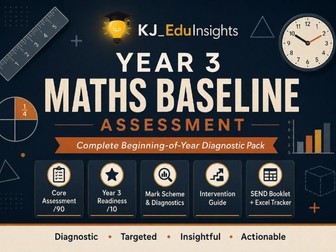
YEAR 3 MATHS BASELINE ASSESSMENT | AUTOMATIC EXCEL TRACKER & SEND
More than a baseline test. A complete diagnostic assessment and intervention toolkit for Year 3 teachers.
Start Year 3 with a clear understanding of what your pupils have retained from Key Stage 1, where their mathematical gaps are and what to teach next.
Designed for the National Curriculum for England, this assessment focuses on Year 2 prior attainment and includes a separate Year 3 Readiness section.
WHAT’S INCLUDED?
10 coordinated assessment and teacher resources:
Complete 100-mark Maths Baseline Assessment
Teacher Administration Guide
Detailed Mark Scheme and Diagnostic Notes
Diagnostic Framework and Worked Exemplification
Targeted Intervention Guide
National Curriculum Objective Mapping
SEND / Accessible Student Assessment Booklet
Inclusive Assessment Teacher Guide
Parent Communication Template
Automated Excel Assessment Tracker
THE ASSESSMENT
Core Year 2 Prior Attainment – 90 marks
Year 3 Readiness – 10 marks (reported separately)
Assess key mathematical knowledge through arithmetic, fluency, reasoning and problem solving.
The assessment covers:
Number and Place Value
Addition, Subtraction, Multiplication and Division
Fractions
Measurement
Geometry and Position
Statistics and Mathematical Reasoning
The separate Year 3 Readiness section helps identify pupils ready for additional challenge without penalising those who have not yet been taught Year 3 content.
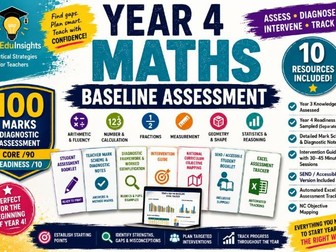
YEAR 4 MATHS BASELINE ASSESSMENT | AUTOMATIC EXCEL TRACKER & SEND
More than a baseline assessment. A complete diagnostic and intervention toolkit for Year 4 teachers.
Start Year 4 knowing exactly what your pupils have retained from Year 3, where mathematical misconceptions remain and what to teach next.
Designed for the National Curriculum for England, this comprehensive Year 4 Maths Baseline Assessment combines arithmetic, fluency, reasoning and problem solving with automatic assessment tracking and targeted intervention support.
WHAT’S INCLUDED?
10 coordinated teacher resources:
Complete 100-mark Maths Baseline Assessment
Teacher Administration Guide
Detailed Mark Scheme with Answers and Diagnostic Notes
Diagnostic Framework and Worked Pupil Exemplification
Targeted Intervention Guide
National Curriculum Objective Mapping
SEND / Accessible Student Assessment Booklet
Automated Excel Assessment Tracker
Inclusive Assessment Teacher Guide
Parent Communication Template
THE 100-MARK ASSESSMENT
Part A: Arithmetic & Fluency
40 marks | 30 minutes
Part B: Reasoning & Problem Solving
60 marks | 45 minutes
The assessment covers:
Number and Place Value
Calculation
Fractions
Measurement
Geometry
Statistics
Mathematical Reasoning and Problem Solving
90 marks assess core Year 3 prior attainment, with 10 additional marks assessing Year 4 readiness.
Readiness is reported separately, ensuring pupils are not disadvantaged by unfamiliar Year 4 content.
AUTOMATIC EXCEL ASSESSMENT TRACKER
Enter pupil results and let the tracker do the calculations.
The tracker supports:
Automatic assessment calculations
Individual and whole-class analysis
Identification of mathematical strengths and gaps
Strand-level diagnostic analysis
Intervention grouping
Pupil progress and assessment discussions
Spend less time analysing spreadsheets and more time planning targeted teaching.
TARGETED INTERVENTION SUPPORT
Turn assessment results into action.
The included Intervention Guide provides:
Targeted 30–45 minute intervention strategies
Mathematical misconceptions and teaching priorities
Guided practice and independent checks
Exit checks to assess understanding
A structured four-week intervention approach
Support pupils in addressing specific mathematical gaps rather than unnecessarily reteaching entire topics.
SEND & ACCESSIBLE ASSESSMENT
A dedicated accessible assessment booklet and inclusive teacher guidance are included to reduce unnecessary barriers while maintaining the intended mathematical demand.
IDEAL FOR
Year 4 teachers
Year 3 to Year 4 transition
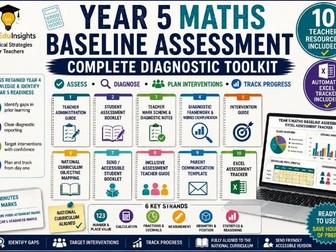
Start Year 5 knowing exactly what your pupils have retained, where the gaps are and what to teach next.
This complete Year 5 Maths Baseline Assessment Toolkit is designed to do more than provide a beginning-of-year test. It combines assessment, diagnostic analysis, intervention planning and progress tracking in one ready-to-use resource.
Assess → Diagnose → Intervene
The assessment is aligned to the National Curriculum for England and primarily assesses retained Year 4 and prerequisite knowledge, while including a carefully separated 10-mark Year 5 readiness sample. This means teachers can identify both gaps in prior learning and pupils who may already be ready for greater challenge, without penalising pupils for content they have not yet been taught.
What is included?
10 coordinated resources:
Teacher Administration Guide – clear instructions, timings, assessment guidance, access arrangements, thresholds and moderation support
Student Assessment Booklet – a 100-mark assessment with dedicated working spaces
Teacher Mark Scheme & Diagnostic Notes – complete answers, method marks and guidance for interpreting errors
Diagnostic Framework & Worked Exemplification – supports consistent teacher judgement with rubrics, borderline decisions and worked pupil profiles
Intervention Guide – links assessment outcomes directly to practical 30–45 minute intervention activities and progress checks
National Curriculum Objective Mapping – maps questions and marks directly to the prior-learning or readiness objectives being assessed
SEND / Accessible Student Booklet – the same mathematical demand with larger working spaces and accessible presentation
Inclusive Assessment Teacher Guide – guidance for supporting pupils without reducing the mathematical challenge
Parent Communication Template – ready to personalise when sharing outcomes with parents and carers
Excel Assessment Tracker – enter pupil scores to support class analysis, individual pupil profiles, planning priorities and intervention grouping
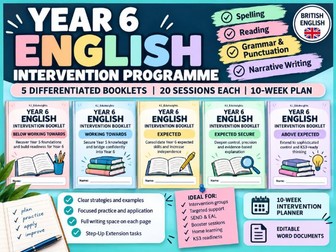
A comprehensive Year 6 English intervention programme designed to help teachers target individual gaps in spelling, reading, grammar and punctuation, and narrative writing.
This resource contains five differentiated intervention booklets, allowing pupils to work at the level most appropriate to their current needs rather than following a one-size-fits-all programme. The booklets can also be mixed by strand — for example, a pupil may need Working Towards support in Reading while working at Expected level in Spelling.
The programme contains 20 focused sessions per booklet, organised across four key English strands:
Spelling • Reading • Grammar & Punctuation • Narrative Writing
The sessions can be delivered as a structured 10-week intervention programme, used selectively to address gaps identified through assessment, or set as supported home learning.
Five levels included
Below Working Towards – rebuilds essential Year 5 prerequisite knowledge and develops readiness for Year 6
Working Towards – secures foundations and bridges pupils towards Year 6 expectations
**Expected **– consolidates Year 6 skills and develops greater independence
Expected Secure – deepens precision, explanation and deliberate language choices
Above Expected – provides greater-depth challenge, evaluation and KS3-ready thinking
Each booklet is designed so that pupils move beyond simply completing exercises. Activities encourage them to notice patterns, explain their thinking, apply skills independently, edit their work and make increasingly deliberate choices as writers and readers.
Each pupil session includes
a clear English Rule / Strategy
worked examples or models
focused Activity 1 practice
an Activity 2 requiring greater application and independence
appropriate writing space directly on the worksheet
guidance for the supporting adult
Marking: Important to Notice prompts to support focused feedback
progressive Step-Up Extension sessions
The programme alternates the four strands across the ten weeks, helping intervention remain varied while allowing teachers to systematically revisit key skills.
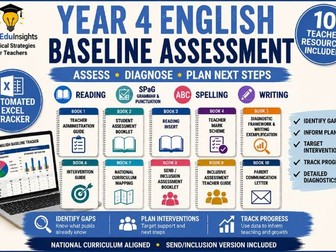
YEAR 4 ENGLISH BASELINE ASSESSMENT | AUTOMATIC TRACKER & SEND
More than an English assessment. A complete diagnostic and intervention toolkit for Year 4 teachers.
Start Year 4 knowing exactly what your pupils understand, where their gaps are and what to teach next.
This comprehensive English Baseline Assessment evaluates Reading, Grammar & Punctuation, Spelling and Writing, providing the resources needed to assess, mark, analyse and respond to pupil attainment.
WHAT MAKES THIS ASSESSMENT DIFFERENT?
Complete Year 4 English diagnostic assessment
Original, age-appropriate reading comprehension material
Detailed teacher marking guidance and writing exemplification
Automatic Excel tracker for individual and whole-class analysis
Intervention recommendations linked to identified gaps
SEND/inclusion assessment materials
National Curriculum objective mapping
AUTOMATIC EXCEL TRACKER
Enter pupil marks and writing judgements to generate individual pupil profiles, class averages, attainment distributions, writing strand analysis and suggested intervention groups.
No need to create separate spreadsheets or manually analyse your class results.
ASSESS → DIAGNOSE → INTERVENE
Identify what your pupils know, understand where support is needed and plan targeted teaching from the very beginning of Year 4.
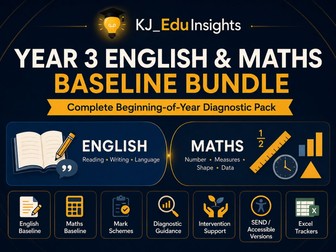
Start Year 3 with a clear, detailed picture of pupils’ starting points in both English and Maths.
Assess → Diagnose → Intervene
This complete baseline assessment bundle combines the Year 3 English Baseline Assessment and Year 3 Maths Baseline Assessment, giving teachers ready-to-use assessments, marking guidance, diagnostic analysis, intervention support and tracking tools in one resource.
Designed for the beginning of Year 3, both assessments focus primarily on retained Year 2 and prerequisite KS1 knowledge, helping teachers identify what pupils can apply independently, where misconceptions remain and which areas need immediate support or additional challenge.
Year 3 English Baseline
Assesses key areas of English including:
Reading
Grammar and Punctuation
Spelling
Writing
Results can be used to identify strengths, gaps and intervention priorities across individual pupils and the wider class.
Year 3 Maths Baseline
Includes:
Core Year 2 Prior Attainment – /90
Separate Year 3 Readiness – /10
Arithmetic and Fluency
Reasoning and Problem Solving
Number and Place Value
Calculation
Fractions
Measurement
Geometry and Position
Statistics and Reasoning
The Year 3 Readiness section is reported separately and helps teachers decide the appropriate starting pace, scaffolding and level of challenge without lowering the pupil’s Year 2 prior-attainment judgement.
Across the bundle you will receive
Teacher Administration Guides
Ready-to-print Student Assessment Booklets
English Reading Insert
Detailed Teacher Mark Schemes
Diagnostic Frameworks and Worked Exemplification
Intervention Guides linked to assessment outcomes
National Curriculum Objective Mapping
SEND / Accessible Assessment Booklets
Inclusive Assessment Teacher Guidance
Parent Communication Templates
Excel Assessment Trackers for recording, analysing and interpreting results
More than just two tests
These resources are designed to help teachers move directly from assessment to action.
Use the results to:
establish clear beginning-of-year starting points
identify individual and whole-class misconceptions
highlight pupils requiring targeted intervention
recognise pupils ready for additional challenge
support early planning and grouping decisions
track attainment across key areas
generate useful pupil and class-level information
communicate starting points clearly with parents
The SEND / accessible versions maintain the same assessment content and mathematical or English demand while reducing unnecessary barriers through clearer formatting, increased spacing and additional response space.
Suitable for Year 3 class teachers, English and Maths leads, KS2 leaders, teaching assistants and schools following the National Curriculum for England.
A comprehensive beginning-of-year bundle designed to reduce assessment preparation, marking, analysis and intervention planning while giving teachers meaningful information they can use immediately.
Start the new academic year with a clear picture of pupils’ strengths, gaps and next steps across English and Maths.
Assess → Diagnose → Intervene
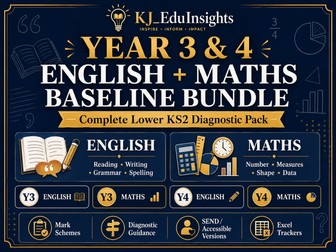
This comprehensive Year 3 and Year 4 Baseline Assessment Bundle brings together four complete beginning-of-year assessment packs:
Year 3 English Baseline Assessment
Year 3 Maths Baseline Assessment
Year 4 English Baseline Assessment
Year 4 Maths Baseline Assessment
Designed for teachers working across Lower KS2, these assessments help identify what pupils have retained from the previous year, where misconceptions remain and which pupils may require additional support or greater challenge.
Rather than providing only an overall score, the resources are designed to support diagnosis, intervention and planning at the start of the year.
English assessment
The English baselines assess key areas including:
Reading comprehension
Grammar and punctuation
Spelling
Writing
Teachers can use the results to identify individual and whole-class strengths, pinpoint gaps in prior learning and establish early English priorities.
Maths assessment
The Maths baselines assess a broad range of curriculum knowledge through a combination of:
Arithmetic and fluency
Number and place value
Calculation
Fractions
Measurement
Geometry and position
Statistics
Reasoning and problem solving
The assessments are designed to establish secure prior attainment while also helping teachers identify pupils ready for additional challenge.
Across the bundle you will find
Depending on the individual assessment pack, resources include:
Teacher Administration Guides
Ready-to-print Student Assessment Booklets
Teacher Mark Schemes and answers
Diagnostic guidance
Worked exemplification
Intervention guidance linked to assessment outcomes
National Curriculum objective mapping
SEND / accessible assessment versions
Assessment trackers
Inclusive assessment guidance
Parent communication resources
Designed to support assessment beyond the test
Use the results to:
establish reliable beginning-of-year starting points
identify gaps from the previous year
highlight individual and class-wide misconceptions
support intervention grouping
identify pupils ready for greater challenge
inform first-term planning
support pupil progress discussions
provide evidence for English and Maths leaders
communicate starting points more clearly with parents
The SEND / accessible versions are designed to reduce unnecessary barriers while maintaining the intended curriculum demand, allowing pupils to demonstrate their mathematical and English understanding more effectively.
Ideal for
Year 3 teachers
Year 4 teachers
Lower KS2 teams
English and Maths subject leaders
Phase leaders
Teaching assistants
Schools following the National Curriculum for England
A practical Lower KS2 assessment bundle that brings English and Maths together in one resource and reduces the time teachers spend creating assessments, mark schemes, trackers, intervention plans and supporting documentation.
Four complete baseline assessments in one bundle – assess, diagnose, plan and support from the very beginning of the year.
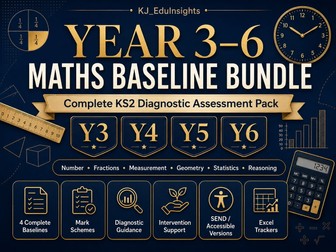
Assess pupils confidently from the very start of the year with this comprehensive Year 3–6 Maths Baseline Assessment Bundle.
Assess → Diagnose → Intervene
This bundle brings together four complete maths baseline assessment systems for Years 3, 4, 5 and 6, designed to identify what pupils have retained from the previous year, highlight misconceptions and gaps, and give teachers practical information to use immediately for planning, intervention and challenge.
Rather than providing only a test and a score, each year-group pack is designed as a complete diagnostic toolkit, taking teachers from assessment through to analysis and next steps.
Four complete Maths baseline packs included
Year 3 Maths Baseline Assessment
Year 4 Maths Baseline Assessment
Year 5 Maths Baseline Assessment
Year 6 Maths Baseline Assessment
Each assessment focuses primarily on the previous year’s National Curriculum knowledge, making the bundle suitable for beginning-of-year assessment, transition information and establishing accurate starting points.
The Year 3 assessment includes a Core Year 2 Prior Attainment score /90 plus a separate Year 3 Readiness /10 section, allowing teachers to identify secure prior learning while also seeing which pupils are already beginning to access selected Year 3 concepts.
Maths areas assessed across the collection
Depending on the year group, assessment covers key areas including:
Number and Place Value
Addition, Subtraction, Multiplication and Division
Arithmetic and Fluency
Fractions
Decimals and Percentages where age appropriate
Measurement
Geometry and Position
Statistics
Mathematical Reasoning
Problem Solving
The assessments include a balance of fluency and application so teachers can identify not only whether pupils can calculate accurately, but whether they can reason, explain and apply their mathematical understanding.
Each year-group toolkit includes
Teacher Administration Guide
Ready-to-print Student Assessment Booklet
Detailed Teacher Mark Scheme and answers
Diagnostic notes and strand analysis
Diagnostic Framework and Worked Exemplification
Targeted Intervention Guide
National Curriculum Objective Mapping
SEND / Accessible Student Assessment Booklet
Inclusive Assessment Teacher Guidance
Parent Communication Template
Excel Assessment Tracker
Assessment that leads directly to action
The accompanying diagnostic resources allow teachers to move beyond an overall percentage and identify exactly where support is needed.
Use the results to:
establish accurate beginning-of-year starting points
identify retained knowledge from the previous year
spot individual and whole-class misconceptions
identify weaker mathematical domains
group pupils for targeted intervention
recognise pupils ready for additional challenge
inform medium-term and first-term planning
support pupil progress and transition discussions
provide useful evidence for Maths and phase leaders
communicate strengths and priorities clearly with parents
The intervention guidance links assessment outcomes to practical next steps, helping teachers focus support on specific misconceptions rather than reteaching an entire strand unnecessarily.
SEND and accessibility included
Each pack contains a SEND / accessible assessment version designed to reduce unnecessary barriers while maintaining the mathematical demand of the standard assessment.
Accessible versions use features such as clearer layouts, increased spacing, larger response areas and reduced visual load so pupils have a fair opportunity to demonstrate their mathematical understanding.
Excel tracking included
The assessment trackers support efficient analysis of pupil and class performance, including:
automatic score calculations
strand-level analysis
overall diagnostic judgements
class performance information
identification of intervention groups
individual pupil profiles and reporting information
Ideal for
Year 3, Year 4, Year 5 and Year 6 teachers
KS2 teams
Maths subject leaders
Phase leaders
Teaching assistants
Schools preparing for a new academic year
Transition and beginning-of-year assessment
Schools following the National Curriculum for England
This Years 3–6 Maths Baseline Bundle provides a consistent approach to diagnostic assessment across KS2 while still ensuring that each assessment is appropriate to the curriculum knowledge pupils should have secured before entering their new year group.
Four year groups. Four complete diagnostic systems. One comprehensive KS2 Maths assessment bundle designed to help teachers assess, diagnose, plan and intervene from the very beginning of the year.
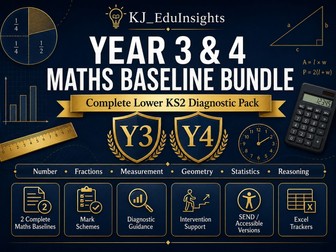
Start the new academic year with a clear understanding of pupils’ mathematical starting points with this comprehensive Year 3 and Year 4 Maths Baseline Assessment Bundle.
Assess → Diagnose → Intervene
This bundle combines complete beginning-of-year maths baseline resources for Year 3 and Year 4, designed to identify what pupils have retained from the previous year, highlight misconceptions and gaps, and help teachers make informed decisions about planning, intervention and challenge from the very start of the year.
Rather than simply producing an overall test score, these assessments are designed as diagnostic tools, allowing teachers to identify strengths and areas for development across key mathematical strands.
Two complete Maths baseline assessments included
Year 3 Maths Baseline Assessment
Year 4 Maths Baseline Assessment
The assessments focus primarily on the mathematical knowledge pupils should have secured before entering their new year group, making them ideal for September assessment, transition information and establishing beginning-of-year starting points.
**Mathematical areas assessed
**
Across the two assessments, pupils are assessed in areas including:
Number and Place Value
Addition and Subtraction
Multiplication and Division
Arithmetic and Fluency
Fractions
Measurement
Geometry and Position
Statistics
Mathematical Reasoning
Problem Solving
Questions include a combination of fluency, reasoning and application so teachers can see not only whether pupils can calculate accurately, but also whether they can apply and explain their mathematical understanding.
Comprehensive teacher resources
The packs include supporting materials designed to take teachers from assessment through to analysis and next steps, including:
Teacher Administration Guides
Ready-to-print Student Assessment Booklets
Detailed Teacher Mark Schemes
Diagnostic guidance
Worked exemplification
Intervention guidance linked to assessment outcomes
National Curriculum objective mapping
SEND / accessible assessment versions
Inclusive assessment guidance
Parent communication resources
Excel assessment trackers
From assessment to action
Use the results to:
establish reliable beginning-of-year starting points
identify gaps in prior learning
highlight individual and whole-class misconceptions
identify weaker mathematical strands
plan targeted intervention
group pupils according to specific needs
recognise pupils ready for additional challenge
inform first-term planning
support transition and pupil progress discussions
provide useful evidence for Maths and phase leaders
The intervention guidance helps teachers move directly from a pupil’s assessment performance to focused teaching priorities, reducing the need to analyse every question and create intervention plans from scratch.
SEND / accessible versions included
Accessible pupil versions are included to reduce unnecessary barriers while maintaining the intended mathematical demand. Clearer layouts, increased spacing and additional response space help pupils demonstrate their understanding without changing what is being assessed.
Ideal for
Year 3 teachers
Year 4 teachers
Lower KS2 teams
Maths subject leaders
Phase leaders
Teaching assistants
Transition and beginning-of-year assessment
Schools following the National Curriculum for England
A practical Lower KS2 Maths assessment bundle that provides much more than two tests. Assess pupils, identify their needs and move directly into informed planning, targeted intervention and appropriate challenge.
Two year groups. Two complete diagnostic assessment systems. One ready-to-use Lower KS2 Maths baseline bundle.
Start Year 5 and Year 6 with a clear picture of what pupils know, where the gaps are and what needs to happen next.
Assess → Diagnose → Intervene
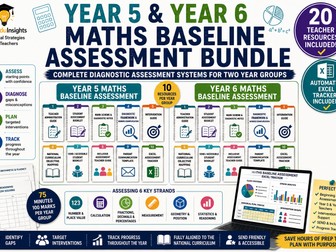
This Year 5 & Year 6 Maths Baseline Assessment Bundle combines two comprehensive diagnostic assessment toolkits designed to help teachers move from assessment to targeted teaching and intervention.
Rather than simply producing a percentage score, each toolkit helps you analyse attainment across key mathematical strands, identify misconceptions, group pupils for intervention and plan appropriate next steps.
Both year groups include a 100-mark assessment, teacher guidance, full marking and diagnostic support, intervention materials, SEND/accessibility resources and an Excel assessment tracker.
What’s included?
You receive the complete Year 5 Maths Baseline Assessment Toolkit and Year 6 Maths Baseline Assessment Toolkit.
Each year group includes:
Teacher Administration Guide
Student Assessment Booklet
Teacher Mark Scheme & Diagnostic Notes
Diagnostic Framework & Worked Exemplification
Intervention Guide
National Curriculum Objective Mapping
SEND / Accessible Student Assessment Booklet
Inclusive Assessment Teacher Guide
Parent Communication Template
Automated Excel Assessment Tracker
That’s 20 coordinated resources across Years 5 and 6.
More than a baseline test
The assessments cover key mathematical areas including:
Number & Place Value | Calculation | Fractions, Decimals & Percentages | Measurement | Geometry & Position | Statistics & Reasoning
The accompanying diagnostic materials help teachers identify pupils who have broad gaps as well as those who may appear secure overall but have specific weaknesses within individual strands.
The Excel trackers make the assessment data much easier to use, providing support for:
Class analysis • Individual pupil profiles • Strand analysis • Attainment judgements • Planning priorities • Intervention grouping • Progress tracking
This means the assessment does not end when the papers are marked.
Built for beginning-of-year assessment
Each assessment is structured as:
Part A: Arithmetic & Fluency
30 minutes | 40 marks
**Part B: Reasoning & Problem Solving
45 minutes | 60 marks
Total: 75 minutes | 100 marks
The assessments can also be administered across two sessions to reduce cognitive load.
SEND and inclusion built in
Both year groups include a dedicated SEND / accessible version alongside teacher guidance for appropriate access arrangements.
The accessible versions maintain the mathematical demand while providing a clearer layout, additional working space and reduced visual overload.
This means teachers do not need to create a separate assessment for pupils who require additional accessibility support.
From assessment to intervention
The real value of the bundle is what happens after assessment.
Use the results to:
Assess → Diagnose → Identify Gaps → Group Pupils → Target Intervention → Track Progress
The intervention guides provide practical activities linked to identified areas of weakness, while the trackers help teachers identify pupils requiring additional support.
Ideal for
Beginning-of-year assessment • September baseline testing • Year 5 and Year 6 teachers • KS2 maths leaders • Transition between year groups • Intervention planning • SEND provision • Pupil progress meetings • Curriculum planning • Identifying learning gaps • Target setting
Why buy the bundle?
Buying the combined Year 5 & Year 6 bundle gives schools and teachers a consistent assessment approach across upper KS2.
It is particularly useful for:
Year 5/6 teams • Maths subject leaders • Two-form or larger schools • Intervention teachers • Schools wanting consistent diagnostic assessment across UKS2
Instead of purchasing separate tests, trackers, SEND versions and intervention resources, everything is organised into two coordinated assessment systems.
Two year groups. 20 resources. One consistent approach to assessing, diagnosing and planning next steps.
KJ_EduInsights
Quality Resources. Less Prep. More Impact.
Start Year 6 with a clear picture of what every pupil knows, where the gaps are and what needs to happen next.
Assess → Diagnose → Intervene
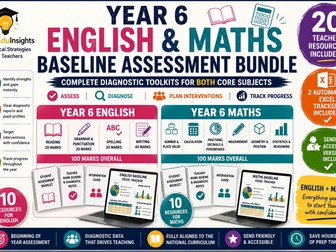
This Year 6 English and Maths Baseline Assessment Bundle brings together two complete diagnostic assessment toolkits, giving teachers everything needed to assess pupils at the beginning of Year 6, analyse their strengths and gaps, plan targeted interventions and track progress.
This is much more than two baseline tests.
Across English and Maths, you receive 20 coordinated teacher resources, including full assessments, mark schemes, diagnostic frameworks, intervention support, SEND/accessibility versions, National Curriculum mapping and automated Excel assessment trackers.
What’s included?
YEAR 6 ENGLISH BASELINE ASSESSMENT
A complete English assessment covering:
Reading • Grammar & Punctuation • Spelling • Writing
The English toolkit includes:
Teacher Administration Guide
Student Assessment Booklet
Reading Insert
Teacher Mark Scheme
Diagnostic Framework & Writing Exemplification
Intervention Guide
National Curriculum Mapping
SEND / Accessible Student Assessment Booklet
Inclusive Assessment Teacher Guide
Parent Communication Letter
Automated Excel Assessment Tracker
The assessment provides a 100-mark overall picture:
Reading – 20 marks
Grammar & Punctuation – 20 marks
Spelling – 20 marks
Writing – 40 marks
Writing is supported by detailed assessment criteria covering areas including composition, organisation, vocabulary, sentence structure, grammar, punctuation, spelling and cohesion.
YEAR 6 MATHS BASELINE ASSESSMENT
The Maths toolkit provides a 100-mark diagnostic assessment covering six key areas:
Number & Place Value • Calculation • Fractions, Decimals & Percentages • Measurement • Geometry & Position • Statistics & Reasoning
The assessment is divided into:
Part A: Arithmetic & Fluency
30 minutes | 40 marks
Part B: Reasoning & Problem Solving
45 minutes | 60 marks
The complete Maths toolkit includes teacher administration guidance, the student assessment, mark scheme and diagnostic notes, worked exemplification, intervention support, National Curriculum mapping, SEND/accessibility materials, parent communication and an automated Excel assessment tracker.
Two automated Excel trackers included
Both subjects include their own Excel assessment tracker.
Enter pupil results and use the trackers to support:
Class analysis • Individual pupil profiles • Attainment judgements • Strand/domain analysis • Identification of strengths and gaps • Planning priorities • Intervention grouping • Progress tracking
Instead of spending hours transferring baseline results into separate spreadsheets and trying to decide what the scores actually mean, the assessment data can be used to inform teaching from the beginning of the year.
From assessment to action
The purpose of these assessments is not simply to generate a score.
Together, the English and Maths toolkits help teachers move through a clear process:
ASSESS → DIAGNOSE → IDENTIFY GAPS → PLAN INTERVENTIONS → TRACK PROGRESS
The diagnostic frameworks provide additional information behind the overall scores, while the intervention materials help teachers turn identified weaknesses into practical next steps.
SEND and accessibility included
Both English and Maths include dedicated SEND / accessible student assessment versions alongside guidance for teachers.
These provide additional accessibility support while maintaining the intended assessment demand, reducing the need for teachers to adapt the standard assessment themselves.
Ideal for
Beginning-of-year assessment • September baseline testing • Year 6 teachers • UKS2 assessment • Year 5 to Year 6 transition • English and Maths subject leaders • SEND and inclusion • Intervention planning • Pupil progress meetings • Identifying learning gaps • Target setting • Curriculum planning
Why choose the bundle?
Purchasing the combined bundle gives you a consistent approach to assessing the two core subjects at the beginning of Year 6.
Rather than sourcing separate tests, creating trackers, designing SEND versions and then producing intervention materials yourself, the complete system is already organised for you.
2 subjects • 20 teacher resources • 2 automated Excel trackers • English + Maths SEND versions • Diagnostic analysis • Intervention support
Everything you need to establish a meaningful Year 6 starting point and use the results to plan what happens next.
KJ_EduInsights
Quality Resources. Less Prep. More Impact.
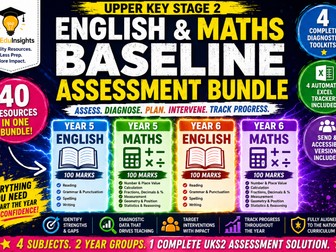
Assess your Year 5 and Year 6 pupils in both English and Maths with one comprehensive Upper Key Stage 2 baseline assessment bundle.
This bundle combines four complete baseline assessment toolkits:
Year 5 English | Year 5 Maths | Year 6 English | Year 6 Maths
Designed for the beginning of the academic year, the assessments help teachers move beyond a simple test score to identify strengths, gaps, misconceptions and priorities for teaching and intervention.
ENGLISH BASELINE ASSESSMENTS
Both Year 5 and Year 6 English assessments provide a 100-mark diagnostic assessment covering:
Reading – 20 marks
Grammar & Punctuation – 20 marks
Spelling – 20 marks
Writing – 40 marks
Each year group includes a complete assessment system with student materials, teacher guidance, mark schemes, diagnostic support, writing assessment guidance and exemplification.
The automated Excel trackers turn assessment results into useful class and pupil-level information, helping teachers identify attainment patterns and pupils requiring additional support.
MATHS BASELINE ASSESSMENTS
The Year 5 and Year 6 Maths assessments each provide a 100-mark diagnostic picture across six key mathematical domains:
Number & Place Value
Calculation
Fractions, Decimals & Percentages
Measurement
Geometry & Position
Statistics & Reasoning
Questions assess a combination of arithmetic, fluency, reasoning and problem solving, helping teachers pinpoint specific misconceptions rather than relying only on an overall score.
4 AUTOMATED EXCEL TRACKERS INCLUDED
Each assessment comes with its own automated Excel tracker, giving you separate tracking systems for:
Year 5 English
Year 5 Maths
Year 6 English
Year 6 Maths
Enter pupil results and use the trackers to support analysis of class attainment, individual pupil performance, strengths and weaknesses, intervention needs and future planning.
A COMPLETE UPPER KS2 BASELINE SYSTEM
Across the four toolkits, teachers receive assessment materials and supporting resources including:
✓ Student assessment booklets
✓ Teacher administration guidance
✓ Teacher mark schemes and diagnostic guidance
✓ English reading materials
✓ Writing assessment guidance and exemplification
✓ Maths diagnostic information and worked support
✓ Intervention guidance
✓ National Curriculum mapping
✓ SEND / accessible assessment versions
✓ Inclusive assessment guidance
✓ Parent communication resources
✓ 4 automated Excel assessment trackers
ASSESS → DIAGNOSE → PLAN → TRACK
Use the assessments to:
✓ establish accurate starting points
✓ identify whole-class and individual gaps
✓ uncover mathematical misconceptions
✓ analyse English strengths and weaknesses
✓ identify pupils requiring intervention
✓ inform differentiation and future planning
✓ support pupil progress discussions
✓ organise targeted support
✓ monitor progress throughout the year
SEND / ACCESSIBLE VERSIONS INCLUDED
Accessible versions are included to support a wider range of learners while maintaining the purpose of the assessments, making the bundle particularly useful for mixed-attainment and inclusive classrooms.
IDEAL FOR
Year 5 & Year 6 teachers | Upper KS2 teams | Phase leaders | English leads | Maths leads | Assessment leads | SENDCos | Intervention teachers | Primary schools
This bundle is particularly useful for schools wanting a consistent approach to baseline assessment across Upper Key Stage 2, rather than purchasing and managing separate assessment systems.
FOUR ASSESSMENTS. TWO YEAR GROUPS. TWO CORE SUBJECTS. ONE COMPLETE SYSTEM.
Get a clear picture of where your Year 5 and Year 6 pupils are starting in English and Maths, then use the diagnostic information to decide what needs to happen next.
Save hours of assessment preparation, marking analysis and spreadsheet setup while creating a consistent baseline approach across Upper KS2.
Create a calm, purposeful and increasingly independent start to every school day with this complete Year 6 September Morning Mission Pack.
Designed specifically for the beginning of Year 6, this resource provides 20 original morning activities, each planned to take approximately 20–30 minutes. Rather than repetitive worksheets or simple filler tasks, pupils are challenged to think, reason, communicate, organise themselves and make responsible decisions.
The resource is particularly useful during September when teachers are establishing expectations, independence and classroom routines.
Included in the download:
23-page Year 6 September Morning Mission pupil booklet
20 complete morning activities
20-slide editable PowerPoint
One clear board-display slide for every activity
Independent, partner and independent-to-partner tasks
Year 6 academic expectations
Year 6 pastoral expectations
Daily pupil self-checks
20-day mission tracker
The accompanying PowerPoint is designed to be displayed as pupils arrive. Each slide clearly shows what pupils need to do, when partner discussion is appropriate and what they should check before considering the activity complete. This makes the resource particularly useful for establishing a morning routine with minimal repeated teacher explanation.
Move beyond traditional classroom jobs and help pupils understand what responsible leadership actually looks like with this complete Day 9 Year 6 teaching pack.
The Leadership Blueprint is a full-day sequence designed to redefine leadership as contribution, responsibility, service and evidence, rather than popularity, confidence or simply being the loudest person in the room.
Pupils challenge common leadership myths, explore ten different ways people can contribute, diagnose realistic classroom situations, design a genuine Class Contribution Project and use evidence from their first eight days to apply for a meaningful classroom responsibility.
The lesson culminates in either a one-minute leadership pitch or structured paired interview, giving every pupil an opportunity to explain what they can contribute and why.
Designed for approximately 4 hours 30 minutes–5 hours 20 minutes of structured learning, Day 9 provides a substantial full-day programme of individual reflection, team analysis, project design, written application and communication.
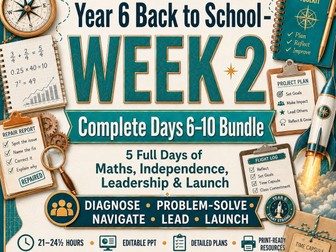
Start the second week of Year 6 with five complete, connected teaching days already planned.
Year 6: Start Strong – Week 2 takes pupils from academic diagnosis and problem-solving through independence, leadership and finally into evidence-based reflection and goal setting.
This is not a collection of unrelated worksheets or filler activities for the first weeks back. Days 6–10 form a deliberate progression:
DIAGNOSE → PROBLEM-SOLVE → BECOME INDEPENDENT → LEAD → LAUNCH
Across the five days, pupils investigate their maths and SPaG starting points, learn how to respond productively when they are stuck, apply mathematical reasoning to a substantial real-world project, build personalised learning strategies, explore responsible leadership and finish by setting precise Year 6 goals.
Together, Days 6–10 provide approximately 21–24½ hours of structured learning, excluding breaks and lunch. Each day combines independent work, paired discussion, collaborative challenges and purposeful reflection.
Five complete Year 6 teaching days
DAY 6 – Maths Fluency & SPaG Repair Agency
Diagnose • Repair • Apply • Explain
Day 6 combines an independent maths diagnostic with a substantial SPaG investigation.
Pupils become linguistic repair specialists and learn a four-stage editing protocol:
SPOT IT → NAME IT → CORRECT IT → EXPLAIN IT
After diagnosing a damaged text, pupils rotate through six specialist repair stations covering:
sentence boundaries
punctuation
apostrophes
verb agreement and tense
word classes
spelling patterns and statutory spellings
pronouns and cohesion
They finish by independently repairing a complete text and explaining the grammatical reasoning behind their changes.
The lesson provides teachers with useful evidence about both mathematical fluency and pupils’ ability to identify, correct and explain SPaG errors rather than simply guessing the answer.
Approx. 3¾–4½ hours
DAY 7 – The Problem-Solving Blueprint
Diagnose • Struggle • Build • Defend
Day 7 moves beyond mathematical calculation and investigates how pupils actually approach difficult problems.
Pupils explore productive struggle before learning a repeatable six-stage Problem-Solving Engine:
READ → REPRESENT → CHOOSE → TRY → CHECK → EXPLAIN
They then apply these strategies to a substantial Year 6 Activity Day Master Plan.
Working within fixed budget and timetable constraints, teams must compare options, calculate costs, create a viable schedule and justify their decisions.
Just when they believe the plan is complete, a Parameter Update changes the conditions and forces pupils to recalculate and adapt.
This gives teachers valuable evidence about mathematical reasoning, resilience, communication and how pupils respond when their original solution no longer works.
Approx. 4–4½ hours
DAY 8 – The Navigator’s Toolkit
Diagnose • Navigate • Reflect
Day 8 explicitly teaches pupils how to become more independent learners.
Rather than treating every difficulty as simply being “stuck”, pupils investigate different barriers and decide what kind of response is actually needed.
They learn the five-step Navigator Sequence:
STOP → REREAD → CHECK → TRY → ASK PRECISELY
Every pupil builds a personalised Navigator Toolkit before completing an evidence-based Learning Profile across Reading, Writing, SPaG, Maths, Teamwork and Independence.
The focus is not on refusing help. It is on knowing what to try first and how to ask for useful support precisely.
Approx. 4½–5 hours
DAY 9 – The Leadership Blueprint
Contribute • Design • Apply • Lead
Day 9 challenges the idea that leadership means being loud, popular or holding a badge.
Pupils explore leadership as responsible contribution.
They investigate ten different contribution styles, challenge common leadership myths and use a four-stage diagnostic framework to respond to realistic classroom situations.
Teams then design a genuine Class Contribution Project.
Pupils then review evidence gathered during Days 1–8 and complete an evidence-based application for a genuine classroom responsibility.
The final communication task can be delivered as either a one-minute leadership pitch or structured paired interview.
Approx. 4½–5⅓ hours
DAY 10 – The Year 6 Flight Path
Review • Verify • Target • Commit • Launch
Day 10 brings the entire ten-day journey together.
Rather than finishing the transition period with a simple celebration, pupils revisit the evidence they have gathered and use it to decide who they are as learners and where they need to go next.
Pupils:
complete a Ten-Day Flight Log
compare their Day 1 and Day 10 thinking
recalibrate their Top Five Year 6 qualities
build a Mission Specialist Profile
verify strengths using specific evidence
set three precise goals
write a Time-Capsule letter
recognise the contributions of classmates
create the Year 6 Commitment
complete Launch Portfolio Entry 10
Every pupil sets one:
Academic Goal
Independence Goal
Contribution Goal
Each goal includes an exact action, reason, support system, evidence of success and review point.
The programme ends with three shared pillars:
WE BELONG • WE DISCOVER • WE LEAD
and one immediate action that begins the pupil’s Year 6 journey.
Approx. 4⅓–5⅓ hours
Important information about the Maths Baseline
Days 6 and 7 are designed to connect with an existing Year 6 Maths Baseline Assessment.
Maths Diagnostic Part A and Maths Baseline Part B are not duplicated within these Day 6–10 resources.
Day 6 uses the existing Part A assessment for its initial maths diagnostic, while Day 7 uses the existing Part B reasoning assessment.
This bundle therefore contains the teaching, reflection, strategy and application resources surrounding those assessments, not the complete separate Maths Baseline Assessment pack.
Move from assessment to independence – and from independence to leadership.
By the end of Day 10, pupils have not simply completed two weeks of back-to-school activities.
They have gathered evidence about their academic strengths, practised strategies for dealing with difficulty, learned how to ask for help more effectively, solved substantial problems, considered how they contribute to others and created precise goals for the year ahead.
Five purposeful days. One connected journey. Your second week of Year 6 – planned.
Part of the Year 6: Start Strong programme:
BELONG → DISCOVER → LEAD → LAUNCH.
Start Year 6 with the entire first two weeks planned.
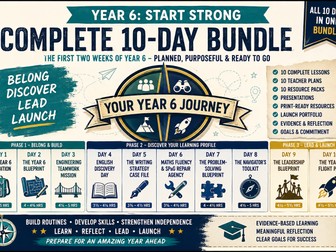
Year 6: Start Strong is a complete 10-day transition and induction programme designed to do much more than keep pupils busy at the beginning of the year. Across approximately 40–48 hours of structured learning, pupils build classroom routines, develop teamwork, complete meaningful English and maths diagnostic work, explore how they learn, strengthen independence, practise leadership and finish the programme with precise goals for the year ahead.
The ten days form one connected journey:
BELONG → BUILD → DISCOVER → LEAD → LAUNCH
Instead of ten unrelated first-day activities, evidence and learning carry forward from one day to the next. By the end of Day 10, pupils have created a detailed Launch Portfolio showing what they have discovered about themselves as learners, while teachers have gathered useful evidence about academic starting points, communication, independence, resilience, organisation, problem-solving and contribution.
PHASE 1 – BELONG & BUILD
DAY 1 – The Year 6 Expedition
Belong • Discover • Lead
Begin Year 6 by helping pupils feel secure, understand their new environment and develop a positive class identity.
Pupils explore classroom systems and support, investigate successful Year 6 habits, solve realistic situations, rank the qualities they believe matter most and create their first team agreement. The day is designed to reveal early evidence about confidence, organisation, independence and how pupils interact with a new group.
Approx. 3½–5 hours
DAY 2 – The Year 6 Blueprint
Diagnose • Rehearse • Remember • Agree
Turn classroom expectations into routines pupils can actually use independently.
Pupils diagnose ineffective classroom behaviours before rehearsing core routines, productive help-seeking, organisation and multi-step instruction skills. They finish by helping construct a clear and observable Class Charter.
The emphasis is not simply on telling pupils the rules. They practise the systems that protect learning time until expectations become visible and repeatable.
Approx. 4–4¾ hours
DAY 3 – Engineering Teamwork Mission
Communicate • Collaborate • Engineer
An active teamwork day built around communication laboratories and a substantial STEM challenge.
Pupils investigate the difference between hearing and listening, talking and explaining, arguing and disagreeing, and taking over and genuinely helping.
They apply these behaviours through Barrier Drawing, Back-to-Back Construction, disagreement scenarios and the main Paper Bridge Engineering Challenge, where teams must plan, build, test, analyse failure and improve their design.
The day develops precise communication, inclusion, organisation, resilience and evidence-based problem-solving rather than simply rewarding the strongest final bridge.
Approx. 4¼–5 hours
PHASE 2 – DISCOVER YOUR LEARNING PROFILE
DAY 4 – English Discovery Day
Assess • Train • Interrogate • Reflect
Establish meaningful English starting points while teaching pupils practical reading strategies.
Pupils complete the Year 6 English baseline before learning the Five Fluency Gears:
Pace • Accuracy • Punctuation • Phrasing • Expression
They then investigate The Keeper of the Clockwork Owl, using A.E.E. – Answer, Evidence, Explain to explore vocabulary, retrieval, inference, authorial intent and prediction.
The day finishes with individual reading reflection and a specific next-step target.
Approx. 3½–4¼ hours
Included for Day 4: the Year 6 English Baseline Student Assessment Booklet and teacher answers required for the lesson.
The wider diagnostic framework, trackers, intervention resources, SEND assessment materials and other components from the complete Year 6 English Baseline Assessment Toolkit are not included in this bundle and remain available separately.
DAY 5 – The Writing Strategy Case File
Investigate • Plan • Craft • Revise
A complete narrative-writing workshop designed to show pupils that strong writing begins long before the first sentence is drafted.
Pupils investigate effective narrative writing before moving through idea-generation stations. They generate several possible story concepts, evaluate them for originality, depth and feasibility, create an eight-point narrative blueprint and complete an independent narrative.
The final stage moves beyond simple proofreading. Pupils revise deliberately to improve meaning, atmosphere, cohesion and the reader’s experience.
Approx. 3¾–4½ hours
DAY 6 – Maths Fluency & SPaG Repair Agency
Diagnose • Repair • Apply • Explain
Begin the second week with academic diagnosis and explicit SPaG teaching.
Pupils first complete Maths Diagnostic Part A before entering the SPaG Repair Agency and learning the four-stage forensic protocol:
SPOT IT → NAME IT → CORRECT IT → EXPLAIN IT
They diagnose a damaged text and work through six specialist repair stations covering sentence boundaries, punctuation, apostrophes, verb agreement and tense, word classes, statutory spellings, pronouns and cohesion.
The day culminates in an independent Final Field Test where pupils must not only make accurate corrections but explain the rule behind them.
Approx. 3¾–4½ hours
DAY 7 – The Problem-Solving Blueprint
Diagnose • Struggle • Build • Defend
Day 7 investigates what pupils actually do when mathematics becomes difficult.
After Maths Baseline Part B and an individual confidence profile, pupils explore productive struggle and learn a transferable six-stage Problem-Solving Engine:
READ → REPRESENT → CHOOSE → TRY → CHECK → EXPLAIN
Teams then design a complete Year 6 Activity Day within fixed budget and timetable constraints. They calculate, compare options, justify decisions and build a feasible plan.
Just when the project appears complete, teams receive a Parameter Update that changes the conditions and forces them to recalculate, adapt and defend their revised solution.
Approx. 4–4½ hours
DAY 8 – The Navigator’s Toolkit
Diagnose • Navigate • Reflect
Teach pupils how to become genuinely more independent rather than simply telling them to “try harder”.
Pupils investigate different meanings of being stuck and learn a five-step Navigator Sequence:
STOP → REREAD → CHECK → TRY → ASK PRECISELY
They then test these strategies across six Challenge Circuit outposts involving logic, reading, instruction-following, maths reasoning, practical construction and organisation.
Every pupil creates a personalised Navigator Toolkit before completing an evidence-based Learning Profile across Reading, Writing, SPaG, Maths, Teamwork and Independence.
Approx. 4½–5 hours
PHASE 3 – LEAD & LAUNCH
DAY 9 – The Leadership Blueprint
Contribute • Design • Apply • Lead
Challenge the idea that leadership belongs only to the loudest, most confident or most popular pupils.
Day 9 reframes leadership as responsible contribution.
Pupils investigate leadership myths, explore ten different contribution styles and diagnose realistic classroom situations before deciding what type of response is actually needed.
Teams then design a genuine Class Contribution Project, considering actions, responsibilities, resources, risks, inclusion and measurable impact.
Finally, pupils use evidence collected during Days 1–8 to apply for a classroom responsibility through either a written application and one-minute pitch or a structured paired interview.
Leadership becomes something pupils can prove through actions, rather than simply claim.
Approx. 4½–5⅓ hours
DAY 10 – The Year 6 Flight Path
Review • Verify • Target • Commit • Launch
Bring the entire programme together in a meaningful final launch.
Pupils revisit their original Day 1 beliefs and complete a Ten-Day Flight Log before recalibrating the qualities they now believe successful Year 6 pupils need.
They create a Mission Specialist Profile and learn to verify strengths using an evidence equation rather than unsupported statements.
Every pupil then sets three precise targets:
Academic Focus
Independence Focus
Contribution Focus
Each target includes an exact action, reason, support system, success evidence and review point.
Pupils also write a Time-Capsule Letter to their future selves, recognise specific contributions from classmates, agree the three Year 6 Commitment pillars and complete Launch Portfolio Entry 10.
Approx. 4⅓–5⅓ hours
The final programme commitment is built around:
WE BELONG • WE DISCOVER • WE LEAD
What is included in the complete 10-day bundle?
10 complete classroom presentations
10 detailed teacher lesson plans
10 extensive print-ready resource packs
approximately 40–48 hours of structured teaching and learning
Year 6 English Baseline Student Assessment Booklet + teacher answers for Day 4
detailed printing and preparation guidance
classroom routines and independence resources
teamwork and communication activities
complete Paper Bridge STEM challenge
English reading-fluency and comprehension resources
narrative planning, drafting and editing resources
six SPaG Repair Stations
maths reasoning and productive-struggle resources
complete Activity Day budgeting and timetable project
Navigator independence strategy
six-station Challenge Circuit
pupil Learning Profiles
leadership scenarios and Contribution Styles
Class Contribution Project
responsibility applications, pitch and interview resources
Ten-Day Flight Log
evidence-based profile and target-setting resources
Time-Capsule activities
Peer Recognition Comm-Links
Year 6 Class Commitment
teacher answer guidance, model responses and worked calculations where appropriate
SEND, EAL and access guidance
teacher observation and evidence-recording tools
Launch Portfolio Entries 1–10
final cohort reflection and next-step tools.
The complete programme is built around ten presentations, ten teacher plans and ten print-ready pupil/teacher resource packs, alongside printing guidance, support materials, observation tools, portfolio reflections and model/answer guidance where tasks have checkable outcomes.
More than two weeks of back-to-school activities
By the end of the programme, teachers have gathered evidence about far more than who completes a worksheet correctly.
The sequence helps reveal who settles independently, who needs repeated reassurance, who communicates precisely, who includes others, who can recover when an idea fails, who uses evidence, who sustains independent writing, who understands reading strategies, who can explain SPaG rules, who reasons mathematically, who uses classroom support effectively and who is ready to take on responsibility.
Day 10 then brings this evidence together so pupils leave the programme with a profile and goals they can actually explain rather than simply a completed transition booklet.
Important Maths Baseline information
Days 6 and 7 are designed to work alongside the Year 6 Maths Baseline Assessment.
Maths Diagnostic Part A and Maths Baseline Part B are not included in this 10-day bundle.
Day 6 requires the existing Maths Diagnostic Part A and mark scheme. Day 7 uses the existing Maths Baseline Part B as its initial reasoning diagnostic.
If you already own the KJ_EduInsights Year 6 Maths Baseline Assessment, these lessons are designed to integrate directly with it.
Designed for real Year 6 classrooms
Year 6: Start Strong is written in British English and designed specifically for Year 6 / Upper KS2. It combines individual reflection, paired learning, structured teamwork, practical challenges, independent assessment, English, mathematics, speaking and listening, self-regulation, leadership and classroom culture.
The programme is designed to reduce the enormous planning load of the first two weeks while still allowing teachers to adapt classroom routines, roles, support systems and examples to their own setting.
Most importantly, the first ten days produce information teachers can actually use when planning the weeks that follow.
Ten complete days. Three connected phases. One clear Year 6 journey.
BELONG → BUILD → DISCOVER → LEAD → LAUNCH
Your first two weeks of Year 6 – planned.


 Quick View