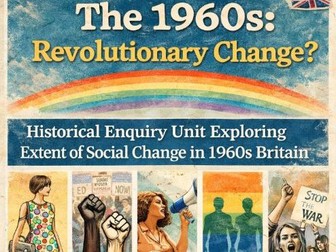
Was the 1960s Really Revolutionary?
This enquiry-based unit moves beyond surface-level “Swinging Sixties” content and challenges students to think like historians.
Across six structured lessons, students analyse cultural change, race relations, women’s liberation, LGBT+ reform and the political unrest of 1968.
Using a clear conceptual framework (change & continuity, extent, significance), students build one analytical paragraph per lesson before completing a fully developed final essay.
Designed to promote critical thinking, structured writing and historical judgement.
Does Bloody Mary deserve her nickname? – KS3 History Lesson
Bring Tudor history to life with this dynamic and thought-provoking KS3 lesson on Mary I. Students will explore whether England’s first queen regnant truly earned her infamous nickname, “Bloody Mary.”
This fully resourced lesson includes:
An engaging starter – Hook students by checking their understanding of the Reformation.
A focused reading task – Students examine the key religious changes Mary introduced during her reign, weighing evidence for and against her “bloody” reputation.
A highly interactive group activity – Step Into the Queen’s Council
Students take on the roles of historical figures from Mary’s time (e.g. Catholic loyalists, Protestant reformers, foreign ambassadors). In groups, they prepare and present their opinions on Mary’s religious reforms, exploring multiple perspectives and debating whether her actions were justified.
Why choose this lesson?
Sparks curiosity and empathy by encouraging students to see history through different lenses.
Builds speaking, listening, and critical thinking skills through role-play and discussion.
Tried and tested – students love stepping into character and debating as part of Mary’s council.
Perfect for KS3 History units on the Tudors, religious change, or controversial figures.
Why was World War I a Turning Point? – KS3 History Lesson
Bring 20th century history to life with this engaging and fully resourced KS3 lesson exploring why World War I was a major turning point in world history.
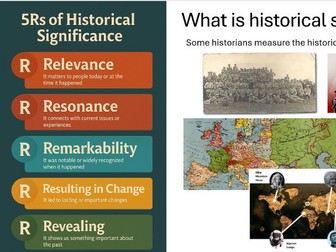
Students will investigate the political, territorial, and technological changes brought about by the war and reflect on its historical significance using a clear framework (the 5 Rs).
This lesson includes:
Thought-provoking starter – Students compare maps of Europe from 1914 and 1920 to identify key changes in borders and countries.
Concept focus – Introduces and discusses “historical significance” and how to evaluate it.
Interactive group task – Students work collaboratively to sort impact cards into short-term and long-term consequences within the 5 Rs framework (developed by historian Christine Counsell).
Knowledge check – A mini whiteboard quiz consolidates understanding of key WWI facts.
Extended writing task – Guided paragraph writing using sentence starters and key vocabulary to answer: Why was WWI a turning point in world history?
Why use this lesson?
Helps students understand the lasting global impact of WWI.
Builds critical thinking by applying a significance framework.
Supports literacy through scaffolded writing and key terminology.
Perfect for KS3 classes and adaptable for higher ability or lower ability groups.
Who Was Responsible for Dropping the Atomic Bomb? – KS3 History Lesson
Challenge your students to explore one of history’s most controversial decisions in this thought-provoking and fully resourced KS3 lesson.
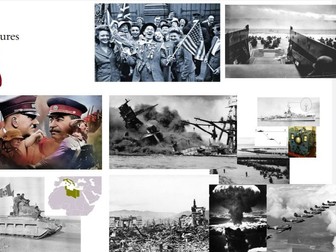
This lesson helps students examine the decision to use atomic bombs on Japan in August 1945, through multiple perspectives and critical debate, before crafting their own reasoned judgement.
This lesson includes:
Engaging starter activity – Students recall key facts about WWII’s end and the Pacific War to set the context.
Rich historical content – Explore perspectives from U.S. leaders, Japanese leaders, Manhattan Project scientists, and Allied leaders.
Collaborative group activity – Students represent different stakeholders, prepare arguments, and deliver presentations to assess responsibility for the atomic bombings.
Knowledge check – A mini whiteboard quiz reinforces core knowledge (cities bombed, key figures, death toll).
Structured extended writing – Scaffolded support to respond to the essay question: “‘The USA was fully responsible for the dropping of the atomic bomb.’ How far do you agree?”
Why use this lesson?
Encourages critical thinking and empathy by analysing multiple perspectives.
Links historical decisions to ethical and global consequences.
Builds oracy skills through group debate and presentation.
Perfect for KS3 or adaptable for GCSE groups to explore historical responsibility and causation.
5 lessons with PP presentation and resources
The impact of the Wall Street Crash
Republican attempts to deal with the crisis
Life during the Great Depression
Rural life during the Great Depression Roosevelt
the New Deal Impact of the New Deal
sequence of 5 lessons about World War II KS3
enquiry question: Did Britain win the war?
4 lessons with activities plus assessement lesson
suitable for SEN
it contains lots of visuals
I am offering a set of 7 lessons on Norman England and 3 lessons focused on essay writing about Durham Cathedral.
Please note: this is not a full teaching program. My students already had a strong understanding of medieval towns and village life, as well as monasticism and the church rebuilding program, which were thoroughly covered through a separate case study on Durham Cathedral. You will need textbook: “Norman England 1066–1100” by Helena Clarke.
I have also included three focused lessons on Durham Cathedral, designed specifically to support essay writing:
Lesson 1: Content and guidance for writing the first paragraph
Lesson 2: Material and structure for the second paragraph
Lesson 3: Support for evidence and points in the third paragraph
There are several useful ideas throughout the resources for teaching exam skills, though they may require some adaptation depending on your group. These materials are not perfect, but they may offer helpful support - so I’m sharing them free of charge.
Lesson Topics:
Succession Crisis (PowerPoint presentation with activities, Requires the textbook: “Norman England 1066–1100” by Helena Clarke)
Why Did the Normans Win the Battle of Hastings? (PowerPoint, videos, reading materials with links, and activities)
How Did the Normans Establish and Maintain Control? (PowerPoint presentation and lesson activities)
Feudal System (PowerPoint presentation with activities)
Domesday Book (PowerPoint presentation with activities)
Legal System (PowerPoint presentation with activities)
The Church (PP presentation with activities, requires a textbook; does not cover monasticism, the papacy, or the building program in detail)
Durham Cathedral Essay Lessons (3 sessions focused on paragraph-by-paragraph essay structure)


 Quick View