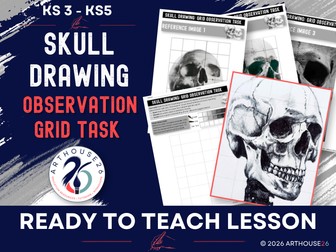
Skull Drawing: Grid Observation Task | Art Cover Lesson & Homework | KS3, KS4 & KS5Quick View
ArtHouse26

Skull Drawing: Grid Observation Task | Art Cover Lesson & Homework | KS3, KS4 & KS5

(0)
Turn a skull into a confident observational drawing in a single lesson. This no-prep grid drawing task teaches students to measure proportion square by square, then build tone and texture in pencil or pen with cross-hatching. Ideal as an art cover lesson, homework task or Halloween activity, and a strong foundation for GCSE and A-level Art. What’s included (8-page printable PDF) • Teacher guidance notes: timing, discussion starter, main task, plenary and extension • Student worksheet with a drawing grid and a tonal value scale, with pencil and pen examples • 3 gridded skull reference photographs at different angles and levels of challenge • Assessment rubric: 4 criteria across 4 levels, linked to Must / Should / Could • Terms of use and image credits Why it works • No preparation: print it and go • Easy for cover supervisors, because the task explains itself • Differentiated through Must / Should / Could objectives, a choice of pencil or biro, and three reference images • A task that suits secondary students • Assessment is built in, so staff have nothing extra to prepare Students will: draw a skull in proportion using a grid, observe detail and shadow, and show an understanding of tonal value and texture. Age range: Year 9 to 13 Time: 60 to 90 minutes, or a homework task over a week Materials: pencils or a black biro / fineliner, and an eraser This is the first lesson in my Skull Observation series, with pen and wash, ink and bleach, and textured ground lessons to follow.
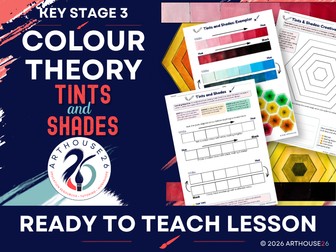
Tints & Shades Art Lesson | Colour Mixing & Class Display, KS3Quick View
ArtHouse26

Tints & Shades Art Lesson | Colour Mixing & Class Display, KS3

(0)
A hands-on KS3 colour mixing lesson that builds toward a genuinely striking collaborative class display. Students learn how adding white creates a tint and adding black creates a shade, mixing a smooth value scale from a single hue. They then apply that control to a set of concentric hexagons, painting a radial gradient from lightest tint at the edge to darkest shade at the centre. Once cut out, every student’s hexagon interlocks with the rest of the class’s. Mounted together, the collection becomes a genuine honeycomb spectrum display. Learning objective: To understand how adding white (tints) and black (shades) changes a colour’s value, then apply this to create a smooth value scale and a tonal display piece. What students will learn The difference between hue, tint, shade and value That tints and shades mix differently How to control paint mixing in small, deliberate increments for a smooth gradient How individual work contributes to a larger collaborative piece What’s included Teacher guidance notes: discussion starter, main task, plenary, extension, and a delivery note Value Scale worksheet with Key Words and Top Tips Creative Challenge worksheet: concentric hexagon template, reflection and confidence scale Worked exemplar showing complete value scales and a finished honeycomb display Available with US spelling Terms of use Ideal for A core colour theory lesson taught directly by a specialist. The mixing judgement involved makes this less suited to an unsupervised cover lesson than the rest of the series A collaborative class display project, with minimal extra planning Following on from the Colour Wheel lesson Details: KS3 (Years 7–9) | 60–90 minutes, or two sessions | paint (white and black specifically needed, not just primaries), palette, water pot, brush, scissors Part of the ArtHouse26 Colour Theory series. Pair it with the Colour Wheel lesson.
Complementary Colours: KS3 Art Colour Theory LessonQuick View
ArtHouse26

Complementary Colours: KS3 Art Colour Theory Lesson

(1)
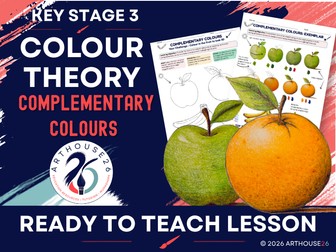
In this hands-on colour theory lesson, students shade an apple, an orange, bananas and blueberries. They use each fruit’s complementary colour to build a convincing shadow from a single light source. A step-by-step exemplar shows the technique in stages, so students can see exactly what to do, and the lesson works without specialist knowledge from the teacher. Ideal for: Cover lessons and supply teachers: print and go, needing only coloured pencils Following a colour wheel or warm and cool colours lesson Preparing students for tonal and observational drawing Key Stage: KS3 (Years 7–8) | Lesson length: 45–60 minutes | Materials: coloured pencils What students will learn: What complementary colours are, and how to use them for shadows How to vary pencil pressure to move from light to dark How to blend colour smoothly rather than outlining a shadow How a single, consistent light source controls where the shadows fall What’s included: Complementary Colours worksheet: four fruit outlines, a light source arrow, Must/Should/Could and Top Tips Exemplar page: the technique shown stage by stage, with pencil swatches for each step and finished examples of all four fruits Teacher guidance notes: learning objective, discussion starter, main task, plenary and extension Available US spelling/Letter Part of the ArtHouse26 Colour Theory series. Pair it with the Colour Wheel and Warm & Cool Colours lessons.
Warm and Cool Colours: KS3 Art Colour Theory LessonQuick View
ArtHouse26

Warm and Cool Colours: KS3 Art Colour Theory Lesson

(1)
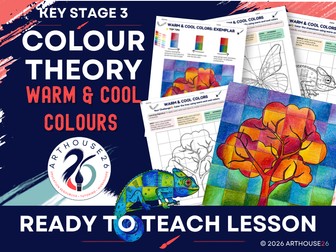
A ready-to-teach KS3 colour theory lesson on colour temperature, contrast and blending. Help students see how warm and cool colours create contrast and mood. Students choose a template (a tree, a butterfly or a chameleon) and colour it using warm colours (reds, oranges, yellows) and cool colours (blues, greens, purples) to make a deliberate contrast. A step-by-step exemplar shows how to vary pencil pressure from dark to light and layer colours for smooth blends, so students can see exactly what good work looks like. Only printing is needed, and no art specialism is required from whoever is teaching it. What students will learn How to sort and apply warm and cool colours Why warm colours “pop forward” while cool colours “recede” How to vary pencil pressure and layer colour to build smooth, gradual blends How to make deliberate colour choices to create contrast and mood What’s included Teacher guidance notes with a discussion starter, main task, plenary and extension Step-by-step exemplar page showing the blending technique Three worksheet templates (tree, butterfly and chameleon), each on a 6×6 grid with Must/Should/Could and Top Tips Terms of use Ideal for Cover lessons and supply teachers: print your chosen template and go Year 7 and Year 8 colour theory Following a colour wheel lesson, or leading into Complementary Colours Details: KS3 (Years 7–8) | 45–60 minutes | coloured pencils (best for blending) or paint Available in US Letter with US spellings Part of the ArtHouse26 Colour Theory series. Pair it with the Colour Wheel and Complementary Colours lessons.
Franz Marc: Colour & Emotion | KS3 Art Lesson, Copy & AnalyseQuick View
ArtHouse26

Franz Marc: Colour & Emotion | KS3 Art Lesson, Copy & Analyse

(0)
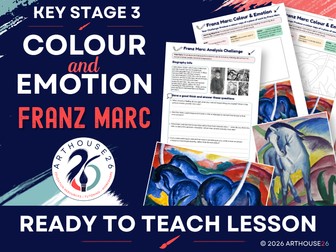
A copy and analyse KS3 art lesson exploring colour as a tool for emotion, not realism. Students copy the composition of Franz Marc’s Blue Horses (1911), matching his flat, bold blocks of colour as closely as they can. A follow-up Analysis Challenge page deepens the thinking with artist biography, guided discussion questions, and an extension task inviting students to paint an animal or subject of their own choosing, using colour to express how it makes them feel rather than how it actually looks. Learning objective: To analyse Franz Marc’s use of colour by copying his painting, Blue Horses (1911), considering how his colour choices create mood. What students will learn How Marc used flat, bold colour rather than realistic shading How colour choice can express emotion rather than describe reality How shape and rhythm connect a subject to its surroundings How to form and justify their own interpretation of an artist’s choices What’s included Teacher guidance notes: discussion starter, main task, plenary, extension Copy Task worksheet with Blue Horses reference image and Must/Should/Could Analysis Challenge worksheet: artist biography, period photograph, three further Marc paintings, four discussion questions, extension idea Terms of use Ideal for Cover lessons and supply teachers: print and go, needing only coloured pencils or paint Pairing with Van Gogh: Colour & Mood as a second artist-link lesson in the series A shorter session, or split across two (copy task, then analysis) Details: KS3 (Years 7–8) | 45–60 minutes, or two shorter sessions | coloured pencils or paint | Available in US spelling Part of the ArtHouse26 Colour Theory series. Pair it with Van Gogh: Colour & Mood.
Colour Wheel & Colour Theory Knowledge Check | KS3Quick View
ArtHouse26

Colour Wheel & Colour Theory Knowledge Check | KS3

(0)
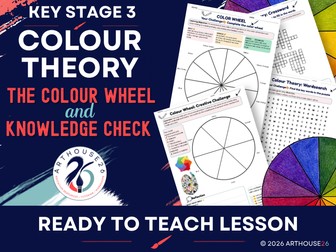
A KS3 colour theory lesson: a practical colour wheel lesson, plus a no-materials knowledge check. Students identify and mix primary colours to create secondary and tertiary colours across a full 12-part wheel, then stretch into a Creative Challenge page, recreating their wheel in a different material with a built-in reflection and confidence-scale check-in. Also included: a Colour Theory Wordsearch and Crossword, covering 20 key terms from across the whole ArtHouse26 Colour series (primary, complementary, analogous, tint, shade, saturation and more) - genuinely useful as a plenary, a cover lesson with zero materials, or revision before an assessment. Learning objective: To understand how colours are organised on the colour wheel and use colour mixing to create primary, secondary and tertiary colours. What’s included Teacher guidance notes: discussion starter, main task, plenary, extension Colour Wheel worksheet (Must/Should/Could, Top Tips) Creative Challenge extension page with reflection and confidence scale Colour Theory Wordsearch (20 key terms) Colour Theory Crossword (clue-based) Terms of use Also available with US spelling/US Letter Ideal for As an introduction to colour mixing and colour theory Cover lessons and supply teachers: the wordsearch/crossword need nothing but a pen, so this works even when paint or pencils aren’t an option A starter, plenary, or early-finisher task alongside the practical wheel lesson Revision before a colour theory assessment, since the vocabulary carries through your whole Colour Theory series Details: KS3 (Years 7–8) | 45–60 minutes (practical) + 10–15 minutes (knowledge check) | paint, coloured pencils or pastels for the wheel; pen only for the puzzles Part of the ArtHouse26 Colour Theory series. Pair it with Warm & Cool Colours and Complementary Colours.
Complementary & Analogous Colours: KS3 Op Art LessonQuick View
ArtHouse26

Complementary & Analogous Colours: KS3 Op Art Lesson

(0)
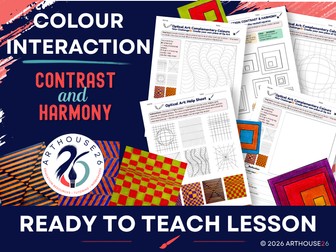
A striking KS3 colour theory lesson exploring contrast and harmony, with an Optical Art extension. Students colour nested squares - the simpler ones using complementary pairs for maximum contrast, the more complex ones using analogous colours for a calm, harmonious effect. The lesson then extends into Optical Art: using a complementary pair, students design their own Op Art pattern, choosing from seven differentiated templates (a blank canvas for confident students, or six pre-drawn pattern outlines for those needing more support), guided by a Key Words box introducing Victor Vasarely, Bridget Riley and Josef Albers. What students will learn The difference between complementary colours (opposite on the wheel, maximum contrast) and analogous colours (neighbouring, calm harmony) How repetition amplifies both effects How Op Art uses colour and pattern to create the illusion of movement How to apply a complementary pair deliberately to their own design What’s included Teacher guidance notes: learning objective, discussion starter, main task, plenary, extension and a differentiation note Colour Interaction worksheet: nested squares task with built-in colour wheel key Seven Optical Art worksheet versions (one blank canvas, five pre-drawn pattern outlines) for easy differentiation Optical Art Help Sheet: pattern references and coloured examples Terms of use Ideal for Cover lessons and supply teachers: print and go, needing only coloured pencils A longer KS3 session, or split across two lessons (core task, then Optical Art) Following on from Complementary Colours Introducing art movements and Op Art Details: KS3 (Years 7–9) | 45–60 minutes, or two sessions with the extension | coloured pencils or markers Part of the ArtHouse26 Colour Theory series. Pair it with the Complementary Colours lesson.
Art Room Health and Safety PostersQuick View
ArtHouse26

Art Room Health and Safety Posters

(1)
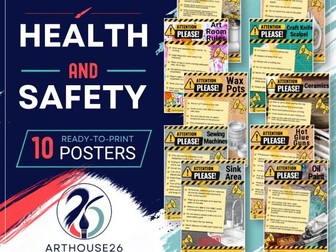
10 ready-to-print A4 posters covering essential health and safety rules for the art classroom. Designed by a secondary art teacher with 26 years’ classroom experience, this set gives you clear, eye-catching visual reminders for the equipment and materials most likely to need explicit safety guidance. The posters are perfect for permanent display, demonstration lessons, or technician handover. Posters included: Irons Hot Glue Guns Wax Pots Oil Paint Sink Area Craft Knives / Scalpels Sewing Machines Spray Fixative / Aerosol Use Ceramics General Art Room Rules Details: A4, print-ready PDF format Consistent “Attention Please” hazard-tape design across the set Suitable for KS3, KS4 and KS5 art, craft and design classrooms Non-editable (design-locked for consistency and safety accuracy) Please note: these posters are intended as visual classroom reminders and do not replace your school’s own COSHH risk assessments. Always follow your school’s specific health and safety policy alongside these posters. © ArtHouse26. For single classroom/personal use. Not for resale or redistribution.
How to Use Your Sketchbook + Bonus BookmarkQuick View
ArtHouse26

How to Use Your Sketchbook + Bonus Bookmark

(0)
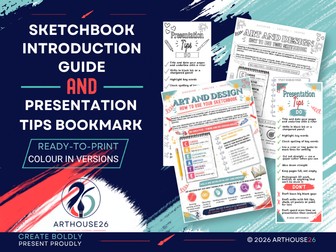
A welcoming sketchbook introduction guide for art students, with a bonus laminate-ready presentation tips bookmark, plus black-and-white colouring versions of both, included free. This resource sets clear expectations for sketchbook use from day one, reinforcing the habits and mindset that make a strong art student, plus guidance on what actually goes in a sketchbook, and the skills students build through studying art and design. What’s included: Sketchbook Introduction Guide - full colour version Black-and-white “colour-in” version of the guide - a fun, engaging alternative students can personalise themselves Bonus: Presentation Tips Bookmark - a laminate-ready bookmark covering Do’s and Don’ts for sketchbook presentation, designed to live inside students’ sketchbooks all year Black-and-white version of the bookmark included too Details: Available in both UK and US spelling versions A4 (Guide) + bookmark sized for printing multiple per sheet Print-ready, 300dpi, PDF format Laminate the bookmark for durability Suitable for middle school / key stage 3 art students Please note: this resource sets expectations and habits; it doesn’t replace your own department’s specific sketchbook or marking policy. © ArtHouse26. For single classroom/personal use. Not for resale or redistribution.
Final Piece Planning in 5 Easy Steps. KS4-KS5Quick View
ArtHouse26

Final Piece Planning in 5 Easy Steps. KS4-KS5

(0)
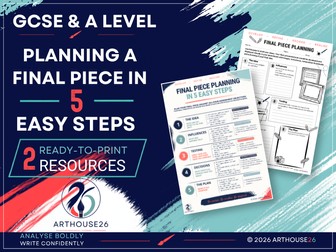
A step-by-step guide and matching worksheet to help GCSE and A Level students plan their final piece with confidence. Print as a classroom display, laminate for durability, or use as an individual student handout. Designed by a secondary art teacher with 26 years of classroom experience, this resource is structured around all four Assessment Objectives and breaks final piece planning into five clear, manageable steps, so students always know exactly what to do next, and how it connects to what examiners are looking for. What’s included: Classroom Guide: Final Piece Planning in 5 Easy Steps with guiding questions and sentence starters for every step Worksheet: matching student planning page, with space for artist images, test pieces, thumbnail compositions, key practical decisions, and a final visual plan Details: Structured around the GCSE and A Level Art & Design Assessment Objectives (AO1 Develop, AO2 Refine, AO3 Record, AO4 Realise) A4, print-ready, 300dpi PDF format Suitable for KS4 and KS5 Please note: this worksheet is for planning and drafting only. Students’ final, presented plan should be developed and displayed visually in their sketchbook. © ArtHouse26. For single classroom/personal use. Not for resale or redistribution.
Complete Art Writing & Analysis Bundle KS3-5Quick View
ArtHouse26

Complete Art Writing & Analysis Bundle KS3-5

(0)
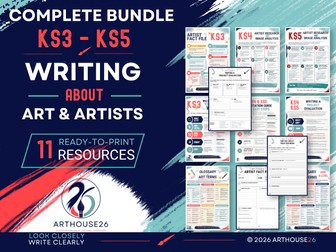
11 ready-to-print resources covering the complete journey from KS3 foundations to GCSE and A Level critical analysis. Everything you need to build confident, articulate art students across every year group. Designed, tried and tested by a secondary art teacher with 26 years of classroom experience, this complete bundle combines our KS3 Art Writing & Analysis set and our GCSE & A Level Advanced Art Analysis set into one comprehensive resource. This resource is ideal for whole department use, curriculum planning, or building a consistent writing scaffold that grows with your students. What’s included: KS3/ Middle School (6 resources) Artist Fact File - writing frame and matching student worksheet Writing About Your Own Work - writing frame and matching student worksheet Glossary of Art Terms (42 foundational terms) Project Evaluation worksheet GCSE & A Level / High School (5 resources) Artist Research & Image Analysis - 9-step GCSE framework Artist Research & Image Analysis - advanced A Level framework Annotation Guide in 5 Easy Steps Writing a Project Evaluation Glossary of Art Terms (40+ advanced terms) Details: Available in both A4 and US Letter sizing, print-ready, 300dpi PDF format Suitable for KS3 through KS5 / Grades 6-12 Consistent colour-coded, icon-based design across the full progression Please note: these resources are designed to scaffold student thinking and writing, not to replace your own curriculum planning or assessment criteria. © ArtHouse26. For single classroom/personal use. Not for resale or redistribution.
KS3 Art Writing and Analysis BundleQuick View
ArtHouse26

KS3 Art Writing and Analysis Bundle

(0)
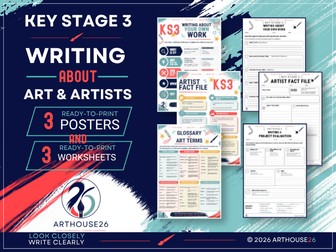
KS3 / Middle School Art Writing and Analysis Bundle 6 ready-to-print resources to build confident art analysis and reflective writing skills. This resource is perfect for classroom display, individual student handouts, or laminated reference sheets. Designed by a secondary art teacher with 26 years of classroom experience, this bundle scaffolds the core writing and thinking skills students need when researching artists and reflecting on their own artwork. What’s included: Artist Fact File - writing frame and matching student worksheet Writing About Your Own Work - writing frame and matching student worksheet Glossary of Art Terms - 42 key vocabulary words across 6 categories (Formal Elements, Colour Theory, Composition and Space, Principles of Design, Concept and Meaning, Technique and Process) Project Evaluation worksheet with a guided reflection scaffold Details: Available in both A4 and US Letter sizing — print-ready, 300dpi PDF format Designed for laminating or individual handout use Suitable for KS3 (UK) / Grades 6-8 (US) Consistent colour-coded, icon-based design across the whole set Please note: these resources are designed to scaffold student thinking and writing, not to replace your own curriculum planning or assessment criteria. © ArtHouse26. For single classroom/personal use. Not for resale or redistribution.
GCSE & A Level Art Writing & Analysis BundleQuick View
ArtHouse26

GCSE & A Level Art Writing & Analysis Bundle

(0)
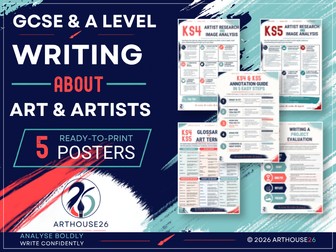
GCSE & A Level / High School Advanced Art Analysis Bundle 5 ready-to-print resources for high-level artist research, image analysis, annotation and evaluation built for GCSE and A Level students, and equally suited to advanced/AP-level High School art programs. These resources are perfect for classroom display, individual student handouts, or laminated reference sheets. Designed, tried and tested by a secondary art teacher with 26 years of classroom experience, this bundle moves beyond foundational analysis into genuine critical thinking: interpretation, comparison, sustained practical response, and evaluative writing. What’s included: Artist Research & Image Analysis (9-step framework) for GCSE-level students Artist Research & Image Analysis for a more advanced synthesis-and-judgement framework for A Level/advanced students Annotation Guide in 5 Easy Steps for ongoing sketchbook annotation Writing a Project Evaluation - a full scaffold for final written evaluations Glossary of Art Terms - 40+ advanced vocabulary terms across 6 categories, including technique-specific and critical-analysis vocabulary (Chiaroscuro, Iconography, Juxtaposition, Appropriation, and more) Details: Available in both A4 and US Letter sizing - print-ready, 300dpi PDF format Suitable for KS4/KS5 (UK) / Grades 9-12, GCSE and A Level / AP Art programs (US) Consistent colour-coded, icon-based design, visually paired with our KS3/Middle School bundle for departments teaching across all levels Please note: these resources are designed to scaffold student thinking and writing, not to replace your own curriculum planning or assessment criteria. © ArtHouse26. For single classroom/personal use. Not for resale or redistribution.
Annotation Guide in 5 Easy Steps (KS4-5)Quick View
ArtHouse26

Annotation Guide in 5 Easy Steps (KS4-5)

(0)
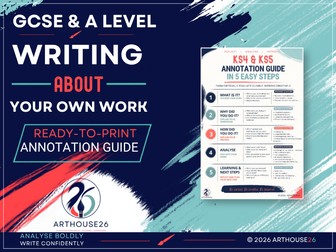
A clear, 5-step scaffold to help GCSE and A Level students write confident, effective sketchbook annotations. Designed, tried and tested by a secondary art teacher with 26 years of classroom experience, this guide breaks sketchbook annotation into five manageable steps - What Is It, Why Did You Do It, How Did You Do It, Analyse, Learning & Next Steps - each with guiding questions and ready-to-use sentence starters, so students always know how to begin. Perfect for ongoing use throughout a project, alongside a final project evaluation, or as a permanent classroom display to reinforce expectations for high-quality annotation. Details: Available in both A4 and US Letter sizing, print-ready, 300dpi PDF format Suitable for KS4 and KS5 / GCSE and A Level, Grades 9-12 Matches the visual style of our full KS3-KS5 Art Writing & Analysis Bundle Please note: this resource is designed to scaffold student thinking and writing, not to replace your own curriculum planning or assessment criteria. © ArtHouse26. For single classroom/personal use. Not for resale or redistribution.