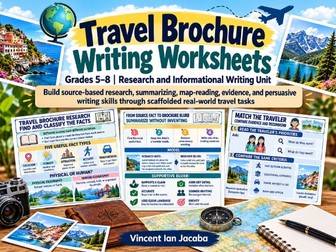
Travel Brochure Writing Unit | English + Geography | Research, Map Skills & Persuasive WritingQuick View
qscience

Travel Brochure Writing Unit | English + Geography | Research, Map Skills & Persuasive Writing

(0)
Travel Brochure Writing Unit | Ages 10–14 | English + Geography Build research, informational writing, geography, and persuasive writing skills through a scaffolded travel brochure project for Grades 5–8 / Ages 10–14. Students Practise researching and selecting relevant facts summarising source information physical and human geography map reading and directional language evidence-based recommendations fact-checking and claim revision descriptive and persuasive writing brochure organisation and editing Includes instructional anchor charts scaffolded worksheets destination research tasks geography and map activities traveller comparison tasks brochure planning activities Final Travel Brochure Challenge teacher guidance and answer keys No outside research is required because destination information is provided within the resource. Ideal For English, literacy, Geography, cross-curricular learning, project-based learning, independent practice, and formative or summative assessment. The flexible progression supports differentiation, allowing teachers to model individual skills or use the full sequence as a complete English and Geography writing unit. Give students a meaningful way to research, evaluate evidence, read maps, summarise accurately, and create persuasive travel writing for a real audience.

Culture Compare and Contrast Worksheets Grades 3–8 | ELA + Global StudiesQuick View
qscience

Culture Compare and Contrast Worksheets Grades 3–8 | ELA + Global Studies

(0)
Culture Compare and Contrast | Grades 3–8 | ELA + Global Studies Develop compare-and-contrast, informational reading, and cultural literacy skills through engaging global studies activities. Students analyse cultural and everyday-life profiles, identify similarities and differences, use textual evidence, and write accurate comparisons without overgeneralising. Students Practise comparing informational texts identifying similarities and differences organising details by category citing evidence from multiple sources evaluating claims writing evidence-based comparisons Includes instructional anchor charts scaffolded worksheets cultural profiles covering routines, food, celebrations, languages, and family experiences claim-analysis and synthesis activities culminating compare-and-contrast task answer keys Ideal for whole-class lessons, literacy centres, small groups, homework, intervention, enrichment, and assessment. Activities progress from structured practice to independent analysis, making differentiation straightforward across Grades 3–8. A practical cross-curricular resource for strengthening ELA skills while building thoughtful, evidence-based cultural understanding.
Ancient Civilizations Artifact Detective Worksheets | Grades 6–9 | ELA & World HistoryQuick View
qscience

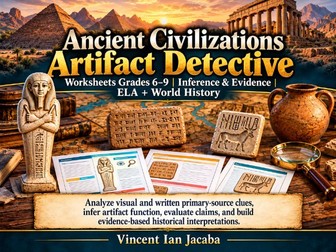
Ancient Civilizations Artifact Detective Worksheets | Grades 6–9 | ELA & World History

(0)
Ancient Civilizations Artifact Detective | Grades 6–9 | ELA + World History Build stronger historical thinking and evidence-based literacy through engaging ancient artifact investigations. Designed for Grades 6–9 (approximately ages 11–15), this interdisciplinary ELA and World History resource teaches students to examine artifacts carefully, distinguish observation from inference, evaluate evidence, and develop cautious, defensible historical interpretations. Skills Developed Primary-source and artifact analysis Inference and evidence-based reasoning Observation versus interpretation Claim evaluation and historical reasoning Visual and disciplinary literacy Comparing multiple sources of evidence Evidence-based reading and writing Recognising uncertainty and unsupported conclusions What’s Included Students investigate artifacts and evidence connected with ancient Egypt, Mesopotamia, the Indus Valley, Shang China, ancient Greece, ancient Rome, and the Maya. Activities include cuneiform analysis, oracle-bone reasoning, Greek pottery interpretation, Roman coin analysis, artifact comparison, museum-label revision, archaeological-context analysis, and a culminating Final Artifact Dossier. Anchor charts and corresponding answer keys are also included. Classroom Benefits The scaffolded sequence progresses from direct observation to increasingly independent historical interpretation, helping students connect multiple clues to claims while avoiding overgeneralisation and unsupported certainty. Differentiation options support developing learners through modelling, vocabulary instruction, annotation, sentence frames, and anchor charts, while advanced students can evaluate competing interpretations and rank evidence by strength. Perfect For Ancient civilizations and World History units ELA–Social Studies cross-curricular learning Primary-source analysis Historical thinking lessons Evidence and inference practice Literacy stations and small groups Warm-ups, review, and formative assessment Intervention or enrichment activities Use the complete sequence as an interdisciplinary mini-unit or select individual activities to strengthen historical reasoning, source analysis, and evidence-based writing across your curriculum.
Argumentative Writing & Argument Analysis Worksheets Grades 6–12 | Claims, Evidence & ReasoningQuick View
qscience

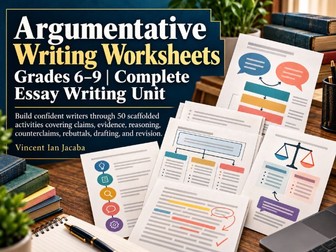
Argumentative Writing & Argument Analysis Worksheets Grades 6–12 | Claims, Evidence & Reasoning

(0)
Argumentative Writing & Argument Analysis Worksheets | Grades 6–12 Build stronger writers and critical readers with this comprehensive argumentative writing and argument analysis resource. Students progress from identifying argument parts to planning, drafting, revising, and evaluating complete argumentative essays. Suitable for • Grades 6–12 / approximately ages 11–18 • Secondary English, ELA, literacy, writing, and reading comprehension • Whole-class teaching, intervention, independent practice, homework, revision, and assessment Key Skills • Claims and thesis statements • Evidence and logical reasoning • Counterclaims and rebuttals • Essay structure and paragraph development • Introductions, transitions, and conclusions • Revision and editing • Bias, exaggeration, loaded language, and logical fallacies • Evaluating strong and weak arguments Includes • 50 scaffolded argument-writing activities • Argument analysis and “Argument Detective” worksheets • Anchor charts and visual reference pages • Planning and full-essay drafting tasks • Open-ended and multiple-choice activities • Differentiation guidance • Detailed answer keys with explanations and sample responses Flexible Classroom Use Teach the resource as a complete argumentative writing unit or select individual worksheets for targeted skill practice, bell ringers, small groups, test preparation, writing centres, substitute lessons, or formative assessment. Help students move beyond simply identifying argument terms and develop the reasoning, evidence evaluation, organisation, and critical-thinking skills needed for effective argumentative writing.
ELL Verb Tense Worksheets | Past, Present & Future Tense PracticeQuick View
qscience

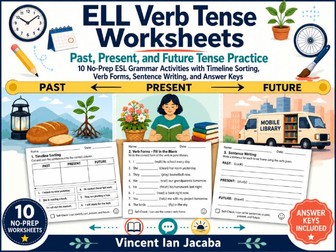
ELL Verb Tense Worksheets | Past, Present & Future Tense Practice

(0)
Build ELL/ESL learners’ confidence with past, present, and future verb tenses using this practical, no-prep grammar resource. Skills Covered Identifying past, present, and future actions Recognising common time clues Using correct verb forms Writing complete sentences Practising capitalisation, spelling, and punctuation Included 10 themed verb tense worksheets Timeline sorting activities Verb-form practice Guided sentence writing Self-check tasks Complete answer keys and sample responses Ideal for upper primary and lower secondary ELL/ESL learners, these worksheets work well for whole-class teaching, small groups, independent practice, homework, intervention, revision, or assessment. Differentiation options support both developing and more confident learners. A clear, classroom-ready resource for reinforcing essential English grammar and verb tense skills.
ELL Dialogue Completion Worksheets | ESL Everyday Conversation PracticeQuick View
qscience

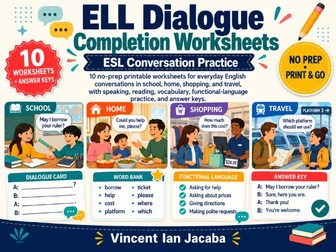
ELL Dialogue Completion Worksheets | ESL Everyday Conversation Practice

(0)
Build practical everyday English skills with this no-prep ELL/ESL Dialogue Completion Worksheets pack. Designed for beginner to early-intermediate learners, the resource uses realistic school, home, shopping, and travel conversations to strengthen functional language and speaking confidence. Skills Covered Everyday vocabulary and functional English Reading comprehension and context clues Questions, responses, requests, and polite expressions Speaking, pronunciation, and conversational fluency Spelling, punctuation, and capitalization What’s Included 10 printable dialogue worksheets Real-life conversation scenarios Word banks and response-selection activities Requests, choices, schedules, offers, and problem-solving tasks Complete answer keys Ideal For Whole-class lessons, independent work, partner speaking practice, ESL intervention, tutoring, homework, learning centres, and revision. Easy to differentiate with sentence frames or oral support for developing learners, while more confident students can extend or create their own dialogues. A practical, print-and-go ESL conversation resource for meaningful everyday English practice.
ELL Listening Comprehension Worksheets | ESL Listening Practice & Answer KeysQuick View
qscience

ELL Listening Comprehension Worksheets | ESL Listening Practice & Answer Keys

(0)
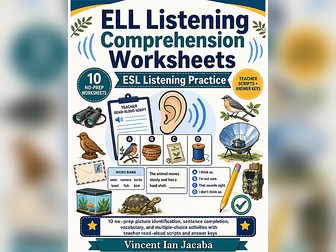
ELL/ESL Listening Comprehension Practice Build confident listening skills with 10 no-prep worksheets designed for beginner to early-intermediate ELL, ESL and EAL learners. Suitable for upper primary to lower secondary students, these activities support listening comprehension, vocabulary recognition and understanding of key details. Students Practise Picture identification from spoken sentences Vocabulary and sentence completion Listening for numbers, objects, actions and locations Short-passage comprehension Multiple-choice responses Resource Includes 10 listening comprehension worksheets Teacher read-aloud scripts Complete answer keys Real-world topics including wildlife, science, community activities and everyday work Flexible Classroom Use Ideal for whole-class lessons, small-group EAL support, intervention, tutoring, learning centres, revision and informal assessment. Differentiate easily by previewing vocabulary, repeating passages or challenging stronger learners with one reading only. A practical, low-preparation resource for developing attentive listening, spoken-language comprehension and learner confidence.
Classroom Object Scavenger Hunt Worksheets for EAL ESL ELL | Vocabulary ActivitiesQuick View
qscience

Classroom Object Scavenger Hunt Worksheets for EAL ESL ELL | Vocabulary Activities

(0)
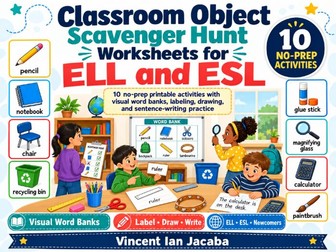
Classroom Vocabulary Scavenger Hunt for EAL, ESL & ELL Help primary/elementary English learners build practical classroom vocabulary with 10 no-prep printable scavenger hunt worksheets. Students identify, label, draw and write about familiar classroom objects using visual word banks and guided sentence frames. Skills Covered Classroom vocabulary and spelling Word-picture matching Simple sentence writing Speaking, observation and communication Object location, purpose and safe classroom use Includes 10 printable activities Visual word banks Find-and-check tasks Picture labelling Drawing prompts Sentence-writing practice Ideal for EAL/ESL lessons, newcomers, intervention, literacy centres, small groups, independent work and back-to-school vocabulary review. Easy to differentiate for beginning through developing English learners. A practical, engaging resource for connecting everyday classroom objects with meaningful language practice.
Coding Vocabulary & Algorithm Reading Worksheets | KS3–KS4 Computing & EnglishQuick View
qscience

Coding Vocabulary & Algorithm Reading Worksheets | KS3–KS4 Computing & English

(0)
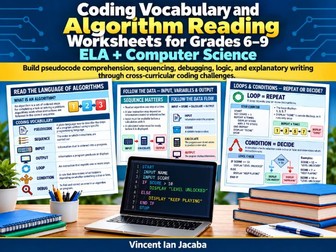
Coding Vocabulary & Algorithm Reading Worksheets | Ages 11–15 Build coding literacy through accessible pseudocode while strengthening reading comprehension, logical reasoning, computational thinking, and explanatory writing. Designed for ages 11–15, this cross-curricular ELA/English and Computer Science resource requires no prior programming experience. Skills Covered coding vocabulary and pseudocode sequence, input, output and variables loops and IF–ELSE conditions tracing algorithms and values debugging logic errors comparing solutions explaining algorithms clearly What’s Included 5 visual reference charts 10 progressive worksheets answer keys teacher guidance and differentiation ideas final Algorithm Control Room challenge Classroom Uses Ideal for Computing, STEM, Digital Literacy and English lessons, as well as independent work, intervention, enrichment, homework and formative assessment. Support students as they progress from foundational coding vocabulary to tracing, debugging, evaluating and explaining complete algorithms with increasing independence.
200 ELA Bell Ringers for Grades 3–8 | Vocabulary, Grammar & Sentence CorrectionQuick View
qscience

200 ELA Bell Ringers for Grades 3–8 | Vocabulary, Grammar & Sentence Correction

(0)
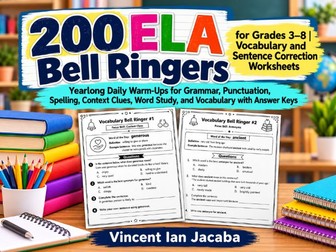
200 Ready-to-Use ELA Bell Ringers for Grades 3–8 Build consistent vocabulary, grammar, punctuation, spelling and editing practice with this comprehensive set of 200 ELA bell ringers. Designed for Grades 3–8, these short, focused activities work well as daily warm-ups, morning work, lesson starters, review, intervention or formative assessment. What’s Included 100 vocabulary bell ringers 100 daily sentence-correction activities Complete answer keys Teacher guidance, differentiation ideas and assessment support Skills Covered Students practise context clues, synonyms, antonyms, multiple-meaning words, prefixes, suffixes, root words, shades of meaning, word relationships, capitalization, punctuation, spelling, grammar, verb forms, subject-verb agreement, sentence structure and proofreading. Flexible Classroom Use Use the activities in sequence for ongoing ELA review or select individual pages to match current learning needs. The consistent format supports independent practice, targeted reteaching, small-group instruction and differentiated learning. Vocabulary activities generally take 5–8 minutes, while sentence-correction activities take approximately 8–12 minutes. Add this versatile ELA resource to your classroom toolkit for practical, ready-to-use vocabulary, grammar and editing practice throughout the school year.
Art Analysis Worksheets | Visual Literacy, ELA & Visual Arts | Grades 6–9 / KS3Quick View
qscience

Art Analysis Worksheets | Visual Literacy, ELA & Visual Arts | Grades 6–9 / KS3

(0)
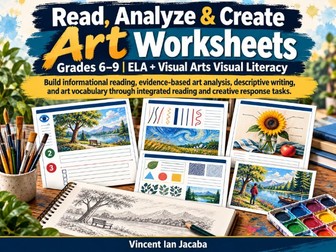
Read, Analyse & Create Art Worksheets — ELA + Visual Arts Develop visual literacy, reading comprehension and evidence-based thinking with this cross-curricular resource for Grades 6–9 / approximately Years 7–10 (ages 11–15). Skills Covered Visual analysis and close observation Observation, inference and opinion Evidence-based interpretation Art vocabulary and descriptive writing Composition, focal point, line, shape, texture and space Comparing artistic styles and techniques Includes Visual literacy anchor charts Progressive art analysis worksheets Impressionism, Pointillism and Cubism activities Creative response and reflection tasks Culminating Art Studio Challenge Answer keys Ideal For Whole-class teaching, independent work, KS3 English and Art integration, visual literacy lessons, enrichment, formative assessment and cross-curricular humanities. Students move from careful observation to supported interpretation, comparison, evaluation and creative application. Differentiation options also support developing and advanced learners. A practical, ready-to-use resource for strengthening visual literacy, art analysis and evidence-based writing.
Young Entrepreneur Business Challenge Grades 6–9 | Business Maths & Financial LiteracyQuick View
qscience

Young Entrepreneur Business Challenge Grades 6–9 | Business Maths & Financial Literacy

(0)
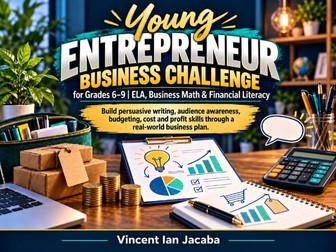
Young Entrepreneur Business Challenge for Grades 6–9 Build real-world entrepreneurship, business maths, financial literacy and persuasive writing skills with this practical interdisciplinary resource. Students identify customer needs, develop business ideas, calculate costs, budgets, revenue and profit, evaluate pricing decisions and create truthful sales pitches. Skills Covered Customer needs and survey evidence Cost, budget, revenue and profit calculations Pricing and business decision-making Features, benefits and audience awareness Persuasive writing and truthful claims Critical thinking and evidence-based reasoning Includes 5 instructional anchor charts Business maths and entrepreneurship worksheets Error-analysis and decision-making tasks Mini business plan Final Young Entrepreneur Business Challenge Teacher guidance and answer keys Ideal for Grades 6–9 / ages 11–15 in English/ELA, business maths, financial literacy, entrepreneurship, career readiness and project-based learning. Use as a complete unit, focused skills practice, enrichment or formative assessment. Give students an engaging way to connect maths, literacy and financial decision-making through an authentic business challenge.
Sports Science Reading Comprehension & Data Analysis Worksheets | KS3 / Grades 6–8Quick View
qscience

Sports Science Reading Comprehension & Data Analysis Worksheets | KS3 / Grades 6–8

(0)
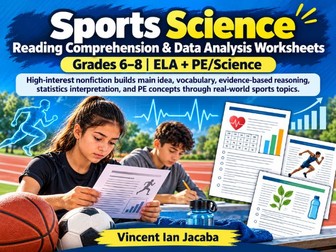
Sports Science Reading Comprehension & Data Analysis | Grades 6–8 Build nonfiction reading, data interpretation and evidence-based reasoning through engaging sports science contexts. Ideal for Grades 6–8, this cross-curricular resource supports ELA, PE, health and science instruction. Skills Covered Main idea and supporting details Vocabulary in context Cause and effect and sequencing Data and pattern analysis Comparing information across sources Evaluating claims and overgeneralisations Evidence-based written responses What’s Included 5 instructional anchor charts 10 sports science worksheets with answer keys Passages, tables, diagrams, timelines and training logs Topics including warm-ups, heart rate, hydration, muscles, sports rules, endurance, recovery and basketball Training Claim Check activity Sports Science Final Challenge Classroom Uses Perfect for whole-class lessons, literacy centres, intervention, homework, independent practice, formative assessment and cross-curricular learning. Differentiation options support developing readers while extending advanced learners through deeper data analysis and evidence evaluation. Help students read, analyse, interpret and defend conclusions using meaningful sports science content.
Economics Scenario Worksheets | Goods, Needs, Producers & Supply | Grades 6–9Quick View
qscience

Economics Scenario Worksheets | Goods, Needs, Producers & Supply | Grades 6–9

(0)
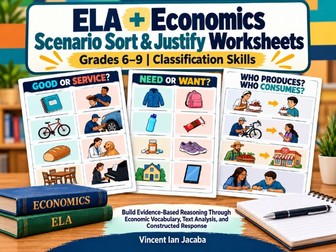
ELA + Economics Scenario Sort & Justify | Grades 6–9 Strengthen economics knowledge, reading comprehension, and evidence-based reasoning with engaging real-world scenarios. Students classify and justify examples involving goods and services, needs and wants, producers and consumers, and supply and demand. Includes 5 instructional anchor charts Sequenced economics worksheets Scenario classification and evidence tasks Cause-and-effect and error-analysis activities Cumulative Scenario Sort & Justify Challenge Complete answer keys Skills Developed Reading comprehension, contextual analysis, classification, textual evidence, economic reasoning, cause and effect, and constructed response. Ideal for ELA, economics, social studies, financial literacy, intervention, independent practice, homework, review, and formative assessment. Differentiation options support multilingual learners, developing students, and advanced learners. A practical cross-curricular resource for helping Grades 6–9 students move beyond vocabulary recall and apply economics concepts with evidence and clear reasoning.
Compare Historical Perspectives Worksheets & Anchor Charts | History Source Analysis Grades 6–8Quick View
qscience

Compare Historical Perspectives Worksheets & Anchor Charts | History Source Analysis Grades 6–8

(0)
Build students’ historical thinking and source-analysis skills with this Grades 6–8 resource for ELA, U.S. History, Social Studies, and interdisciplinary literacy. Skills Covered Perspective, bias and framing Fact vs inference Claims and evidence Source usefulness and limitations Corroboration and missing perspectives Evidence-based comparison and synthesis Includes 5 instructional anchor charts 10 historical perspective worksheets Paired historical accounts Complete answer keys Topics including the Boston Massacre, Cherokee Removal, women’s suffrage, the Montgomery Bus Boycott and the Boston Tea Party Classroom Use Ideal for whole-class teaching, guided practice, independent work, small groups, homework, intervention, or formative assessment. Differentiation can be supported through vocabulary help, sentence frames, guided annotation, and reduced scaffolding for advanced learners. A practical, classroom-ready resource for helping students evaluate historical sources, compare perspectives, corroborate evidence, and write balanced, evidence-based conclusions.
ELA + SEL Scenario Worksheets for Grades 5–8 | Inference, Perspective & Conflict ResolutionQuick View
qscience

ELA + SEL Scenario Worksheets for Grades 5–8 | Inference, Perspective & Conflict Resolution

(0)
Build ELA and SEL skills through realistic social scenarios designed for Grades 5–8. Students practise making evidence-based inferences, considering different perspectives, distinguishing facts from assumptions, resolving conflicts, communicating respectfully, and justifying decisions in writing. Includes 5 instructional anchor charts 10 scenario-based worksheets Complete answer keys Cumulative SEL Scenario Challenge Ideal For Whole-class lessons, small groups, partner work, independent practice, intervention, advisory, and SEL instruction. With built-in differentiation and practical, relatable scenarios, this resource supports reading comprehension, critical thinking, perspective-taking, communication, and conflict-resolution skills in an engaging, classroom-ready format.
400 ELA Bell Ringers for Grades 3–8 | Grammar, Vocabulary, Reading & WritingQuick View
qscience

400 ELA Bell Ringers for Grades 3–8 | Grammar, Vocabulary, Reading & Writing

(0)
400 ELA Bell Ringers for Grades 3–8 Make daily English Language Arts practice simple and consistent with 400 ready-to-use bell ringers covering grammar, vocabulary, reading, writing, sentence correction, punctuation, capitalisation and spelling. Designed for Grades 3–8, these short activities are ideal for quick, purposeful literacy practice with minimal preparation. What’s Included 200 multi-skill ELA bell ringers 100 vocabulary bell ringers 100 sentence-correction bell ringers Answer keys with sample responses where appropriate Teacher guidance for implementation and differentiation Skills Covered Students practise grammar and language conventions, context clues, synonyms and antonyms, prefixes and suffixes, root words, reading comprehension, inference, punctuation, spelling, subject–verb agreement, sentence structure and short written responses. Classroom Uses Ideal for: Morning work and lesson starters ELA warm-ups and bell work Grammar and vocabulary review Independent or small-group practice Intervention and skill reinforcement Formative assessment Most activities can be completed in approximately 5–10 minutes and may be used sequentially for year-round practice or selected by skill to match current learning needs. Support consistent literacy practice, targeted review and differentiated instruction with this comprehensive collection of 400 ELA bell ringers.
ELA + Civics Case Study Worksheets Grades 9–12 | Argument Writing & Civic Decision-MakingQuick View
qscience

ELA + Civics Case Study Worksheets Grades 9–12 | Argument Writing & Civic Decision-Making

(0)
ELA + Civics Case Study Worksheets for Grades 9–12 Develop argument writing, evidence analysis, and civic decision-making skills through realistic public-policy case studies. Designed for Grades 9–12, this resource supports ELA, civics, government, social studies, and interdisciplinary literacy. Students Practise Evaluating evidence and claims Identifying civic rights, responsibilities, and government duties Comparing policy options, costs, benefits, and trade-offs Analysing stakeholder perspectives Writing evidence-based recommendations and policy briefs Included 5 instructional anchor charts Civic case-study worksheets Policy brief activity Culminating Civics Decision Challenge Detailed answer keys and sample responses Ideal for classwork, small groups, homework, intervention, enrichment, formative assessment, and argument-writing practice. Differentiation options support both developing and advanced learners. Help students build stronger literacy, reasoning, and responsible civic decision-making through meaningful, evidence-based tasks.
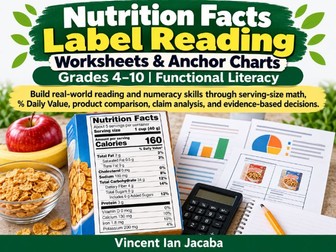
Nutrition Facts Label Reading Worksheets & Anchor Charts | Grades 4–10 | Functional LiteracyQuick View
qscience

Nutrition Facts Label Reading Worksheets & Anchor Charts | Grades 4–10 | Functional Literacy

(0)
Nutrition Facts Label Reading Worksheets & Anchor Charts for Grades 4–10 Build functional literacy, health literacy, numeracy, and critical-thinking skills with this practical Nutrition Facts label reading resource for Grades 4–10. Students learn to interpret food labels, calculate serving-based values, compare products, analyse ingredient lists, evaluate claims, and make evidence-based decisions. Skills Covered Serving size and servings per container Grams, milligrams, and percentages Multiple and fractional serving calculations % Daily Value interpretation Product comparison Ingredient-list analysis Claim evaluation and evidence-based reasoning Multi-criteria decision making What’s Included Instructional anchor charts Progressive student worksheets Nutrition label and serving-size activities Product comparison and claim-checking tasks Reasoning and error-analysis activities Answer keys Classroom Use Ideal for ELA, functional literacy, health education, consumer education, applied maths, intervention, independent work, homework, centres, and formative assessment. Activities can be differentiated through modelling, vocabulary support, calculators, sentence frames, or extension tasks. Help students build practical reading, maths, and consumer literacy skills through meaningful real-world Nutrition Facts label activities.
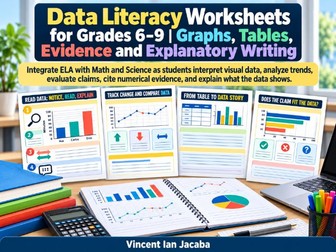
Data Literacy Worksheets Grades 6–9 | Graphs, Tables, Evidence & Data AnalysisQuick View
qscience

Data Literacy Worksheets Grades 6–9 | Graphs, Tables, Evidence & Data Analysis

(0)
Build students’ data literacy and evidence-based reasoning with this Grades 6–9 resource combining English, maths, and science skills. Students interpret graphs, tables, and scatter plots, analyse trends, evaluate claims, distinguish association from causation, and write clear explanations supported by numerical evidence. Suitable For Grades 6–9 / ages approximately 11–15. Skills Covered Reading graphs, tables, and scatter plots Comparing values and identifying trends Evaluating supported and unsupported claims Recognising misleading graph scales Distinguishing association from causation Selecting numerical evidence Writing evidence-based explanations What’s Included Instructional anchor charts Scaffolded worksheets Data interpretation and claim-evaluation activities Explanatory writing tasks Data Story Capstone Answer keys Classroom Uses Ideal for whole-class teaching, independent practice, small groups, intervention, review, assessment, and cross-curricular English, maths, or science lessons. Help students move beyond simply reading data to interpreting evidence carefully, explaining patterns accurately, and making well-supported conclusions.
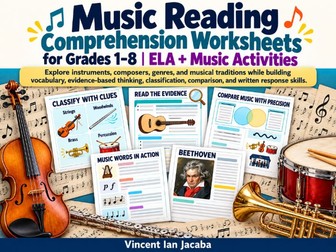
Music Reading Comprehension Worksheets & Activities for Grades 1–8 | ELA + MusicQuick View
qscience

Music Reading Comprehension Worksheets & Activities for Grades 1–8 | ELA + Music

(0)
Music Reading Comprehension Worksheets for Grades 1–8 Combine literacy and music learning with this cross-curricular resource for Grades 1–8. Students explore instruments, composers, genres, sound production, and global musical traditions while building vocabulary, inference, comparison, evidence, synthesis, and written response skills. What’s Included anchor charts, worksheets, and answer keys instrument families and music vocabulary Beethoven, jazz, classical, blues, and folk music gamelan, mariachi, and taiko traditions sound production, claim evaluation, and text comparison culminating Music Museum Exhibit task Classroom Use Ideal for whole-class lessons, small groups, literacy centres, independent work, homework, intervention, enrichment, and formative assessment. Activities can be scaffolded for younger learners or extended for more advanced readers. A practical, ready-to-use resource for strengthening reading comprehension through engaging music-focused content.