 Quick View
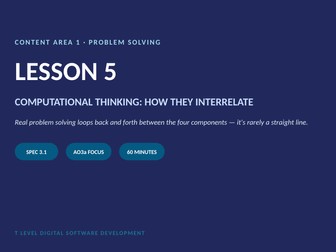
T Level DSD: How Computational Thinking Components Interrelate – Full Lesson (Lesson 5)
Lesson 5 of a full T Level Digital Software Development Problem Solving scheme of work, covering spec point 1.1 Computational Thinking — how decomposition, pattern recognition, abstraction and algorithmic design interrelate. Completes the computational thinking sub-unit that began in Lesson 1.
This is a complete, ready-to-teach lesson: a 12-slide PowerPoint (a “Sequential or Not?” poll, a loop diagram replacing the straight-line view of the four components, a six-stage case study — “Mrs Osei’s Clubs Sign-Up System” — showing a developer looping back to an earlier component when new information comes to light, guided practice matching a second case study’s stages to components, independent practice ordering and labelling a jumbled case study while spotting its loop-back moment, a mark-schemed AO3a exam question, and a plenary exit ticket), a detailed lesson plan using a standard Content Area 1 template, and a matching practice worksheet.
Students will be able to explain that the four components aren’t used in a strict, one-way order, analyse a case-study narrative to identify which component is being applied at each stage (including loop-back moments), and evaluate whether a solution could be reached by skipping one or more components — completing their understanding of computational thinking ahead of algorithmic design.
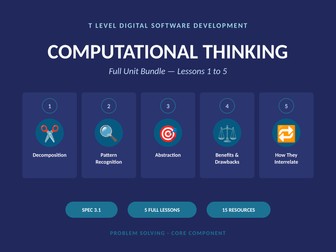
Perfect for T Level Digital Software Development (Core Component, Problem Solving) teachers wanting a genuinely discussion-led lesson that consolidates the whole computational thinking topic before moving on to algorithms. Part of a growing 20-lesson full scheme of work — see my shop for Lessons 1–4 (decomposition, pattern recognition, abstraction, benefits/drawbacks), available individually or as a discounted bundle.