


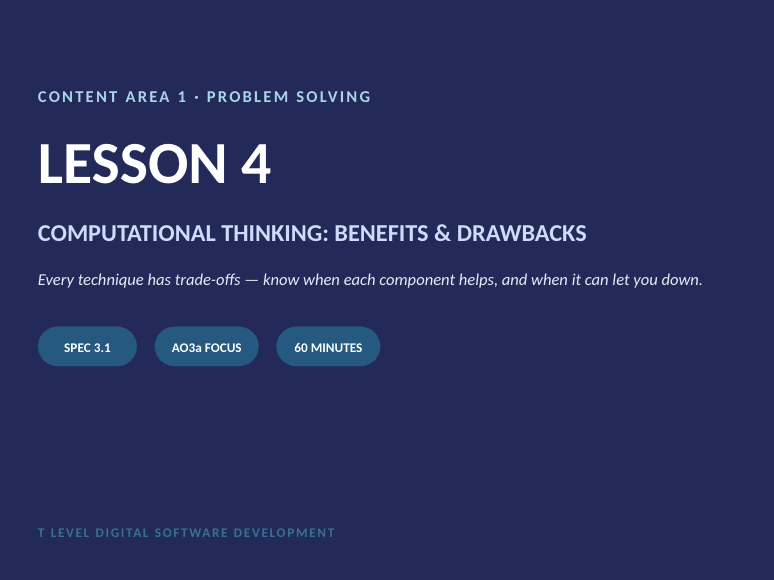


Lesson 4 of a full T Level Digital Software Development Problem Solving scheme of work, covering spec point 1.1 Computational Thinking — the benefits and drawbacks of decomposition, pattern recognition, abstraction and algorithmic design. Builds on Lessons 1–3.
This is a complete, ready-to-teach lesson: a 12-slide PowerPoint (an “Only One Tool?” hook, direct teaching giving one benefit and one drawback for each of the four components — each tied back to a scenario from earlier lessons — a guided card-match task, independent analysis of which component’s drawback poses the biggest risk across three new scenarios, a mark-schemed AO3a exam question on a bank fraud-detection system, and a plenary exit ticket), a detailed lesson plan using a standard Content Area 1 template, and a matching practice worksheet.
Students will be able to state a benefit and drawback for each computational thinking component, explain why a specific benefit or drawback applies in context, and analyse which component’s drawback is most likely to cause a problem in a given scenario — a key AO3 analysis skill for Paper 1.
Perfect for T Level Digital Software Development (Core Component, Problem Solving) teachers looking for a detailed, exam-focused lesson that builds AO3 analysis skills around computational thinking. Part of a growing 20-lesson full scheme of work — see my shop for Lessons 1–3 (decomposition, pattern recognition, abstraction) and Lesson 5 (how the four components interrelate), available individually or as a discounted bundle.
Something went wrong, please try again later.
This resource hasn't been reviewed yet
To ensure quality for our reviews, only customers who have purchased this resource can review it
Report this resourceto let us know if it violates our terms and conditions.
Our customer service team will review your report and will be in touch.
£3.50