Design & Media Studio: A student workbookQuick View
Makerspaceesports

Design & Media Studio: A student workbook

(0)
Unit & Chapter OverviewUnit 1:See and Communicate Ch 1: The Brief, the Audience, and the Process Ch 2: Elements, Principles, and Shape Language Ch 3: Color and Type (Grayscale checks & pairings) Ch 4: Hierarchy, Composition, and the Grid Unit 1 Assessment Unit 2: Build the Brand Ch5: Simple, Memorable Marks (Design Diet & Recall tests) Ch 6: Scalable Marks and Negative Space (Shrink & One-Color testing) Ch 7: Vector Craft: Building the Mark (Boolean operations & Bézier math) Ch 8: The Identity System and Brand Guide Unit 2 Assessment Unit 3: Image, Layout, and Output Ch 9: Layers, Selections, and Non-Destructive Editing Ch 10: Retouching and Color Correction, Honestly (Histograms & ethics) Ch 11: Layout, Grids, and Styles (Paragraph/Character styles & parent pages) Ch 12: Export for Screen and Print (Resolution, Bleed, RGB vs CMYK) Unit 3 Assessment Unit 4: Persuade Ch 13: Consumer Behavior and Emotional Design (Motivation mapping) Ch 14: First Impressions, Trust, and Calls to Action (A/B testing) Ch 15: Print Ads, Posters, and Packaging (Package nets / die lines) Ch 16: Social Graphics and Thumbnails (Safe zones & Alt text) Unit 4 Assessment Unit 5: Capture and Edit Ch 17: Photography: Composition, Light, and Settings (Exposure triangle) Ch 18: Pre-Production: Script, Storyboard, and Shot List (Two-column scripts) Ch 19: Video: Shooting, Editing, Pacing, and Titles (Coverage & J/L cuts) Ch 20: Sound and Motion (Audio waveforms, ducking, keyframes & easing) Unit 5 Assessment Unit 6: Design for People Ch 21: User-Centered Design and Accessibility (WCAG 2.2 AA standards) Ch 22: Navigation, Wireframes, and Prototypes (Site maps & card sorting) Ch 23: Publishing, Distribution, Rights, and Ethics (Copyright, Creative Commons & metric math) Ch 24: Portfolio, Careers, and the Pitch (Case study structure & 5-minute pitch) Unit 6 Assessment Back Matter: Full 200+ Term Glossary, Complete Answer Key, and Reference Sources.

Video Games, Esports & The Business of PlayQuick View
Makerspaceesports

Video Games, Esports & The Business of Play

(0)
Video Games, Esports & The Business of Play: Full-Course Student Workbook Turn your students’ passion for gaming into a rigorous, interdisciplinary academic course exploring business, economics, law, media literacy, culture, and career pathways. Rather than focusing on competitive play, this 250+ page student workbook investigates how the global video game and esports industries actually function. Students analyze real-world case studies, complete hands-on activities, and build an authentic portfolio culminating in a comprehensive Esports & Gaming Business Venture Capstone Project. What’s Inside: 26 Chapters Across 5 Core Units Unit 1: History & Culture of Games Arcade origins and game design fundamentals Identity, access, and gaming culture Evolution of the modern video game market The rise and globalization of competitive esports Unit 2: The Business of Games & Esports Industry economics, publisher monetization, and revenue splits Product marketing, launch campaigns, and brand partnerships Creator economies: streaming, sponsorship deals, and merchandise Esports organization operations, team valuations, and investor decks Unit 3: Law, Policy & Regulation Intellectual property, copyright, and modding rights Player, team, and influencer contracts Data privacy, cybersecurity, and digital consumer rights Virtual economies, digital asset ownership, loot boxes, and age ratings Unit 4: Games, Players & Society Media panics, censorship, and the evolution of ratings (ESRB/PEGI) Interactive storytelling, game mechanics, and branching narratives Social simulation, online community health, and digital ethics Representation, accessibility, and diversity in modern media Unit 5: Careers, Event Management & The Future Career mapping across production, marketing, broadcast, and law End-to-end tournament and live event planning Emerging technologies: cloud gaming, AI in development, and virtual production Final Capstone: Student Esports/Gaming Venture Pitch Ideal For: High School Esports & Gaming Electives Business, Marketing & Entrepreneurship Courses CTE (Career and Technical Education) Programs Media Studies, Communications & Digital Literacy Game Design & Interactive Tech Foundations Extracurricular Esports Clubs & Academy Programs Key Features for Educators: Flexible Modular Format: Teach sequentially as a full-year or semester syllabus, or extract standalone units and lessons to supplement existing business or computing curricula. Applied Learning: Every chapter pairs foundational industry theory with student-facing analytical prompts, debate questions, and practical design challenges. No Specialized Hardware Required: Focuses entirely on business, legal, creative, and socio-cultural frameworks, no high-spec gaming rigs or software licenses necessary.
Creative Media Semester Course | Photoshop, Illustrator, InDesign, Lightroom & VideoQuick View
Makerspaceesports

Creative Media Semester Course | Photoshop, Illustrator, InDesign, Lightroom & Video

(0)
Tes Description A complete half-year / semester creative media curriculum covering Photoshop, Illustrator, InDesign, Lightroom, and Final Cut Pro. Designed for secondary Graphic Design, Digital Media, Creative Media, Visual Communication, and CTE courses, this resource teaches practical software skills through hands-on activities and substantial portfolio projects. Students progress through four complete units: Unit 1 — Photoshop Layers, selections, retouching, adjustment layers, colour correction, blend modes and professional export. Capstone: Promotional Campaign Unit 2 — Illustrator Vector graphics, Pen tool, Pathfinder, colour, gradients, typography, logos and scalable icon design. Capstone: Brand Identity & Icon System Unit 3 — InDesign Page layout, grids, parent pages, styles, typography, multi-page documents, prepress and export. Capstone: Multi-Page Editorial Design Unit 4 — Photography & Video Lightroom organisation and editing, Photoshop roundtrip workflow, Final Cut Pro editing, titles, audio and export. Capstone: Photo & Video Promotional Campaign The course is designed around real production work rather than software memorisation. Each unit moves from instruction and guided practice into a major finished Capstone project. Included Complete instructional units Teacher materials Student activities and handouts Lesson presentations Quizzes and answer keys Four major Capstone projectsRubrics and teacher guidance Unit tests Standards alignment Pacing guides Course syllabus Teacher guide Assignment tracker Gradebook Midterm Exam + Answer Key Final Exam + Answer Key Full-course pacing guide The course contains a 46-day baseline for 55–65 minute lessons and approximately 68–83 days for 40–50 minute lessons, making it suitable for a semester/half-year timetable. Students finish with four substantial portfolio pieces covering promotional design, branding, editorial design, photography and video production. Requirements Access to the relevant Adobe Creative Cloud applications is required. Unit 4 also uses Final Cut Pro and requires access to a camera; a smartphone camera is sufficient for the Capstone. Please note: This is a half-year / semester course, not a full academic-year curriculum. Software is not included.
Digital Media & Multimedia CurriculumQuick View
Makerspaceesports

Digital Media & Multimedia Curriculum

(0)
Complete Digital Media & Multimedia curriculum for secondary/high school students, with ready-to-teach lessons, projects, assessments, and teacher resources. This comprehensive curriculum is designed for teachers delivering Digital Media, Multimedia Production, Creative Media, Design, Technology, or related secondary/high school courses. The course provides a structured sequence of classroom-ready materials that can be used as a complete programme of study or adapted to fit an existing course. Included throughout the curriculum: Teacher presentation slides Student handouts and activities Individual and collaborative projects Quizzes and assessments Teacher notes and instructional guidance Career connections Applied design and production activities Capstone/project-based learning Supporting resource and example links Students explore digital media through practical, career-connected learning while developing skills in visual communication, multimedia production, design, digital content creation, and related technologies. Suitable for: Secondary / High School Ages 14–18 Digital Media Multimedia Production Creative Media Design & Technology Computing / Technology Education Career & Technical Education (CTE) Materials are provided in editable/classroom-ready formats where applicable, allowing teachers to adapt the curriculum for their own students and timetable. This resource is designed to save teachers the substantial planning time required to develop a complete Digital Media course from scratch while still providing enough flexibility for individual classrooms. Please note: This curriculum was originally developed for the US secondary/high school classroom. International teachers should review the materials against their local curriculum and qualification requirements before use.
Complete Graphic Design and MarketingQuick View
Makerspaceesports

Complete Graphic Design and Marketing

(0)
Teach a complete graphic design course without spending your year building lessons from scratch. This comprehensive high school Graphic Design curriculum bundle introduces students to the principles, strategies, projects, and careers behind professional visual communication. Students move from foundational design concepts to logo design, digital communication, advertising, user experience, and creative careers. Each unit combines direct instruction with discussion, analysis, collaborative activities, design challenges, assessments, and authentic capstone projects. This curriculum focuses on how designers think, not simply which buttons they click.
Robotics & Automation Full CourseQuick View
Makerspaceesports

Robotics & Automation Full Course

(0)
Complete Robotics & Automation curriculum for secondary/high school STEM, Engineering, Computing and Design & Technology. Covers robotics foundations, mechanical systems, CAD, electronics, sensors, programming, control systems, manufacturing, automation, computer vision and AI. Includes 8 units, lesson activities, quizzes, unit tests, capstone projects, midterm and final exams, teacher guides, pacing guide, syllabus, gradebook and assignment tracker. Hardware-agnostic and compatible with Arduino, VEX, LEGO SPIKE, micro:bit, Raspberry Pi, REV, FTC and FRC platforms. Students progress from robotics fundamentals to designing a complete real-world robotic solution using mechanical, electrical, sensing and programming concepts. Ideal for Robotics, Engineering, STEM, Computing, Makerspace and Design & Technology courses.
3D Printing, Toy Design & CADQuick View
Makerspaceesports

3D Printing, Toy Design & CAD

(0)
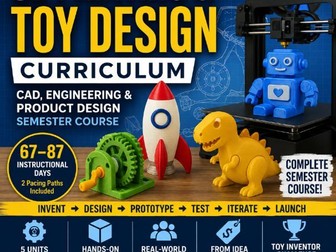
Complete full-year 3-D printing, CAD toy design, and product development curriculum. Covers parametric modeling, printing, mechanisms, and marketing. Designed for Secondary / High School Design & Technology (D&T), Engineering, and Applied STEM pathways (Grades ), this complete turnkey course takes students from an initial 2-D sketch to a finished, tested, priced, and packaged original product. What’s Included in the Complete Course Package: Interactive Slide Decks (power point): wide screen presentation slides with visual CAD breakdowns, slicer walk and design review prompts. Student Guided Handouts & Workbooks (word document): Structured note-taking pages, technical sketching grids, and design brief worksheets. Teacher Facilitator Guides & Solutions (.word document): Pacing time lines, lesson talking points, troubleshooting notes, and full answer keys. Unit Capstones & Design Challenges: 5 major hands-on engineering challenges (including a built-in No-Printer Pathway for classrooms with limited 3-D printers). Midterm & Final Exams (.document): Formative quizzes and comprehensive exams featuring multiple-choice and short-answer synthesis questions with complete scoring rubrics. Vocabulary Importers (.text files: Ready-to-paste digital flashcard study sets for digital learning platforms. Course Units & Core Modules: Unit 1: CAD Foundations for Toy Design (Parametric variables, constraints, revolve, sweep, loft, organic forms, and product families). Unit 2: Understanding & Designing for 3-D Printing (physics, materials, slicer settings, tolerances, snap-fits, and failure diagnosis). Unit 3: Toy Design Fundamentals (Play theory, target-age ergonomics, safety standards, character silhouettes, and center-of-gravity stability). Unit 4: Mechanisms, Prototyping & Iteration (Gears, linkages, joints, cardboard-before-CAD prototyping, and evidence-based play-test loops). Unit 5: From Prototype to Product (Cost-plus pricing formulas, Bill of Materials, production strategies, packaging, /patents, and the final Toy Inventor Capstone). Classroom & Technical Specs: Software-Agnostic: Works seamlessly with many software Flexible Pacing: Includes dual calendar paths (sixty seven-day block schedule or eighty seven-day standard periods) fitting a full semester or flexible year-long sequence. Standards Aligned: Fully Editable:
Cybersecurity Fundamentals Full CourseQuick View
Makerspaceesports

Cybersecurity Fundamentals Full Course

(0)
This is a complete year-long cybersecurity curriculum with lesson presentations, quizzes, group activities, assessments, and capstone projects. The course was developed to help students conceptualize cybersecurity principles and build transferable problem-solving skills, rather than simply memorize technical terminology. It can be taught independently as a foundational cybersecurity course or used alongside a more code-heavy or lab-based cybersecurity course to strengthen students’ conceptual understanding. Cybersecurity Fundamentals Full-Year Course Complete full-year Cybersecurity Fundamentals curriculum covering networks, cyber threats, cryptography, incident response, ethical hacking, and cybersecurity careers. Designed for secondary/high school Computer Science, Computing, IT, Digital Technologies, STEM, and CTE classrooms, this ready-to-teach course provides a structured pathway through modern cybersecurity without requiring specialised cybersecurity software or a dedicated cyber lab. Complete 6-Unit Curriculum Unit 1 — Foundations of Cybersecurity CIA Triad Threat landscape Risk and vulnerabilities Ethics and legal boundaries Cybersecurity careers Unit 2 — Networks & Systems How networks move data OSI Model Firewalls and network defence Operating system security IoT and Operational Technology security Unit 3 — Threats & Social Engineering Insider threats Phishing and social engineering Password attacks and authentication The human factor Real-world breach case studies Unit 4 — Cryptography & Data Protection Encryption Hashing and data integrity Digital certificates and HTTPS Identity and Access Management (IAM) Data privacy and compliance Unit 5 — Blue Team & Incident Response Security Operations Centres (SOC) Security monitoring Threat detection and threat hunting Incident response Endpoint protection Cloud security Unit 6 — Ethical Hacking & Careers Ethical hacking and authorisation Cybersecurity career pathways Building a cybersecurity portfolio Security assessment planning Vulnerability research Responsible disclosure
Python Coding & Computational ThinkingQuick View
Makerspaceesports

Python Coding & Computational Thinking

(0)
Complete Python programming and computational thinking curriculum for secondary and high school students. This course teaches the concepts behind programming before focusing on syntax. Students develop transferable computational thinking skills through pseudocode, group activities, Python coding, game-based examples, and applied projects. 6-Unit Curriculum Unit 1 - Thinking Like a Computer Algorithms, abstraction, debugging, data representation, and pseudocode. Unit 2 - Getting Started with Python Python and VS Code, variables, data types, comments, input, output, and first programs. Unit 3 - Conditionals and Logic Boolean logic, comparison operators, if/elif/else, compound conditions, game rules, and debugging. Unit 4 - Loops and Iteration For loops, while loops, game loops, nested loops, patterns, and infinite loops. Unit 5 - Functions and Data Structures Functions, parameters, return values, lists, dictionaries, and program organization. Unit 6 - Files, Errors, and Game Development File handling, exceptions, Python graphics, careers, and building an original Python game. What’s Included 77 core instructional class days 6 complete instructional units Lesson presentations Student handouts and group activities Python coding activities Lesson quizzes Unit tests 6 capstone projects Midterm and final exams Answer keys and rubrics Teacher guide Pacing guide Course syllabus Assignment tracker Gradebook Applied Capstone Projects Students progress from computational thinking activities to increasingly sophisticated Python projects, including a paddle-and-ball game, game rules programming, procedural level generation, an RPG battle system, and an original Python game. Flexible Classroom Use The 77 core instructional days fit comfortably within a traditional semester with room for review, coding practice, and extensions. The curriculum can also cover most of a school year on an alternating A/B block schedule. Python 3 and Visual Studio Code are used for coding. No specialized software beyond Python and its standard library is required. Aligned to the CSTA K-12 Computer Science Standards, Revised 2017, Level 3A. Ideal for Python Programming, Computer Science, Computing, Computational Thinking, Coding, Game Development, STEM, CTE, and introductory secondary/high school programming courses.
Cryptography and DataProtectionQuick View
Makerspaceesports

Cryptography and DataProtection

(0)
This free resource provides a direct look inside the full course curriculum. It includes a curated sample of classroom-tested instructional slide decks, student-facing activity materials, and lab guides. In the complete full-year course, every unit is organized into 4 to 6 structured lessons designed for 100% plug-and-play delivery. The master package also features comprehensive unit capstone projects, full-year pacing guides, teacher answer keys, and complete educational standards alignments.