School AI Policy Pack: 7 documentsQuick View
aiforschool

School AI Policy Pack: 7 documents

(0)
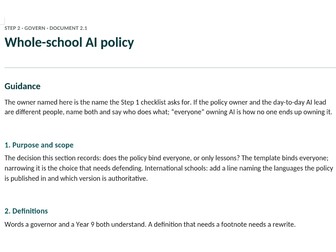
Editable AI policy pack: the documents a school needs, as Word templates, plus examples. EU AI Act, GDPR, JCQ. 15 files. Every school now needs documents related to AI policy. I noticed many schools are using ChatGPT to draft the documents, often containing mistakes or gaps… I have worked in compliance, so I prepared for you these examples - blank templates with guidance, and 2 complete, filled-in sets for 2 fictional schools. Who it is for: heads and principals, deputies, teachers who are AI leads, data protection officers, exams officers. What the resource contains: a .zip with 14 Word documents, and the readiness checklist as a fillable PDF you can tick on screen. a 35-item AI readiness checklist, in Word and as a fillable PDF Whole-school AI policy AI literacy curriculum statement Assessment integrity addendum Tool vetting record, DPIA and FRIA screen Staff AI guidance and the Article 4 training file Parent and carer communications pack Student agreement, age-banded staff training plan curriculum mapping grid, parent communication templates student assembly outline. fictional secondary schools in England and Spain I prepared this as careful general guidance and examples, it’s not formal legal advice. MADE BY: Diana Szyperska, a teacher with British and Polish teaching qualifications, who spent two decades in international education. I taught and examined: IB Theory of Knowledge IB integrated humanities (I&S) GCSE ethics PSHE Design and engineering I also managed operations in cyber security and led compliance (ISO 27001 and 9001). I now serve primarily as a safety-first AI literacy educator, and EU AI compliance consultant. Check my other resources - activity packs and lessons for various age groups.
AI Literacy KS1/KS2: screen-free lessonsQuick View
aiforschool

AI Literacy KS1/KS2: screen-free lessons

(0)
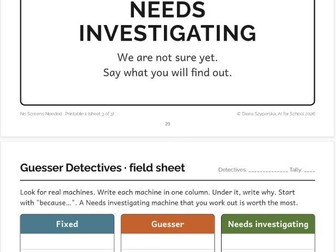
KS1/KS2 AI literacy: 4 screen-free lessons, 12 printables, teaching ages 6-11 what artificial intelligence can and cannot do. Inside No Screens Needed, a 29-page PDF: The Robot in the Box — an original story read aloud, with questions for discussion Spot the Guesser — a detective sort, twelve picture cards, then a hunt around the building Robot Job or Human Job? — sixteen jobs, three corners, and an argument worth having Design Your Helper Robot — one purpose, limits, and a never-tell box Twelve printable sheets: picture cards, corner signs, a field sheet, job cards and a design sheet Children (and adults too;) will learn what a pattern machine is, what it can and cannot do, which work deserves a human, and how to design a helper that keeps a secret. Every session maps to the AILit Framework (EU/OECD, June 2026), Engage with AI 1–2, Manage AI 1 and Shape AI 1 and 3 at Basic level, and to the UNESCO AI competency framework for students (2024) at Understand level. Fits PSHE, English, computing and topic time. Session one (story + questions: Robot in the Box) is also available on its own, for free. MADE BY: Diana Szyperska, a teacher with British and Polish teaching qualifications, who spent two decades in international education. I taught and examined: IB Theory of Knowledge IB integrated humanities (I&S) GCSE ethics PSHE Desing & engineering. I also managed operations in cyber security and led compliance (ISO 27001 and 9001), and now serve as a safety-first AI literacy educator and EU AI compliance consultant. Check the other activity packs and lessons for various age groups, and the guidance for school leaders on how to implement AI Literacy programme at your school.
AI Literacy KS1/KS2: story + questionsQuick View
aiforschool

AI Literacy KS1/KS2: story + questions

(0)
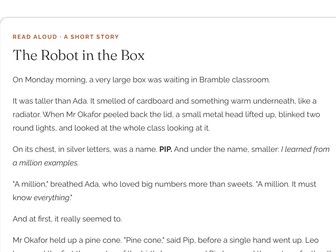
S1/KS2 AI literacy lesson: a read-aloud story teaching ages 6-11 what artificial intelligence really does. Screen-free. AILit Framework (EU/OECD), UNESCO AI competency framework. Inside the 5-page PDF: The Robot in the Box — a story about a robot that arrives to a school Five “stop and think” questions in the story The conversation that closes the lesson Children finish able to say what AI - a pattern machine - does, in its essence: it guesses from examples it’s been given, and it sounds just as sure when it is wrong. This activity is aligned with the AILit Framework (EU/OECD, June 2026), Engage with AI 2 at Basic level, and with the UNESCO AI competency framework for students (2024) at Understand level, under AI foundations and human agency. This is session one of “No Screens Needed”. The full pack adds three more sessions and twelve printables. MADE BY: Diana Szyperska, a teacher with British and Polish teaching qualifications, who spent two decades in international education. I taught and examined: IB Theory of Knowledge IB integrated humanities (I&S) GCSE ethics PSHE Design and engineering I also managed operations in cyber security and led compliance (ISO 27001 and 9001). I now serve primarily as a safety-first AI literacy educator, and EU AI compliance consultant. Check my other resources - activity packs, lessons for various age groups, and the guidance and resources for school leaders on how to implement AI Literacy programme.
School AI Readiness Checklist: 35 itemsQuick View
aiforschool

School AI Readiness Checklist: 35 items

(0)
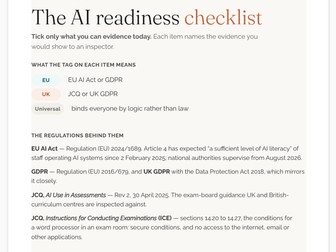
Free AI readiness checklist for school leaders: 35 items on AI policy, staff training, GDPR, the EU AI Act and assessment integrity. 8 pages. Fillable PDF. Who it is for: heads and principals, deputies, AI and computing leads, data protection officers, exams officers and governors. Any teacher or staff member who has to say what the school’s position on AI is and show the evidence behind it. 22 of the 35 items apply in any country. Every item carries a tag, so you can see at a glance which rules it refers to and skip what is not relevant to your school: Universal - good practice in any school system, anywhere EU - the EU AI Act and the GDPR UK - UK GDPR, and the JCQ exam rules for coursework and controlled assessment Inside the 8-page printable/fillable PDF, one section per page: Governance and accountability (who owns AI, what has to exist in writing) Teaching and AI literacy competences (where it is taught, and the age lines for under-13s) Assessment integrity (malpractice policy, acknowledgement, and being honest about AI detectors) Data protection and tool vetting (inventory, DPIAs, contracts, risk levels) Staff capability (training by role, induction, a sanctioned way to experiment) Parents and community (what families are told, and how objections and opt-outs are handled) At the end, you count your score and see where you are at. I prepared this as careful general guidance and example, it’s not formal legal advice. MADE BY: Diana Szyperska, a teacher with British and Polish teaching qualifications, who spent two decades in international education. I taught and examined: IB Theory of Knowledge IB integrated humanities (I&S) GCSE ethics PSHE Design and engineering I also managed operations in cyber security and led compliance (ISO 27001 and 9001). I now serve primarily as a safety-first AI literacy educator, and EU AI compliance consultant. Check my other resources - activity packs, lessons for various age groups, and the guidance and resources for school leaders on how to implement AI Literacy programme.