DNA Structure Paper Model Activity | Build-a-DNA-LadderQuick View
osmialearning

DNA Structure Paper Model Activity | Build-a-DNA-Ladder

(0)
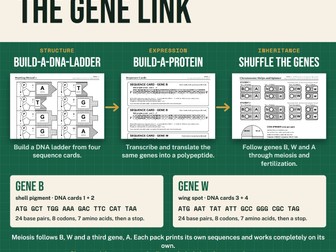
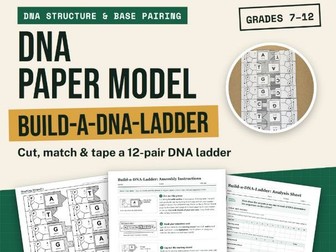
DNA paper model activity for US grades 7–12: students cut and tape flat 12-base-pair DNA ladders, then analyze nucleotide structure, complementary base pairing, and antiparallel strands. Groups of four suggested; pairs or solo also work. SUPPLIES: scissors and tape. Everything prints on regular copy paper. Supplies are not included. Build-a-DNA-Ladder is one of three connected activities in the Genetics Paper Model Bundle (with Build-a-Protein and Shuffle the Genes): [BUNDLE LINK]. This DNA activity also works completely on its own. WHAT STUDENTS DO In this DNA model activity, students work from four sequence cards: groups of four are suggested, one card each; pairs build two cards each; a solo student builds all four. For each card they cut out the starting strand, choose the complementary partner pieces and turn them 180 degrees. They match triangle connectors (A–T) and square connectors (G–C), then tape the pieces together on the back into a flat 12-pair DNA ladder. Nothing folds. The last assembly step is a diagram that shows how real DNA twists into a double helix. For a quicker build, use the quick cut sheets: their Quick Partner Strand pages give each card’s partner strand already built as two strips. Cards 1 and 2 (and cards 3 and 4) join end to end to make a whole 24-base-pair gene. Groups of four are suggested, one card each; pairs build two cards each (cards 1+2 or 3+4), and a solo student builds all four. Print one file per group, pair or student. The DNA structure activity has three parts and a closing response. Part A: record the strands, count bases, check Chargaff’s rule and collect class data. Part B: explain constant rung width (purines and pyrimidines), antiparallel strand direction, an A–C mismatch and the limits of the model. Part C is a DNA replication analysis on paper: students show where the strands separate and write the new partner strands. It is not a hands-on replication simulation. A claim–evidence–reasoning response closes the task. ABOUT THE PHOTOS Photos show a sample paper model built by hand on regular paper. They are real photos, not retouched.
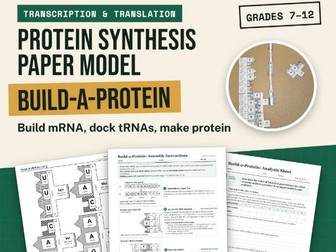
Protein Synthesis Paper Model | Transcription and Translation | MutationsQuick View
osmialearning

Protein Synthesis Paper Model | Transcription and Translation | Mutations

(0)
This protein synthesis paper model for grades 7-12 has students transcribe DNA to mRNA, translate it with a codon chart, and build a polypeptide from paper. How does the order of bases in a gene become the order of amino acids in a protein? Students see it happen on their desks, then classify three mutations in the gene they built. WHAT STUDENTS DO Students work with two genes of a fictional glade beetle: gene B (shell pigment) and gene W (wing spot), each 24 bases long and read as 8 codons. Each gene gives a polypeptide of 7 amino acids joined by 6 peptide bonds and ends at a stop codon. Students: Transcribe the DNA template on paper, then make the mRNA: tape together the prebuilt mRNA strip (Quick file), or cut out the template strand and build the mRNA on it from RNA nucleotides (Nucleotide file) Match each tRNA anticodon to its mRNA codon, using the codon chart to find each amino acid Notice that decoy tRNAs fit no codon, and bring in the release factor at the stop codon Join the amino acid cards with peptide bond strips into a polypeptide The 4-page analysis sheet follows the model. Part A covers transcription: the enzyme, where it happens, how DNA and mRNA differ, and why a cell makes mRNA. Part B covers translation: the codon, anticodon and amino acid table, start and stop codons, the reading frame, the P and A sites, and a two-gene comparison. Part C classifies three DNA mutations in gene B as silent, missense or nonsense and connects the recessive b allele to a tan shell. A claim-evidence-reasoning response closes the task. WHAT IS INCLUDED Quick cut sheets: 11 pages in US Letter and 11 pages in A4 (prebuilt mRNA strip) Nucleotide cut sheets: 15 pages in US Letter and 15 pages in A4 (students build the mRNA) The Quick and Nucleotide files are alternatives, and each builds both genes. Print every page of one file per group, pair or student. Genetic code chart (codon chart): 1 page Assembly instructions: 3 pages Student analysis sheet: 4 pages Answer key: 4 pages Teacher guide: 3 pages Terms of Use 9 activity PDFs: 67 pages, or 41 pages counting one paper size. Letter and A4 are both included; use either size.
Modeling Meiosis Activity | Crossing Over & Genetic VariationQuick View
osmialearning

Modeling Meiosis Activity | Crossing Over & Genetic Variation

(0)
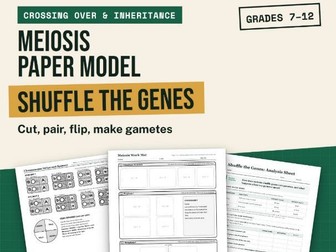
In this meiosis lab for grades 7-12, students model meiosis with paper chromosomes, flip a coin for crossing over, and end with four gametes. They copy, pair and separate paper chromatids along the way. Partners then combine gametes to model fertilization. Why do offspring of the same two parents come out genetically different? Students answer it with evidence from their own model. WHAT STUDENTS DO Students follow a fictional glade beetle (2n = 4) through meiosis. Both parents are Bb Aa Ww: shell color (B/b), antenna length (A/a) and wing spots (W/w). Each student runs one meiosis, and partners combine gametes in Part C. Students: Cut out the chromosome strips, cut each chromosome into two sister chromatids, and tape them at the centromere to model S phase Pair the homologs on the work mat in prophase I Flip a coin (or use the printed spinner) for a crossover between the B and A genes: heads, cut and swap one maternal and one paternal chromatid; tails, no crossover Flip again for each chromosome pair to line the pairs up at random in metaphase I Separate the homologs in meiosis I and the sister chromatids in meiosis II Write each gamete’s alleles on a gamete card, join one gamete each with a partner, and fill in an offspring beetle outline Heads and tails decide the crossover and the lineup, so each student’s four gametes come from their own run, and different runs can give different gametes. The 4-page analysis sheet follows the model. Part A: count chromosomes and chromatids at each stage, tell homologous chromosomes from sister chromatids, name the paired structure, and decide whether a crossover happened. Part B: record the four gametes, show that gametes are haploid, compare them with a partner’s, tally the class results as parental or recombinant, and explain independent assortment. Part C: combine two gametes into a zygote, record genotype and phenotype on a beetle outline, and complete a short mitosis vs. meiosis comparison table. A claim-evidence-reasoning response closes the task. WHAT IS INCLUDED Cut sheets: 3 pages in US Letter and 3 pages in A4 (Cut Sheet 1: chromosome strips and spinner; Cut Sheet 2: gamete cards; Cut Sheet 3: offspring beetle outlines) Meiosis work mat: 2 pages Model procedure: 2 pages with step-by-step diagrams Student analysis sheet: 4 pages Answer key: 4 pages Teacher guide: 2 pages covering materials, timing, common errors and model limits Terms of Use 7 activity PDFs: 20 pages, or 17 pages counting one paper size. Letter and A4 cut sheets are both included; use either size.
Genetics Lab Bundle | DNA Structure, Protein Synthesis & Meiosis Paper ModelsQuick View
osmialearning

Genetics Lab Bundle | DNA Structure, Protein Synthesis & Meiosis Paper Models

3 Resources
This genetics lab bundle for grades 7-12 has three paper models: DNA structure, protein synthesis and meiosis, all built around one fictional glade beetle. WHAT STUDENTS DO Students cut, match and tape paper pieces to build each model, then answer an analysis sheet with evidence from their own work. DNA structure (Build-a-DNA-Ladder): build a flat 12-base-pair DNA ladder, match A-T and G-C connectors, and test Chargaff’s rule on their own data Protein synthesis (Build-a-Protein): transcribe a DNA gene into mRNA, translate it with a codon chart, build a polypeptide, and classify three mutations Meiosis (Shuffle the Genes): copy, pair and separate paper chromosomes, flip a coin for crossing over, end with four gametes, and combine gametes with a partner to model fertilization THE GENE CONNECTION The three models share one organism. The DNA pack and the protein pack use the same two genes: gene B (shell pigment, sequence cards 1 and 2) and gene W (wing spot, cards 3 and 4), each 24 base pairs long. In the protein pack those genes are read as 8 codons, giving a 7-amino-acid polypeptide and a stop. The meiosis pack follows the beetle’s genes B and W through meiosis and adds a third gene, A (antenna length). Students can see one set of genes move from DNA structure to protein to inheritance. Each pack also works on its own. WHAT IS INCLUDED Build-a-DNA-Ladder: 8 activity PDFs, 49 pages. Standard and quick cut sheets are alternatives, each in US Letter and A4, plus instructions, a 4-page student analysis sheet, an answer key and a teacher guide. Build-a-Protein: 9 activity PDFs, 67 pages. Quick and Nucleotide cut sheets are alternatives, each in US Letter and A4, plus a codon chart, instructions, a 4-page student analysis sheet, an answer key and a teacher guide. Shuffle the Genes: 7 activity PDFs, 20 pages. Cut sheets in US Letter and A4, work mat, procedure, a 4-page student analysis sheet, an answer key and a teacher guide. Terms of Use 24 activity PDFs: 136 pages, or 89 pages counting one paper size for each activity. Letter and A4 are both included; use either size. HOW TO USE IT Use the three models in this genetics lab bundle in any order, or pick the ones that fit your unit. Each includes its own teacher guide with materials, timing, common errors and model limits. DNA structure: groups of four are suggested, one sequence card per student. Protein synthesis: groups of four are suggested, one gene per pair (each student builds half a gene). Pairs and solo students take longer on both, and the guides say how to plan for it. Meiosis: pairs, with each student running one meiosis and partners combining gametes. Supplies for all three: scissors and clear tape. The meiosis model also uses a coin (or the printed spinner with a pencil and paper clip); envelopes are optional. Supplies are not included. Print in black and white on regular copy paper at 100%. Standards: the teacher guides cite NGSS codes: DNA structure HS-LS1-1 and HS-LS3-1; protein synthesis HS-LS1-1, HS-LS3-1 and MS-LS3-1; meiosis HS-LS1-4 and HS-LS3-2. Students practice building and testing a DNA model, transcribing and translating a gene, classifying mutations, and modeling meiosis, crossing over and fertilization. They use their own models to explain genetics and heredity: how DNA structure makes a copy possible, how a gene becomes a protein, and why offspring of the same parents differ. Key terms: nucleotide, base pair, Chargaff’s rule, transcription, translation, codon, anticodon, polypeptide, silent, missense, nonsense, homologous chromosomes, sister chromatids, crossing over, independent assortment, gamete, zygote. The glade beetle is fictional and simplified, its gene sequences are short model sequences rather than real genes, and each teacher guide lists what its model leaves out.
Reindeer Genetics Lab | Punnett Squares & Inherited Traits ActivityQuick View
osmialearning

Reindeer Genetics Lab | Punnett Squares & Inherited Traits Activity

(0)
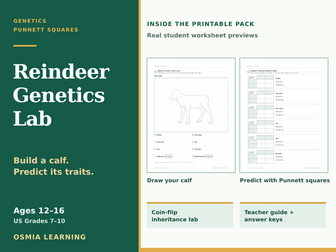
Students model inheritance by flipping coins to pass alleles from two reindeer parents, create a calf, and use Punnett squares to compare predicted probability with observed class results. This printable genetics lab for ages 12–16 (US grades 7–10) includes parent cards, a lab, reading, exit ticket, extension, answer keys, and teacher guide. It suits a Holiday biology activity or a heredity unit at any time of year. Students record genotypes and phenotypes for six fictional traits, draw and color their calf, complete six Punnett squares, and compare predicted ratios with class herd percentages. They explain why observed outcomes may differ from predictions. WHAT IS INCLUDED Five-page coin-flip lab with calf drawing, Punnett squares, herd tally, analysis, and explanation One-page illustrated parent cards Two-page reading with questions and vocabulary One-page exit ticket with two tickets per page Two-page optional extension on incomplete dominance and sex-linked inheritance Matching answer keys for the five student resources, with labeled sample data Three-page teacher guide and Terms of Use PLANNING DETAILS Ages 12–16; US grades 7–10; life science and biology About two 50-minute periods, plus an optional extension period One coin per student, pencils, colored pencils or crayons, printed pages, and board or chart space 26 PDF pages across 12 PDFs, supplied in a ZIP with a manifest. Works in black and white. The Frostline Herd and inheritance patterns are fictional teaching models. The reading distinguishes real reindeer facts from the simplified traits; coin-flip outcomes vary.
Why Do Leaves Change Color? Leaf Chromatography Lab & ReadingQuick View
osmialearning

Why Do Leaves Change Color? Leaf Chromatography Lab & Reading

(0)
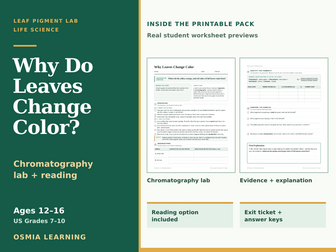
Explore why leaves change color with a leaf chromatography experiment and a science reading for ages 12–16 (US grades 7–10). Students separate and compare pigments, calculate Rf values, and use evidence to explain autumn colors. The pack includes a lab, reading, exit ticket, answer keys, and teacher guide. Use the experiment and reading together or separately: the reading works as a pre-lab, homework, or a no-lab activity. Groups extract pigments from green and fall leaves, run coffee-filter strips in alcohol, record pigment bands, and compare results. Sample Rf data are labeled because results vary. WHAT IS INCLUDED Two-page student lab and two-page answer key Two-page reading with five questions and a two-page answer key One-page exit ticket, with two tickets per page, and a one-page answer key Two-page teacher guide with preparation, pacing, safety, troubleshooting, and extensions Terms of Use PLANNING DETAILS Ages 12–16; US grades 7–10; life science, biology, or general science Groups of 3–4; about three class periods over three days, including overnight extraction. The guide also offers a hot-tap-water option of about 20 minutes. Materials per group include green leaves or spinach, fresh fall leaves, isopropyl alcohol, four clear cups, coffee filters, toothpicks or swabs, plastic wrap, a spoon, scissors, tape, pencils, ruler, and goggles. Alcohol is flammable; follow the guide’s safety notes. 13 pages across eight non-editable US Letter PDFs, including Terms of Use.
Variables & Fair Tests | Full LessonQuick View
osmialearning

Variables & Fair Tests | Full Lesson

(0)
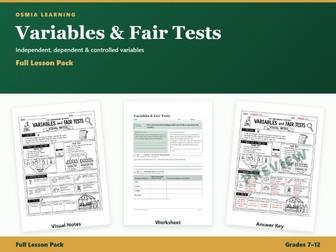
Direct instruction with online reinforcement This Full Lesson pack combines a teacher-led direct-instruction lesson with an online companion for reinforcement. Teach with the included editable slides, then use the online lesson and its matching printable companion pages to reinforce learning. The online companion is hosted on an external, ad-free educational website and is free to use, with no fees, login, or registration required. Internet access is required for the online companion. The direct lesson link is included in the downloadable teacher guide. Teach fair-test design in Grades 7–12 with this science lesson. Students identify independent, dependent, and controlled variables, spot flawed tests, and explain why changing one factor at a time makes evidence interpretable. What is included Editable PowerPoint slide deck (12 slides) plus matching PDF Teacher guide with pacing and implementation guidance Lesson standard worksheet Lesson visual notes Slide-deck standard notes Slide-deck visual notes Standalone exit ticket Complete answer keys for all five student materials Terms of use Classroom use Run the editable deck first, then choose the worksheet or visual-notes format that matches your instruction. Students practice identifying variables, controlling conditions, and deciding whether a claim is supported by a fair test. Internet access is required for the included online companion. The downloadable slides and printables are suitable for grades 7–12 science, including biology, chemistry, environmental science, and scientific-practices units. Single-teacher license. © Osmia LLC. Related TES resources Variables & Fair Tests | Direct Instruction Observation vs. Inference | Full Lesson Update (November 2026): laser-printer compatibility fix. The ruled answer lines in the slide-deck standard notes (student and key) now print reliably on school laser printers and copiers. No content changes. Re-download for the updated files.
Variables & Fair Tests | Direct InstructionQuick View
osmialearning

Variables & Fair Tests | Direct Instruction

(0)
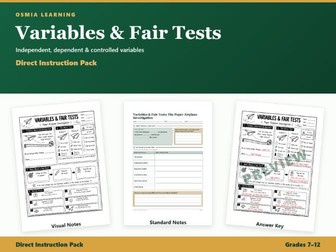
Teach variables and fair tests directly to Grades 7–12 with this self-contained, no-device lesson. Students identify independent, dependent, and controlled variables and redesign flawed investigations. What is included Fully editable 16:9 PowerPoint slide deck with teacher notes (12 slides) Project-ready PDF version of the complete presentation Structured Guided Notes student packet Illustrated Visual Notes student packet Standalone formative Exit Ticket with student page and teacher key Matching teacher answer keys for both note formats 3-page Direct Instruction Teacher Guide with pacing, common mix-ups, and grading guidance Terms of use Classroom use Project the editable deck for whole-class instruction while students complete either note format. Use the second format for differentiation, review, makeup work, or a substitute plan. The pack is complete for offline teaching and works well for grades 7–12 science, including biology, chemistry, environmental science, and scientific-practices units. Single-teacher license. © Osmia LLC. Related TES resources Variables & Fair Tests | Full Lesson Observation vs. Inference | Full Lesson Update (November 2026): laser-printer compatibility fix. The ruled answer lines in the slide-deck standard notes (student and key) now print reliably on school laser printers and copiers. No content changes. Re-download for the updated files.
Drawing Conclusions from Data | Outliers & CER | Full LessonQuick View
osmialearning

Drawing Conclusions from Data | Outliers & CER | Full Lesson

(0)
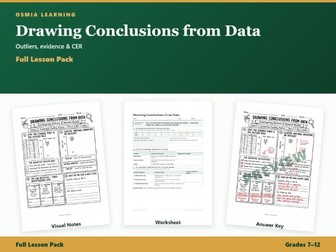
Direct instruction with online reinforcement This Full Lesson pack combines a teacher-led direct-instruction lesson with an online companion for reinforcement. Teach with the included editable slides, then use the online lesson and its matching printable companion pages to reinforce learning. The online companion is hosted on an external, ad-free educational website and is free to use, with no fees, login, or registration required. Internet access is required for the online companion. The direct lesson link is included in the downloadable teacher guide. Teach students in Grades 7–12 to draw evidence-bounded conclusions from experimental data with this full lesson. Students distinguish patterns from natural variation, investigate outliers, and write CER conclusions. What is included Editable slide deck plus matching PDF Teacher guide with pacing and implementation guidance Standard student worksheets Visual notes for the lesson and slide deck Outlier, cluster, and conclusion-building practice pages Complete answer keys for the student materials Terms of use Classroom use Run the editable deck first, then choose the worksheet or visual-notes format that matches your instruction. Students use a main-pattern, natural-variation, and outlier routine before writing a conclusion that fits the evidence and the limits of the investigation. Internet access is required for the included online companion. The downloadable slides and printables are suitable for grades 7–12 science, including biology, chemistry, environmental science, and scientific-practices units. Single-teacher license. © Osmia LLC. Related TES resources Drawing Conclusions from Data | Direct Instruction CER Practice Worksheet | Everyday Science + Answer Key Update (November 2026): laser-printer compatibility fix. The answer lines in the Data Detective section of the guided notes (student and key) now print reliably on school laser printers and copiers. No content changes. Re-download for the updated files.
Drawing Conclusions from Data | Direct InstructionQuick View
osmialearning

Drawing Conclusions from Data | Direct Instruction

(0)
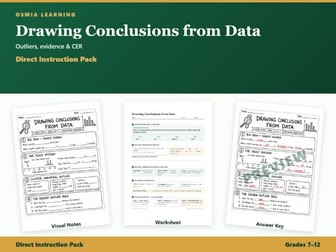
Teach evidence-based conclusions from data directly to Grades 7–12 with this self-contained, no-device lesson. Students investigate outliers, review procedural evidence, and write a bounded CER conclusion. What is included Fully editable 16:9 PowerPoint slide deck with teacher notes (18 slides) Project-ready PDF version of the complete presentation Structured Guided Notes student packet Illustrated Visual Notes student packet Matching teacher answer keys for both note formats 3-page Direct Instruction Teacher Guide with pacing, common mix-ups, and grading guidance Terms of use Classroom use Project the editable deck for whole-class instruction while students complete either note format. Use the second format for differentiation, review, makeup work, or a substitute plan. The pack is complete for offline teaching; students learn to read clusters and variation, investigate surprising outliers, distinguish biological variation from test errors, sort evidence, and write a bounded claim supported by data. Grades 7–12. Best fit for middle school science, biology, environmental science, and data-analysis units. Single-teacher license. © Osmia LLC. Related TES resources Drawing Conclusions from Data | Outliers & CER | Full Lesson CER Practice Worksheet | Everyday Science + Answer Key Update (November 2026): laser-printer compatibility fix. The answer lines in the Data Detective section of the guided notes (student and key) now print reliably on school laser printers and copiers. No content changes. Re-download for the updated files.
Science Graphing Practice | Line, Bar, Circle & ScatterQuick View
osmialearning

Science Graphing Practice | Line, Bar, Circle & Scatter

(0)
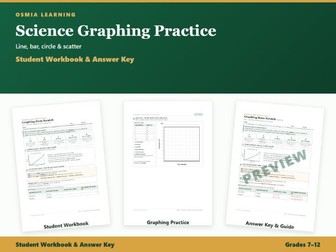
Give Grades 7–12 students print-and-go science graphing practice with this independent workbook. Students scale axes, choose graph types, plot line, bar, circle, and scatter graphs, interpret trends, and check their work with a rubric. What’s included 6-page student workbook with the TAILS checklist: Title, Axes, Intervals, Labels, and Scale. A 3-step axis-scaling rule with worked examples: find the maximum, divide by the boxes, and round up to a friendly counting number. A graph-choice matrix and a “Broken Graph” error-diagnostic audit. Four practice investigations: a line graph for continuous data, a bar graph for categorical data, a circle graph for atmospheric composition with a pre-divided percentage wheel, and a scatter plot with a line of best fit and prediction. 7-page answer key and teacher guide with complete model graphs, flexible 60–90 minute pacing, common student errors, and the TAILS Graphing Mastery Rubric. Classroom use 100% print-and-go: no lab prep, internet, or student accounts required. Use it as a back-to-school science-skills primer, a sub-day packet, or a graphing refresher before a lab. It fits Intro/Physical Science, Biology, and Chemistry. Students practice scaling axes, choosing graph types, plotting continuous and categorical data, labeling units, constructing circle graphs, drawing a line of best fit, interpreting trends, making predictions, and checking their work against a rubric. Single-teacher license. © Osmia LLC. Tes paid licence. Related TES resources Types of Graphs | Bar, Line, Circle & Scatter Types of Graphs | Direct Instruction Update (November 2026): laser-printer compatibility fix. The graph grids in the student workbook and answer key now print reliably on school laser printers and copiers. No content changes. Re-download for the updated files.
Repeat the Test | Direct InstructionQuick View
osmialearning

Repeat the Test | Direct Instruction

(0)
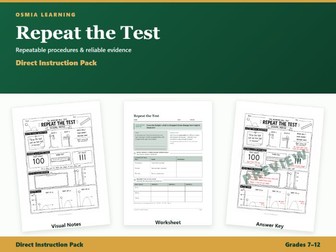
Teach replication and reliable evidence directly to Grades 7–12 with this self-contained, no-device lesson. Students plan repeatable procedures, run multiple trials, and interpret averages. What is included Fully editable 16:9 PowerPoint slide deck with teacher notes (9 slides) Project-ready PDF version of the complete presentation Structured Guided Notes student packet Illustrated Visual Notes student packet Standalone formative Exit Ticket with student page and teacher key Matching teacher answer keys for both note formats 3-page Direct Instruction Teacher Guide with pacing, common mix-ups, and grading guidance Terms of use Classroom use Project the editable deck for whole-class instruction while students complete either note format. Use the second format for differentiation, review, makeup work, or a substitute plan. The pack is complete for offline teaching and works well for grades 7–12 science, including biology, chemistry, environmental science, and scientific-practices units. Single-teacher license. © Osmia LLC. Related TES resources Repeat the Test | Reliable Data Full Lesson Variables & Fair Tests | Direct Instruction
Where Does Plant Mass Come From? Photosynthesis Companion WorksheetQuick View
osmialearning

Where Does Plant Mass Come From? Photosynthesis Companion Worksheet

(0)
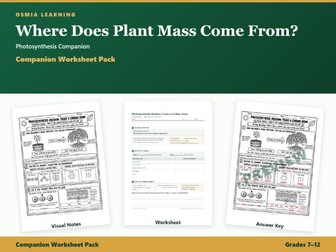
Printable companion for an online lesson These printable worksheets and visual notes accompany an online lesson hosted on an external, ad-free educational website. The online lesson is free to use, with no fees, login, or registration required. Internet access is required to use the online lesson alongside these pages. The teacher guide identifies the website and the lesson to use. This is the printable companion pack for the free Where Does Plant Mass Come From? photosynthesis lesson. Use it alongside the online investigation to help students trace a tagged carbon atom from atmospheric CO₂ into a leaf, run the chloroplast reaction, account for every atom, and explain how plants build permanent mass from air. What is included Visual Notes and a Standard Worksheet covering the same companion sequence Matching answer keys for every student page Companion Teacher Guide with lesson flow and classroom-use guidance Osmia Terms of Use Students investigate the willow mass mystery, distinguish matter from energy, follow carbon dioxide into the leaf, model the chloroplast reaction, and track glucose into plant structures. The two student formats are alternate versions of the same core activity, so teachers can choose the format that best fits the class. Assign the free Where Does Plant Mass Come From? interactive lesson, then use these pages alongside the online lesson for guided notes, practice, and review. This companion pack is designed to go with the online lesson and is not a replacement for the interactive experience. Grades 7–12 life science and biology. Single-teacher license. © Osmia LLC.
Repeat the Test | Reliable Data Full LessonQuick View
osmialearning

Repeat the Test | Reliable Data Full Lesson

(0)
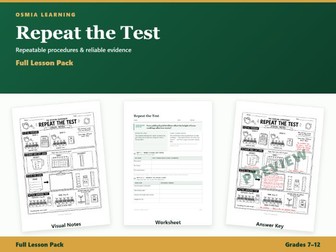
Direct instruction with online reinforcement This Full Lesson pack combines a teacher-led direct-instruction lesson with an online companion for reinforcement. Teach with the included editable slides, then use the online lesson and its matching printable companion pages to reinforce learning. The online companion is hosted on an external, ad-free educational website and is free to use, with no fees, login, or registration required. Internet access is required for the online companion. The teacher guide identifies the website and the lesson to use. Teach replication and reliable data in Grades 7–12 with this science lesson. Students compare one-off and repeated results, recognize natural variation, write repeatable procedures, and interpret new data. What is included Editable PowerPoint slide deck (9 slides) plus matching PDF Teacher guide with pacing and implementation guidance Online worksheet Slide-based worksheet Visual notes for the online lesson Visual notes for the slide deck Standalone exit ticket Complete answer keys for all five student materials Terms of use Classroom use Run the editable deck first, then choose the worksheet or visual-notes format that matches your instruction. Students practice planning repeatable investigations and using repeated data to distinguish a consistent pattern from a single result. Internet access is required for the included online companion. The downloadable slides and printables are suitable for grades 7–12 science, including biology, chemistry, environmental science, and scientific-practices units. Single-teacher license. © Osmia LLC. Related TES resources Repeat the Test | Direct Instruction Variables & Fair Tests | Direct Instruction
What Is Matter? Companion Worksheet PackQuick View
osmialearning

What Is Matter? Companion Worksheet Pack

(0)
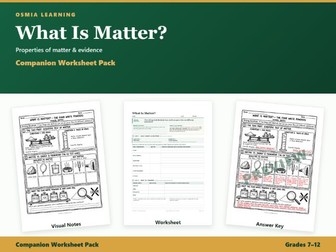
Printable companion for an online lesson These printable worksheets and visual notes accompany an online lesson hosted on an external, ad-free educational website. The online lesson is free to use, with no fees, login, or registration required. Internet access is required to use the online lesson alongside these pages. The teacher guide identifies the website and the lesson to use. This is the printable companion pack for the free interactive What Is Matter? lesson. Use the online lesson first or alongside these pages—the wording, data, and student tasks are designed to match. Four jars of white powder look exactly alike—so how do your students prove which is which? These printable companion pages guide students through evidence-based property tests as they investigate salt, sugar, baking soda, and chalk. Students will: determine what actually counts as matter: it has mass and takes up space distinguish matter from tricky non-matter examples such as heat, sound, and a shadow run property tests involving solubility, crystal appearance, and mass for a fixed 10 mL sample use evidence to rule out suspects and identify a mislabeled mystery jar build a claim, select evidence, and explain their reasoning Included in this companion pack: illustrated visual notes for students who think in pictures a clean standard worksheet format matching answer keys for both formats a 3-page teacher guide with lesson flow, classroom-use options, and common student mix-ups a teacher-facing manifest and terms of use The visual notes and standard worksheet cover the same content, so you can choose the format that fits your class and use the other for review or makeup work alongside the online lesson. The printable pages are designed for grades 7–12, including intro chemistry, physical science, and upper middle school. Single-teacher license. © Osmia LLC.
CER Practice Worksheet | Everyday Science + Answer KeyQuick View
osmialearning

CER Practice Worksheet | Everyday Science + Answer Key

(0)
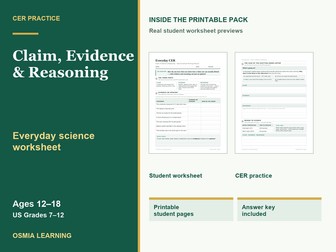
Students sort evidence from opinion, solve an everyday laptop mystery, and apply claim–evidence–reasoning to dissolving-rate data. This independent CER practice worksheet for ages 12–18 (US grades 7–12) includes a printable student worksheet and a separate answer key with model responses. Use the activity to introduce scientific argumentation before a lab or to revisit how evidence supports a claim. Students learn the three parts of CER, distinguish objective observations from opinions, write a complete explanation for an everyday scenario, and transfer the structure to science data. WHAT IS INCLUDED Print-ready student worksheet with CER explanations, evidence-or-opinion sorting, the laptop mystery, and a bridge to science Separate answer key with model responses Ages 12–18; US grades 7–12. Suitable for biology, chemistry, physical science, environmental science, or introductory science. Single-teacher license. © Osmia LLC.
DNA Structure & Replication Companion Worksheet | Life Science LessonQuick View
osmialearning

DNA Structure & Replication Companion Worksheet | Life Science Lesson

(0)
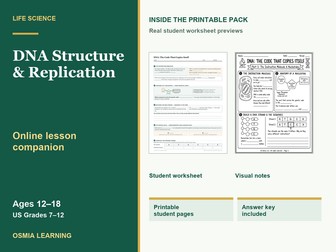
Students build a nucleotide, apply DNA base-pairing rules, and model replication with printable worksheets and visual notes for ages 12–18 (US grades 7–12). This companion supports the online DNA lesson and includes two student formats, answer keys, and a teacher guide. The interactive lesson is hosted online; the direct link is included in the downloadable teacher guide. Internet access is needed for the lesson. It is free to use without a login or registration. WHAT IS INCLUDED Three-page illustrated Visual Notes and matching answer key Two-page Standard Worksheet and matching answer key Companion Teacher Guide, Terms of Use, and manifest The Visual Notes and Standard Worksheet are alternate formats of the same companion activity. Students identify nucleotide components, apply complementary base pairing, correct mismatches, and model semiconservative replication. Use alongside the online lesson for guided notes and practice in biology or life science. Ages 12–18; US grades 7–12. Single-teacher license. © Osmia LLC.
Choose the Graph Companion Worksheet PackQuick View
osmialearning

Choose the Graph Companion Worksheet Pack

(0)
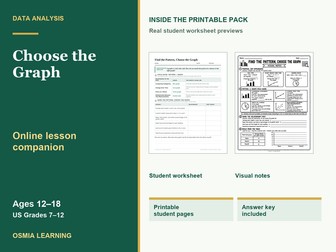
Students identify relationships in data, choose an appropriate graph, and explain their choice with this printable companion for ages 12–18 (US grades 7–12). The pack includes a worksheet, visual notes, answer keys, and teacher guide for the interactive Find the Pattern: Choose the Graph lesson. The lesson is hosted online and its direct link is included in the downloadable teacher guide. Internet access is required; the lesson is free to use without a login or registration. The printable pages accompany the interactive lesson. WHAT IS INCLUDED Student worksheet for identifying data relationships and choosing graphs Visual notes following the lesson sequence Matching answer keys Companion Teacher Guide, Terms of Use, and manifest Students compare categories, change over time, parts of a whole, and relationships between measured quantities, then justify a graph choice. Use the pages for guided notes and follow-up practice in science and data analysis. Ages 12–18; US grades 7–12. Single-teacher license. © Osmia LLC.
Reading Graphs & Charts Direct Instruction | Interpreting Graphs, Slides & NotesQuick View
osmialearning

Reading Graphs & Charts Direct Instruction | Interpreting Graphs, Slides & Notes

(0)
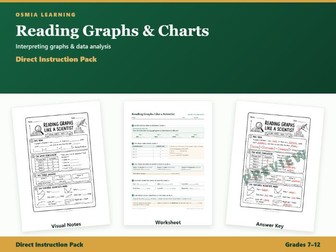
Teach Grades 7–12 students to read graphs critically with this self-contained, no-device lesson. Students annotate graphs, detect misleading scales, distinguish trend from causation, and write bounded CER conclusions. What is included Fully editable 16:9 PowerPoint slide deck with teacher notes (18 slides) Project-ready PDF version of the complete presentation Structured Guided Notes student packet Illustrated Visual Notes student packet Matching teacher answer keys for both note formats 3-page Direct Instruction Teacher Guide with pacing, common mix-ups, and grading guidance Terms of use Classroom use Project the editable deck for whole-class instruction while students complete either note format. Use the second format for differentiation, review, makeup work, or a substitute plan. The pack is complete for offline teaching; students learn to annotate graphs, detect truncated or misleading axes, distinguish trend from causation, repair vague statements, and build bounded CER conclusions supported by graph evidence. Grades 7–12. Best fit for middle school science, biology, environmental science, and data-analysis units. Single-teacher license. © Osmia LLC. Related TES resources Reading Graphs & Charts | Data Analysis Lesson Science Graphing Practice | Line, Bar, Circle & Scatter
Observation vs. Inference: Companion PackQuick View
osmialearning

Observation vs. Inference: Companion Pack

(0)
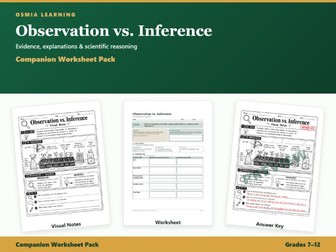
Printable companion for an online lesson These printable worksheets and visual notes accompany an online lesson hosted on an external, ad-free educational website. The online lesson is free to use, with no fees, login, or registration required. Internet access is required to use the online lesson alongside these pages. The direct lesson link is included in the downloadable teacher guide. Printable companion pages for the free interactive Observation vs. Inference lesson. Use the online lesson first or alongside these pages—the examples, evidence work, and student tasks are designed to match. Students learn to separate what they directly observe from what they infer, then use evidence to support careful explanations. They analyze a plant-growth investigation, sort observations from interpretations, identify evidence, and practice writing inferences that are grounded in what the data and images show. What is included Visual Notes: 2 illustrated sketch-style student pages with a matching answer key Standard Worksheet: 3 student pages following the online lesson, with a matching answer key 5-page Companion Teacher Guide with use options, pacing, teaching notes, and answer-key guidance Terms of use Classroom use The free online lesson is self-paced. Use it with these companion pages for stations, substitute days with internet access, flipped classrooms, or beginning-of-year science-practice review. Assign either student format alongside the online lesson and use the other for review, differentiation, or makeup work. Every student page has a matching answer key. Grades 7–12. Best fit for middle school science, introductory biology, and observation/evidence units. Single-teacher license. © Osmia LLC.
Repeat the Test: Companion Worksheet PackQuick View
osmialearning

Repeat the Test: Companion Worksheet Pack

(0)
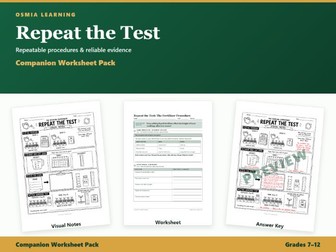
Printable companion for an online lesson These printable worksheets and visual notes accompany an online lesson hosted on an external, ad-free educational website. The online lesson is free to use, with no fees, login, or registration required. Internet access is required to use the online lesson alongside these pages. The direct lesson link is included in the downloadable teacher guide. Printable companion pages for the free interactive Repeat the Test lesson. Use the online lesson first or alongside these pages—the wording, data, and student tasks are designed to match. Students practice writing specific, repeatable procedures and explaining why replication gives comparable results. They compare plant-growth investigations with vague directions, repair the missing details, identify variables, and explain why repeated results should be close but not identical. What is included Visual Notes: 2 illustrated sketch-style student pages with a matching answer key Standard Worksheet: 2 student pages following the online lesson’s five acts, with a matching answer key 4-page Companion Teacher Guide with use options, pacing, teaching notes, and answer-key guidance Terms of use Classroom use The free online lesson is self-paced. Use it with these companion pages for stations, substitute days with internet access, flipped classrooms, or beginning-of-year lab-skills review. Assign either student format alongside the online lesson and use the other for review, differentiation, or makeup work. Every student page has a matching answer key. Grades 7–12. Best fit for middle school science, introductory biology, and experimental-design units. Single-teacher license. © Osmia LLC.