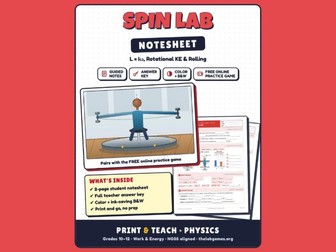
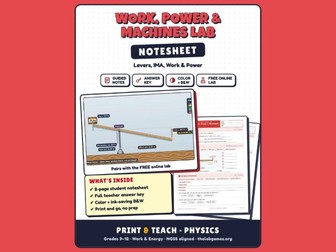
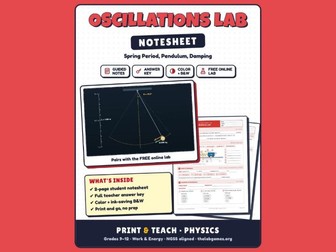
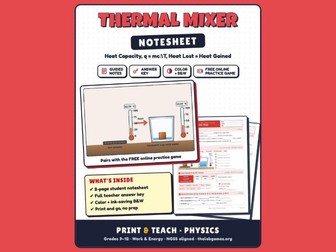
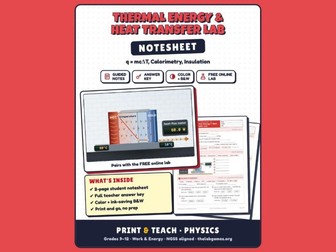
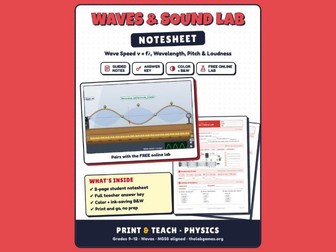
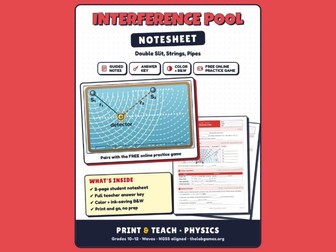
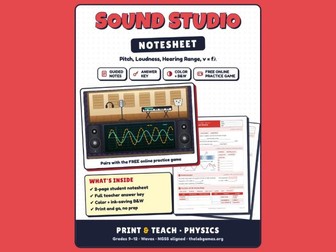
 Quick View
Le Chatelier's Principle Notesheet | Shifts, Q vs K + Key
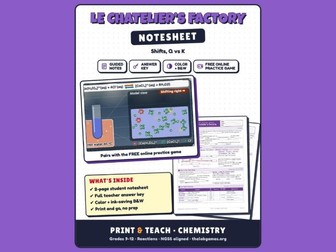
Students learn what dynamic equilibrium really means and then predict how a system shifts under stress. They fill in guided notes on reversible reactions, Le Chatelier’s principle and K, read a concentration-time graph after NO₂ is injected into an NO₂/N₂O₄ syringe, and work through a step-by-step method for every kind of stress: concentration, temperature, pressure, catalysts, adding water and inert gases.
The notesheet pairs with Le Chatelier’s Factory, a free online practice game at thelabgames.org, where students supervise a plant of sealed reactors, predict each shift, then press Apply and watch the molecules and graph respond. It works for class practice, absent-student makeups and sub days. The AP Chemistry box covers writing K (pure liquids left out) and Q vs K calculations.
What’s Included
Student notesheet (2 pages) in full color AND black & white
Teacher answer key (red answers) in full color AND black & white
What Students Do
Complete fill-in background notes on reversible reactions, dynamic equilibrium, Le Chatelier’s principle, K and Q
Label a concentration vs. time graph (equilibrium, the stress, the shift, the new equilibrium, which curve is NO₂) and explain why the added NO₂ is only partly used up
Follow the four steps for a work order and complete the worked Haber example (cooling shifts right; K goes up)
Fill in a reference chart of the plant’s five reactors: heat as reactant or product, moles of gas on each side, colours
Solve 9 practice work orders: adding and removing substances, heating, pressure (including the equal-moles trap), catalysts, adding water, choosing every change that maximizes NH₃ yield, and what equilibrium means
AP: write K for the cobalt chloride equilibrium and calculate Q vs K for two fresh mixtures
Fill in key ideas (common mistakes) and log their practice runs
Skills & Standards
Reversible reactions, dynamic equilibrium, Le Chatelier’s principle, endothermic vs. exothermic shifts, pressure and moles of gas, catalysts, the equilibrium constant K, reaction quotient Q, the Haber process trade-off
• Ngss Hs-Ps1-6
AP Chemistry Unit 7 (equilibrium) extension
Grades 9-12 Chemistry and AP Chemistry
Great For
Guided notes while students play the activity
Absent-student makeups
Sub days
Homework or review before an equilibrium quiz
Pairing with the Chemical Equilibrium Lab