


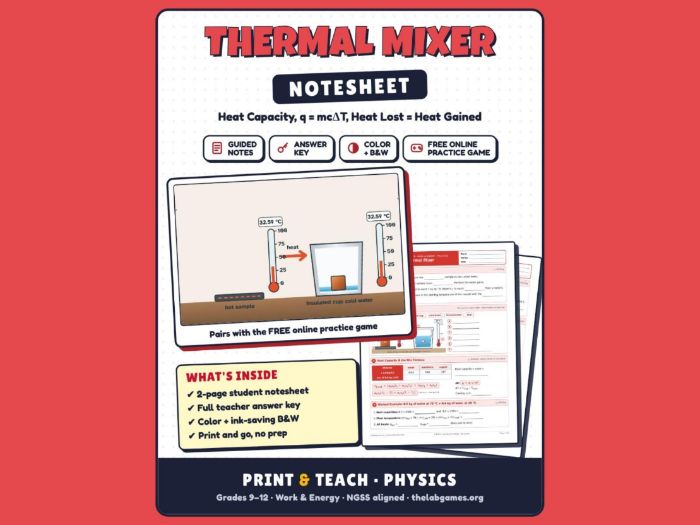
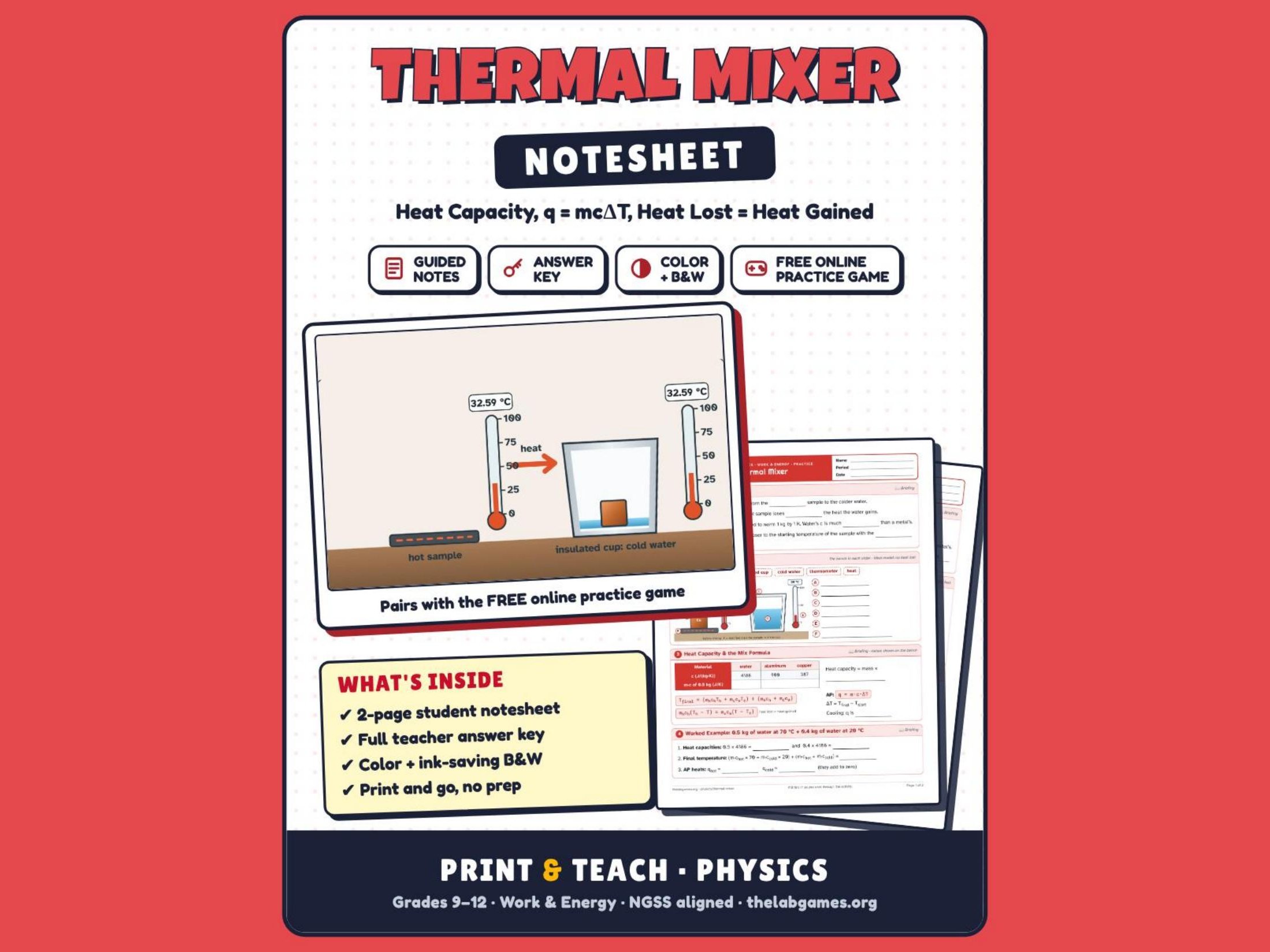
Help students predict where a hot-and-cold mix will settle. This roomy, student-friendly 2-page notesheet walks students through thermal equilibrium in an insulated cup: heat flows from hot to cold, heat lost equals heat gained, and the final temperature sits closer to the sample with the bigger heat capacity (m·c). Students label the quench bench, use specific heats for water, aluminum and copper, and follow a worked example before trying four practice orders.
It pairs with Thermal Mixer, a free online practice game at thelabgames.org where students choose masses of a hot sample and cold water to hit a target temperature. Use it in class, for absent-student makeups, or on sub days. A complete teacher key with every value worked out is included.
What’s Included
- Student notesheet (2 pages) in full color AND black & white
- Teacher answer key (red answers) in full color AND black & white
What Students Do
- Background fill-in: heat flows from hotter to colder, conservation of energy, specific heat, and why the final temperature is a weighted average
- Label the Quench Bench: hot sample, hot plate, insulated cup, cold water, thermometer and the heat arrow
- Heat Capacity & the Mix Formula: find m·c for three materials, then use the final-temperature formula and heat lost = heat gained (plus q = mcΔT and the sign of q for AP)
- Worked Example: hot water into cold water, with heat capacities, the final temperature and both heats
- Practice Orders: find the hot-water mass for a water + water mix, find the aluminum mass for a metal + water mix, decide how to adjust a copper mix that missed its target, and (AP) predict a final temperature and both signed heats
- Key Ideas: the final temperature lies between the starts, water’s large heat capacity, the direction of heat flow, and q_hot + q_cold = 0
- My Runs: a log for tracking practice scores
Skills & Standards
- Thermal equilibrium, heat transfer, specific heat, heat capacity, calorimetry, q = mcΔT, conservation of energy
- Supports NGSS HS-PS3-4
- Grades 9–12 Physics (with AP Physics 2 extension problems)
Great For
- Work and energy or thermodynamics units
- Absent-student makeups
- Sub plans
- Homework or stations
- Test review
Something went wrong, please try again later.
This resource hasn't been reviewed yet
To ensure quality for our reviews, only customers who have purchased this resource can review it
Report this resourceto let us know if it violates our terms and conditions.
Our customer service team will review your report and will be in touch.
$2.49