


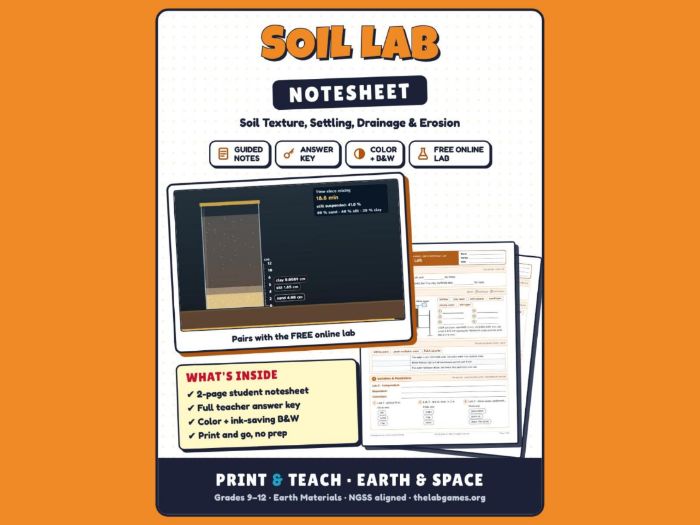
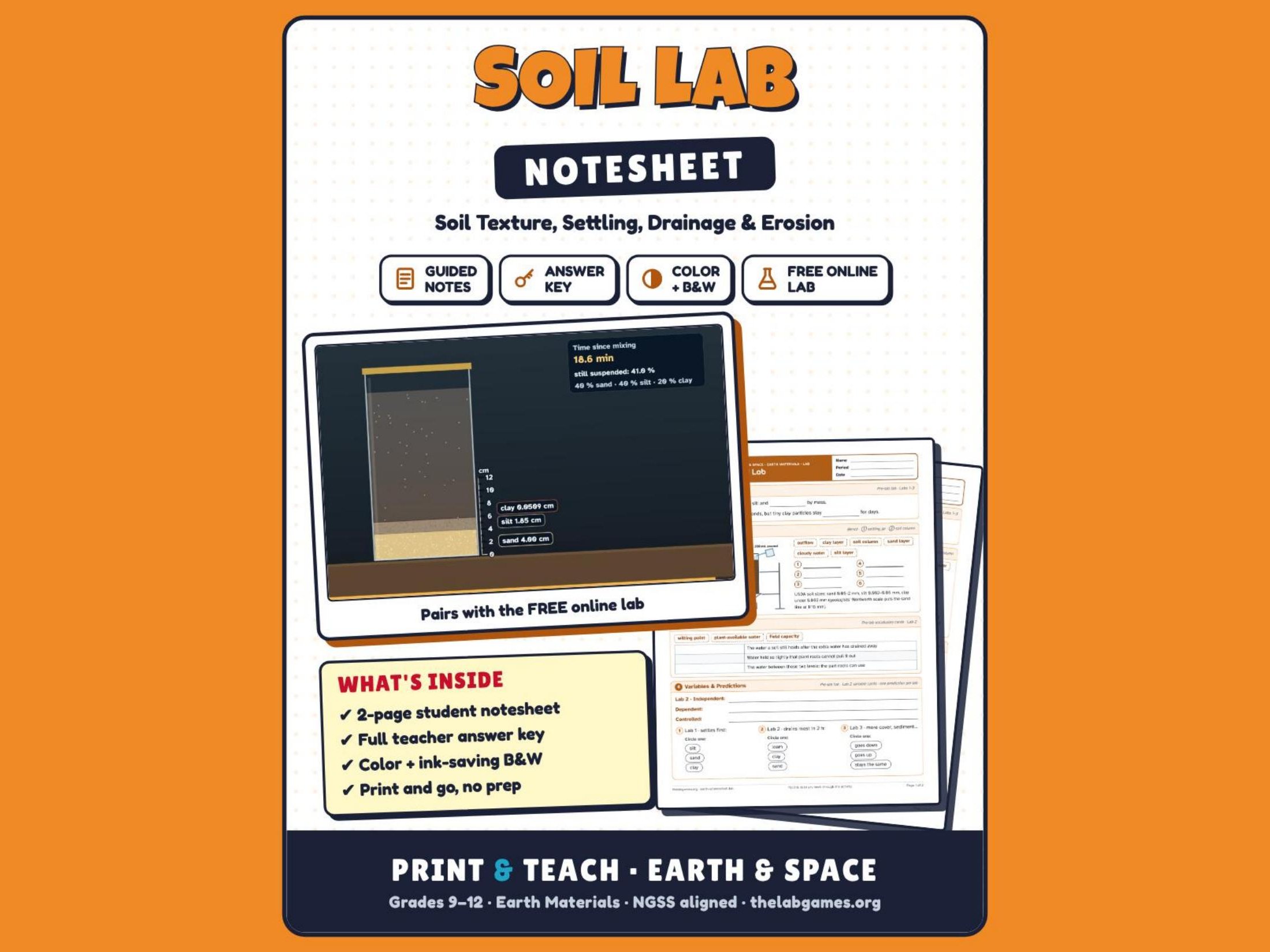
Help students find out what soil is made of and where the water poured on it goes. In this roomy, student-friendly 2-page lab notesheet, students fill in the background on soil texture and settling, label a settling jar and a soil column, define field capacity, wilting point and plant-available water, name the variables and make one prediction for each lab. On page 2 they record how six soils drain and hold water, add quick data from the settling jar and the erosion tray, draw a bar graph of outflow and plant-available water, answer analysis questions and write a claim, evidence and reasoning.
It pairs with the Soil Lab, a free online lab at thelabgames.org where students settle sand, silt and clay in a jar, pour water through soil columns, read a soil test kit and wash soil off a rain tray. Use it in class, for absent-student makeups, or on sub days. A complete teacher key is included.
What’s Included
- Student notesheet (2 pages) in full color AND black & white
- Teacher answer key (red answers) in full color AND black & white
What Students Do
- Background fill-in: soil texture and why clay stays suspended
- The Jar and the Column: label the sand, silt and clay layers, the cloudy water, the soil column and the outflow
- Key Words: field capacity, wilting point and plant-available water
- Variables & Predictions: Lab 2 variables, plus one circle-the-prediction question for each of the three labs
- Lab 2 Data: outflow, water remaining, field-capacity target and plant-available capacity for six soils from sand to clay
- Labs 1 & 3 Quick Data: settling-jar layers and the share still suspended, and runoff and sediment from a bare and a fully covered tray
- Graph & Analysis: a bar graph of outflow and plant-available water, the water budget, why clay is not best for plants, and (AP) the percent cut in sediment
- Claim, Evidence, Reasoning for “How do the soils differ in drainage and plant-available water?”
Skills & Standards
- Soil texture, sand, silt and clay, settling, suspension, drainage, hydraulic conductivity, field capacity, wilting point, plant-available water, runoff, erosion, surface cover, conservation of water
- Supports NGSS HS-ESS2-5
- Grades 9–12 Earth Science (with AP Environmental Science Unit 4 connections)
Great For
- Earth materials, soil and erosion units
- Absent-student makeups
- Sub plans
- Lab write-up practice
- Test review
Something went wrong, please try again later.
This resource hasn't been reviewed yet
To ensure quality for our reviews, only customers who have downloaded this resource can review it
Report this resourceto let us know if it violates our terms and conditions.
Our customer service team will review your report and will be in touch.
$0.00