


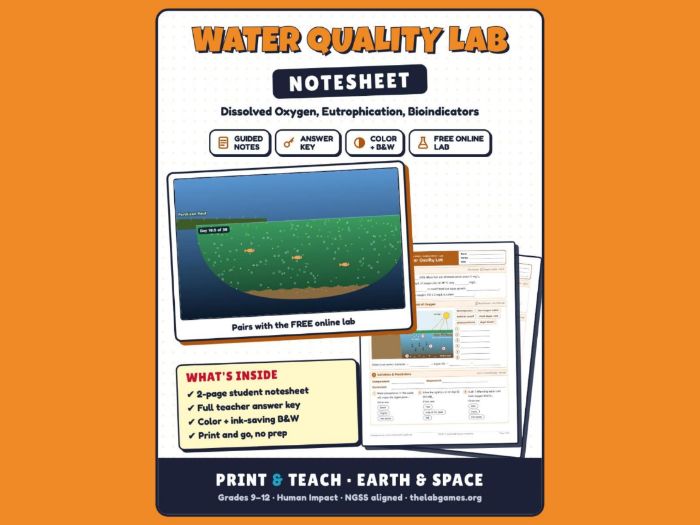
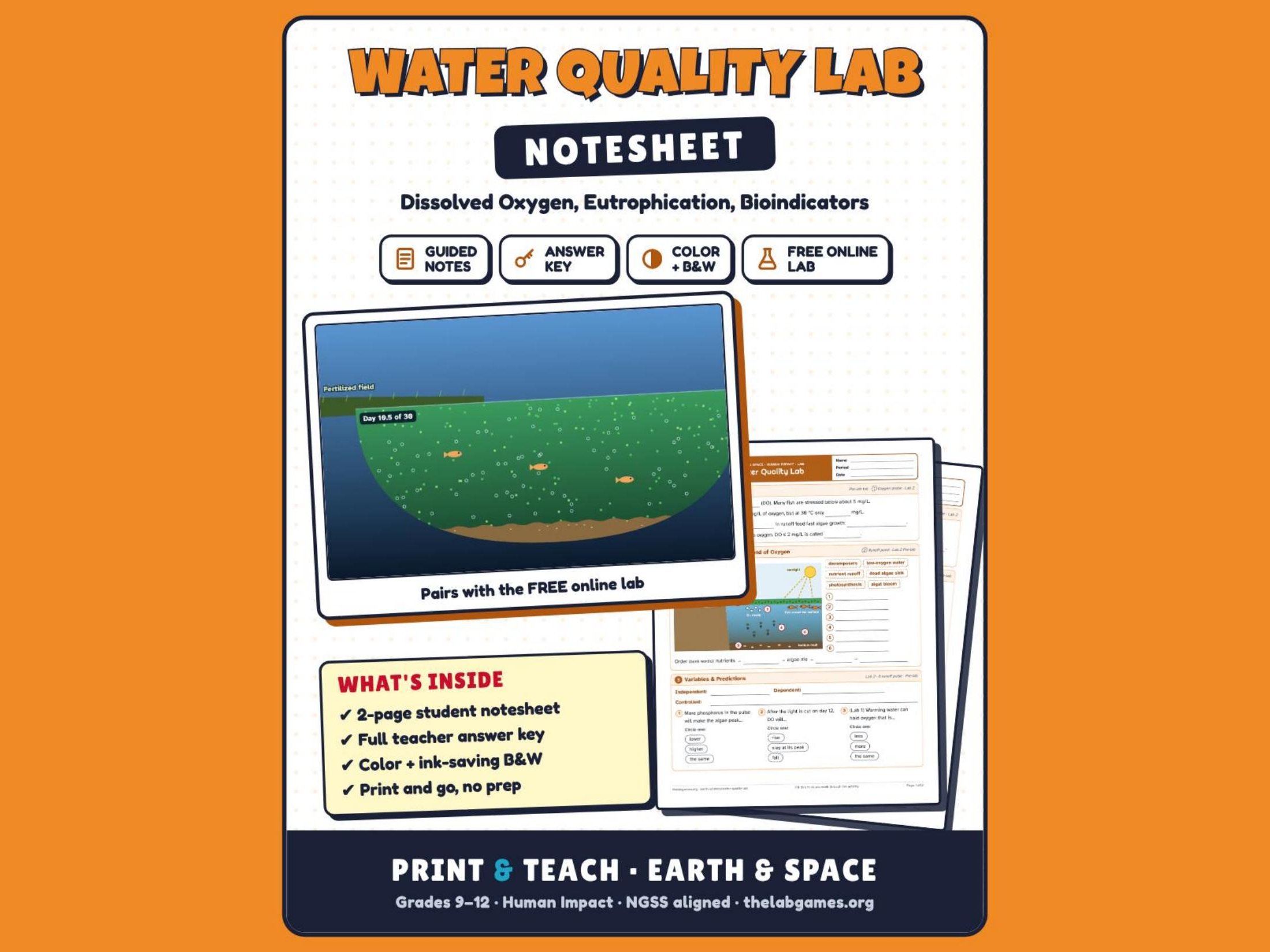
Help students see how runoff can starve a pond of oxygen and how stream animals reveal water quality. In this roomy, student-friendly 2-page lab notesheet, students fill in the background on dissolved oxygen, oxygen capacity, eutrophication and hypoxia, label a runoff-fed pond (nutrient runoff, algal bloom, photosynthesis, sinking dead algae, decomposers and low-oxygen water), put the eutrophication steps in order, name the variables and make three predictions. On page 2 they record algae and oxygen through a 30-day runoff pulse and graph the oxygen crash, compare three phosphorus pulses, score stream sites by their macroinvertebrates and write a claim, evidence and reasoning.
It pairs with the Water Quality Lab, a free online lab at thelabgames.org where students test oxygen against temperature, follow a runoff pulse into an algae bloom and oxygen crash, and score streams by the animals living in them. Use it in class, for absent-student makeups, or on sub days. A complete teacher key is included.
What’s Included
- Student notesheet (2 pages) in full color AND black & white
- Teacher answer key (red answers) in full color AND black & white
What Students Do
- Background fill-in: dissolved oxygen, how much oxygen cold and warm water can hold, nutrient runoff, eutrophication and hypoxia
- How Runoff Can Starve a Pond of Oxygen: label six parts of a runoff-fed pond and complete the eutrophication sequence
- Variables & Predictions: independent, dependent and controlled variables for the runoff-pulse lab, plus three circle-the-prediction questions
- Lab 2 Data: algal biomass and dissolved oxygen over 30 days after a runoff pulse, graphed against a hypoxia line
- Compare Pulses and Stream Survey: peak algae, highest and lowest oxygen for three phosphorus pulses, and the streamside index, taxa and animal counts for three stream sites
- AP Environmental Science box: percent saturation of a supersaturated reading, BOD₅ from a dark bottle, and a streamside index from taxon weights
- Claim, Evidence, Reasoning for “How does more phosphorus in the runoff pulse change the algae and the oxygen?”
Skills & Standards
- Dissolved oxygen, oxygen solubility and temperature, percent saturation, nutrient pollution, eutrophication, algal blooms, photosynthesis, decomposition, hypoxia, BOD, benthic macroinvertebrates, bioindicators, pollution tolerance, taxa richness
- Supports NGSS HS-ESS3-4, HS-LS2-7
- Grades 9–12 Earth and Space Science or Biology (also fits AP Environmental Science Unit 8)
Great For
- Human impact and water pollution units
- Ecology units
- Absent-student makeups
- Sub plans
- Test review
Something went wrong, please try again later.
This resource hasn't been reviewed yet
To ensure quality for our reviews, only customers who have downloaded this resource can review it
Report this resourceto let us know if it violates our terms and conditions.
Our customer service team will review your report and will be in touch.
$0.00