30 lessons – ‘The Explorer’ by Katherine Rundell – Year 4/5/6 – English planningQuick View
brads72

30 lessons – ‘The Explorer’ by Katherine Rundell – Year 4/5/6 – English planning

(6)
30 lessons – ‘The Explorer’ by Katherine Rundell – Year 4/5/6 – English planning A whole term’s English planning linked to the book ‘The Explorer’ (Winner of the Children’s Book Prize Winner of the Costa Children’s Book Award 2017) by Katherine Rundell. This story fits well with any topic linked work about South America, as it is set in the Amazon Rainforest. Ideal for Year 4, Year 5 or Year 6 children. There are 30 lessons in total, all with SMART Notebook screens, task sheets and header sheets. To assist teaching, there are a total of 149 SMART Notebook screens and each lesson is clearly marked along with which lesson each chapter should be read to aid and link to the learning. (Update - I personally use SMART Notebook files in my own lessons. In response to many requests, I have converted the SMART Notebook screens to Powerpoint, so there is also a Powerpoint presentation included for the teaching sequence for those unable to use SMART Notebook. However, please note that while the SMART Notebook screens can be edited, the Powerpoint screens can not be edited as they are screen snips from the SMART Notebook file.) This planning includes: Writing a narrative Writing a persuasive letter SATs style comprehension questions Journal writing Writing an information text Recording a radio broadcast This book and planning link well with topic work on South America, Brazil, the Amazon Rainforest and the Yanomami indigenious tribe. It will also educate and inform the children of a very current real problem that others in the world face - the destruction of the rainforest. Some comments from reviews on this resource: ‘This resource is absolutely brilliant - it has everything you need for a term’s worth of work on The Explorer … in an engaging and fun way. Perfect!’ (staylor138) ‘Fantastic and well worth the money, a very broad range of activities that are very well planned and resourced.’ (taylor29) ‘Great resource- such a timesaver!’ (penrich1)
32 lessons - 'The Boy at the Back of the Class' by Onjali Rauf - Year 4/5/6 - English planningQuick View
brads72

32 lessons - 'The Boy at the Back of the Class' by Onjali Rauf - Year 4/5/6 - English planning

(25)
32 lessons - ‘The Boy at the Back of the Class’ by Onjali Rauf - Year 4/5/6 - English planning A whole term’s English planning linked to the book ‘The Boy at the Back of the Class’ (Winner of the Blue Peter Best Story Award 2019) by Onjali Rauf. Since its release, this book has been a classroom favourite, covering a topic that is never far from the news. Onjali Rauf writes about the topic of migration and refugees fantastically. I’ve taught this scheme three times now to different classes, and each time the children have all cheered at the end of the book (always a good sign that they’ve enjoyed it!) There are 32 lessons in total, all with accompanying SMART Notebook screens, task sheets and header sheets. To aid teaching each lesson, there are a total of 162 SMART Notebook screens (in one file) and each lesson is clearly marked along with which lesson each chapter should be read to aid and link to the learning. (Update - I personally use SMART Notebook files in my own lessons. In response to many requests, I have converted the SMART Notebook screens to Powerpoint, so there is also a Powerpoint presentation included for the teaching sequence for those unable to use SMART Notebook. However, please note that while the SMART Notebook screens can be edited, the Powerpoint screens can not be edited as they are screen snips from the SMART Notebook file.) This teaching sequence and planning will require the children to complete the following tasks over the 32 lessons: writing a recount writing a persuasive letter answering SATs style comprehension questions writing a narrative descriptive writing drama session writing an information text writing a newspaper report I have also included some examples of work for some lessons in the planning. This topic will also educate and inform the children of a very current real problem that others in the world face - the plight of the refugee. Using this book will expand their understanding of the world and help them to empathise and appreciate what some of the other children in school may have gone through. Even if you don’t need this scheme of work, I would highly recommend the book to share with the class. This resource has received over 20 five-star reviews from teachers who have purchased it. Some of the comments include: We have used this scheme for 2 years it is suitable for high, middle and low ability. It provides the cross curricular style that we wanted for year 7. Worth every penny. (united77) The best resource I have ever downloaded, this made my life so much easier. (AJ40) Absolutely love this. Brilliant scheme of work to go with an excellent book. (ajtranter) Thank you ! These resources are amazing. (teach_explore) Wonderful purchase. All lessons and clearly explained and the appropriate resources are all numbered which makes it super easy to follow. (torylindsay96)
Shakespeare's Macbeth: key quotations for GCSEQuick View
mishymashy

Shakespeare's Macbeth: key quotations for GCSE

(8)
A revision resource for GCSE students to help them memorise key quotations from Macbeth. A 5 page document, colour-coded according to character. Accompanying brief analysis of each quotation: stylistic features, key themes, similar scenes. Easily adaptable for differentiation.
NPQ Assignment 22/23 (NPQLT)Quick View
madelainerush

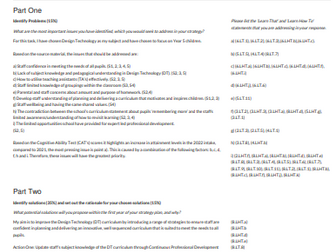
NPQ Assignment 22/23 (NPQLT)

(5)
This is my assingment for the new framework for NPQLT (Leading Teachers) 22/23. I was in the first cohort of the new framework and therefore hoping this can give people an example of what a PASS looks like for the new framwork. Included in this is: My final assignment My result and percentages against the marking criteria My references for the LHT and LT statements. Please note: I have uploaded this as a PDF so that you can see how I linked in the LHT and LT statements. You can still copy and paste from this PDF.
NPQSL 2023/2024 NEW Format Example, Full Assignment, Feedback, Case Study Questions & Help Sheet!Quick View
jodiesmith93

NPQSL 2023/2024 NEW Format Example, Full Assignment, Feedback, Case Study Questions & Help Sheet!

(2)
This full NPQSL example / exemplar is ideal for anyone who is doing their NPQSL, I am certain it will 100% help. This is my final write up for the new NPQSL scoring 15/17 (passmark 10). I also scored the full 2 marks for the JAR adjustment score. This is the new and most current NPQSL assessment format - grade received in August 2023 - I was ‘cohort 1’, the first cohort since the revised NPQ’s. I have included everything! My full written responses/ submission to all 5 questions, the full feedback and marking I received, (very helpful) so you can see what the moderators are looking for in each section and how they assess against a rubric of statements, the 5 questions and case study I was given to respond too and a little help sheet I created and used which helped me ensure I was responding concisely to the questions. INCLUDES: Full assignment Full feedback and moderation Full case study and 5 questions Help sheet I have added my email on the help sheet if you need to reach out for any help with your write up as well :) Please leave a review if you make a purchase :)
Gruffalo rhyming wordsQuick View
mmaddocks93

Gruffalo rhyming words

(1)
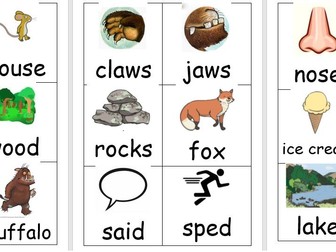
Here is a set of visual rhyming words found in the Gruffalo story to support teaching rhyme within this book. I have found pictures to provide support for SEN/EAL/young children. These can be cut up and laminated for teaching or just cut up and mixed up for activity work (print 2 pages per sheet for evidence in books).
Topic 7 Ecology model answer revision notes AQA GCSE BiologyQuick View
biologywitholivia

Topic 7 Ecology model answer revision notes AQA GCSE Biology

(0)
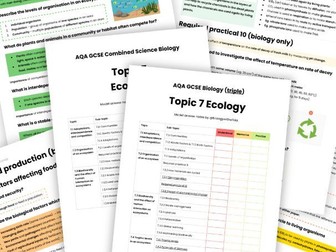
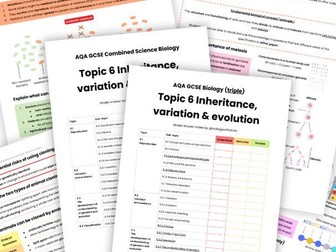
Follow my TikTok and Instagram @biologywitholivia to see these notes in action. Any questions please email hello@biologywitholivia.co.uk. DESCRIPTION Drawing on my experience as a teacher and extensive analysis of past papers, mark schemes and examiner reports, I’ve created ‘model answer’ notes that cover every point on the AQA specification (including required practicals). These notes are presented in an easy-to-use Q&A format. Colour coding, diagrams and a simple layout makes learning easy. After each sub-topic, you’ll find common misconceptions and why they’re wrong, as well as example application questions and model answers. Having refined these over the last 3 years alongside working as a teacher, I’ve seen first-hand the results they can achieve. I’m confident that they will be an invaluable tool to you. Included are separate versions for combined science (trilogy) and triple science. TOPICS INCLUDED (ECOLOGY) 7.1.1 Communities 7.1.2 Abiotic factors 7.1.3 Biotic factors 7.1.4 Adaptations 7.2.1 Levels of organisation Required practical 9 7.2.2 How materials are cycled 7.2.3 Decomposition Required practical 10 7.2.4 Impact of environmental change 7.3.1 Biodiversity 7.3.2 Waste management 7.3.3 Land use 7.3.4 Deforestation 7.3.5 Global warming 7.3.6 Maintaining biodiversity 7.4.1 Trophic levels 7.4.2 Pyramids of biomass 7.4.3 Transfer of biomass 7.5.1 Factors affecting food security 7.5.2 Farming techniques 7.5.3 Sustainable fisheries 7.5.4 Role of biotechnology
Topic 6 Inheritance, variation & evolution model answer revision notes AQA GCSE BiologyQuick View
biologywitholivia

Topic 6 Inheritance, variation & evolution model answer revision notes AQA GCSE Biology

(0)
Follow my TikTok and Instagram @biologywitholivia to see these notes in action. Any questions please email hello@biologywitholivia.co.uk. DESCRIPTION Drawing on my experience as a teacher and extensive analysis of past papers, mark schemes and examiner reports, I’ve created ‘model answer’ notes that cover every point on the AQA specification (including required practicals). These notes are presented in an easy-to-use Q&A format. Colour coding, diagrams and a simple layout makes learning easy. After each sub-topic, you’ll find common misconceptions and why they’re wrong, as well as example application questions and model answers. Having refined these over the last 3 years alongside working as a teacher, I’ve seen first-hand the results they can achieve. I’m confident that they will be an invaluable tool to you. Included are separate versions for combined science (trilogy) and triple science. TOPICS INCLUDED (INHERITANCE, VARIATION & EVOLUTION) 6.1.1 Sexual and asexual reproduction 6.1.2 Meiosis 6.1.3 Advantages and disadvantages 6.1.4 DNA and the genome 6.1.5 DNA structure 6.1.6 Genetic inheritance 6.1.7 Inherited disorders 6.1.8 Sex determination 6.2.1 Variation 6.2.2 Evolution 6.2.3 Selective breeding 6.2.4 Genetic engineering 6.2.5 Cloning 6.3.1 Theory of evolution 6.3.2 Speciation 6.3.3 The understanding of genetics 6.3.4 Evidence for evolution 6.3.5 Fossils 6.3.6 Extinction 6.3.7 Resistant bacteria 6.4 Classification of living organisms
NEW Topic 4 Genetic info, variation & relationships model answer revision notes AQA A Level BiologyQuick View
biologywitholivia

NEW Topic 4 Genetic info, variation & relationships model answer revision notes AQA A Level Biology

(3)
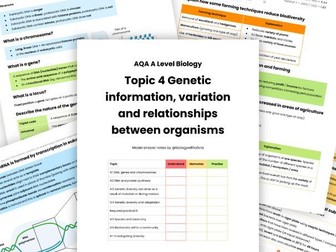
Follow my TikTok and Instagram @biologywitholivia to see these notes in action. Any questions please email hello@biologywitholivia.co.uk. DESCRIPTION Drawing on my experience as a teacher and extensive analysis of past papers, mark schemes and examiner reports, I’ve created ‘model answer’ notes that cover every point on the AQA specification (including required practicals). These notes are presented in an easy-to-use Q&A format. Colour coding, diagrams and a simple layout makes learning easy. After each sub-topic, you’ll find a list of common mistakes that will help you beat those specific mark schemes. Having refined these over the last 3 years alongside working as a teacher, I’ve seen first-hand the results they can achieve. I’m confident that they will be an invaluable tool to you. TOPICS INCLUDED (GENETIC INFO, VARIATION AND RELATIONSHIPS BETWEEN ORGANISMS) DNA, genes and chromosomes DNA & protein synthesis Genetic diversity mutation meiosis Genetic diversity and adaptation Required practical 6 Species and taxonomy Biodiversity within a community Investigating diversity
NEW Topic 3 organisms exchange substances model answer revision notes AQA A Level BiologyQuick View
biologywitholivia

NEW Topic 3 organisms exchange substances model answer revision notes AQA A Level Biology

(3)
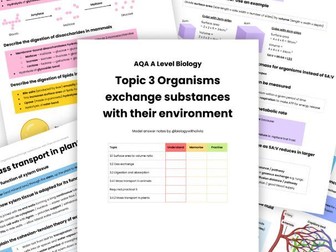
Follow my TikTok and Instagram @biologywitholivia to see these notes in action. Any questions please email hello@biologywitholivia.co.uk. DESCRIPTION Drawing on my experience as a teacher and extensive analysis of past papers, mark schemes and examiner reports, I’ve created ‘model answer’ notes that cover every point on the AQA specification (including required practicals). These notes are presented in an easy-to-use Q&A format. Colour coding, diagrams and a simple layout makes learning easy. After each sub-topic, you’ll find a list of common mistakes that will help you beat those specific mark schemes. Having refined these over the last 3 years alongside working as a teacher, I’ve seen first-hand the results they can achieve. I’m confident that they will be an invaluable tool to you. TOPICS INCLUDED (ORGANISMS EXCHANGE SUBSTANCES WITH THEIR ENVIRONMENT) Surface area to volume ratio Gas exchange Digestion and absorption Mass transport in animals Required practical 5 Mass transport in plants
NEW Topic 2 Cells model answer revision notes AQA A Level BiologyQuick View
biologywitholivia

NEW Topic 2 Cells model answer revision notes AQA A Level Biology

(5)
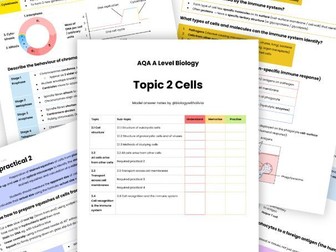
Follow my TikTok and Instagram @biologywitholivia to see these notes in action. Any questions please email hello@biologywitholivia.co.uk. DESCRIPTION Drawing on my experience as a teacher and extensive analysis of past papers, mark schemes and examiner reports, I’ve created ‘model answer’ notes that cover every point on the AQA specification (including required practicals). These notes are presented in an easy-to-use Q&A format. Colour coding, diagrams and a simple layout makes learning easy. After each sub-topic, you’ll find a list of common mistakes that will help you beat those specific mark schemes. Having refined these over the last 3 years alongside working as a teacher, I’ve seen first-hand the results they can achieve. I’m confident that they will be an invaluable tool to you. TOPICS INCLUDED (CELLS) Cell structure All cells arise from other cells Required practical 2 Transport across cell membranes Required practical 3 Required practical 4 Cell recognition and the immune system
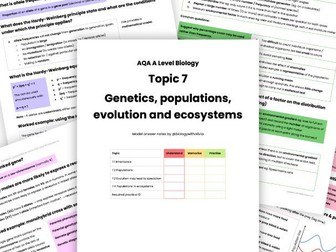
NEW Topic 7 Genetics, populations, evolution & ecosystems model answer notes AQA A Level BiologyQuick View
biologywitholivia

NEW Topic 7 Genetics, populations, evolution & ecosystems model answer notes AQA A Level Biology

(3)
Follow my TikTok and Instagram @biologywitholivia to see these notes in action. Any questions please email hello@biologywitholivia.co.uk. DESCRIPTION Drawing on my experience as a teacher and extensive analysis of past papers, mark schemes and examiner reports, I’ve created ‘model answer’ notes that cover every point on the AQA specification (including required practicals). These notes are presented in an easy-to-use Q&A format. Colour coding, diagrams and a simple layout makes learning easy. After each sub-topic, you’ll find a list of common mistakes that will help you beat those specific mark schemes. Having refined these over the last 3 years alongside working as a teacher, I’ve seen first-hand the results they can achieve. I’m confident that they will be an invaluable tool to you. TOPICS INCLUDED (GENETICS, POPULATIONS, EVOLUTION AND ECOSYSTEMS) Inheritance Populations Evolution may lead to speciation Populations in ecosystems Required practical 12
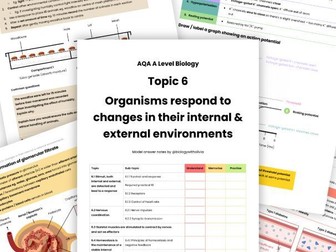
NEW Topic 6 Organisms respond to stimuli model answer revision notes AQA A Level BiologyQuick View
biologywitholivia

NEW Topic 6 Organisms respond to stimuli model answer revision notes AQA A Level Biology

(8)
Follow my TikTok and Instagram @biologywitholivia to see these notes in action. Any questions please email hello@biologywitholivia.co.uk. DESCRIPTION Drawing on my experience as a teacher and extensive analysis of past papers, mark schemes and examiner reports, I’ve created ‘model answer’ notes that cover every point on the AQA specification (including required practicals). These notes are presented in an easy-to-use Q&A format. Colour coding, diagrams and a simple layout makes learning easy. After each sub-topic, you’ll find a list of common mistakes that will help you beat those specific mark schemes. Having refined these over the last 3 years alongside working as a teacher, I’ve seen first-hand the results they can achieve. I’m confident that they will be an invaluable tool to you. TOPICS INCLUDED (ORGANISMS RESPOND TO CHANGES IN THEIR INTERNAL AND EXTERNAL ENVIRONMENTS) Survival and response Required practical 10 Receptors Control of heart rate Nerve impulses Synaptic transmission Skeletal muscles Principles of homeostasis and negative feedback Control of blood glucose concentration Required practical 11 Control of blood water potential
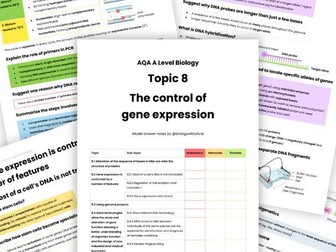
NEW Topic 8  The control of gene expression model answer notes AQA A Level BiologyQuick View
biologywitholivia

NEW Topic 8 The control of gene expression model answer notes AQA A Level Biology

(6)
Follow my TikTok and Instagram @biologywitholivia to see these notes in action. Any questions please email hello@biologywitholivia.co.uk. DESCRIPTION Drawing on my experience as a teacher and extensive analysis of past papers, mark schemes and examiner reports, I’ve created ‘model answer’ notes that cover every point on the AQA specification (including required practicals). These notes are presented in an easy-to-use Q&A format. Colour coding, diagrams and a simple layout makes learning easy. After each sub-topic, you’ll find a list of common mistakes that will help you beat those specific mark schemes. Having refined these over the last 3 years alongside working as a teacher, I’ve seen first-hand the results they can achieve. I’m confident that they will be an invaluable tool to you. TOPICS INCLUDED (CONTROL OF GENE EXPRESSION) Alteration of the sequence of bases in DNA can alter the structure of proteins (aka mutations) Most of a cell’s DNA is not translated (aka stem cells) Regulation of transcription and translation Gene expression and cancer Using genome projects Recombinant DNA technology Differences in DNA between individuals of the same species can be exploited for identification and diagnosis of heritable conditions (aka DNA probes) Genetic fingerprinting
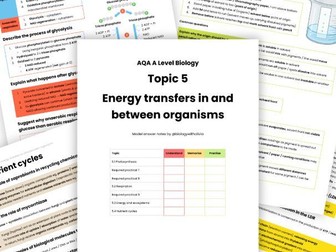
NEW Topic 5 Energy transfers in & between organisms model answer revision notes AQA A Level BiologyQuick View
biologywitholivia

NEW Topic 5 Energy transfers in & between organisms model answer revision notes AQA A Level Biology

(2)
Follow my TikTok and Instagram @biologywitholivia to see these notes in action. Any questions please email hello@biologywitholivia.co.uk. DESCRIPTION Drawing on my experience as a teacher and extensive analysis of past papers, mark schemes and examiner reports, I’ve created ‘model answer’ notes that cover every point on the AQA specification (including required practicals). These notes are presented in an easy-to-use Q&A format. Colour coding, diagrams and a simple layout makes learning easy. After each sub-topic, you’ll find a list of common mistakes that will help you beat those specific mark schemes. Having refined these over the last 3 years alongside working as a teacher, I’ve seen first-hand the results they can achieve. I’m confident that they will be an invaluable tool to you. TOPICS INCLUDED (ENERGY TRANSFERS IN AND BETWEEN ORGANISMS) Photosynthesis Required practical 7 Required practical 8 Respiration Required practical 9 Energy and ecosystems Nutrient cycles
NEW Topic 1 Biological molecules model answer revision notes AQA A level BiologyQuick View
biologywitholivia

NEW Topic 1 Biological molecules model answer revision notes AQA A level Biology

(8)
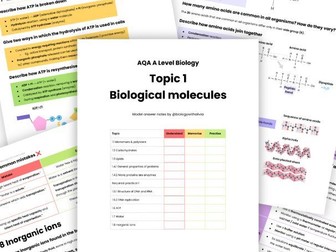
Follow my TikTok and Instagram @biologywitholivia to see these notes in action. Any questions please email hello@biologywitholivia.co.uk. DESCRIPTION Drawing on my experience as a teacher and extensive analysis of past papers, mark schemes and examiner reports, I’ve created ‘model answer’ notes that cover every point on the AQA specification (including required practicals). These notes are presented in an easy-to-use Q&A format. Colour coding, diagrams and a simple layout makes learning easy. After each sub-topic, you’ll find a list of common mistakes that will help you beat those specific mark schemes. Having refined these over the last 3 years alongside working as a teacher, I’ve seen first-hand the results they can achieve. I’m confident that they will be an invaluable tool to you. TOPICS INCLUDED (BIOLOGICAL MOLECULES) Monomers and polymers Carbohydrates Lipids Proteins Required practical 1 Nucleic acids ATP Water Inorganic ions
Heroes by Robert CormierQuick View
tealou

Heroes by Robert Cormier

(3)
A 286 slide long PowerPoint of complete chapter by chapter lessons. Each lesson has a ‘Do Now’ summary activity, a starter, development and plenary. Teacher notes are provided at the bottom of slides. There are separate resource files for ease of photocopying. The PowerPoint ends with a quiz (including answers) and revision lessons. Topics covered: What is a hero? Social and historical context Francis Nicole Larry Relationships between characters Language used to convey the horrors of war Veterans Foreshadowing War and the consequences of war Heroism Changes in characters, events and relationships Mood and atmosphere exam questions Responsibility Religion Guilt The ending of the novel
GCSE History Edexcel Model Answers: The Cold WarQuick View
Simply-Revisable

GCSE History Edexcel Model Answers: The Cold War

(4)
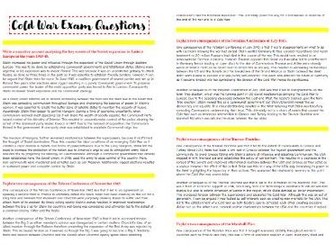
Model Answers for GCSE Edexcel History: Superpower Relations and the Cold War This document (7 pages) contains 11 model answers and 2 plans. This style of question can be found in Paper 2 of Edexcel GCSE History (P4: Superpower relations and the Cold War 1941-91) A list of the questions answered are also available in the preview. Students can use these as inspiration to construct their own answers. Ideal for students who have fallen behind on revision or for mock exams. Written by a straight 9 student with an offer to study at Cambridge, and have been fully corrected by an experienced Examiner and teacher! CONSEQUENCE QUESTIONS Explain two consequences of the Tehran Conference of November 1943 Explain two consequences of the Potsdam Conference of July 1945. Explain two consequences of the Truman Doctrine. Explain two consequences of the Marshall Plan. Explain two consequences for relations between the USA and the Soviet Union of Reagan becoming President. Explain two consequences of Gorbachev’s new thinking on Eastern Europe. Explain two consequences of the Cuban Revolution of 1959 Explain two consequences of Mikhail Gorbachev’s decision to abandon the Brezhnev Doctrine - NOTE PLAN ONLY NARRATIVE ACCOUNT QUESTIONS Write a narrative account analysing the key events of the Soviet expansion in eastern Europe in the years 1945-48. Write a narrative account analysing the key events in the Soviet Union in the years 1989-91. You may use the following in your answer: The impact of Sinatra Doctrine, Developments in East Germany. Write a narrative account analysing the key events of the Hungarian Uprising in 1956. You may use the following in your answer: Imre Nagy, Soviet Tanks. IMPORTANCE QUESTIONS The importance of the Potsdam Conference for early Cold War tension between the USA and the Soviet Union. Explain the importance of Ronald Reagan for relations between the USA and the Soviet Union - DETAILED PLAN ONLY We really appreciate **feedback **on our resources so if you kindly leave a review below, you will be able to claim any resource (up to the value of this resource) from our shop for FREE. Just email simplyrevisable@gmail.com with your username and your chosen resource. More resources available in my shop!
GCSE History Edexcel Early Elizabethan England Model AnswersQuick View
Simply-Revisable

GCSE History Edexcel Early Elizabethan England Model Answers

(6)
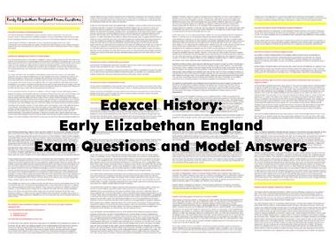
GCSE History Edexcel: Weimar and Nazi Germany Exam Questions Model Answers This document (14 pages) contains 19 detailed exam questions and model answers. This style of question can be found in Paper 2 of Edexcel GCSE History (option B4: Early Elizabethan England 1558-88) A list of the questions answered are also available in the preview. Students can use these as inspiration to construct their own answers. Ideal for students who have fallen behind on revision or for mock exams. Written by a straight 9 student with an offer to study at Cambridge, and have been fully corrected by an experienced Examiner and teacher! Describe two feature … (4 marks) Describe two features of Elizabethan theatre. Describe two features of Elizabethan government. Describe two features of Elizabethan society. Describe two features of the Elizabethan religious settlement Describe two features of Puritan religious beliefs. Describe two features of Walsingham’s methods of catching Catholic plotters. Describe two features of grammar schools. Describe two features of universities. Describe two features of theatres in Elizabethan London. Explain why … (12 marks) Explain why Raleigh’s first colony to Virginia failed? Explain why Mary, Queen of Scots created a problem for Elizabeth when she came to England in 1568. Explain why Mary, Queen of Scots was executed in 1587? Explain why the Spanish Armada was defeated. Explain why there was an increase in exploration in the years 1558-88. Explain why Raleigh’s first colony in Virginia failed. How far do you agree with this statement? (16 marks) ‘Elizabeth’s greatest problem in 1558 was the threat of invasion.’ ’The Northern Earls rebelled for religious reasons.’ ‘The government tried hard to help everyone who was poor’. ‘Population growth was the main reason why vagabondage increased in Elizabethan England ‘ We really appreciate feedback on our resources so if you kindly leave a review below, you will be able to claim any resource (up to the value of this resource) from our shop for FREE. Just email simplyrevisable@gmail.com with your username and your chosen resource. More resources available in my shop!
GCSE French Theme 3 Model Answers Speaking WritingQuick View
Simply-Revisable

GCSE French Theme 3 Model Answers Speaking Writing

(3)
GCSE French model answers for Theme 3: Current + Future Study and Employment writing and speaking exam questions. Over 20 questions + answer in 2 formats: revision cards for students and a pdf for teachers. Grade 9 standard and answers include many techniques such as idioms, opinions, adjectives, adverbs etc. Students can use these as inspiration to construct their own answers. Ideal for students who have fallen behind on revision or need extra support and guidance. Written by a straight 9 student with an offer to study at Cambridge, and have been fully corrected by a native French speaker/AQA Examiner! A list of the questions answered are also available in the preview. These questions cover the following modules of Theme 3: My Studies Life at School/College Education post-16 Jobs, Career choices and Ambitions We really appreciate feedback on our resources so if you kindly leave a review down below, you will be able to claim any resource (up to the value of this resource) from our shop for FREE. Just email simplyrevisable@gmail.com with your username and your chosen resource. More resources available in my shop!
GCSE History Edexcel: Weimar and Nazi Germany Model AnswersQuick View
Simply-Revisable

GCSE History Edexcel: Weimar and Nazi Germany Model Answers

(3)
GCSE History Edexcel: Weimar and Nazi Germany Exam Questions Model Answers This document (over 10 pages) contains 14 detailed exam questions and model answers. There is at least 1 model answer for each style of question. This style of question can be found in Paper 3 of Edexcel GCSE History (option 31: Weimar and Nazi Germany 1918-39). A list of the questions answered are also available in the preview. Sources are taken from the Pearson (John Child) and Hodder (John Wright & Steve Waugh) textbooks and are NOT included in the download due to copyright. Students can use these as inspiration to construct their own answers. Ideal for students who have fallen behind on revision or for mock exams. Written by a straight 9 student with an offer to study at Cambridge, and have been fully corrected by an experienced Examiner and teacher! Question 1 – Give two things you can infer from Source A about: (4 marks) life in Germany under the Nazis. the treatment of prisoners in concentration camps. 4 marks the Hitler Youth. the role of women in Nazi Germany. Question 2 – Explain why: (12 marks) Nazi propaganda was so effective. there was so little resistance and opposition to Hitler and the Nazis in Germany in the years 1933-1939. there was a great reduction in unemployment in Germany between 1933-39? the Nazi police state was successful between 1933-39. Question 3a – How useful are Sources B and C for an enquiry into…? (8 marks) the Hitler Youth? the attitudes of Germans towards Nazi policies towards women? the Reich Labour Service? Question 3b. Study interpretations 1 and 2 They give different views about the threats posed by the extremes towards the Weimar Republic 1919-1923. What is the main difference between these views? (4 marks) Question 3c.Suggest one reason why interpretations 1 and 2 on p.129 and p.130 of Pearson give different views about the standard of living of German workers in Nazi Germany. (4 marks) Question 3d. How far do you agree with Interpretation 2 about the threat posed to the Weimar Republic 1919-1923 from the extreme left and right? (20 marks) We really appreciate feedback on our resources so if you kindly leave a review below, you will be able to claim any resource (up to the value of this resource) from our shop for FREE. Just email simplyrevisable@gmail.com with your username and your chosen resource. More resources available in my shop!