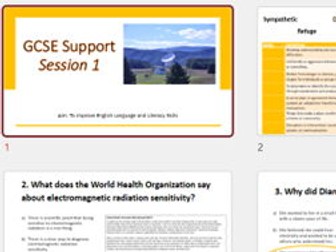
Here are some slides to complement the extract and exercises on boxing in the WJEC GCSE English and English Language Higher Level course book, pages 62, 63 and 64. There are anagrams of keywords to do with boxing, true and false on the passage on Spencer Oliver (p.62) match up the opposite words, the pros and cons of boxing and a look at keywords. Some of my group have got EAL and need this kind of differentiation.
This is a practice task booklet based on how to answer the 2024 Paper 2 Section B part of the exam. It gives guidance on how to structure answers.
It has suggested answers/sentence starters as well.
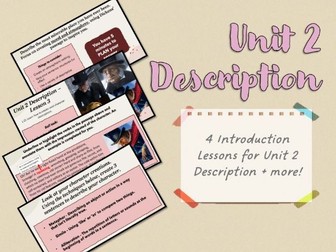
This resource include four introductory lessons for the Unit 2: Description, Narration and Exposition aspect of the WJEC English Language paper. Although intended for KS4, these lessosn can also be used to enhance descriptive skills among KS3 students as well.
It includes:
How to include more ambitious word classes to achieve outstanding grades.
Varying sentence structures.
Incorporating literary devices into writing.
How to create an effective sense of mood and atmosphere.
Analysis of different literary characters.
Kahoot! Quiz in ‘notes’
An ‘Introduction to Descriptive Writing’ task that can be used as cover work or independent research.
This is a quick workshop designed to be used as recap/revision for when the exam draws near. It can be used as a full lesson and it can but altered to suit any exam board.
This session looks at high and low level language features which can be used in the creative writing task of paper 1 of the WJEC GCSE English exam board. It is a quick paced lesson which uses Donald Trump, images of an eccentric looking man and a John Oliver Clip to help inspire the students. Be advised that the John Oliver clip does use swear words and may be unsuitable for some learners. However as I work with 16+ and adults, this clip works very well in getting teaching metaphors and similes. The main task is to complete a descriptive writing task and a peer marking assessment. You may wish to cut this out or use an alternative.
Please be aware that the TES preview does distort the look of the resource and this is not a true reflection. Hope it helps
This resource details 54 common mistakes at GCSE in reading and listening papers, as documented by the WJEC GCSE Examiners' Reports. Students work in pairs to translate the key vocabulary.
An excellent resource to prepare students immediately before their exam.
A wide range of writing tasks (all 4 styles of tasks) just like in the WJEC exams - they are all sorted into the GCSE topic areas … over 80 pages. Can be used like individual worksheets or printed out as a booklet to prepare students for writing.
This is an example of a 'Description' for the new WJEC English Language GCSE - Unit 2 Section B. Because the difference between a 'description' and 'narration' is difficult to gauge with the new definitions given, I wrote this piece so students could see a model. It has helped my students to realise the difference and to give them a model to aspire towards.
A PDF full of key phrases to help students with the photocard aspect of the GCSE Spanish speaking exam. Includes people, action, location, mood, weather, clothes, key tips & specific timings for AQA, Edexcel & WJEC.
WJEC GCSE Critical Essay: Critical Essay Question:
Many plays and poems are concerned with the relationship between men and women. Choose a relationship in a Shakespeare play you have studied and compare it with the way Play: Shakespeare’s Hamlet.
Poem: Robert Browning’s Porphyria’s Lover
The essay is around 3500 words in length.
An Excel spreadsheet of Hamlet key quotes with columns for students to fill in notes about techniques used/their analysis of the quotes. Useful as a homework exercise.
Sample critical essay on Hamlet. Approx. 750 words.
Three Hamlet essay questions which may be assigned to students.
23 page Word document with summary notes, key quotes, analysis, discussion questions and suggested activities.
1 page Word document providing a summary of the background to Hamlet. Useful as a student handout.
I have always used cheat sheets as a form of revision for my students sitting GCSE. It is essentially an extended version of an exam plan but not quite a mock exam, it’s some where in the middle. I love to use these because it promotes a sense of confidence for the students and it it a condensed version of EVERYTHING they need to know about each question of the exam. I explain it to them as an “exam blueprint”. This session is what I call a “meat and potato” type of lesson. No frills just does what it says on the tin and gives the students what they need. The session puts students into teams and takes them through a breakdown of each exam question and they copy these “cheats” onto a past exam paper. Along the way they try their hand at some of the questions, get examples of what makes a good answer and they have some independent study questions in their cheat sheet to try at home. They get to keep their “cheat sheet” for revision purposes. This has always worked and I have found that students have always got on board with this idea because they instantly see the benefit of it and it helps them feel more secure about sitting their exam. This session comes with a full powerpoint for paper 2 and student handouts with source material. Please keep in mind that TES preview can distort the look of resources but this is not a true reflection. Hope it helps
This resource was designed for a post-16 resit group - those learners who had achieved a D grade in their previous attempts at the qualification. In designing these resources, we are looking to build on existing knowledge rather than reinvent the wheel. By this, I mean that we assume a pre-existing level of understanding and are looking to bring learners up to the next level so that they might achieve in their resit attempt.
This resource recaps information that would have been inputted in years 10 and 11 and seeks to give students ownership so that they can augment and develop the skills required without relying too much on the teacher’s help.
This is a complete mock exam for paper 1 of the WJEC GCSE English exam. The extract is taken from To Kill a Mockingbird. The resource uses the formal layout of the exam with extract as separate. There are two videos which you may wish to use as warm up with your students. One is the blu-ray trailer for the movie and second is a break down of the story by Thug Notes. Please note that Thug Notes does contain some mild use of language and adult themes, as I work with 16+ and adults, this is fine for me to use but you may wish to use the trailer or an alternative. Be advised that TES preview does distort the view of the resource and this is not a true reflection. Hope it helps.
This is a mini workshop session which focuses on how to use sentence structures for effect for the creative writing section of paper 1 of the WJEC GCSE English exam. This lesson is designed for revision sessions as the exam draws close but can be developed further or used with another exam board.
This session uses Donald Trump for inspiration in how to use interesting sentences to describe. It also recaps high and low level language features. It is a fast paced session with paired activities and a main writing task taken from a practice paper. It ends with a self assessment plenary.
Be advised that the TES preview does distort the look of the resource and this is not a true reflection. Hope it helps
This is a bundle pack for the GCSE English language paper from the WJEC exam board. This bundle contains 2 mock papers, 1 for each component, Cheat sheets (with lesson) for each component and creative writing lessons. There are 8 complete lessons all together. All resources sold separately would cost a total of £24. I’m selling this bundle at £20 . Hope it helps