Lesson suited to KS3 on your, you're, their, there and there. Common mistakes. Literacy skills. Million pound drop and you say we pay activities on homophones.
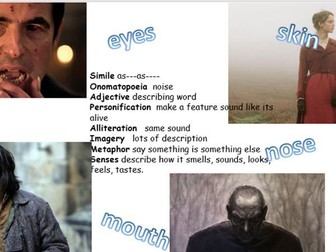
Lesson and PowerPoint for Carol Ann Duffy's poem Medusa. Poetry analysis. Metaphors and other poetic devices. Success criteria and PEE scaffold. AF&'s included.
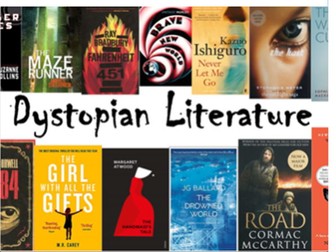
Journey through time to explore some futuristic extracts whilst developng creative and narrative writing!
Explore:
Government control
Environmental destruction
Technology and technological control
Survival
Loss of individualism
A scheme of work comprising of 23 lessons, aimed at KS3, made for year 7 but would work for 8 or 9 and adapted for KS4. It introduces the Dystopian genre with a look at its history, exploring various extracts. Each lesson is 70 minutes in length. WAGOLL exemplar answers provided.
Booklet: 28 pages of booklet to be printed and given to students. The booklet has a SPAG starter for each lesson, linked to the Dystopian topic. There are copies of each text used in extract form and tasks to do such as cmpleting the table/ Frayer model/ story mountain. There is also a full knowledge orgainser with key terminology, context and facts at the back.
Reading: There are reading tasks, exploring Utopia, The Time Machine, Lord of the Flies, 1984, The Hunger Games, Klara and The Machine, Oryx and Crake, There are inference and analysis tasks. PEI and PEA. Strong women and feminism in dystopia,
Writing: synonym and vocabulary improvement, ISPACED openers, SOAP AIMS devices, writing in an author’s style, creating Overviews and Zooms in descriptive writing, narrative structures, plot development. Review writing.
Oracy: discussions, debates, talk trios, presentations, conversation starters, building a vocal repertoire, speeches, instigate-probe-challenge, Speaking and Listening, role-play, freeze-frames.
Assessment: Two Formative assessments- one Reading an extract of The Handmaid’s Tale and analysing it. One Writing assessment- using an image as stimuli for a description. They have markscheme/ success criteria on them for marking, suitable for Peer/Self or teacher assessment and Learner Responses/ improvements.
A KS3 complete scheme of work based on Manon Steffan Ros’s dystopian novel The Blue Book of Nebo. A modern dystopian story with a dual narrative from the perspective of a mother and son, surviving in a post-apocalyptic world with no electricity, running water and few humans.
It comprises of 22 70 minute lessons, with SPAG starters, a scheme overview, a booklet with key texts and two formative assessments. Fully resourced PowerPoints/ slides.
Opportunities for live modelling and exemplars, scaffolding student responses, WAGOLL, differentiated challenges and clear success criteria.
Reading: Comprehensions, inference, analysis, dystopian genre, post-apocalptic features, dual narratives, structure, symbolism, women in dystpian fiction, real-life survival: Chernobyl, Covid-19, different reading techniques and strategies.
Writing: Creative descriptions, narrative structure, synonyms and vocabulary development, writing from different perspectives, writing to review, OZZZO- overviews and zooms, story mountain plot structure, diary entry, foreshadowing, pathetic fallacy and free-writing.
Assessment: Peer/ self- assessment, success criteria, two formative assessments- one reading and analysing a key extract, the other writing thir own creative description opening with an image as stimulus. Learner Response and improvements, clear markscheme/ success criteria for teachers.
Oracy: Talk Trios, debates, role-plays, speaking-and-listening, discussions, Talk Detectives, freeze-frames, developing vocal repertoire, instigate-clarify-probe and sentence stems.
A Level Year 13 Spoken Language analysis with Lakoff and Grice's theories applied to Not in the 9 O'Clock News comedy transcript. PowerPoint presentation of whole lesson with SOLO taxonomy objectives and AfL throughout. Flouting and violating maxims application. Model answers and example WAGOLL with Success Criteria. Transcript provided with full essay answer.
Explaining jokes and why they are linguistically funny- pun/ irony/ sarcasm/ juxtaposition/ tone.
Drawing on your knowledge of the frameworks of language study, analyse and discuss the spoken language of this text as an example of comedy. (40 marks)
Made for WJEC LG4 spec- could be adapted for new WJEC Component 1.
English Language, creative writing, overviews, zooms, model examples. Picture/ image stimuli and descriptive writing tasks. Colour synonyms. Suitable for KS3 or KS4. AQA descritpive writing. WAGOLL.
Three long lessons.
Overview, zoom structure for descriptions.
ISPACED outstanding openers for sentence variation.
Group work, discussion/ debate activity. Students select 10 individuals from a list to create a new planet, taking into consideration age, gender, race, job, skills etc.
Novel study as a springboard for learning narrative structure through investigation of plot, character development and language use. The horror/ thriller genre provides a stimulating text for exploration.
There should be a balance of the tripartite strands Reading, Writing and Speaking and Listening to enable development in each area.
Activities include group discussion, role play, PEE paragraph writing, character studies, language analysis, debate, predicting, diary writing and creative description.
WJEC LG1 Section B Sentence Structure; simple, compound and complex.
Unseen text analysis. Writers attitude conveyed. Exam preparation using fun, modern article.
AS Level English Language