A murder has been committed! There are 32 suspects, and one of them is guilty. Using your powers of deduction, can you crack each of the five coded clues to reveal the identity of the killer?
ANSWERS & TIPS INCLUDED
The Original TES Murder Mystery!
NEW!! Excel Spreadsheets for the effect Total Disbelief.
A collection of mathematical magic tricks for teachers. Particularly suitable for KS3 but also popular with older children. Each trick gives an anecdotal account of the effect being used in the classroom, followed by the explanation and teaching points if used for further work. Appendix includes details of simple sleights such as coin vanishes etc.
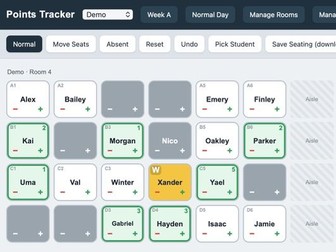
A seating plan shows your students’ first names. Tap a name to award positive or negative points during the lesson. At the end of the lesson, save the log to the daily record; at the end of the day, download that record for filing.
Set up
Store the HTML file in OneDrive, open it in your browser, and bookmark it. Closing the tab mid-lesson deletes that lesson’s data, so always click End Lesson first. Keep the app open in a tab and switch away when needed.
Manage Rooms
Create a classroom layout for each room. Each grid square can be a desk, aisle, or unused space. Desks use Battleship-style references: rows A, B, C etc. and columns 1, 2, 3 etc.
Manage Classes
Add each class and select its room, for example: 11A1 Room 4 or 8A3 Room 13.
Manage Timetable
Choose a one- or two-week timetable, enter lesson start times, then complete each day using the drop-downs. The app anticipates the current seating plan, with a manual override. You can also add an alternative timetable, such as for exam season.
Seating Plan
Import a CSV with: Class,Seat,Firstname,Lastname. Create it in Excel with these four columns, then export as CSV. The app flags errors, such as students assigned to seats outside the room layout.
Manual adjustments
Fine-tune names under Manage Classes—for example, display Benedict as Benny, or distinguish Hannah F and Hannah T. You can also edit class names and room layouts.
Move Seats
Click Move Seats. Select a student, then an empty desk to move them; select another student to swap seats. Select an empty desk first to add a new student. Click Save Seating to download the updated CSV, then Normal to exit.
Absent Students
Click Absent, then tap absent students. They are greyed out and excluded from random selection and behaviour points. Tap again to restore them, then click Normal to exit.
Behaviour
Use the +/− beneath each name to award positive points or sanctions independently. Sanctions progress through Warn, Move, and Remove; customise these labels in Settings. The app logs the time of every point. Use Undo to reverse actions, or Reset then select a student to erase their lesson points.
Pick Student
Choose a student at random, instantly or with animation. The app slightly favours students with sanctions, giving them a chance to redeem themselves.
End Lesson
Tap End Lesson to save the lesson’s points to the daily log.
Daily Report
At the end of the day, tap Daily Report to download a summary of every student’s points, ready to transfer into your school system.
Generate unlimited, fully customisable calculator-skills worksheets with matching answer sheets - pick your topics and export a ready PDF.
Built to give students real, varied practice with the exact calculator skills that come up again and again on Foundation and Higher exam papers - not just “type this in,” but the full range of button presses examiners actually test.
QUESTION TYPES (mix and match any combination):
The four rules (+, -, x, ÷), with an integer-answers-only option
Brackets and order of operations
Fractions and mixed numbers, including “find the fraction of an amount”
Fraction expressions - a calculation in the numerator AND denominator, testing correct use of the fraction and bracket buttons
Percentages - “X% of N”, “A out of B as a percentage”, and percentage increase/decrease
Roots - square roots plus optional cube and higher roots, including roots of a calculation
Exponents - squares plus optional cubes and higher powers
Fractional roots and indices (e.g. 64^(1/3))
Pi in real-life formulas: circle area/circumference, cone/cylinder and sphere volume
Trigonometry (sin/cos/tan in degrees), logs (base 10 and ln), reciprocals, and factorials
ANSWER FORMAT:
Choose one rounding rule for the whole sheet - exact calculator display, a set number of decimal places, or significant figures - and the instruction line updates automatically to match.
WORKSHEET OPTIONS:
Any number of questions, laid out in a self-balancing two-column PDF
Optional matching answer sheet
Optional name/date/title header
A fun extra: a random joke or quote at the bottom of the page (PDF only), with your own editable, expandable library and CSV import
WHY TEACHERS WILL LIKE IT:
Fully offline once opened - no installation, no accounts, no internet needed
GDPR-friendly - nothing a pupil types or produces is ever uploaded anywhere
Genuinely randomised every time, so no two printouts are ever identical - ideal for cover work, revision homework, or exam-season drilling without answers being passed around
Works in any modern browser, on any device
Scales from a five-question warm-up to a full revision booklet
Ideal for KS3 and KS4 maths classes, calculator-skills starters, homework, and GCSE Foundation/Higher revision.
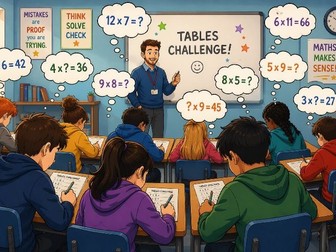
A self-checking times-tables puzzle grid that runs entirely offline in the browser — no installs, no accounts, and no pupil data ever leaves the device.
Choose any combination of tables from 0 to 16, or use the built-in preset buttons to step pupils through a structured progression: Foundation (0, 1, 2, 5, 10) → Build-up (+3, 4) → Patterns (+6, 9, 11) → Complete to 12 (+7, 8, 12) → Advanced to 16 (+13–16).
Live Play
Every puzzle is checked by a logic solver before it’s shown, so even the hardest grid — with several missing row and column headers — is always solvable by step-by-step reasoning, never guesswork. Pupils type answers directly into the grid and get instant right/wrong feedback, with a celebratory animation on completion; an on-screen timer supports timed practice.
Worksheet Mode
For worksheets, switch to Teacher mode to generate print-ready PDF puzzle packs (single-difficulty sets or a full five-level pack), with 1, 2 or 4 puzzles per page and optional answer key pages.
Installation
Works on any device with a modern browser — desktop, laptop, Chromebook, or tablet. No sign-up, no server, no data collection: everything runs locally in the pupil’s own browser tab.
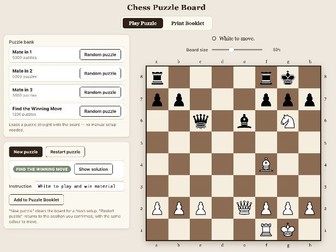
An offline, in-browser chess trainer with 14,000+ built-in Mate-in-1/2/3 and tactics puzzles, plus a one-click booklet builder and PDF printer.
PLAY:
Set up any position by pasting a FEN (standardised code for a chess diagram) or by placing pieces by hand, then play it out on the board with full legal-move checking (castling, en passant, promotion, check and checkmate detection included). Or skip straight to the built-in Puzzle Bank — 5,000 Mate in One, 5,000 Mate in Two, 3,500 Mate in Three, and 1,200 Find the Winning Move puzzles (14,700 in total), each loadable at random with one click, with a “Show solution” reveal when you’re ready. Puzzles are deliberately aimed at beginner and intermediate players, as typical for a school club.
BUILD A BOOKLET:
Tell the app how many of each puzzle type you want (e.g. 8 Mate in 1, 6 Mate in 2, 1 Mate in 3, 1 Find the Winning Move) and it randomly assembles them straight into a booklet, skipping anything already added so nothing repeats. A single toggle controls whether an answer key prints at the end.
PRINT BOOKLET:
Turn any set of puzzles — built-in, hand-set-up, or a mix — into a ready-to-hand-out PDF worksheet. Choose A4 or A5, 1/2/4 puzzles per page, with or without a full answer-key page at the back, numbered to match. Puzzles you solve or set up yourself on the board can be added to the booklet in one click too, so your own classroom puzzles sit alongside the built-in bank.
Fully offline once opened — everything runs in the browser with no installation, and no pupil data ever leaves the device or is uploaded anywhere. Suitable for whole-class teaching, chess club sessions, or independent practice.
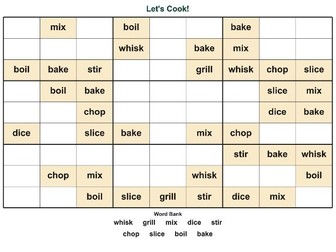
Turn any 9 words, symbols or emoji into a print-ready Sudoku - ideal for vocab, music notation, Christmas symbols or any topic. Includes answer key.
Paste in any 9 words, phrases, symbols or emoji, and this tool instantly builds a complete Sudoku puzzle using them in place of the numbers 1–9 — then generates a polished, ready-to-print worksheet.
Works for any subject.
Modern Foreign Languages: vocabulary, tenses, key phrases
Music: notation, dynamics, tempo markings — even music symbol fonts render beautifully
Seasonal: Christmas, Easter, or topic-themed emoji puzzles
Any subject with 9 key terms, symbols or images pupils need to learn
Built for the classroom, not number-scanning
Word Sudokus are naturally harder to solve than number Sudokus, since pupils can’t pattern-scan digits — so puzzles are generated at Very Easy or Easy difficulty, keeping the focus on vocabulary recall rather than logic-puzzle difficulty.
Two worksheet styles
Square grid — the classic Sudoku look
Relaxed Fit — a wider landscape layout with larger, more legible text and generous space in every cell for pupils to write their answers by hand. Great for accessibility and younger pupils.
Every worksheet includes
An editable title, so you can rename it for each class or topic
The puzzle grid with a word bank reference underneath
A second page with the full answer key, automatically generated
Play on screen or print
Pupils can solve the puzzle interactively in the browser (click a cell, then click a word to fill it in), check their answers, reveal the solution, or generate a brand new puzzle from the same 9 words for extra practice.
Simple and safe to use
Runs entirely offline in the browser once opened — no installation, no accounts, no login
Fully GDPR-compliant: no pupil data is ever uploaded or transmitted anywhere
Works across any topic, any language, any symbol set your keyboard (or emoji picker) can produce
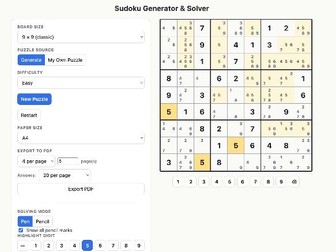
A complete offline Sudoku toolkit: generate genuinely graded 6×6 / 9×9 puzzles, solve on-screen, or export print-ready worksheet and answer PDFs
This self-contained, browser-based app covers the whole Sudoku workflow in one place. Generate puzzles at four real difficulty levels — rated by an actual logic-technique solver, not just clue count — or type in your own puzzle from any source and let the app validate it and work out the answer for you.
Pupils can solve directly on-screen with pen and pencil-mark modes, auto-seeded candidates, instant mistake feedback, digit highlighting, an optional reveal system, and a pausable timer. When you’re ready to print, export beautifully laid-out PDF worksheets — 1, 2, 4 or 6 puzzles per page, in A4 or A5, across any number of pages — with an optional compact answer booklet appended at the back.
Runs entirely offline after opening, with no installation, no login, and no pupil data ever uploaded anywhere — fully GDPR-compliant for classroom use.
Suitable across KS2–KS4 for starters, independent practice, differentiation, or full puzzle booklets, and versatile enough for maths, form time, or enrichment sessions.
Turn any message into a printable secret-code worksheet in seconds — 12 cipher levels from simple word shuffles right up to genuine RSA encryption.
Codemaker is a single self-contained HTML tool — no installation, no accounts, and no internet needed once it’s open — that turns any typed message into a coded worksheet at the click of a button. Twelve age-graded levels are built in: six transposition ciphers (Word Shuffle, Anagrams, Block Flip, Rectangle, Rail Fence, Keyed Columns) and six substitution ciphers (Reverse Alphabet/Atbash, Caesar Shift with a printable cipher wheel, Keyword Substitution, Vigenère, a Hill Cipher with matrix arithmetic mod 25, and a fully guided Simplified RSA level using genuine public-key cryptography with small, calculator-friendly numbers).
Every level generates a print-ready 3-part PDF automatically: Part 1 is the coded message, Part 2 is a fully worked step-by-step decoding worksheet (grids, cipher wheels, letter wheels or working boxes, depending on the level), and Part 3 is an answer sheet for quick marking. Export to A4, US Letter, or 6×9 for booklet-style printing.
Great for creating maths starters and plenaries, cryptography enrichment days, “murder mystery” challenges, Maths club puzzles, escape-room-style lessons, primary school transition events, riddles with coded answers, or cross-curricular links with computing — scaling all the way from a five-minute Year 5 warm-up to genuine RSA encryption for your top set or A-level Computer Science students.
The Detail
Word shuffle - just changes the order of the words
Anagrams - an anagram of each word in turn
Block flip - reverses the order of each block of (for example) 3 letters at a time and chunks the output into fixed length ‘words’
Rectangle - writes the message into the rectangle one way (across) and then reads them out the other way (downwards). The rectangle shape is customisable
Rail Fence - the classic shape-based zig-zag mix up
Keyed columns - Like Rectangle but the columns are read in a special order given by the keyword
Reverse Alphabet / Atbash - each letter is replaced by its partner in the reversed alphabet
Caesar shift - The alphabet is ‘wrapped round’ by a shift of n letters
Keyword substitution - the keyword determines the order of the substitution alphabet
The classic Vigenère Cipher - each letter has its own lookup table determined by the keyword and its position in the message
Hill Cipher - The step-by-step decoding sheet assumes no knowledge of matrix multiplication (by a (2x2) matrix) and explains it clearly, but the app also offers a tool for doing this. Very carefully guided to maximise success.
Simplified RSA using much smaller numbers
Installation
Runs entirely in the browser with no pupil data ever entered, stored, or uploaded anywhere — fully GDPR-compliant and safe on any school network. Works completely offline once opened. Full setup and troubleshooting guide included.
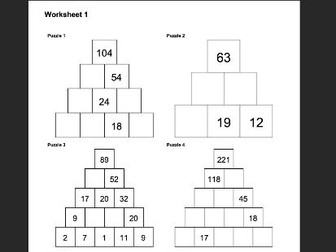
Generate arithmetic pyramid worksheets with genuinely unique solutions, four difficulty levels, and one-click PDF export for puzzles and matching answers.
Each brick equals the sum of the two below it — pupils work backwards from the clues you choose to show. Four difficulty tiers (Easy through Very Hard)
The app uses genuine linear-algebra rank-testing to guarantee a unique solution, not just “probably fine.”
Five puzzle styles: standard integers, negative numbers, decimals, fractions, and two algebra modes (solve for x, or simultaneous equations in x and y).
Bulk-generate whole worksheet packs with matching answer booklets, both exported as print-ready A4 PDFs.
Fully offline once opened — runs in any browser, no installation, no account, no pupil data ever leaves the device.
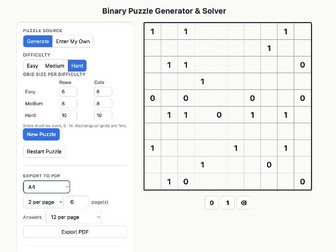
Generate, solve, and print Binary Puzzles (0s and 1s / Takuzu) at any size from 6x6 to 14x14, with three difficulty levels and full on-screen solving tools.
Every row and column must end up with an equal number of 0s and 1s, no run of three identical digits is allowed, and no two rows or columns may match — this tool generates, checks, and helps solve exactly that puzzle.
Key features
• Three genuine difficulty levels — Easy, Medium and Hard are defined by the logical technique needed to solve them, not just by how many clues are missing. Hard puzzles specifically require spotting the “matching row/column” trap, so they stay satisfying rather than just fiddly.
• Any grid size from 6×6 up to 14×14, including rectangular grids (e.g. 8×12) — set a different size for each difficulty level, ideal for differentiation across a class.
• Every generated puzzle is computer-verified to have exactly one solution — no dead ends, no guessing required.
• Full on-screen solving tools: click or use the number pad/keyboard to fill cells, live rule-conflict highlighting, a Reveal option (single cell, row, column, or the whole solution), and a Hint button that highlights the next logical cell to fill in — without ever giving away the digit.
• “Enter Your Own” mode — type in any Binary Puzzle from a book or magazine. The tool checks it has a unique solution, then offers the same hints and reveal tools to help you solve it.
• Print-ready PDF export — choose A4 or A5, 1, 2, 4 or 6 puzzles per page, any number of pages, with optional reduced-size answer pages at the back for booklet-style printing.
• Fully offline once opened — runs entirely in the browser with no installation and no accounts.
• GDPR-friendly by design — nothing a pupil types or generates is ever uploaded anywhere; everything stays on the device.
• A flexible extra for logical-reasoning and computational-thinking activities, puzzle clubs, or simply a well-designed maths starter or filler — as useful for take-home practice as for a projected classroom activity.
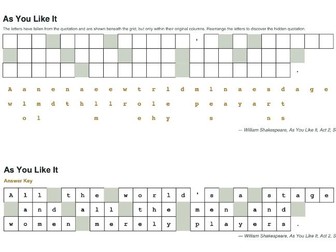
Turn any quotation into an instant, self-marking puzzle — solve on screen or print as a worksheet. 100% offline. No pupil data collected.
Type in any quote, proverb, verse, or exam-style stimulus — a spelling rule, a subject-specific definition, anything up to 150 characters. Every space and punctuation mark stays fixed; every letter falls out of its square and scrambles below its own column. Pupils reconstruct the original by working out which letter goes where.
Three ways to use it, all in one file:
Solve on screen — tap or drag letters into place (works with mouse, touch, or keyboard), check answers with one click, and get instant right/wrong feedback without giving the game away.
Print-ready worksheets — export a two-page PDF (puzzle + answer key) in A4, sized and laid out automatically so it always fits on one page, however long the quote.
Preview mode — a clean static view for planning or display, no interactivity needed.
Built for real classroom use:
Auto-generates a sensible grid size for any quote, and wraps text at word boundaries by default so words are never awkwardly split across rows (with an option to pack rows tightly if you prefer).
Optional, toggleable instructions text and source attribution (Author/Speaker and Book/Reference/Occasion) — perfect for crediting quotes properly without cluttering simpler puzzles.
Editable title, adjustable cell size and font size, and a seed option so you can regenerate an identical puzzle later or share the exact same version with a colleague.
Works for any subject — literary quotations, historical speeches, scientific definitions, foreign vocabulary, spelling lists, or anything else that’s really just “a string of characters to reconstruct.”
Safe and self-contained:
Runs entirely offline in the browser once opened — no installation, no internet connection, and no pupil data is ever collected, stored, or sent anywhere. Ideal for shared drives, VLEs, or school networks with restricted permissions.
See the included Setup Guide for opening instructions, and the Files List for exactly what’s in this download.
A fast 2-player matching race for any topic. Type your own words, emoji, or pictures — the app builds and prints out the whole tile set automatically.
Match Two is a self-contained, offline HTML app for the interactive whiteboard. Enter any list of words for your topic and it builds a full set of matching tiles using the same combinatorial principle behind Dobble/Spot It — any two tiles always share exactly one match. Two players race to spot and tap it first.
Words can be plain text, emoji, or your own pictures, and can be entered as translation pairs (bonjour = hello) for MFL practice. Choose circular or square tiles and one of three tile layouts, then either play on screen or print the entire set as a ready-to-cut PDF for a physical, screen-free version of the game.
Runs entirely offline in the browser with no installation and no data collection of any kind — nothing here needs an internet connection, a login, or ever touches pupil data.
Technical note: picture tiles & local images
If you use the optional picture-tile feature — naming a tile object after an image file, e.g. koala.jpg — the app needs to load that file from an “images” folder placed next to the .html file.
Most browsers, Chrome in particular, block a web page from loading local files like this when the page has simply been double-clicked open. This is a browser security restriction, not a fault in the app, and it cannot be switched off from within the app.
In practice:
• Plain word tiles and emoji tiles will always work, however the file is opened.
• Picture tiles are likely to work if the app is opened from a network location or web address using Right-click “open in browser” — for example, hosted on a school intranet or server — because that counts as the page being “served” rather than opened directly.
• Picture tiles may fail silently (the tile simply appears blank, rather than the app crashing) if the file is opened by double-clicking it directly from a folder, which is the most common way of opening these files.
If picture tiles don’t appear, try opening the folder through a simple local web server instead of double-clicking the file directly. Please test this on your own school’s setup before relying on it for a lesson — it depends on your browser and network, not on this app.
Recommended image file types: JPG or PNG — both are supported directly. JPG keeps file sizes (and the printed PDF) smaller and is the better choice for ordinary photographs; use PNG only if you specifically need transparency. GIF and WEBP files will display on screen but are not recommended for the printable PDF version.
Wordsearch Maker
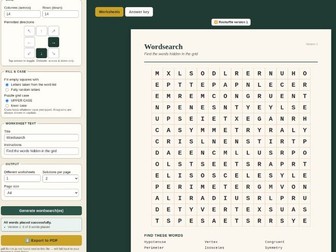
Turn any word list into a printable wordsearch in seconds — with clue, anagram, or find-the-word modes, and instant PDF export for a full class set.
Paste in any list of words (with or without your own clues) and this tool builds a complete wordsearch worksheet around it — for any subject, any key stage.
✔ Three puzzle styles: find the words directly, solve a clue for each word, or unscramble an anagram
✔ Choose your grid size and which of the 8 directions words can run in — across and down only for an easier puzzle, or add diagonals and backwards words for a harder one
✔ Generate several different worksheets from the same word list in one click — perfect for a class set where you don’t want pupils copying a neighbour’s answers
✔ Answer key included automatically, with every word circled
✔ Exports straight to a print-ready PDF (A4 or A5)
✔ Runs completely offline in the browser once opened — no installation, no accounts, and no pupil data is ever uploaded anywhere (GDPR-friendly by design)
✔ Works on Windows, Mac, Chromebook and iPad
A generic Setup & Troubleshooting Guide and an app-specific Files List are included — please read these before use, they explain the (very quick) one-off step of renaming the downloaded files.
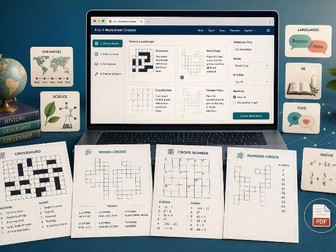
Criss-Cross Puzzle Maker: 4-in-1 Generator
Four puzzle generators in one: Crossword, Word-Cross, CrossNumber and Number-Cross, with instant print-ready PDF worksheets and answers.
Give it a list of words or numbers (with optional clues) and this single tool builds a genuine interlocking puzzle grid automatically — no manual grid design needed — then lets you choose how it’s presented:
• Crossword — numbered grid with full clues and letter counts
• Word-Cross — the same grid with a word bank (grouped by length) instead of clues
• CrossNumber — clues written as LaTeX calculations, properly typeset in both the on-screen preview and the exported PDF
• Number-Cross — a numeric grid with a number bank grouped by digit count
That flexibility means one tool covers Maths (times tables, algebra, arithmetic — LaTeX rendering handles fractions, powers, roots and more), Literacy and MFL vocabulary, Science and Geography key terms, and any subject where you want pupils fitting words or numbers into a grid.
Designed by a teacher for teachers, and built for real classroom use, not just a demo:
• Generate multiple different puzzle variations from the same word list in one go, for different classes or to deter copying
• For Word-Cross and Number-Cross, the app checks that the word/number bank fits the blank grid in only one way, so pupils can’t get “stuck” on a genuinely ambiguous puzzle
• Full control over title, instructions, page size (A4 or A5), and number of puzzles per PDF
• Answers as a solved-grid image or as an Across/Down list, with control over how many fit on a page
• Three blocked-cell background options (black, grey or white) to suit your photocopier budget, plus an optional bold outline so the puzzle shape stays clear even on a plain white background
Runs entirely in your browser — open the file and it works immediately, with no installation, no sign-in, and no account. It works completely offline once open, and nothing you or your pupils type is ever uploaded anywhere, so there’s no pupil data to worry about from a GDPR perspective. Works on any school laptop, Chromebook or tablet with a modern browser.
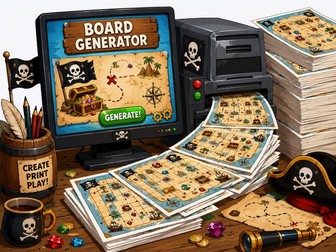
Load this app in any browser, then with a single click generate a new set of 32 pre-filled Pirate Game sheets for saving as a pdf, with one sheet per A4 page.
Supplied as .txt
Just change the extension to .html and run it in your browser.
Students absolutely love the Pirate Game, but one of the few drawbacks is the time taken for everyone to fill in their grid before the action can begin. For some classes, particularly younger pupils or slower writers, this can take several minutes and eat into valuable lesson time.
These easily-generated game boards remove that problem completely. Simply print, hand out, and start playing.
Included on each board are:
A fully completed 7×7 Pirate Game grid -no duplicates
Clearly labelled coordinates
A quick-reference key for all special squares
A points-recording area
Shield and Mirror tracking boxes
A Bank box for students to record their final banked score
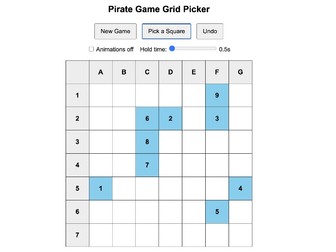
This grid picker clearly choose squares from the 7 x 7 grid when playing The Pirate Game. At any point, a square may be chosen by a player, and then the randomiser continues with the remaining ones.
There is a flash animation showing which square was selected, big enough to be seen across the room. Each square is also numbered to keep track of the order in which they were picked.
Supplied as .txt
just save it as .html and then you can run it in your browser. No software installation required.
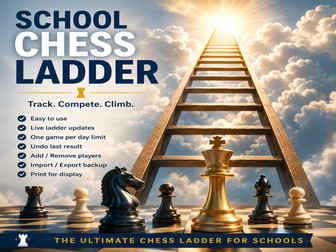
A complete browser-based Chess Ladder system for schools with CSV import, easy match entry, printable ladder display, and teacher-password protected admin.
No accounts, no databases, no subscriptions.
This browser-based Chess Ladder has been designed specifically for school Chess Clubs and enrichment sessions. It runs entirely from a single HTML file, meaning no installation, no internet connection, and no student data ever leaves the school computer.
Ideal for:
Lunchtime Chess Clubs
House competitions
Enrichment programmes
Inter-form tournaments
Library or Games Room activities
Features
Supports up to 100 players
Smart ladder movement rules
One-click match recording
Auto-complete player selection
Daily game limit protection
Undo last result
Match history
Player statistics
Teacher-password protected admin controls
Add/remove players easily
CSV bulk import for initial setup
Export/import backups
Clean printable wall-display format
Fully offline and GDPR-friendly
The ladder updates instantly after every game, giving students immediate feedback and strong motivation to climb the rankings.
Because everything is stored locally in the browser, there are:
no subscriptions,
no logins,
no cloud accounts,
and no safeguarding concerns around online student data.
The system has been tested in a real school Chess Club environment over several months.
At only £2, this is a simple, low-cost way to add structure, competition and excitement to a school chess programme.
WHY BUY THIS?
For many schools, organising a Chess Ladder becomes surprisingly time-consuming:
paper charts become messy,
rankings become disputed,
pupils forget results,
and spreadsheets are awkward to update live.
This system solves all of that with a simple interface students can use themselves while still giving teachers full control.
For £2, schools receive:
a complete ready-to-run system,
no setup headaches,
no ongoing costs,
and something students genuinely enjoy using.
One lunchtime of improved organisation easily justifies the cost.
Designed by a practising teacher for real school Chess Clubs.
NEW: Some users seem to be having difficulty opening this large file. It is a text file. The first line has '3.' The second line begins '14159...' as expected. There is no 3.014159 as some claim :-)
A large text file consisting simply of the first million digits of Pi. The digits are arranged in rows of 50 digits per row, beginning with the 1 after the decimal point. You’ll be delighted to know that the millionth decimal place is a 1 as well.
A sketch that could be used with KS3 to present issues related to personal hygiene in a humorous way. There are four contestants, and the 'Weakest Stink' (the cleanest) is eliminated at the end of each of three rounds, leaving one repulsively smelly champion.
Simple staging could involve a music stand or similar to hold each contestant's script and this could be decorated with the programme's logo (design your own!) at the front. Written for female quizmaster and four male contestants but contestants 2 and 3 could easily be girls Duration about 5-6 minutes.
My entire collection of Pi Day goodies, covering 20+ years of running Pi Days and Pi Clubs in schools. The biggest collection of Pi Resources on TES!
1. Computer Science Folder
Four Python projects using different methods to find digits of Pi by experiment or calculation. Python code included.
2. Digits of Pi
More digits of Pi than you could ever need, including a special sheet of Pi to One Place for those who like to keep the memory work simple! Multiple pdf files ideal for printing, and plain text files ideal for analysis. Includes a secret link to download a Pi file so big I can’t even describe it here!
3. English and MFL
Find out about “Piphilology”, “Pi-lish” and “Pi-kus” as Language and Pi overlap to create wonderful poetry and prose. Includes ‘Beauty’ - digits of Pi recounted in dozens of languages from around the world.
4. Head to Head Challenge
A very tricky competition requiring knowledge of Pi digits, knowledge of the history of Pi, ability to calculate with Pi entirely without a calculator (or just guess and hope for the best!), as well as the essential ability to roll dice at speed. All questions and the interactive Excel score sheet provided for the best Pi Day showdown your school has ever seen!
5. History
Copies of two original announcements when the Pi records have been broken and announced to the world
6. Maths
Pi Trivia, A Pi Memory Sheet to hand out to students, a list of even more Pi Day ideas, and a Pi Day geometry paradox
7. Media
Copies of my TES Article on Pi Day, and a Pi Day special from NCETM
8. Pi Club Resources
Sample Material from the “Pi Mnemonicists Club” I used to run at a Prep School in the 1990s. All the resources, Newsletters, Note Paper, Badges, Booklets and Certificates to inspire you to run your own Pi Club
9. Pi Docs
More Pi Digit files, including Pi in Binary and Pi in Hexadecimal
10. Posters
A 29-page landscape poster to print out and run down the Maths corridor or around the Maths classroom comprising 100 digits of Pi with 5-6 digits per page; a multi-page poster displaying 1 million digits in tiny writing; ideas for other posters to promote Pi
The only thing not included is an actual pie. See your local Tesco for details.


 Quick View