A Level Mathematics - Laws of Indices ASQuick View
rhysharniess

A Level Mathematics - Laws of Indices AS

(0)
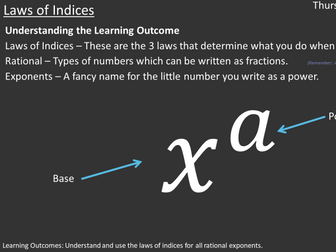
This Laws of Indices lesson enables students to understand and apply the laws of indices for all rational exponents, building on core skills developed at GCSE and extending them into A Level study. The resource begins with a focused recap of prior knowledge before developing fluency through clear explanations, worked examples, and guided practice. Learners apply key rules of indices; including multiplication, division, and powers of powers; across a range of structured tasks. The lesson culminates in a challenging exam-style problem, helping students develop problem-solving skills, mathematical reasoning, and confidence with more complex algebraic expressions.
A Level Mathematics - Surds ASQuick View
rhysharniess

A Level Mathematics - Surds AS

(0)
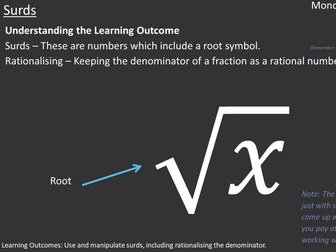
Learning Outcomes: Use and manipulate surds, including rationalising the denominator. Using skills brought from GCSE, extending those into A Level. Recap, examples, task & difficult exam style question
GCSE Stats - 01.03 Primary Secondary Data - StatisticsQuick View
rhysharniess

GCSE Stats - 01.03 Primary Secondary Data - Statistics

(0)
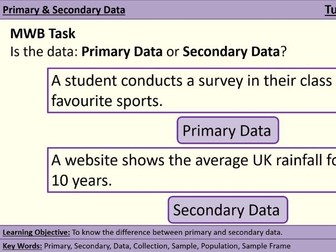
This GCSE Statistics lesson on primary and secondary data enables students to understand the differences between data types and their uses in statistical investigations. Building on prior knowledge of data classification, the lesson introduces clear definitions of primary and secondary data, alongside key concepts such as population, sample, and sampling frame. Students develop their understanding through recap activities, real-life examples, and structured tasks that explore how data is collected and interpreted. The lesson also examines the advantages and disadvantages of each data type, helping learners evaluate reliability, relevance, and potential bias. With a range of applied activities and exam-style practice, this resource supports students in developing confidence with data collection methods and statistical reasoning.
GCSE Stats - 01.06 Random Sampling - StatisticsQuick View
rhysharniess

GCSE Stats - 01.06 Random Sampling - Statistics

(0)
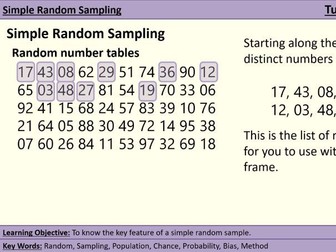
Edexcel GCSE Statistics lesson on simple random sampling and unbiased data collection methods. Students learn how to select fair and representative samples. This lesson enables students to understand the key features of simple random sampling, including how to ensure every member of a population has an equal chance of selection. Building on prior knowledge of populations and samples, learners explore how to construct and use a sampling frame, and apply practical methods such as random number tables and generators. Through recap questions, worked examples, and structured tasks, students develop fluency in selecting valid samples. The lesson also evaluates the advantages and disadvantages of random sampling, including issues of bias, practicality, and sample size. Ideal for preparing students for Edexcel GCSE Statistics exam questions involving sampling methods and data collection techniques.
GCSE Stats - 01.01 Describing Data - StatisticsQuick View
rhysharniess

GCSE Stats - 01.01 Describing Data - Statistics

(0)
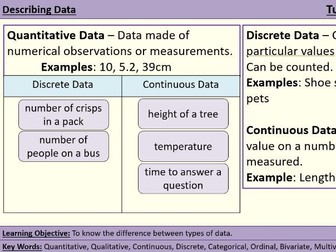
This GCSE Statistics lesson on describing data is designed to support and complement the Pearson Edexcel GCSE Statistics textbook, helping students build core statistical knowledge. The lesson covers key concepts including quantitative and qualitative data, as well as discrete and continuous variables, using engaging classification and sorting activities based on real-life examples. Students are also introduced to important data types such as categorical, ordinal, bivariate, and multivariate data, ensuring full coverage of specification content. Aligned with Edexcel exam requirements, this resource prepares learners to confidently answer exam-style questions and apply statistical terminology with accuracy.
GCSE Stats - 01.02 Grouping Data - StatisticsQuick View
rhysharniess

GCSE Stats - 01.02 Grouping Data - Statistics

(0)
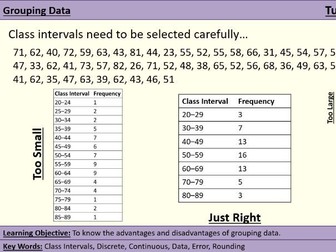
This Edexcel GCSE Statistics lesson on grouping data enables students to understand the advantages and disadvantages of grouped data, building on prior knowledge of discrete and continuous data. The lesson begins with a recap of key concepts before developing students’ ability to construct and interpret grouped frequency tables using carefully selected class intervals. Through worked examples and structured tasks, learners explore common pitfalls such as overlapping intervals, gaps, and the impact of rounding and accuracy on data classification. The lesson culminates in deeper reasoning around interval selection and real-world data contexts, helping students develop the skills needed for exam-style questions and accurate statistical analysis.
GCSE Stats - 01.04 Census & Sample - StatisticsQuick View
rhysharniess

GCSE Stats - 01.04 Census & Sample - Statistics

(0)
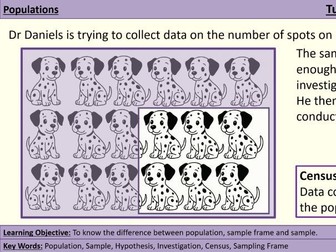
Edexcel GCSE Statistics lesson on census vs sample, population and sampling frame. Students learn when and how to use each method effectively in investigations. This lesson develops students’ understanding of population, sample, census, and sampling frame, building on prior knowledge of data collection. Through recap activities, real-life examples, and structured tasks, learners explore how and why samples are used in place of full populations. The resource highlights the advantages and disadvantages of census and sampling methods, including considerations of bias, reliability, cost, and practicality. Students also encounter key terminology such as sampling units and hypothesis, applying their knowledge to exam-style scenarios. Ideal for preparing learners to make justified decisions in Edexcel GCSE Statistics investigations and exam questions.
GCSE Stats - 01.05 Petersen Capture Recapture Method - StatisticsQuick View
rhysharniess

GCSE Stats - 01.05 Petersen Capture Recapture Method - Statistics

(0)
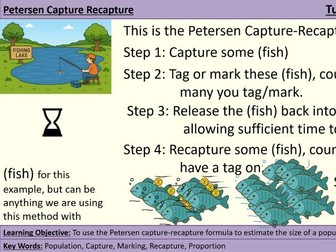
Edexcel GCSE Statistics lesson on capture‑recapture methods to estimate population size. Students learn to apply the Petersen formula in real contexts. This lesson develops students’ understanding of the Petersen capture‑recapture method, enabling them to estimate unknown population sizes using proportional reasoning. Building on prior knowledge of sampling, learners follow a step-by-step process of capture, marking, recapture, and calculation, supported by clear examples and visual representations. The lesson introduces and applies the capture‑recapture formula, before moving into structured tasks and exam-style questions to build fluency. Students also explore the assumptions of the model, including population stability and equal probability of capture, helping them evaluate the reliability of estimates. Ideal for preparing learners for Edexcel GCSE Statistics exam questions involving real-world population estimation.