Food chains and energy transfer - questionsQuick View
classleading

Food chains and energy transfer - questions

(5)
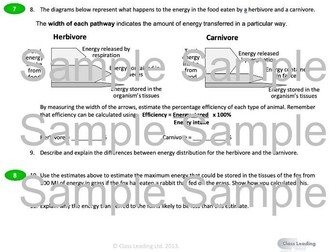
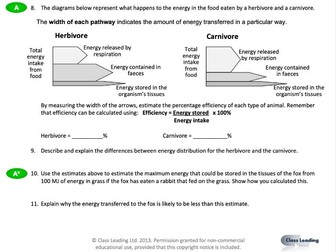
This is a worksheet based activity that includes some higher order thinking to explore the ideas around energy transfer in simple food chains. Two versions are included, one with legacy GCSE grades, the other without. (please note that grade indications are only approximate). Why not try getting learners to choose a selection of questions to answer (e.g. do Q1-4 or Q3-8) An answer sheet is included. This resource was originally designed for OCR 21st Century Science unit B3. A premium editable version of this is available at: https://www.tes.com/teaching-resource/-11858631 Keywords: energy, transfer, food chain, efficiency
Resistance of LDR & thermistor - graded questionsQuick View
classleading

Resistance of LDR & thermistor - graded questions

(5)
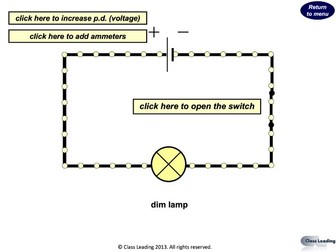
This activity contains a powerpoint with graded questions & answers and matching pupil activity sheets, designed to be used at the end of a lesson and/or the start of the next lesson to review previous learning. The questions are based on the previous OCR 21st Century Science Specification unit P5, although could be used with other exam boards. Clicking through the show reveals answers one a time. These reduce to A5 easily, the ideal size for most pupils. Please note grades are approximate.
Eating a sandwich - modelling digestionQuick View
classleading

Eating a sandwich - modelling digestion

(9)
There are two parts to this activity, one is a practical activity to model the process of digestion. The other is a powerpoint slideshow to show what happens to the food on its journey through the body. If using with KS3 then the learning outcomes on the activity plan could also include breaking up of molecules in digestion. If using with KS2 for the new curriculum, the powerpoint will include some terms/slides that you may wish to miss out, so it has been left in an editable form. Please ensure that you carry out a risk assessment before carrying out a practical activity.
The Carbon Cycle - Extracting info from a textQuick View
classleading

The Carbon Cycle - Extracting info from a text

(8)
Keywords: Carbon cycle, photosynthesis, respiration, decomposition, combustion. An activity sheet and guidance sheet (with answers highlighted) in which students extract information from a text and then use this to identify the processes in the carbon cycle and ultimately construct a diagram from these. These can then be compared to one published in a textbook to allow students to make corrections. This works exceptionally well as a peer assessed activity.
Electron structure & ionic bonding revision (editable)Quick View
classleading

Electron structure & ionic bonding revision (editable)

(0)
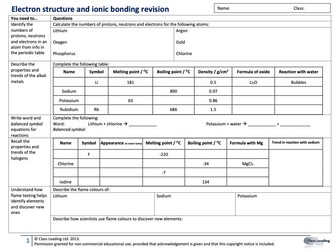
Keywords: structure, bonding, electron, energy levels, shells, orbitals, rings, periodic table, patterns. Notes: This is a revision summary sheet that has questions about structure and bonding relating to electron arrangements and ion formation. Please note that this resource was originally designed for unit C4 of OCR 21st Century Science, but is applicable to other specifications. It includes an answer sheet. A non-editable version is available for free at https://www.tes.com/teaching-resource/-6336987
Electron Structure BundleQuick View
classleading

Electron Structure Bundle

2 Resources
This bundle contains two resource: Animated electron arrangements Electron structure and ionic bonding revision (editable)
The Wave Equation - graded questionsQuick View
classleading

The Wave Equation - graded questions

(3)
This activity contains a powerpoint with graded questions & answers and matching pupil activity sheets, designed to be used at the end of a lesson and/or the start of the next lesson to review previous learning. The questions are based on OCR 21st Century Science Specification, although could be used with other exam boards. Clicking through the show reveals answers one a time. There are two slightly different activity sheets for differentiation - one has key words, the other without. These reduce to A5 easily, the ideal size for most pupils. Please note grades are approximate.
Engaging model of ionic and covalent bondingQuick View
classleading

Engaging model of ionic and covalent bonding

(4)
Keywords: bonding, model, electrons, ionic, covalent. Notes: This engaging activity makes use of very affordable and easily available ball pool balls to support whole class teaching and group work. It models what happens to the electrons during ionic and covalent bonding. Please note that this was originally published a number of years ago as part of the North Yorkshire Success for All project of which I was part and had the pleasure of working with an excellent team of teachers on resource development. Right click the web links to download the powerpoint shows.
The carbon cycle - grade questionsQuick View
classleading

The carbon cycle - grade questions

(5)
This activity contains a powerpoint with graded questions & answers and matching pupil activity sheets, designed to be used at the end of a lesson and/or the start of the next lesson to review previous learning. The questions are based on the previous OCR 21st Century Science Specification unit P2, although could be used with other exam boards. Clicking through the show reveals answers one a time. These reduce to A5 easily, the ideal size for most pupils. Please note grades are approximate.
Electron structure & ionic bonding revisionQuick View
classleading

Electron structure & ionic bonding revision

(4)
Keywords: structure, bonding, electron, energy levels, shells, orbitals, rings, periodic table, patterns. Notes: This is a revision summary sheet that has questions about structure and bonding relating to electron arrangements and ion formation. Please note that this resource was originally designed for unit C4 of OCR 21st Century Science, but is applicable to other specifications. It includes an answer sheet. An editable premium version is available at: https://www.tes.com/teaching-resource/-13142395
Thinking About - Coke & MentosQuick View
classleading

Thinking About - Coke & Mentos

(0)
This activity is part of the ‘Thinking About’ Series. The sequence aims to think through the investigative process using a very engaging activity. It involves learners thinking through the control and measurement of variables. It can be used to produce and analyse graphs and think through challenging explanations. There are also some surprising events for further challenge if different soft drinks are used. In this activity there is a PowerPoint, an activity guide and making and launching guides (which it is recommended that you laminate!)
Thinking About Goldilocks and the Three BearsQuick View
classleading

Thinking About Goldilocks and the Three Bears

(0)
This activity is a context led approach to look at changes over time, in particular how temperature changes as time goes by. Children find it much more interesting that watching the change in temperature as water cools. The activity centres around finding that learners will find surprising helping them make progress as a results. There is an engaging start to the activity through a very familiar story.
Animated Electron ArrangementsQuick View
classleading

Animated Electron Arrangements

(0)
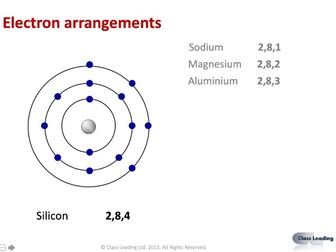
This resource contains an animated PowerPoint slideshow and a variety of sheets, that provide various levels of scaffolding that can be used to accompany this. This can be used as a teaching tool to help pupils learn the pattern of electron arrangements in the first 20 elements. It can also be used as a revision tool to recap the electron arrangements or as an independent learning tool to help learners explore the arrangements.
Food chains & energy transfer (updated)Quick View
classleading

Food chains & energy transfer (updated)

(0)
This is an editable worksheet based activity that includes some higher order thinking to explore the ideas around energy transfer in simple food chains. Two versions are included, one with revised GCSE (1-9) grades, the other without. (please note that grade indications are only approximate). Why not try getting learners to choose a selection of questions to answer (e.g. do Q1-4 or Q3-8) An answer sheet is included. This resource was originally designed for OCR 21st Century Science unit B3, but still applies across a range of exam specifications. Keywords: energy, transfer, food chain, efficiency
Sound waves on an oscilloscope - with soundQuick View
classleading

Sound waves on an oscilloscope - with sound

(0)
This resource is an interactive slideshow aimed at pupils in KS3/4. It shows the screen of an oscilloscope with different waveforms of sounds. Embedded in the slideshow are sounds that would produce that waveform, so that pupils can hear the sound and see the waveform at the same time. There are slides that show the relationship between the waveform and the sound. There are also questions at the end that can be used to check that pupils can recall and understand the relationship between the waveform and the sound. There are worksheets included that can be printed on A4 and included in booklets or pasted into larger books. The worksheets can also be easily cut or folded in half for pupils using smaller books.
Everyday leversQuick View
classleading

Everyday levers

(4)
In this activity pupils can look at the images of levers and think about where the find them and what they do. Either images or real objects (or a combination) can be used with the two sheets, which are differentiated in terms of the number of expected responses and the questions used. Please note that clock (a 'distance multiplier&') is different to the other levers shown (&';force multipliers') and spotting the odd one out and providing a reason gives an extension for more able pupils. Please ensure that you have carried out a full risk assessment before carrying out any practical activity.
GCSE Physics/ Science flash cards (suitable to make at home)Quick View
classleading

GCSE Physics/ Science flash cards (suitable to make at home)

(0)
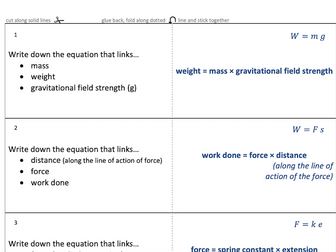
These are flash cards for GCSE Physics/ Science. They cover key facts that pupils need to learn. They are designed to be suitable for pupils to print at home and make up the cards. They include advice as to how to use the flash cards to help them to make the best use of their time when learning. Flash cards sets included are: Physics equations that need to be learnt Circuit symbols, including some common questions linked to the symbols Force and motion sketch graphs Designed for AQA Science.
Classification with HoopsQuick View
classleading

Classification with Hoops

(0)
This activity is aimed at supporting primary science (currently year 4 and year 6 in the primary science national curriculum). In this activity, children are encouraged to look at strategies for classification using physical objects that are accessible to most primary science teachers.
Thinking About - The 3% fat challengeQuick View
classleading

Thinking About - The 3% fat challenge

(0)
This activity is part of the ‘Thinking About’ series. It is designed to provide deep challenge to pupils in terms of their understanding of percentages. It sets a problem in a work-based context and asks them to explain how they solve the problem. There is also the opportunity to manipulate familiar objects as part of solving the problem. It is accessible in that pupils can attempt a solution to the problem, yet also challenging as the solution to the problem is not as straightforward as it seems for most pupils. Many pupils will find percentages challenging and this activity is designed for those who you feel have mastered the idea that percentages involve a fraction out of 100.
Thinking About - Do unbalanced forces cause movement?Quick View
classleading

Thinking About - Do unbalanced forces cause movement?

(0)
This activity is designed to probe preconceptions about the idea that forces cause movement. Children will often think, based on their prior experience of stationary objects that introducing an unbalanced force will make something move in the direct of the force. This activity gives first hand experience of a situation that involves unbalanced forces on a moving object and helps challenge this preconception.
Greenhouse Effect & Solar System (editable)Quick View
classleading

Greenhouse Effect & Solar System (editable)

(0)
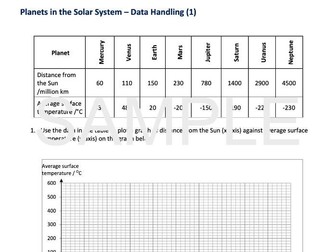
This activity follows on well from the Greenhouse effect starter. Based on interpreting data about planets in the solar system, it leads learners to the conclusion that Venus is hotter than it should be due to CO2. There are two levels of activity, the more demanding one explores the role of photons/light/radiation in heating planets. This activity was originally designed for 21st Century Science unit P2. Please note that this is an editable resource. Key words: greenhouse effect, atmosphere, CO2, carbon dioxide, global warming