Soul, Mind & Body OCR A-Level Religious Studies Philosophy RevisionQuick View
TheRationalMind

Soul, Mind & Body OCR A-Level Religious Studies Philosophy Revision

(0)
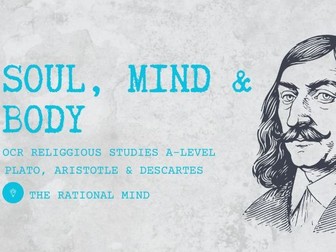
An exploration of the nature of the soul, mind and body, including dualism, materialism, and debates about identity, consciousness and life after death. This topic explores philosophical and religious debates about what it means to be human, focusing on the relationship between the soul, mind and body. It examines classical and modern theories, alongside religious views about life, death, and personal identity. The Concept of the Soul The soul as the essence or animating principle of a human being Religious understandings of the soul (particularly within Christianity) The soul as the seat of identity, personality, and morality Distinction between soul, mind, and body Plato and the Soul Plato’s dualistic view of body and soul The soul as immortal and pre-existent The tripartite soul: reason, spirit, appetite The soul’s imprisonment in the body and its release at death Influence on later religious thought World of the forms and Plato’s cave Aristotle and the Soul Rejection of Plato’s dualism The soul as the form of the body Different types of soul: Vegetative (plants), Sensitive (animals) and Rational (humans) The soul as inseparable from the body Mind-Body Dualism René Descartes’ substance dualism Problems with interaction between mind and body Materialist Views The view that only physical matter exists Mind as a product of brain processes Challenges to belief in an immaterial soul Type-Identity Theory Implications for life after death and personal identity Dawkins’ criticisms Gilbert Rule and category error and the ghost in the machine Life After Death Resurrection vs immortality of the soul Religious views on the afterlife Philosophical problems of personal identity over time Evaluation and Debate Strengths and weaknesses of dualism and materialism Whether humans can exist without a body The relationship between science, philosophy, and religion Is belief in the soul coherent in a modern scientific worldview? Essay questions and guide to answering
Business Ethics: OCR Religious Studies A-Level RevisionQuick View
TheRationalMind

Business Ethics: OCR Religious Studies A-Level Revision

(0)
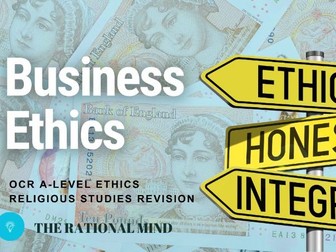
This resource provides an overview of Business Ethics in line with the OCR A Level Business specification, focusing on the moral principles that guide decision-making within organisations. It explores the idea that businesses have responsibilities beyond profit, including duties to employees, customers, stakeholders, and the wider community. Key issues such as Corporate Social Responsibility (CSR), stakeholder theory, and whistleblowing are considered, highlighting the challenges businesses face when balancing ethical responsibilities with financial objectives. The resource also examines the impact of globalisation, particularly how operating across countries can create ethical dilemmas around wages, working conditions, and environmental responsibility. Different ethical approaches are used to analyse business behaviour, including Kantian ethics, utilitarianism, Natural Moral Law, and Situation Ethics. These frameworks offer contrasting perspectives on whether businesses should prioritise duty, outcomes, universal principles, or compassion when making decisions. Overall, the resource emphasises the complexity of ethical decision-making in business, encouraging students to consider how companies can act responsibly while remaining competitive, and how ethical behaviour can influence reputation, trust, and long-term success.
Ancient Philosophical Influences OCR Religious Studies A-Level RevisionQuick View
TheRationalMind

Ancient Philosophical Influences OCR Religious Studies A-Level Revision

(0)
This resource explores the influence of ancient Greek philosophy, particularly the ideas of Plato and Aristotle, in line with the OCR A-Level Religious Studies specification for Philosophy of Religion. It examines how their key concepts have shaped philosophical and theological thinking about reality, knowledge, and the nature of God. The resource outlines Plato’s philosophical framework, including his Theory of Forms, the distinction between the world of appearances and the world of reality, and his understanding of the Form of the Good. It also explores his use of analogy, such as the Allegory of the Cave, to explain how humans can move from ignorance to true knowledge. Attention is given to Aristotle’s contrasting approach, including his emphasis on empirical observation, his theory of causation, and his concept of the Prime Mover. The resource explains Aristotle’s Four Causes and his belief in purpose (teleology) within the natural world, highlighting how his ideas differ from and respond to Plato’s. The resource also considers the lasting impact of these philosophers on religious thought, particularly how their ideas have influenced later theological developments, including arguments for the existence of God and understandings of divine nature. Students are encouraged to evaluate the strengths and limitations of Plato’s and Aristotle’s ideas, as well as their relevance for religious belief and philosophical inquiry. Exam questions are included at the end of the resource to test students in developing both AO1 knowledge and AO2 evaluation for OCR A-Level essay questions on ancient philosophical influences.
Religious Pluralism and Society OCR A-Level Religious Studies RevisionQuick View
TheRationalMind

Religious Pluralism and Society OCR A-Level Religious Studies Revision

(0)
This resource explores the topic of religious pluralism and its impact on contemporary society in line with the OCR A‑Level Religious Studies specification for Religion and Ethics / Christianity and Society. It examines how increasing religious diversity, resulting from factors such as migration, globalisation and changing demographic patterns, has shaped modern multi‑faith societies. The resource outlines the concept of religious pluralism and considers different Christian responses to the reality of religious diversity. It explores how some Christians engage positively with other faiths through practices such as inter‑faith dialogue and scriptural reasoning, and how official teachings from Christian traditions, including Catholic and Anglican approaches, inform these engagements. It also explains key debates about how Christians should relate to people of other religious traditions, whether through cooperation, witnessing, conversion, or respectful co-existence, and how these approaches influence social cohesion. Attention is given to the challenges that religious pluralism poses to exclusive truth claims, including discussions about relativism, objective truth and the possibility of shared moral values across religions. The resource includes a range of theological, ethical and sociological perspectives on whether religious pluralism strengthens or weakens religious identity and practice in contemporary society. Students are encouraged to evaluate the significance of religious pluralism for belief, practice and community life, considering both the opportunities it presents for mutual understanding and the tensions it creates for traditional religious claims. Exam guidance is included at the end of the resource to support students in developing both AO1 knowledge and AO2 evaluation for OCR A‑Level essay questions related to religious pluralism.
Religious Pluralism & Theology Exclusivism, Inclusivism & Pluralism OCR A-Level RS RevisionQuick View
TheRationalMind

Religious Pluralism & Theology Exclusivism, Inclusivism & Pluralism OCR A-Level RS Revision

(0)
This resource explores Religious Pluralism and Theology in accordance with the OCR A Level Religious Studies Developments in Christian Thought specification. It examines how Christianity responds to the existence of multiple religious traditions and the theological challenges this presents. The resource outlines the three key Christian responses to religious diversity: exclusivism, inclusivism, and pluralism. Exclusivism is explored through the belief that salvation is found uniquely in Christ. Inclusivism considers whether salvation may be possible outside explicit Christian faith, while still centred on Christ. Pluralism is examined as the view that different religions may represent equally valid responses to the divine. The work of key theologians such as Karl Rahner, particularly his concept of the “anonymous Christian,” and John Hick’s pluralist hypothesis are analysed. The resource considers how these views challenge traditional Christian doctrines of salvation, revelation, and the uniqueness of Christ. Students are encouraged to evaluate whether Christian theology can remain doctrinally coherent while affirming religious diversity. Exam guidance is included at the end of the resource, supporting students in developing AO1 knowledge and AO2 evaluation for OCR theology essay questions.
Liberation Theology & MarxQuick View
TheRationalMind

Liberation Theology & Marx

(0)
This resource explores Liberation Theology in line with the OCR A Level Religious Studies specification for Developments in Christian Thought. It examines the development of Liberation Theology in Latin America during the twentieth century and its focus on the relationship between Christian faith and social justice. The resource outlines the historical and social context in which Liberation Theology emerged, particularly widespread poverty and political oppression in Latin America. It explores the work of key theologians such as Gustavo Gutiérrez, who argued that Christian theology must respond to the suffering of the poor and promote social and political liberation. The concept of God’s “preferential option for the poor” is examined, highlighting the belief that Christian discipleship requires active commitment to justice and the transformation of unjust social structures. The resource also explores the influence of biblical teachings, particularly the Exodus narrative and the teachings of Jesus about the poor and marginalised. Attention is given to debates about the use of social and political analysis within theology, including criticisms that Liberation Theology draws too heavily on Marxist ideas. Students are encouraged to evaluate whether Liberation Theology represents an authentic development of Christian teaching or a radical reinterpretation of traditional theology. Exam guidance is included at the end of the resource to support students in developing AO1 knowledge and AO2 evaluation for OCR A Level essay questions.
The Person of Jesus Christ Theology OCR Religious Studies A-Level RevisionQuick View
TheRationalMind

The Person of Jesus Christ Theology OCR Religious Studies A-Level Revision

(0)
This resource explores The Person of Jesus Christ in line with the OCR A Level Religious Studies Developments in Christian Thought specification. It examines theological debates about the nature and identity of Jesus, focusing on Christology and the development of Christian doctrine. The resource outlines key Christological titles, including Son of God, Son of Man, Messiah, and Logos, and explains their theological significance. It examines the doctrine of the Incarnation, exploring how Jesus is understood as fully divine and fully human, and considers the importance of the Chalcedonian Definition in shaping orthodox Christian belief. The resource also explores different models of atonement, including substitutionary, moral influence, and Christus Victor, and evaluates how these interpretations shape understanding of Jesus’ mission and significance. Attention is given to modern Christological developments and the ways in which contemporary theologians reinterpret Jesus’ identity in light of historical criticism and social context. Students are encouraged to evaluate whether traditional Christological claims remain coherent and relevant in modern theology. Exam guidance is included at the end of the resource, supporting students in developing strong AO1 knowledge and AO2 evaluation for OCR theology essays.
The Four Noble Truths OCR Buddhism Religious Studies RevisionQuick View
TheRationalMind

The Four Noble Truths OCR Buddhism Religious Studies Revision

(0)
This resource explores the Four Noble Truths in accordance with the OCR A Level Religious Studies specification on Buddhism. It examines the Buddha’s central teaching about the nature of human suffering and the path to liberation. The resource outlines the concept of dukkha, the First Noble Truth, which teaches that suffering, dissatisfaction, and imperfection are inherent aspects of human existence. It then explores tanha, often translated as craving or attachment, which is identified as the cause of suffering. The resource explains how desire for pleasure, existence, and material things leads individuals to remain trapped in the cycle of suffering. The teaching of nirvana is examined as the cessation of suffering, representing the ultimate goal of Buddhist practice. Nirvana is understood as the end of craving and liberation from the cycle of rebirth. The resource then explores magga, the path that leads to the cessation of suffering, specifically the Noble Eightfold Path, which provides guidance for ethical living, wisdom, and mental discipline. Students are encouraged to consider how these teachings form the foundation of Buddhist philosophy and practice. Exam guidance is included at the end of the resource to support students in developing AO1 knowledge and AO2 evaluation for OCR A Level essay questions
Theravada Buddhism OCR Religious Studies A-Level RevisionQuick View
TheRationalMind

Theravada Buddhism OCR Religious Studies A-Level Revision

(0)
This resource explores Theravada Buddhism in line with the OCR A Level Religious Studies specification. It provides an overview of the key beliefs, practices, and philosophical foundations of the Theravada tradition, often referred to as the “Teaching of the Elders,” which is the oldest surviving school of Buddhism. The resource introduces the historical development of Theravada Buddhism and its roots in the earliest Buddhist teachings preserved in the Pali Canon. It examines core doctrinal concepts such as the Four Noble Truths, the Noble Eightfold Path, the Three Marks of Existence (anicca, dukkha, and anatta), and the goal of achieving nibbana through wisdom, ethical conduct, and mental discipline. The resource also explores the central role of the monastic community (Sangha), the importance of meditation practices such as samatha and vipassana, and the ideal of the arahant as the model for spiritual attainment. Attention is given to the relationship between monks and the laity, including the significance of merit-making and devotional practices. Students are encouraged to consider how Theravada Buddhism emphasises individual responsibility for liberation and how its teachings shape ethical living and spiritual practice. Exam guidance is included at the end of the resource to support students in developing AO1 knowledge and AO2 evaluation for OCR A Level essay questions.
The Buddha OCR A-Level Buddhism Religious Studies RevisionQuick View
TheRationalMind

The Buddha OCR A-Level Buddhism Religious Studies Revision

(0)
This resource explores the life and significance of the Buddha in accordance with the OCR A Level Religious Studies specification on Buddhism. It provides an overview of the key events in the life of Siddhartha Gautama and examines how these events shape Buddhist belief and practice. The resource outlines the traditional accounts of the Buddha’s life, including his birth into a royal family, the Four Sights, the Great Renunciation, and his search for enlightenment. It explores the period of asceticism and the eventual realisation of the Middle Way, leading to his enlightenment under the Bodhi tree. The resource also considers the Buddha’s first sermon at the Deer Park in Sarnath, where he taught the Four Noble Truths and established the foundations of the Buddhist community. Attention is given to the significance of the Buddha as an enlightened teacher who discovered the path to liberation from suffering. The resource also examines the role of the Buddha as a model for spiritual development and the importance of his teachings in guiding followers toward enlightenment. Students are encouraged to evaluate the importance of the Buddha within Buddhist tradition and consider how his life and teachings continue to influence Buddhist belief and practice. Exam guidance is included at the end of the resource to support students in developing AO1 knowledge and AO2 evaluation for OCR A Level essay questions.
Arguments Based on Reason: The Ontological Argument OCR A-Level RS RevisionQuick View
TheRationalMind

Arguments Based on Reason: The Ontological Argument OCR A-Level RS Revision

(0)
An exploration of the Ontological Argument for God’s existence, focusing on a priori reasoning, Anselm, Gaunilo, Descartes and Kant. This topic examines arguments for the existence of God based solely on reason, rather than experience or observation. It focuses primarily on the Ontological Argument, exploring classical and modern formulations, key criticisms, and its philosophical significance. Introduction to Arguments Based on Reason Definition of a-priori reasoning (knowledge gained independently of experience) Contrast with a-posteriori arguments (based on observation) examples of deductive, inductive, analytic and synthetic arguments The claim that God’s existence can be deduced logically from the concept of God alone Anselm’s Ontological Argument Anselm’s definition of God as “that than which nothing greater can be conceived” The distinction between existing in the mind and existing in reality The claim that existence in reality is greater than existence in the mind alone Conclusion: God must exist in reality, otherwise He would not be the greatest conceivable being Anselm’s Second Formulation God as a necessary being rather than a contingent one The idea that God cannot be conceived not to exist -Necessary existence as a perfection Gaunilo’s Criticism The “perfect island” objection Argument that Anselm’s logic could be used to prove the existence of anything perfect Question of whether existence can be treated as a predicate Descartes’ Version of the Ontological Argument God defined as a supremely perfect being Existence as a perfection God’s existence follows logically from the concept of God Comparison to mathematical truths (e.g. triangle having three sides) 3 waves of doubt Kant’s Critique Rejection of existence as a real predicate Argued that existence does not add a property to a concept Therefore, the ontological argument fails to prove God’s existence Norman Malcom’s argument God being the ‘unlimited being’ development of Anselm’s second argument Thomas Aquinas critique of Anselm’s ontological argument use of reason and observation together Russell critique of Anselm’s ontological argument Evaluation and Debate Strengths of a priori reasoning Whether existence can meaningfully be defined as a property Whether the argument proves anything beyond a concept Ongoing relevance of the ontological argument in philosophy of religion Essay questions and guidance on how to answer
Free Will and Moral Responsibility AQA A-Level RSQuick View
TheRationalMind

Free Will and Moral Responsibility AQA A-Level RS

(0)
This in-depth resource covers the AQA A-Level Philosophy topic of Moral Responsibility, exploring the key philosophical debates surrounding free will, determinism, and moral accountability. It is designed for both students and teachers, providing clear explanations, structured content, and exam-focused material to support high-level understanding and assessment preparation. Topics Covered Free Will and Moral Responsibility • What it means to act freely • The conditions required for moral responsibility • The relationship between freedom, choice, and blame • The difference between voluntary and involuntary actions Determinism • The claim that all events are causally determined • Hard determinism and the denial of moral responsibility • Key arguments supporting determinism (scientific, psychological, theological) • Implications for praise, blame, punishment, and moral accountability Libertarianism • The belief that humans possess genuine free will • Agent causation and the idea that individuals can initiate actions • Challenges to libertarianism, including randomness and lack of control • Key philosophers and thought experiments supporting libertarian freedom Compatibilism • The view that free will and determinism are compatible • Freedom as the ability to act according to one’s desires without external constraint • Soft determinism and moral responsibility • Strengths and weaknesses of compatibilist theories Moral Responsibility and Punishment • The relationship between free will and moral accountability • Justifications for punishment: retributive vs consequentialist approaches • Whether punishment is fair in a determined world • The role of moral responsibility in praise, blame, and justice Essay questions.
Miracles AQA Religious Studies A-Level Revision PowerPointQuick View
TheRationalMind

Miracles AQA Religious Studies A-Level Revision PowerPoint

(0)
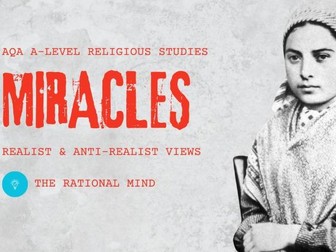
An exploration of miracles in religious belief, including definitions, types, challenges from Hume, and debates about evidence, faith, and reason. This topic explores philosophical and theological debates surrounding miracles, focusing on how they are defined, evaluated, and understood within religious belief,particularly Christianity. It examines both traditional and critical perspectives and assesses whether belief in miracles is rationally justified. What Is a Miracle? General understanding of miracles as extraordinary events attributed to divine intervention Distinction between natural and supernatural explanations The role of miracles in religious belief and faith traditions Realist and Anti-Realist views Aquinas on miracles Hume’s Definition of a Miracle David Hume’s definition: a miracle as a violation of the laws of nature The idea that laws of nature are established by uniform human experience The implication that miracles are extremely improbable Hume’s argument that testimony is never sufficient to prove a miracle Hume’s Critique of Belief in Miracles The problem of unreliable testimony The influence of ignorance, superstition, and emotional bias Competing miracle claims across different religions Hume’s conclusion that it is always more rational to reject miracle claims Responses to Hume Richard Swinburne’s understanding of miracles as non-repeatable divine acts The principle of testimony: when testimony should be accepted The idea that miracles may be the most reasonable explanation of certain events Criticisms of Hume’s narrow definition of natural law Holland Wiels and Hume comparison Miracles as Signs - Tillich Miracles understood as signs of God’s activity rather than violations of nature Biblical examples, such as healing miracles and resurrection narratives The role of miracles in strengthening faith rather than proving God’s existence Evaluation and Debates Whether miracles can be rationally believed Whether miracles undermine scientific understanding The relationship between faith and reason Are miracles necessary for religious belief? Essay questions