Discover the Seasons 176 Picture Cards, Search-and-Find Activities and Dice GamesQuick View
sunnyventa

Discover the Seasons 176 Picture Cards, Search-and-Find Activities and Dice Games

(0)
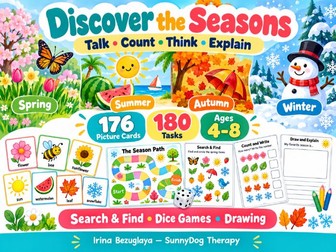
Discover the Seasons 176 Picture Cards, Search-and-Find Activities and Dice Games for Talking, Counting and Explaining Why might an umbrella belong to more than just autumn? Which clue points to winter? And what changes when spring arrives? This versatile activity pack helps children explore the four seasons through pictures, conversations and varied tasks. They search, count, sort, draw and tell stories — while learning to explain their choices. For children aged approximately 4–8, with adult guidance. Suitable for nursery, preschool, early primary school, language development and shared activities at home. What’s Included 176 numbered picture cards across 11 A4 sheets for cutting out, sorting and storytelling. 9 ways to play with the picture cards, including guessing the season, making connections, comparing clues and telling stories. 16 different search-and-count pictures, with an answer key. 19 additional activity sheets featuring season cards, sorting and thinking grids, drawing tasks, sequencing activities and three more search-and-find pictures. 6 colourful activity grids with 180 tasks in total, covering spring, summer, autumn, winter, weather and the seasons. A 48-space game path, in both colour and black and white. Detailed instructions in German, sample answers, a complete picture-card directory and a quick-start overview. More Than Naming the Seasons The activities encourage children to look closely and think further: ✓ Expand vocabulary and build complete sentences ✓ Find objects, count them and compare quantities ✓ Recognise similarities and differences ✓ Put changes into a meaningful sequence ✓ Choose clues and explain decisions ✓ Explore and discuss other possibilities There is room for different answers: a butterfly may fit more than one season, and a watermelon can also be bought in winter. What matters is how the child explains their idea. Flexible and Easy to Prepare Start with a few cards or a single activity sheet. Younger children can name and point to objects; older children can compare several clues, explain connections or invent a story. The pack is suitable for individual work, small groups, learning stations and short sessions focused on specific skills. The picture-card games can be played without dice. For the game path, you will need a standard six-sided die and small playing pieces. Format A digital download pack supplied in one ZIP file: PDFs for A4 printing, editable instructions in Word format and individual PNG files. Many of the picture resources are in black and white and can also be coloured in. No physical product will be shipped. Created by Irina Bezuglaya — SunnyDog Therapy Psychologist, speech therapist and dog-assisted therapy specialist. For personal use or use with one class, therapy group or your own professional clients. The digital files may not be shared or resold.
A Dog’s Friend — Young Dog Expert: What Dogs Feel and SayQuick View
sunnyventa

A Dog’s Friend — Young Dog Expert: What Dogs Feel and Say

(0)
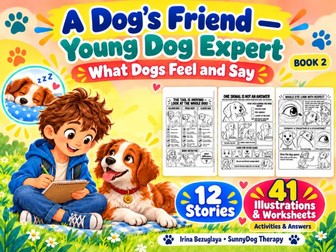
A Dog’s Friend — Young Dog Expert: What Dogs Feel and Say 12 stories, 41 illustrations and worksheets, plus learning activities and answers Can a wagging tail mean something other than happiness? Does a dog’s “guilty look” really mean guilt? How can children tell when a dog wants company—or needs space? Turn these questions into an engaging reading adventure! Join a curious boy and his witty talking dog as they investigate everyday situations, challenge their first guesses and discover how dogs communicate. Combining humorous storytelling with practical information, this book helps children look beyond a single tail wag or facial expression and consider the dog’s whole body and the situation. What’s included? 12 main stories exploring dogs’ feelings, behaviour and needs. 41 illustrations and worksheets supporting observation and discussion. Opening riddles that encourage children to make predictions. 12 “A Problem from Barbos” tasks inviting children to suggest solutions. Questions connecting the stories with children’s own feelings and experiences. Drawing, observation and role-play activities. “True or Myth?” questions, worksheet answers and suggested responses for adults. What will children explore? Children learn about dogs’ eyes, ears, mouths, tails and posture; why one signal alone does not tell the whole story; and how fear, uncertainty or discomfort can affect behaviour. Stories also explore gentle introductions for puppies, changing needs in older dogs, veterinary visits, predictable routines and the importance of a quiet place to rest. Along the way, children practise empathy, respect for personal space and the ability to distinguish what they observe from what they assume. Who is it for? Ideal for primary school teachers, homeschool educators, parents and professionals leading animal welfare or dog awareness activities. Particularly suitable for children aged 7–10, with adult support adapted to their reading level. How can you use it? Read a story aloud, pause at the opening riddle, discuss the characters’ choices and finish with a related activity. Use individual chapters for reading comprehension, speaking and writing practice, social and emotional learning, or lessons about caring for animals. No live dog is needed for the classroom activities. An enjoyable book to read—and a thoughtful resource for helping children become more observant, considerate friends to dogs. Irina Bezuglaya — SunnyDog Therapy
Who Lives Where? — 116 Animals for Play, Learning and Language DevelopmentQuick View
sunnyventa

Who Lives Where? — 116 Animals for Play, Learning and Language Development

(0)
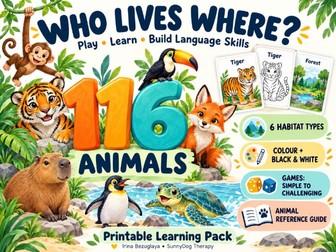
Who Lives Where? — 116 Animals for Play, Learning and Language Development Where does a tiger live? What about a capybara? Can the same animal live in different habitats? Turn learning about animals into an engaging game as children explore pictures, match animals to suitable habitats, discuss their choices and build sentences. “Who Lives Where?” is a printable resource that combines learning about the natural world, developing language skills and practising English. One pack, many activities — from simple picture matching to telling a short story about an animal! What’s included? 116 animals in colour and black and white — for picture-based games, colouring and creative activities. 6 habitat types — for sorting animals, comparing habitats and discussing choices. Game rules and variations, from simple to more challenging — to help you choose activities that suit the children’s skill levels. A brief “Who Lives Where?” reference guide — for learning about the animals and checking answers. What can you do with the pack? In science and nature activities, children discover familiar and unusual animals, match them to habitats, and explore similarities and differences. Asking “Why did you choose this habitat?” encourages them to explain their thinking rather than simply guess an answer. For language development, the pictures support sentence building, descriptions and short stories: “A fox lives in the forest”, “This animal has…”, or “These animals are alike because…”. Children can describe an animal for others to guess, ask questions and discuss their answers in pairs. In English lessons, the pack helps children practise animal and habitat vocabulary, ask questions and give complete answers: Where does a tiger live? — A tiger lives in the forest. Children can progress from individual words to sentences, then to short descriptions of their chosen animal. The black-and-white pictures are ideal for colouring, creating a personal animal album and reinforcing learning after the game. Where can you use it? In preschool and primary school, English lessons, language development groups, clubs and at home. The pack works well for individual activities, pair work, small groups and whole-class tasks. Print the materials, choose a difficulty level and set off to explore the animal world! First, children discover who lives where; next, they explain their choices; then, they talk about it in English.
Young Dog Expert: How a Dog’s Body WorksQuick View
sunnyventa

Young Dog Expert: How a Dog’s Body Works

(0)
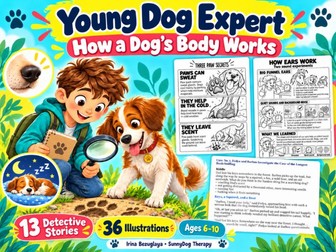
Young Dog Expert: How a Dog’s Body Works — 13 Detective Stories, 36 Illustrations and Learning Activities Turn children’s curiosity about dogs into an engaging classroom reading adventure! Why do dogs spend so long sniffing one bush? What can their paws feel? Do dogs dream? Help children investigate these questions through humorous stories, illustrated explanations and activities that invite them to think for themselves. Follow nine-year-old Fedya and his witty talking dog, Barbos, as they prepare for an exam at an animal shelter. Each new case reveals something surprising about a dog’s body—and teaches Fedya that becoming a young dog expert means observing carefully, checking his ideas and learning from mistakes. What’s inside? 13 detective stories connected by an engaging storyline. 36 illustrations that support understanding and exploration. A prologue and a concluding exam story. Opening riddles and “Check your theory” sections. “True or Myth?” quizzes with an answer key. Observation activities and simple experiments. “A Problem from Barbos” challenges, with suggested solutions for adults. “Let’s Talk About Feelings” questions about friendship, responsibility, patience and empathy. Discover how a dog’s body works Children explore smell, hearing, vision, paws, the heart, teeth and jaws, digestion, whiskers, movement, sleep and coats. They also learn about working dogs and discover why every dog has its own preferences. These discoveries help children make sense of everyday behaviour: why sniffing matters, why rest is important and why an animal needs space and choice. The book offers opportunities to practise: Reading comprehension: predicting, finding evidence and explaining ideas. Scientific thinking: observing, comparing and separating facts from guesses. Speaking and listening: discussing discoveries and considering different answers. Empathy and responsibility: noticing animals’ needs and reflecting on the characters’ choices. Who is it for? Ideal for primary teachers, homeschool educators, school librarians and families looking for meaningful reading material for children aged 6–10. Use it for class read-alouds, small reading groups, animal-themed lessons or reading together at home. Confident readers aged 8–10 can also explore it independently. No live dog is needed for classroom reading and discussion. Activities involving a dog are intended only for the family’s own dog, with adult supervision and when the dog is comfortable participating. Bring a new mystery to reading time—and give children something useful to discover in every chapter. Irina Bezuglaya — SunnyDog Therapy
How Do Animals Move? — 116 Animals for Play, Learning and Language DevelopmentQuick View
sunnyventa

How Do Animals Move? — 116 Animals for Play, Learning and Language Development

(0)
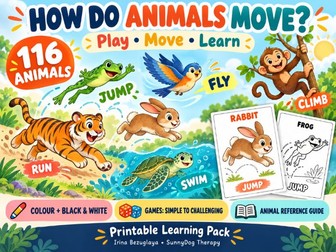
How Do Animals Move? — 116 Animals for Play, Learning and Language Development How does a tiger move? What about a capybara? Can the same animal walk, run and swim? Turn learning about animals into an engaging game in which children explore pictures, name movements, act them out and explain their choices. “How Do Animals Move?” is a printable resource that combines learning about the natural world, movement activities, language development and English practice. One pack, many activities — from naming a simple action to comparing animals and describing how they move! What’s included? 116 animals in colour and black and white — for picture-based games, colouring and creative activities. Game rules and variations, from simple to more challenging — to help you choose activities that suit the children’s skill levels. A brief animal reference guide — to support learning and discussions about how animals move. What can you do with the pack? In science and nature activities, children discover familiar and unusual animals and explore how they move: walking, running, jumping, crawling, flying, swimming and climbing. Questions such as “Can this animal move in more than one way?” and “What helps it swim or climb?” encourage children to compare animals and explain their thinking. In movement games, children choose a picture and demonstrate an action: waddle like a penguin, stretch like a cat or flap their arms like a bird. Other players guess the animal or name the movement. Activities can progress from one simple action to a sequence that others watch, remember and repeat. For language development, the pictures support sentences, descriptions and short stories: “A frog jumps”, “A bird flies”, or “Both animals can swim, but they move differently on land”. Children can describe an animal’s movements for others to guess, ask questions and discuss answers in pairs. In English lessons, the pack helps children practise animal names and action verbs, ask questions and give complete answers: How does a frog move? — A frog jumps and swims. Can a tiger swim? — Yes, it can! Children can progress from individual words to sentences, then to short descriptions of what their chosen animal can do. The black-and-white pictures are ideal for colouring, creating a personal animal movement book and reinforcing learning after the game. Where can you use it? In preschool and primary school, English lessons, language development groups, movement sessions, clubs and at home. The pack works well for individual activities, pair work, small groups and whole-class games. Print the materials, choose a difficulty level and get moving! First, children name the actions; next, they demonstrate and compare them; then, they describe how animals move in English.
Friendship Quest – Social Skills Card Game and Board GameQuick View
sunnyventa

Friendship Quest – Social Skills Card Game and Board Game

(0)
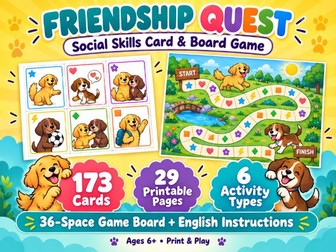
Friendship Quest – Social Skills Card Game and Board Game How can I ask for help? What can I say when I disagree? And how can we resolve an argument? With Friendship Quest, children explore different ways to respond to everyday social situations through play. Friendly illustrated dog characters introduce activities about friendship, feelings, personal boundaries and treating others with respect. Children can answer from their own perspective or help a character on a card. This encourages conversations, new ideas and short role-play activities. What’s included: 168 activity cards across 28 illustrated printable pages 6 activity types: name three ideas, complete sentences, find solutions, act out scenes, discuss statements and decide what to do next A game board with 36 spaces, supplied as PDF and PNG A two-page game guide in German, covering preparation, gameplay and alternative ways to play How to play: Roll the die, move the counter and draw a card with the matching symbol. Children then answer a question, suggest a solution together or act out a short scene. With one shared counter, the group works together to reach the finish. The cards can also be used without the board for group discussions, partner activities or short practice sessions. Children practise: Starting conversations and listening to others Expressing their wishes and boundaries Respecting a “no” Handling disappointment and disagreements Acknowledging mistakes and making things right Including others and asking for support There can be more than one helpful answer. Children may ask for help, answer together or skip a card. Sharing personal experiences is always optional. Recommended for ages 6+, for 2–6 children with adult guidance. Suitable for primary classrooms, small groups, school counselling and family game time. Digital resource to print at home or school. A die and playing counters are required.
**Who Eats What? – Animal Food Matching Game with 60 Picture Pairs**Quick View
sunnyventa

**Who Eats What? – Animal Food Matching Game with 60 Picture Pairs**

(0)
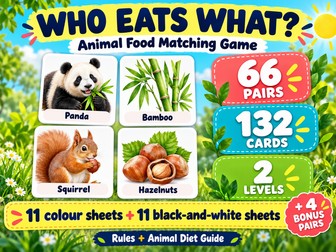
Who Eats What? – Animal Food Matching Game with 60 Picture Pairs What does a panda eat? What food does a sea otter find? And can different animals eat the same food? With this illustrated card game, children explore the diets of familiar and unusual animals. They match animals to their food, compare possible answers and practise explaining their choices in their own words. What’s included: 10 colour card sheets with 60 animal–food pairs — 120 individual cards to cut out. 5 additional black-and-white sheets providing an alternative print version for 30 of the included pairs. English instructions with two difficulty levels and several ways to play. A clear diet guide covering all 60 animals: main foods, other possible foods and the corresponding picture match. Card sheets as PNG files and A4 printable PDFs; instructions and diet guide as PDF and text files. Two difficulty levels For the easy level, an adult selects a small set of cards so that each animal has one matching food. For the harder level, children find two or three suitable food cards for selected animals. They discover that an animal can eat different foods and that the same food can suit several animals. Lots of ways to play Use the cards for matching, memory games, guessing games, team activities or “What’s missing?” Adapt them for a quick activity or a longer play session. Simple sentence patterns such as “The panda eats bamboo” also support English language learning. Suitable for science lessons, vocabulary practice, EAL activities, small groups and family play. Adjust the number of cards to suit the children’s learning level. Print, cut out and play! The food cards show examples from the animals’ natural diets. The accompanying guide helps adults identify and discuss other suitable answers.
About Dogs | Illustrated Classroom Resource Pack + Teaching Guide BonusQuick View
sunnyventa

About Dogs | Illustrated Classroom Resource Pack + Teaching Guide Bonus

(0)
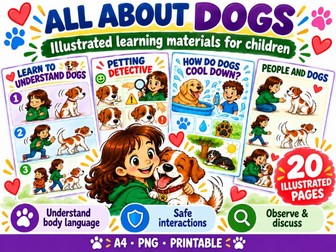
Help children discover how dogs communicate, what they need, and how to make safe, respectful choices around them. This illustrated collection gives you engaging material for more than one classroom discussion. Show the pictures, read a section together, and invite students to look closely: Is the dog relaxed or tense? What clues can they see? What should a child do next? What’s included: • 17 illustrations in the main resource • Illustrated reading about dog body language, feelings, individual differences, rest, play, and personal space • An observation challenge that encourages children to notice and explain what they see • Child-friendly information about dog teeth, digestion, and foods that can be dangerous for dogs • BONUS: How to Teach Children to Understand Dogs — a guide with games and activities using movement, toys, pictures, and discussion Use the material for animal studies, dog safety, reading and discussion, or social-emotional learning. The bonus guide gives you ways to build on the illustrations, so children can practise observing before making a guess about how a dog feels. The key lesson: one tail wag, yawn, or facial expression never tells the whole story. Children learn to look at the dog’s whole body and the situation—and to give the dog space and ask an adult when they are unsure.
Dog Safety and Body Language GameQuick View
sunnyventa

Dog Safety and Body Language Game

(0)
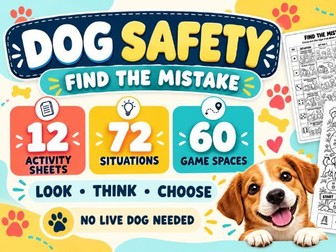
Dog Safety and Body Language Game Can you spot the mistake before it happens? This printable game helps children practise noticing a dog’s body language and choosing a safer response in everyday situations. A dog is eating, resting, moving away or meeting someone new. Children look at the pictures, cross out the unsafe action and explain what they would do instead. The set includes 12 illustrated activity sheets with 72 situations, a two-page game trail with 60 spaces, and an answer key with short explanations. Topics include safety at home and outdoors, personal space, greetings, play, walks, caring for a dog and situations in which a child feels unsure. One sheet focuses on matching body language signs to the dog’s state. Use a single sheet for a short activity or combine sheets with the game trail for a longer session. The activities work with the printed pages—no live dog is needed. Designed for guided conversations with children at home, in classrooms and in dog safety education.
YOUNG INVENTORS – 20 Creative WorksheetsQuick View
sunnyventa

YOUNG INVENTORS – 20 Creative Worksheets

(0)
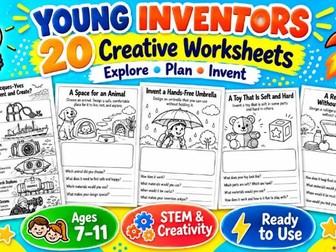
YOUNG INVENTORS – 20 Creative Worksheets How are new inventions created? What can we learn from nature, famous researchers, and everyday problems? This creative worksheet set invites children to become young researchers and inventors. They learn about important figures and fascinating discoveries, observe the world around them, and develop their own original ideas. The open-ended STEM activities encourage children to draw, plan, compare, improve, and explain. There is intentionally no single correct answer—every child can use their imagination to design a unique invention. What’s Included 20 A4 worksheets 4 fact sheets about famous scientists and explorers 16 varied invention challenges large spaces for drawing and planning short guiding questions to help children describe their ideas child-friendly illustrations to color clear black-and-white design for cost-effective printing Skills Developed The material supports creative and logical thinking, problem-solving, technical understanding, spatial awareness, vocabulary, and oral and written communication. Children learn to develop their own ideas, explain their solutions, and present their inventions. The worksheets are ideal for children aged approximately 7–11 and can be used flexibly in science lessons, STEM activities, project weeks, learning stations, substitute lessons, or gifted education. They are suitable for individual work, pairs, and small groups. A versatile, ready-to-use resource for children who enjoy exploring, drawing, experimenting, and inventing new solutions. Tags: Young inventors, elementary inventions, creative worksheets, elementary STEM, primary STEM, science worksheets, young scientists,
Science Activities: 15 Experiments, 28 Worksheets & 4 STEM MissionsQuick View
sunnyventa

Science Activities: 15 Experiments, 28 Worksheets & 4 STEM Missions

(0)
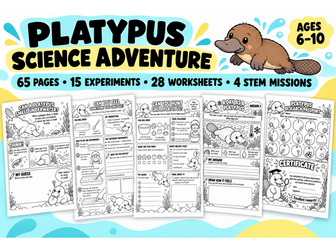
Explore the amazing world of the platypus with this 65-page printable science pack for children aged 6–10. Included 15 hands-on science experiments 28 illustrated worksheets 4 creative STEM missions 45 discussion questions Research Passport and certificate Materials list and safety guidance 42 illustrations and visual elements Children investigate webbed feet, sensitive bills, insulating fur, cheek pouches, burrows, eggs, fluorescence and other fascinating platypus adaptations. Each experiment includes materials, clear instructions, questions, a child-friendly conclusion and a scientific explanation. Develops scientific enquiry, observation, prediction, problem-solving, attention, working memory and vocabulary. Format: 65 A4 pages Age: 6–10 Suitable for: KS1, lower KS2, STEM lessons and home education.
CATCH THE WORD — A Motor Speech Card GameQuick View
sunnyventa

CATCH THE WORD — A Motor Speech Card Game

(0)
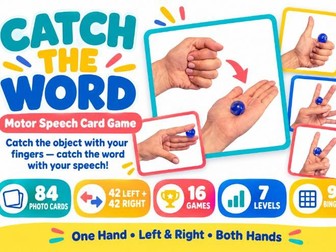
CATCH THE WORD — A Motor Speech Card Game Catch the object with your fingers — catch the word with your speech! One set, a complete learning system: 42 hand-position cards, 16 ready-to-play games, 7 difficulty levels, and 9 bingo boards that grow with the child. What’s Included 42 cards with real photographs of hand and object positions—not illustrations, but clear photos that are easy to copy 16 ready-to-play activities: 8 motor games for movement, attention, and memory + 8 speech games for sound practice, vocabulary, grammar, and connected speech 7 difficulty levels—from “one card, one hand” to “both hands simultaneously + a speech task” 3 activity modes: one hand, left/right hand using L/R cards, or both hands simultaneously A detailed 5-step quick-start guide A list of 10+ objects that can replace the ball—from a button to a bead 9 ready-to-use bingo boards Why It Works The child simultaneously looks, feels with their fingers, plans a movement, and says a word. This engages five channels at once: vision, touch, proprioception, motor skills, and speech. One card supports motor, sensory, and speech development at the same time. Who Is It For? Speech-language therapists, special education teachers, occupational therapists, preschool teachers, and parents. The resource is suitable for individual sessions, partner activities, and group work. Format: Print-ready Activity time: Just 5–10 minutes per round
Pets & Domestic Animals Mega Learning Bundle — 112 Printable PagesQuick View
sunnyventa

Pets & Domestic Animals Mega Learning Bundle — 112 Printable Pages

(0)
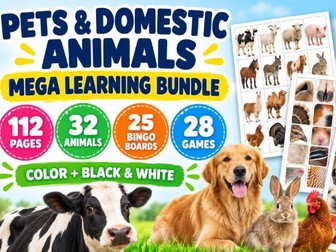
Pets & Domestic Animals Mega Learning Bundle — 112 Printable Pages Turn learning about animals into an exciting game! This large printable resource helps children explore 32 domestic animals, their babies, homes, food, body parts and unique features through matching activities, bingo, sorting, coloring, observation and speech-development games. The same animals appear in different formats, helping children move gradually from simple recognition to comparison, logical thinking, memory tasks and storytelling. WHAT’S INCLUDED 112 printable pages 8 editable Word files 32 domestic animal species 64 color cards: 32 adult animals + 32 babies 64 black-and-white coloring cards: 32 adult animals + 32 babies 272 body-part picture cards on 17 pages 25 different 5×5 bingo boards 10 full-color bingo boards 15 black-and-white bingo boards 9 pages featuring animal homes, habitats, food and play scenes 35-page illustrated animal reference guide 32 detailed animal information profiles 14-page English Methodological Guide 28 ready-to-use games and learning activities 3 difficulty levels: easy, intermediate and advanced 3 ready-made lesson plans: 10, 20 and 30 minutes Color and printer-friendly black-and-white materials BODY-PART CARDS INCLUDE Eyes Ears Noses, mouths and beaks Paws, feet and hooves Tails Fur, wool, feathers, scales and other body coverings Unusual animal features WAYS TO USE THE SET Use the materials for: Bingo Memory and matching games “Adult and Baby” activities “Whose Eyes, Ears or Tail?” games Food and habitat matching Sorting and classification Animal riddles Vocabulary lessons Speech and language activities Storytelling Coloring Individual sessions Small-group activities Preschool and primary-school lessons Homeschool learning Speech therapy and educational support PERFECT FOR Children ages 3–8 Preschool and kindergarten Early primary school Homeschooling families Teachers and teaching assistants Speech and language therapists Child psychologists Special education professionals Parents looking for screen-free learning activities PLEASE NOTE This is a digital printable product. No physical item will be shipped. The package contains editable Word documents. The Methodological Guide is in English; the detailed 35-page animal reference guide is in Russian. Most game cards are picture-based and contain no text.
Animal Tracks & Signs Nature Detective Game — 60 Printable AnimalQuick View
sunnyventa

Animal Tracks & Signs Nature Detective Game — 60 Printable Animal

(0)
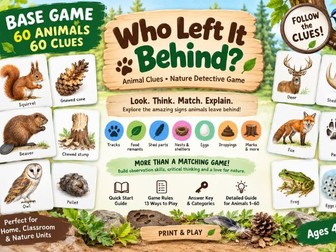
WHO LEFT WHAT? Animal Tracks, Clues & Nature Detective Game Who Left It Behind? — Base Game is a ready-to-print educational nature detective game built around 60 animal-and-clue pairs. Children examine tracks, food remains, feathers, shed skin, nests, shells, feeding marks, and other signs animals leave behind. They then determine which animal could have left each clue, what happened, and what evidence supports their answer. This is much more than a simple matching activity. Children begin by recognizing and pairing pictures, then move on to describing evidence, explaining connections, comparing possibilities, and testing their assumptions. The accompanying guide includes three levels of questions: Recognize and describe → Explain the connection → Test an assumption What’s Included 60 animal cards main game Color and black-and-white versions Black-and-white cards that can also be used as coloring activities Quick Start Guide — begin with 6–10 easy pairs and gradually add more Full game rules with 13 ways to play Bingo game Printable board game Competitive options: player versus player and team versus team Cooperative group activities Answer key with the animal, clue, and evidence category Sorting categories for different types of animal evidence Detailed guide for animals 1–60 Three levels of thinking questions for every pair Activities for matching, memory, sorting, vocabulary, reasoning, discussion, and teamwork Vocabulary and Language Learning The cards can also be used to introduce and practise new vocabulary. Children learn the names of animals, tracks, nests, body coverings, food remains, shelters, and other signs found in nature. Use the cards to practise: Naming animals and natural objects Learning new topic-related words Describing pictures Building complete sentences Answering questions Comparing two clues Explaining cause and effect The set can be used during science lessons, vocabulary lessons, language classes, speaking activities, and themed nature units. What Children Practise Observation • Classification • Cause and effect • Vocabulary • Evidence-based reasoning • Comparing possibilities • Explaining ideas • Speaking and listening • Memory • Teamwork Who Is It For? Suitable for: Preschool and primary-school children Teachers and classroom assistants Homeschool families Parents Speech and language specialists Psychologists and special-education professionals Nature clubs and outdoor-learning groups Ready to Print Simply download, print, and cut out the cards. Choose the full-color version for immediate play or the black-and-white version for economical printing and coloring activities.
Printable Learning Game | Ages 5–7Quick View
sunnyventa

Printable Learning Game | Ages 5–7

(0)
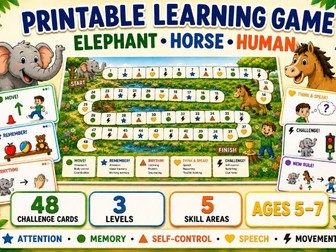
Elephant • Horse • Human Printable Learning Game | Ages 5–7 Develop attention, memory, self-control, speech, reasoning, rhythm, and coordination through play! Children roll the die, move around the board, choose a matching card, and complete a fun challenge. You’ll Get: 1 colorful printable game board; 48 illustrated activity cards; 3 difficulty levels on every card; clear instructions for adults; 5 developmental categories. Three Levels on Every Card: ● Easy — short task with support; ●● Medium — longer sequence with fewer prompts; ●●● Hard — switching rules, reverse order, delay, speech, or reasoning. Perfect for classrooms, speech therapy, occupational therapy, special education, homeschool, small groups, and family learning. Players: 1–4 Age: 5–7 Time: 5–15 minutes Print, choose a level, roll the die—and turn skill-building into an adventure! Tags: executive function, working memory, self-control, speech therapy, attention activities, movement cards, brain breaks, following directions, printable board game, kindergarten activities
Attention, Memory, Self-Control & Speech Practical Activity PackQuick View
sunnyventa

Attention, Memory, Self-Control & Speech Practical Activity Pack

(0)
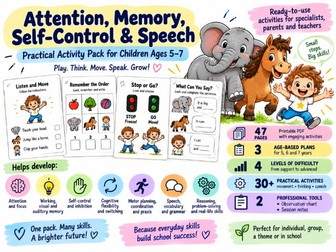
Attention, Memory, Self-Control & Speech Practical Activity Pack for Children Ages 5–7 A ready-to-use resource for specialists who want to do more than simply give children a collection of exercises. This pack is designed to systematically build the skills children need for learning and everyday life: listening to instructions, holding a rule in mind, remembering sequences, stopping an automatic response, switching between tasks, planning actions, and explaining their answers. What’s included: 47 pages of practical materials. 3 ready-made session plans for ages 5, 6, and 7, lasting approximately 25–45 minutes depending on the child’s age and current level. 4 difficulty levels, progressing from supported performance to rule changes, delayed responses, and dual-task activities. Just 4–7 activities per session — there is no need to complete the whole pack at once. Activities targeting attention, working and visual memory, inhibition, cognitive switching, praxis, rhythm, coordination, and speech and language. Movement + language activities where children do more than perform an action: they name, describe, explain, compare, and justify their answers. Tasks developing cause-and-effect reasoning, grammar, sentence building, connected speech, and flexible thinking. Built-in ways to increase difficulty, allowing the same materials to be used across multiple sessions while gradually increasing the challenge. A Specialist Observation Chart to track progress and identify the next appropriate step instead of simply marking an activity as “completed” or “not completed.” A separate Post-Session Notes page for recording the child’s level, type of support needed, independence, areas of difficulty, language responses, and next goal. A key feature of the pack is its clear progression: with adult support → following a demonstration → following verbal instructions → delayed response → rule switching → dual task → transferring the skill to a new situation Ideal for speech-language therapists, psychologists, special education professionals, early childhood educators, and school-readiness specialists. One pack → many session possibilities → a clear next step for every child.
HORSE Speech & Language Therapy BundleQuick View
sunnyventa

HORSE Speech & Language Therapy Bundle

(0)
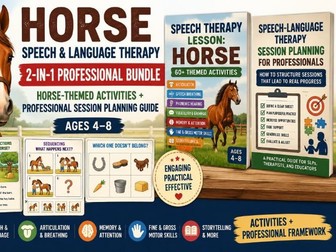
HORSE Speech & Language Therapy Bundle Horse-Themed Activities for Ages 4–8 + Professional Session Planning Guide Two resources. One complete approach to planning engaging, purposeful speech and language sessions. This bundle combines a large collection of horse-themed speech and language activities for children ages 4–8 with a separate professional guide to planning effective speech-language therapy sessions. You don’t simply get activities. You get the activities AND a framework for deciding which activities to use, why to use them, how to adjust the difficulty, when to provide support, and how to move the child toward independent use of the target skill. RESOURCE 1 Speech Therapy Lesson: HORSE A rich collection of horse-themed activities that can be selected and adapted to the individual child’s goals. Activities cover: • Speech breathing & voice • Articulation motor skills • Phonemic hearing • Auditory attention & working memory • Vocabulary development • Grammar • Verbs, adjectives & antonyms • Prepositions & spatial language • Cause-and-effect language • Connected speech & storytelling • Sequencing & prediction • Visual attention & perception • Categorization & logical thinking • Fine motor skills • Gross motor skills & coordination • Following multi-step instructions • Flexible thinking & explanation Children don’t just name pictures. They listen, move, remember, compare, explain, predict, categorize, follow instructions, build sentences, and create stories — all within an engaging horse theme. Many activities can be adapted across different levels, making the resource useful for children from approximately 4 to 8 years old. RESOURCE 2 — INCLUDED IN THE BUNDLE Speech-Language Therapy Session Planning for Professionals Having dozens of activities doesn’t automatically create an effective therapy session. This companion professional guide focuses on the question: What exactly should the child be able to do a little better, more accurately, or more independently at the end of the session? It explains how to move from: child profile → specific target → starting level → appropriate practice → sufficient target opportunities → cueing → fading support → independence → generalization → self-monitoring PERFECT FOR Speech-Language Pathologists / Speech Therapists Special Education Professionals Early Childhood Specialists Teachers supporting speech and language development Therapy students and new clinicians Professionals looking for adaptable themed session materials ONE BUNDLE = PRACTICAL ACTIVITIES + PROFESSIONAL CLINICAL FRAMEWORK Instead of asking: “Which worksheet should I do next?” start asking: “What am I teaching — and which activity will give the child the best opportunity to practise it?” That’s the difference between a collection of activities and a purposeful speech-language session.
72 Anxiety Coping Cards + 16 Bonus Technique CardsQuick View
sunnyventa

72 Anxiety Coping Cards + 16 Bonus Technique Cards

(0)
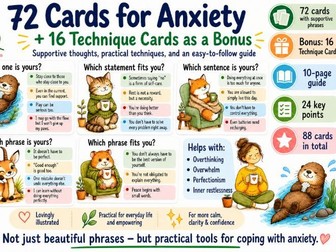
72 Anxiety Coping Cards + 16 Bonus Technique Cards CBT-Inspired Self-Talk Prompts, Anxiety Relief Tools & 10-Page Guide Help interrupt anxious thoughts, reduce overthinking, and find a calmer next step with this practical 88-card anxiety support set. This printable resource combines 72 supportive coping cards, 16 bonus technique cards, and a 10-page practical guide designed to help teenagers and adults better understand anxiety and respond to it with simple, concrete tools. What’s Included • 72 Anxiety Coping Cards with short, supportive statements for anxious thoughts, overthinking, perfectionism, overwhelm, self-doubt, and inner pressure • 16 Bonus Technique Cards with practical strategies that can be used during moments of anxiety, stress, or emotional overload • 10-Page Anxiety Guide covering 24 important topics and practical points The Cards Can Help With • interrupting repetitive anxious thoughts • separating thoughts from facts • reducing perfectionistic pressure • coping with overthinking and uncertainty • finding a manageable next step • noticing reassurance-seeking patterns • reducing avoidance • understanding the need for control • returning attention to the present moment • building a more supportive inner dialogue Instead of long explanations, the cards offer short prompts that can be picked up and used exactly when support is needed. Choose a card, read the statements, notice which one feels most useful right now, and use it as a calmer alternative to the anxious thought. The 10-Page Guide Covers The included guide explains 24 important aspects of working with anxiety, Perfect For • teenagers and adults • self-help and emotional regulation • psychologists and therapists • counselors and mental health professionals • coaching and support sessions • therapy homework and take-home resources • calm corners and wellbeing spaces • individual or group work Total 72 Coping Cards + 16 Bonus Technique Cards = 88 Cards PLUS a 10-page practical anxiety guide with 24 key points This is more than a collection of positive affirmations. These cards are designed to provide practical, easy-to-use support and help answer two important questions: What is happening to me right now? What can I do next? A useful printable resource for building awareness, reducing anxious thought spirals, and developing a calmer, more supportive way of responding to difficult thoughts. Search Keywords Anxiety Coping Cards, CBT Cards, Anxiety Cards, Coping Skills, Anxiety Worksheets, CBT Printable, Overthinking Help, Anxiety Relief, Self Help Cards, Therapy Cards, Therapist Resources, Mental Health Printable, Emotional Regulation, Coping Skills for Teens, Perfectionism, Reframing Thoughts, Calming Strategies, Counseling Resources, Anxiety Toolkit
Anxiety Coping Cards Bundle | 74 Calming & CBT Strategy CardsQuick View
sunnyventa

Anxiety Coping Cards Bundle | 74 Calming & CBT Strategy Cards

(0)
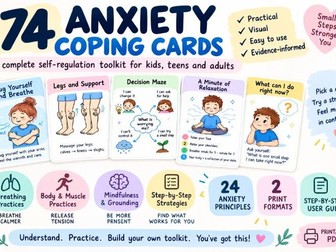
74 practical coping cards. 4 strategy categories. 2 printable formats. 1 complete anxiety toolkit. Help make anxiety feel more manageable with a practical, visual collection of tools that can be used at home, in counseling, therapy sessions, classrooms, or individual support work. This bundle includes 74 unique coping cards designed to give a clear answer to one difficult question: “What can I do right now?” Inside you’ll get: 74 unique illustrated coping cards 4 color-coded categories: breathing, body & muscle practices, mindfulness/grounding, and step-by-step strategies 2 printable card formats — larger cards and space-saving 4-per-page format 24 important principles about anxiety — from recognizing the anxiety wave and body signals to avoidance, reassurance seeking, uncertainty, predictions and small brave steps 5-page “How to Work With the Cards” guide a simple 0–10 anxiety rating system strategies for mild, moderate and strong anxiety guidance for building a personal coping toolkit instead of expecting one technique to work for everyone printable tools for body regulation, breathing, grounding, movement, relaxation, cognitive reframing and taking small actions The cards are designed to be used, tested and personalized. A child, teen, or adult can gradually discover which strategies actually help them and create their own small “first-aid kit” for anxious moments. The guide specifically recommends sorting strategies by what helps and building a personal sequence from the most effective techniques.
Dog Body Language & Safe Interaction Cards | 56 Visual Cards for KidsQuick View
sunnyventa

Dog Body Language & Safe Interaction Cards | 56 Visual Cards for Kids

(0)
Dog Body Language & Safe Interaction Cards | 56 Visual Cards for Kids Help children learn to understand dogs before problems happen. This practical set includes 56 illustrated cards about dog body language, emotions, personal space, and safe interaction. Children learn to notice what a dog is communicating through its eyes, ears, mouth, tail, posture, movement, and overall body tension. The cards cover real-life situations such as: fear, stress, anxiety, and discomfort; relaxed and happy body language; warning and threat signals; licking, yawning, freezing, shaking off, and turning away; soft gaze vs. intense staring; ear and mouth positions; whole-body posture and tension; when a dog needs more space; safe ways to approach and pet a dog; why children should not hug, lean over, disturb, or corner a dog; dogs that are sleeping, eating, injured, tired, or protecting toys; interactions between children and unfamiliar dogs; situations where the safest choice is simply to stop and give the dog distance. More Than Flashcards These cards can be used on their own for discussion, sorting, observation, storytelling, role-play, and “safe or unsafe?” activities. The resource also includes ready-to-use game ideas, including: Find the Pair — memory and matching game Mine! — reaction-speed game Act It Out — children imitate emotions and situations Storytelling Game — create a real or imaginary story connected to a card While playing, children develop memory, observation, logical thinking, emotional awareness, empathy, and practical dog-safety skills. Perfect for parents, teachers, psychologists, speech and language therapists, dog-assisted intervention professionals, dog trainers, and anyone teaching children how to interact with dogs safely and respectfully. A practical resource children can look at, discuss, play with, and actually remember.
Deutsch Angst bei Kindern verstehen & bewältigenQuick View
sunnyventa

Deutsch Angst bei Kindern verstehen & bewältigen

(0)
Angst bei Kindern verstehen & bewältigen 105 Seiten mit Übungen, Spielen, Experimenten und Elternbegleitung Angst • Gedanken • Gefühle • Selbstregulation • Mut • Atemübungen Was passiert im Kopf und Körper eines Kindes, wenn es Angst bekommt? Und wie kann es lernen, zwischen einer tatsächlichen Gefahr und einem ängstlichen Gedanken zu unterscheiden? Dieses umfangreiche Material hilft Kindern, Angst besser zu verstehen und konkrete Strategien für schwierige Situationen zu entwickeln. Statt nur zu hören „Du brauchst keine Angst zu haben“, lernen Kinder Schritt für Schritt: Was passiert gerade mit mir? Was denke ich? Was weiß ich wirklich? Was vermutet meine Angst? Und was kann ich jetzt tun? Das ist enthalten 79 Seiten für Kinder mit visuellen Übungen, Spielen, Experimenten und Arbeitsblättern zu: Gefühlen und Körpersignalen Angst und Sorgen Gedanken, Fakten und Vermutungen echter Gefahr und Fehlalarm Atem- und Beruhigungsstrategien Aufmerksamkeit und Selbstregulation Mut und kleinen machbaren Schritten Umgang mit Vermeidung und Unsicherheit eigenen Erfolgen und Selbstvertrauen Plus 26 Seiten für Eltern und begleitende Erwachsene mit praktischen Hinweisen zum Umgang mit kindlicher Angst, Unterstützung ohne Überbehütung, Tagesstruktur, Schlaf, Bewegung, Belastung und der Frage, wann zusätzliche Hilfe sinnvoll sein kann. Das Ziel ist nicht, dass Angst vollständig verschwindet. Kinder lernen vielmehr: „Ich darf Angst haben – und kann trotzdem meinen nächsten Schritt machen.“ Ein vielseitiges Materialpaket für die gemeinsame Arbeit mit Kindern zu Hause sowie im pädagogischen und beratenden Kontext.