Sentence Expansion Worksheets Grades 3–5 | Adding Details Writing & Grammar PracticeQuick View
qscience

Sentence Expansion Worksheets Grades 3–5 | Adding Details Writing & Grammar Practice

(0)
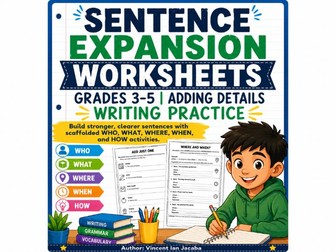
Sentence Expansion Worksheets for Grades 3–5 Help students build stronger, clearer sentences by adding purposeful WHO, WHAT, WHERE, WHEN, and HOW details. Designed for Grades 3–5, this scaffolded writing resource develops sentence fluency, precision, vocabulary, revision, and grammar skills while teaching students that effective sentence expansion is about adding useful information—not simply making sentences longer. Skills Covered Identifying WHO, WHAT, WHERE, WHEN, and HOW details Expanding basic sentences with relevant information Replacing vague words with precise language Choosing details that logically fit Organising details in a natural order Revising repetitive, irrelevant, unclear, or awkward details Checking sentence completeness, punctuation, spelling, and clarity What’s Included 20 progressive sentence expansion worksheets 5 full-colour anchor charts Teacher guidance and differentiation suggestions Answer keys with sample responses Activities progress from identifying and sorting detail types to using picture and context clues, selecting purposeful details, repairing weak sentences, and independently creating expanded sentences. Perfect For Whole-class writing lessons, guided practice, literacy centres, intervention, independent work, homework, revision, and formative assessment. Teachers can follow the sequence or select individual worksheets to target specific student needs. Add this ready-to-use sentence writing resource to your literacy toolkit for practical, differentiated practice that helps students write clearer, more detailed, and purposeful sentences.
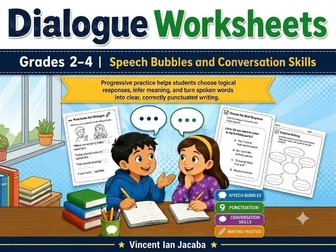
Dialogue Worksheets Grades 2–4 | Speech Bubbles & PunctuationQuick View
qscience

Dialogue Worksheets Grades 2–4 | Speech Bubbles & Punctuation

(0)
Dialogue Worksheets Years 3–5 | Speech Bubbles, Punctuation & Conversation Skills Develop pupils’ dialogue skills through engaging, picture-supported activities covering reading comprehension, punctuation, character perspective and writing. Includes: 20 progressive worksheets 5 instructional anchor charts Speech bubble and conversation activities Capitalisation and punctuation practice Character perspective and inference tasks Quotation marks and speaker tags Dialogue editing and writing practice Answer keys, sample responses and teacher guidance Pupils practise identifying speakers, matching logical responses, punctuating dialogue correctly, staying on topic, showing character feelings and creating connected conversations. Ideal for whole-class lessons, small groups, literacy centres, independent work, intervention, revision, assessment, homework and cover lessons. Use as a complete dialogue mini-unit or select individual worksheets to target specific skills.
Five-Finger Story Retell Worksheets Grades 1–2 | Reading ComprehensionQuick View
qscience

Five-Finger Story Retell Worksheets Grades 1–2 | Reading Comprehension

(0)
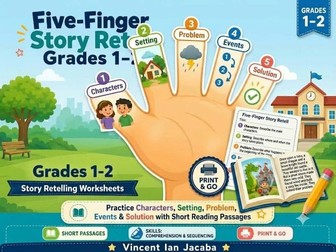
Five-Finger Story Retell Worksheets for Ages 5–7 | Reading Comprehension Help young learners strengthen reading comprehension and story-retelling skills with clear, structured Five-Finger Retell activities. Using short narrative passages and simple organisers, pupils identify the characters, setting, problem, key events and solution before retelling each story in sequence. What’s Included 5 instructional Five-Finger Retell anchor charts Short, age-appropriate narrative passages Five-finger story-retelling organisers Practice with characters, setting, problem, events and solution Sequencing prompts including First, Next and Then Printer-friendly black-and-white worksheets Answer keys with suggested responses Teacher guidance for instruction, differentiation and assessment Skills Covered Reading comprehension Story retelling Story elements Characters and setting Problem and solution Sequencing events Recalling key details Identifying important information Organising ideas logically Ideal for pupils aged 5–7 and suitable for whole-class teaching, guided reading, literacy centres, small groups, intervention, independent work, homework, revision and informal assessment. This ready-to-use resource gives pupils a memorable Five-Finger Retell strategy they can apply across narrative texts while helping teachers provide focused comprehension practice with minimal preparation.
Point of View Worksheets Gr. 3–5: Character Perspective Writing & Anchor ChartsQuick View
qscience

Point of View Worksheets Gr. 3–5: Character Perspective Writing & Anchor Charts

(0)
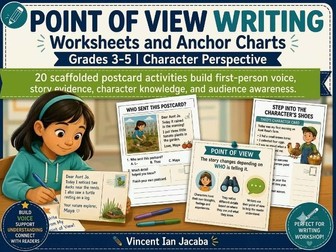
Make Point of View Meaningful Through Character Postcards Help learners aged approximately 8–11 develop a stronger understanding of point of view, character perspective and first-person writing through engaging postcard activities. This scaffolded English resource guides learners from identifying what a character can realistically know, notice, think and feel to independently writing from a consistent viewpoint. What’s Included 20 scaffolded point-of-view postcard activities 5 instructional anchor charts first-person writing practice character knowledge and text-evidence tasks perspective comparison and switching activities character voice, feelings, goals and audience practice planning and self-check tools independent writing task answer key with sample responses teacher guidance for differentiation and assessment Learners Will Practise maintaining a consistent first-person viewpoint selecting accurate story evidence distinguishing character knowledge from reader-only information expressing feelings, motivations and goals comparing different character perspectives adapting details for a specific audience writing authentic character postcards independently Ideal For Whole-class lessons, literacy centres, guided or independent practice, small groups, intervention, homework, revision and assessment. A practical upper-primary English resource combining reading comprehension, character perspective, text evidence and purposeful writing in one progressive set of activities.
Story Elements Worksheets Grades 1–2 | Story Map Cut & PasteQuick View
qscience

Story Elements Worksheets Grades 1–2 | Story Map Cut & Paste

(0)
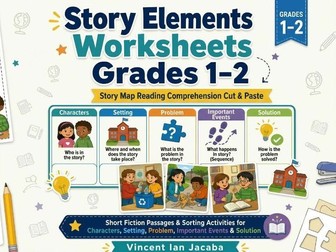
Story Elements Worksheets for Years 1–2 | Story Maps and Cut-and-Paste Activities Help young learners strengthen reading comprehension with 20 engaging short-fiction worksheets focused on five key story elements: characters, setting, problem, important events and solution. What’s Included 20 story elements worksheets Cut-and-paste sorting activities Story maps Relevant and extra-detail practice 5 full-colour anchor charts Answer keys with explanations Teacher guidance Skills Practised Identifying characters and setting Recognising problems and solutions Sequencing important events Distinguishing key details from unnecessary information Organising and retelling stories Ideal for whole-class lessons, guided reading, literacy centres, independent work, intervention, homework, revision and assessment. A ready-to-print resource that provides structured, hands-on practice with essential fiction comprehension skills.
Opinion Writing Worksheets and Anchor Charts Grades 2–4 | Reasons and EvidenceQuick View
qscience

Opinion Writing Worksheets and Anchor Charts Grades 2–4 | Reasons and Evidence

(0)
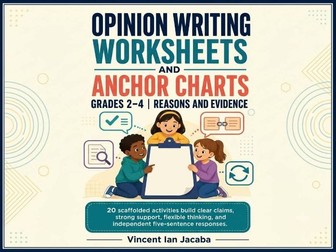
Opinion Writing Worksheets for Grades 2–4 | Scaffolded Writing Activities Help pupils develop clear, well-supported opinion writing with this structured set of scaffolded activities. Learners progress from stating a simple preference to writing an organised five-sentence response using clear reasons, supporting details, evidence, transitions and a conclusion. Suitable for Grades 2–4, this resource provides explicit teaching, guided practice and independent application to build confidence in opinion and persuasive writing. What’s Included 20 scaffolded pupil activity pages Coordinated instructional anchor charts Opinion-and-reason sentence frames Reason-and-detail planning organisers Claim, reason and evidence activities Perspective-taking and audience-awareness tasks Persuasive note-writing practice Independent opinion writing challenge Teacher guidance for differentiation and assessment Complete answer key with explanations and sample responses 50-page printable PDF Key Skills Pupils will practise: stating a clear opinion or claim explaining choices using because developing specific and relevant reasons replacing vague ideas with precise supporting details identifying weak, repeated or unrelated reasoning expanding reasons with examples and details providing two distinct supporting reasons using information from a source as evidence considering different perspectives and audiences responding respectfully to different opinions revising ideas when new information is introduced organising a focused five-sentence opinion response writing a courteous persuasive note Progressive and Supportive Activities increase gradually in difficulty, beginning with familiar choices and simple opinion-and-reason sentences before progressing to stronger reasoning, supporting details, perspective, evidence and complete written responses. Visual prompts, sentence frames, planning organisers and reason lenses provide useful support for developing writers while still allowing meaningful pupil choice and independent thinking. Ideal For whole-class writing lessons guided writing literacy centres or stations small-group teaching partner discussion and oral rehearsal independent practice intervention and additional support homework formative assessment end-of-unit writing assessment A practical, ready-to-use resource for helping young writers move from simply stating what they think to explaining why with clear, relevant and well-supported reasoning.
Procedural Writing Worksheets Grades 2–4-How-To Writing & Sequencing ActivitiesQuick View
qscience

Procedural Writing Worksheets Grades 2–4-How-To Writing & Sequencing Activities

(0)
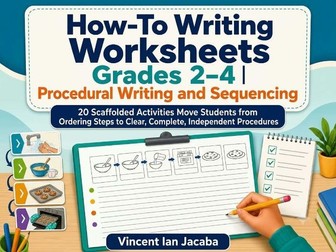
Build Confident How-To Writers Step by Step Support pupils in Grades 2–4 as they develop clear, well-organised procedural writing skills. This structured resource includes 20 progressive worksheets that guide learners from sequencing simple steps to independently planning, drafting and revising complete how-to procedures. What’s Included 20 procedural writing and sequencing worksheets 5 instructional anchor charts Teacher guidance Answer keys with explanations and sample responses Picture sequencing and ordering activities Missing and unnecessary step tasks Sequence word practice Precise action verb activities Clear versus vague direction practice Planning, paragraph writing and revision tasks Independent how-to writing challenge Skills Covered Pupils practise sequencing events logically, using transition words, identifying missing or irrelevant steps, choosing precise verbs, writing clear instructions, organising procedural paragraphs and editing for clarity, spelling, punctuation and capitalisation. Ideal For Procedural and instructional writing lessons Literacy and writing centres Whole-class teaching Small-group support and intervention Independent practice Revision and formative assessment Activities gradually reduce scaffolding as pupils gain confidence, culminating in an independent 5–7 sentence procedure with a clear opening, logical sequence, precise language and effective ending. A practical resource for helping young writers move from ordering steps to producing clear instructions that a reader can successfully follow.
Sensory Details Writing Worksheets Grades 3–5 | Five Senses Descriptive WritingQuick View
qscience

Sensory Details Writing Worksheets Grades 3–5 | Five Senses Descriptive Writing

(0)
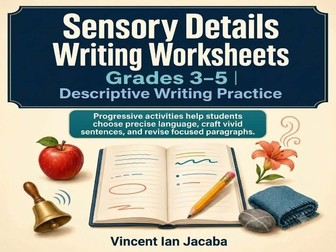
Bring Descriptive Writing to Life with Sensory Details Help pupils in Grades 3–5 develop vivid, precise descriptive writing using the five senses. This scaffolded resource moves from identifying sensory details to planning, revising and independently writing focused descriptive paragraphs. What’s Included 20 progressive sensory writing worksheets 5 full-colour anchor charts Teacher’s guide Answer keys and sample responses Independent descriptive writing task 50 printable PDF pages Skills Covered Using sight, sound, smell, taste and touch Replacing vague words with precise vocabulary Writing complete sensory sentences Selecting relevant descriptive details Distinguishing observations from inferences Organising details logically Using viewpoint and mood Planning, revising and improving descriptive paragraphs Ideal For Descriptive writing units Guided or independent writing Literacy centres Small-group support Homework and revision Formative assessment Home education A practical, structured resource that helps pupils build stronger vocabulary and create clear, vivid descriptions their readers can see, hear, smell, taste and feel.
Draw and Write Worksheets Grades 1–3 | Sentence Writing & Idea DevelopmentQuick View
qscience

Draw and Write Worksheets Grades 1–3 | Sentence Writing & Idea Development

(0)
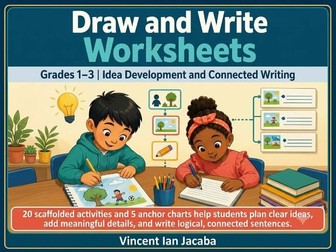
Draw and Write Worksheets for Grades 1–3 Help young writers turn pictures into clear, connected sentences with this scaffolded draw-and-write resource. Students progress from developing one simple idea to writing detailed two- and three-sentence responses. Includes 20 progressive draw-and-write worksheets 5 instructional anchor charts Teacher guidance and differentiation ideas Planning supports and checklists Independent writing challenge Skills Covered Developing clear ideas Writing complete sentences Using precise verbs and descriptive details Sequencing events Showing feelings Using because to explain reasons Exploring cause and effect and problem and solution Connecting dialogue with action Planning beginnings, middles and endings Revising unclear or unrelated ideas Ideal for literacy lessons, writing centres, guided or independent practice, intervention, home learning, early finishers and formative assessment. A practical Grades 1–3 resource for building confidence in planning, illustrating, writing and revising.
Picture Writing Prompts Grades 1–5 | Narrative Story WorksheetsQuick View
qscience

Picture Writing Prompts Grades 1–5 | Narrative Story Worksheets

(0)
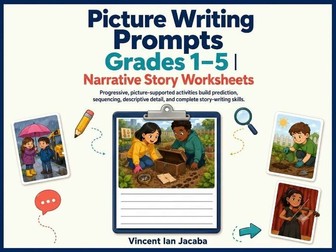
Picture Writing Prompts Grades 1–5 | Narrative Story Worksheets Help pupils develop confident narrative writing through engaging picture-based prompts and progressive storytelling activities. What’s Included 20 differentiated picture writing worksheets 5 full-colour narrative writing anchor charts Teacher guidance and differentiation suggestions Answer keys with sample responses 50-page printable PDF Printer-friendly black-and-white pupil pages Skills Covered Interpreting picture clues Predicting and sequencing events Cause and effect Problem and solution Character goals and setting Precise verbs and sensory details Dialogue and first-person point of view Show-not-tell writing Suspense, revision and editing Activities progress from supported writing in Grades 1–2 to more independent narrative composition in Grades 4–5, making the resource suitable for mixed-ability teaching. Ideal for narrative writing lessons, literacy centres, independent practice, intervention, assessment, homework, cover lessons and home education.
Sentence Writing Worksheets Grades 3–5 | Roll-a-Sentence Grammar PracticeQuick View
qscience

Sentence Writing Worksheets Grades 3–5 | Roll-a-Sentence Grammar Practice

(0)
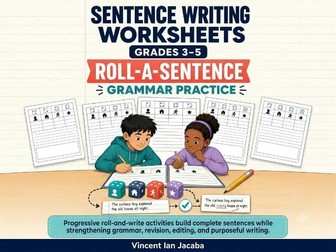
Sentence Writing Worksheets Grades 3–5 | Roll-a-Sentence Grammar Practice Make sentence writing engaging with 20 progressive Roll-a-Sentence worksheets for Grades 3–5. Pupils roll a die to generate characters, settings, actions and writing challenges, then create original sentences while practising key grammar and writing skills. What’s Included 20 Roll-a-Sentence worksheets 10 full-colour anchor charts 2 worked sample-response pages Teacher guidance and differentiation ideas 38 printable US Letter pages Skills Covered Complete and logical sentences Capitalisation and punctuation Precise adjectives and strong verbs How, when and where details Conjunctions and because clauses Varied sentence openings Sentence fluency Fragments and run-on sentences Purpose, audience and point of view Planning, revising and editing Ideal for literacy centres, grammar lessons, independent work, intervention, homework, formative assessment and home education. Responses will vary because pupils create original sentences from their individual roll results. Worked examples and teacher guidance are included to support instruction and assessment.
Alternate Story Endings Writing Worksheets – Grades 2–4Quick View
qscience

Alternate Story Endings Writing Worksheets – Grades 2–4

(0)
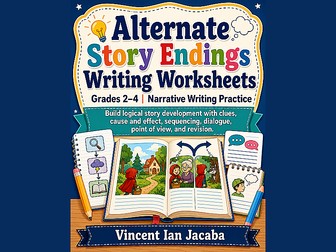
Alternate Story Endings Writing Worksheets – Grades 2–4 Help pupils move beyond random story endings and learn to create conclusions that are imaginative, believable, and logically connected to the original narrative. Designed for Grades 2–4, approximately ages 7–10 / Years 3–5, this structured narrative writing resource develops story comprehension alongside increasingly independent creative writing. Skills and Learning Objectives Pupils practise: writing logical alternate story endings using story clues and textual evidence connecting endings to setting, characters, problems and goals sequencing events clearly developing cause-and-effect relationships considering character actions and feelings using dialogue and first-person point of view creating plausible twists comparing stronger and weaker endings revising vague or poorly connected conclusions What’s Included The resource provides a progressive range of narrative writing activities, including: short story scenarios and writing prompts ending-selection and matching tasks sequencing and cause-and-effect activities story clue and evidence work storyboards and planning organisers dialogue and point-of-view practice alternative solution and twist-writing activities revision tasks independent narrative writing teacher guidance and differentiation suggestions a complete answer key with sample responses and explanations for open-ended tasks Classroom Uses Ideal for: whole-class writing lessons guided writing literacy or writing centres independent practice small-group intervention enrichment formative assessment narrative writing units Teachers can select individual worksheets for targeted skills or teach the activities progressively to build towards independent alternate-ending writing. Differentiation Support developing writers through oral rehearsal, highlighted story clues, sentence starters or drawing before writing. Extend confident writers by asking them to compare possible endings, justify choices with evidence, use purposeful dialogue and point of view, or develop a supported narrative twist. Build More Purposeful Narrative Writers A practical addition to narrative writing, creative writing and reading comprehension lessons, this resource helps pupils understand an essential storytelling principle: a new ending can be creative and surprising, but it still needs to belong to the story. Add this resource to your writing toolkit for structured, flexible practice in story endings, sequencing, cause and effect, narrative coherence and revision.
Capitalization & Punctuation Worksheets | Grammar, Sentence Editing & Anchor Charts (Grades 4–8)Quick View
qscience

Capitalization & Punctuation Worksheets | Grammar, Sentence Editing & Anchor Charts (Grades 4–8)

(0)
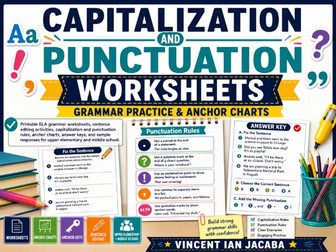
Make capitalisation, punctuation, and sentence editing practice simple, effective, and completely no-prep with this classroom-ready ELA grammar resource. Packed with anchor charts, printable worksheets, answer keys, and sample responses, this resource gives upper elementary and middle school students the focused practice they need to strengthen writing conventions and edit sentences with confidence. What’s Included Capitalisation rules anchor charts Punctuation rules anchor charts Oxford/serial comma reference chart Printable grammar worksheets Sentence editing activities Multiple-choice grammar questions Missing punctuation practice Capitalisation check activities Answer keys and sample responses Teacher’s guide Skills Covered Capitalising sentence beginnings, proper nouns, titles, dates, holidays, places, and the pronoun I Using periods, question marks, exclamation marks, commas, quotation marks, and apostrophes Practising semicolons, colons, hyphens, dashes, and parentheses Applying the Oxford/serial comma correctly Editing sentences for grammar, clarity, punctuation, and correctness Perfect For Grammar warm-ups and bell ringers Morning work Homework Literacy centres Writing workshops Small-group intervention Test preparation and revision Early finishers Emergency cover/sub plans Why Teachers Will Love It No-prep, print-and-go activities save valuable planning time Supports explicit teaching, guided practice, revision, and independent work Builds essential capitalisation, punctuation, grammar, and editing skills Visual anchor charts provide clear, student-friendly reference support Answer keys and sample responses make checking work faster and easier Flexible enough for whole-class teaching, intervention, homework, or ongoing spiral review Give students the repeated practice they need to become more accurate, confident writers and editors—without spending hours creating grammar activities from scratch. Download today and add a ready-to-use capitalisation, punctuation, and sentence editing toolkit to your ELA classroom.
200 ELA Bell Ringers for Grades 4–8 | Grammar, Vocabulary, Reading & Writing Warm-UpsQuick View
qscience

200 ELA Bell Ringers for Grades 4–8 | Grammar, Vocabulary, Reading & Writing Warm-Ups

(0)
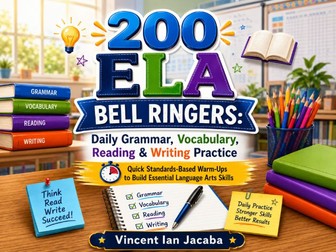
Make daily English practice quick, consistent, and completely hassle-free with 200 ELA Bell Ringers: Daily Grammar, Vocabulary, Reading & Writing Practice. This ready-to-print resource gives you 200 focused literacy warm-ups designed to strengthen essential language arts skills in just 5–10 minutes a day. Perfect for upper primary and lower secondary / upper elementary and middle school, these bell ringers provide regular practice in grammar, vocabulary, reading comprehension, punctuation, sentence correction, and writing. The predictable format makes it easy to build a strong daily routine while reducing lesson-planning time. What’s Included 200 printable ELA bell ringer worksheets Daily grammar and sentence correction practice Vocabulary in context activities Reading comprehension practice Capitalisation and punctuation review Sentence writing activities Answer keys and sample responses Brief explanations for review and reteaching Student-friendly, classroom-ready layouts Perfect For Bell work and lesson starters Morning work Daily literacy warm-ups Homework Intervention and targeted support Literacy centres Early finishers Exit tickets Test and assessment preparation Substitute / cover lessons Year-round ELA spiral review Why Teachers Love It ✔ Saves valuable planning time with 200 ready-to-use activities ✔ Provides consistent grammar, vocabulary, reading and writing practice ✔ Supports long-term retention through spiral review ✔ Makes marking easier with answer keys and sample responses ✔ Works flexibly across whole-class teaching, independent work and intervention Build Stronger ELA Skills—One Bell Ringer at a Time Stop searching for meaningful daily English activities. With 200 ready-to-print ELA bell ringers, you’ll have enough focused practice to support your literacy routine throughout the school year. Download today and give students consistent grammar, vocabulary, reading, punctuation and writing practice—without adding hours to your planning.
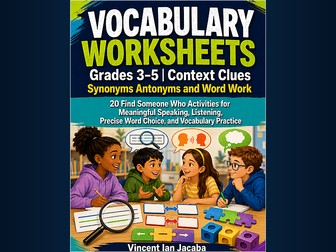
Vocabulary Worksheets Grades 3–5 | Context Clues, Synonyms, Antonyms & Word Work ActivitiesQuick View
qscience

Vocabulary Worksheets Grades 3–5 | Context Clues, Synonyms, Antonyms & Word Work Activities

(0)
Build vocabulary, speaking, and listening skills with 20 interactive “Find Someone Who…” activities designed for Grades 3–5. Students move beyond simple definitions by discussing word meanings, listening to classmates, applying vocabulary in context, and explaining their thinking. Skills Covered Synonyms and antonyms Context clues Categories and word relationships Precise word choice and action words Compound words, prefixes, and suffixes Listening for key details Restating and follow-up questions Academic vocabulary Explaining and justifying word choices What’s Included 20 vocabulary activity worksheets 5 vocabulary anchor charts Teacher guidance and differentiation ideas Answer keys with explanations Vocabulary Challenge and reflection activities Classroom Uses Ideal for vocabulary lessons, literacy centres, partner work, small groups, intervention, review, early finishers, and formative assessment. Activities can be used individually to target specific skills or together for broader vocabulary practice. Support learners with word banks, oral rehearsal, reduced prompts, or strategic partners, while extending confident students through explanations, examples, and student-created questions. A practical, classroom-ready resource for teachers seeking Grades 3–5 vocabulary worksheets that combine context clues, word relationships, precise vocabulary, speaking, listening, and meaningful student interaction.
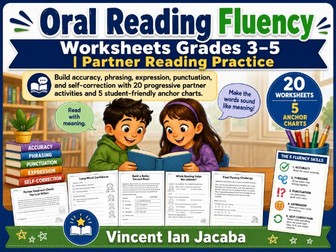
Oral Reading Fluency Worksheets Grades 3–5 | Partner Reading Activities & Anchor ChartsQuick View
qscience

Oral Reading Fluency Worksheets Grades 3–5 | Partner Reading Activities & Anchor Charts

(0)
Oral Reading Fluency Worksheets Grades 3–5 | Partner Reading Practice Build accurate, smooth, and meaningful oral reading with 20 progressive partner-reading activities and 5 student-friendly anchor charts for Grades 3–5. Skills Covered Accuracy, phrasing, punctuation, expression, and self-correction Partner feedback and purposeful rereading Fluency goal setting and self-monitoring What’s Included 20 partner-reading worksheets 5 fluency anchor charts Sentence, passage, dialogue, poetry, and longer-word practice Checklists, reflections, repeated reading, and a final fluency challenge Teacher guidance, differentiation, and assessment suggestions Ideal For Literacy centres, partner reading, small groups, intervention, ELA lessons, fluency practice, and formative assessment. Use the activities sequentially or select individual worksheets to meet student needs. Add this practical, classroom-ready oral reading fluency resource to your literacy toolkit for focused practice that helps students read with greater accuracy, expression, and meaning.
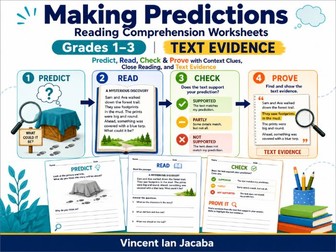
Making Predictions Worksheets Grades 1–3 | Reading Comprehension & Text EvidenceQuick View
qscience

Making Predictions Worksheets Grades 1–3 | Reading Comprehension & Text Evidence

(0)
Support young readers in making thoughtful, evidence-based predictions with this engaging Grades 1–3 reading comprehension resource. Students use picture clues, context clues, titles, and passage details to predict, read, check, and prove their thinking with text evidence. Included 20 reading comprehension worksheets 20 answer keys 5 instructional anchor charts Teacher’s guide with differentiation and assessment support Skills Covered Making predictions Close reading Context clues Checking and revising predictions Identifying text evidence Supporting conclusions Classroom Uses Ideal for whole-class teaching, guided reading, literacy centres, small groups, intervention, independent work, homework, review, or assessment. The consistent Predict → Read → Check → Prove routine helps students move beyond guessing and develop stronger comprehension and evidence-based thinking. Add this ready-to-use prediction and text evidence resource to your literacy lessons for focused, practical reading comprehension practice.
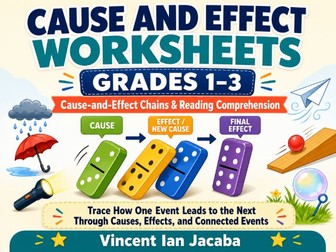
Cause and Effect Worksheets Grades 1–3 | Cause-and-Effect Chains & Reading ComprehensionQuick View
qscience

Cause and Effect Worksheets Grades 1–3 | Cause-and-Effect Chains & Reading Comprehension

(0)
Cause and Effect Worksheets for Grades 1–3 Build stronger reading comprehension and logical thinking with this structured cause-and-effect resource for Grades 1–3. Pupils practise identifying causes and effects, tracing multi-step event chains, recognising when an effect becomes a new cause, and explaining how events are connected. What’s Included 20 cause-and-effect worksheets 5 colourful anchor charts Short passages, visual activities, sequencing, matching, and chain-building tasks Complete answer keys with explanations Teacher guidance, differentiation ideas, and assessment support Skills Developed Cause and effect Reading comprehension Sequencing Logical reasoning Explaining relationships between events Ideal for whole-class teaching, guided reading, literacy centres, independent work, homework, intervention, revision, or assessment. The varied activities provide accessible support for developing learners while offering opportunities for more confident pupils to explain and create their own cause-and-effect chains. A practical, classroom-ready resource for helping pupils understand not just what happened, but why it happened and what happened next.
Problem and Solution Worksheets Grades 1–3 | Reading Comprehension ActivitiesQuick View
qscience

Problem and Solution Worksheets Grades 1–3 | Reading Comprehension Activities

(0)
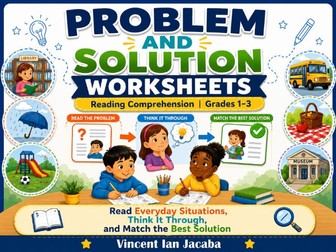
Problem and Solution Reading Comprehension Worksheets | Grades 1–3 Help young learners strengthen reading comprehension and logical reasoning with engaging problem-and-solution activities based on familiar everyday situations. Students identify problems, evaluate possible responses, and choose the most appropriate solution. Skills Practised Identifying problems and solutions Cause and effect Context clues and logical reasoning Making safe, helpful choices Explaining answers using text details What’s Included 20 themed worksheets 20 answer keys with explanations 5 instructional anchor charts Teacher’s guide and introduction Perfect for literacy centres, guided reading, independent work, intervention, homework, review, or assessment, with built-in opportunities for support and extension. A practical, ready-to-use Grades 1–3 resource for developing confident readers and thoughtful problem-solvers.
Reading Comprehension Worksheets Grades 1–3 | True, False or Fix It | Close ReadingQuick View
qscience

Reading Comprehension Worksheets Grades 1–3 | True, False or Fix It | Close Reading

(0)
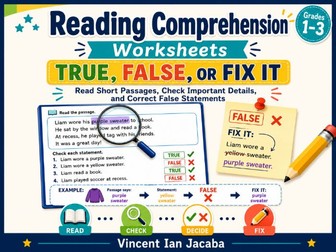
Build stronger reading comprehension and close-reading skills with this engaging True, False, or Fix It resource for Grades 1–3. Students read short passages, decide whether statements are true or false, and correct inaccurate details using evidence from the text. Skills Covered Reading comprehension and close reading Identifying key details Using text evidence Comparing information Correcting false statements accurately What’s Included 20 printable reading comprehension worksheets Short, age-appropriate passages True/False and correction activities 5 supporting anchor charts Teacher guidance and differentiation ideas Answer keys with corrections and explanations Perfect For Whole-class teaching, guided reading, literacy centres, independent work, intervention, homework, review, or assessment. A practical, low-prep resource for helping Grades 1–3 students read carefully, check important details, and support their answers with evidence.
Main Idea & Supporting Details Worksheets Grades 1–3 | Cut-and-Paste Reading ComprehensionQuick View
qscience

Main Idea & Supporting Details Worksheets Grades 1–3 | Cut-and-Paste Reading Comprehension

(0)
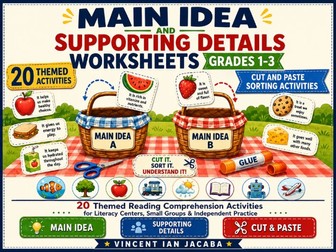
Main Idea and Supporting Details Worksheets Grades 1–3 Build reading comprehension with 20 engaging cut-and-paste activities that help students identify main ideas and match relevant supporting details. Designed for Grades 1–3, this resource uses familiar themes and hands-on sorting to make comprehension practice clear and meaningful. Skills Practised Identifying main ideas Recognising supporting details Matching details to the correct main idea Making logical connections Explaining reasoning What’s Included 20 themed cut-and-paste worksheets Visual instructional anchor charts Answer keys with concise explanations Differentiation opportunities for support and challenge Ideal For Literacy centres, whole-class lessons, small groups, partner work, independent practice, intervention, review and informal assessment. Add this ready-to-use main idea and supporting details resource to your literacy toolkit for practical, engaging comprehension practice.