Bundle
 Quick View
T Level DSD: Computational Thinking Full Unit Bundle (Lessons 1–5) — Problem Solving
The complete Computational Thinking sub-unit for T Level Digital Software Development — Problem Solving (spec point 1.1), covering all five lessons as a single discounted bundle. Save 43% compared to buying the lessons individually.
This bundle takes students from first principles through to full exam-ready understanding of computational thinking:
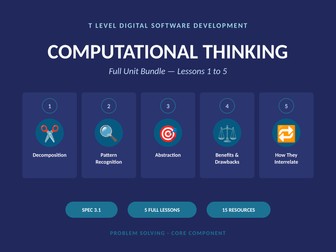
Lesson 1 — Introduction & Decomposition (AO1b): what computational thinking is, its four components, and how to break a problem into manageable sub-problems.
Lesson 2 — Pattern Recognition (AO1b): spotting trends and similarities to reuse solutions and make predictions from data.
Lesson 3 — Abstraction (AO1b/AO2): filtering relevant from irrelevant information, plus a synthesis lesson linking all four components together.
Lesson 4 — Benefits & Drawbacks (AO3a): the strengths and limitations of each component, and how to analyse which drawback matters most in a given scenario.
Lesson 5 — How They Interrelate (AO3a): a case-study-driven lesson showing that real problem solving loops back between components rather than following a fixed order.
Every lesson is a complete, ready-to-teach package: a detailed 12-slide PowerPoint (starters, modelled worked examples, guided and independent practice, a mark-schemed exam-style question, and a plenary exit ticket), a full lesson plan written to a standard Content Area 1 template, and a matching practice worksheet — 15 files in total (5 PowerPoints, 5 lesson plans, 5 worksheets).
By the end of the unit, students can define and apply all four components of computational thinking, evaluate their benefits and drawbacks, and analyse how they interrelate in real problem solving — covering AO1a, AO1b, AO2, AO3a and AO3b across the sequence, and fully preparing them for Paper 1 questions on this spec point.
Ideal for T Level Digital Software Development (Core Component, Problem Solving) teachers wanting a coherent, fully resourced run of lessons rather than piecing together individual resources. Part of a growing 20-lesson full scheme of work — Lesson 6 onward (Algorithmic Design) coming soon.