Microscope Biology Lesson: Magnification and Scale ActivityQuick View
MoreLessonsLessPlanning

Microscope Biology Lesson: Magnification and Scale Activity

(0)
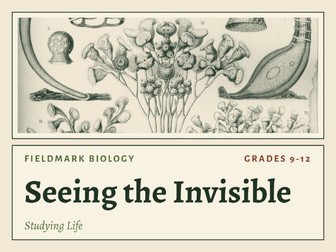
A complete microscopes and scale lesson for US high school biology, grades 9-12, built around Antonie van Leeuwenhoek, the Delft cloth merchant who ground his own lenses. Students read how Leeuwenhoek reported tiny swimming “animalcules” in the 1670s and how respected local citizens confirmed what he saw. They separate magnification from resolution, convert between millimeters, micrometers and nanometers, calculate actual size from a magnified image, and compare light and electron microscopes. The figure compares the approximate diameter of a hemoglobin molecule, an influenza virus, an E. coli bacterium and a red blood cell in nanometers. It is labeled sample data for teaching. Vocabulary: magnification, resolution, micrometer, nanometer and electron microscope. Open with First Look, which asks what a cloth merchant saw wriggling in a drop of lake water. Teach with the slides and Field Notes, then hand out the Field Study and close with Last Look. A home educator can use it with a single student. The download has 6 PDFs (13 pages) and one editable PowerPoint file. NGSS: HS-LS1-2. Part of Fieldmark Biology’s Studying Life unit. Included in the ZIP download: First Look (bell ringer): a one-page opening activity. Field Notes (guided notes): 3 pages of student notes to use with the slides. Field Study (reading and activity): a 3-page packet with the reading, comprehension questions, vocabulary and figure analysis. Last Look (exit ticket): a 1-page closing check. Teacher Key: 3 pages of answers plus the Lesson at a Glance plan. PowerPoint: 12 slides with speaker notes. Start Here: a 2-page introduction and terms of use.
Scientific Method Biology Lesson: Experimental Design ActivityQuick View
MoreLessonsLessPlanning

Scientific Method Biology Lesson: Experimental Design Activity

(0)
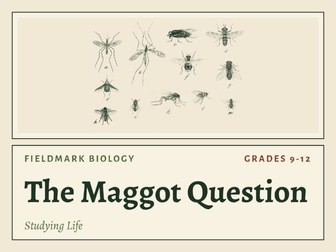
A complete experimental design lesson for US high school biology, grades 9-12, built around Francesco Redi’s 1668 test of whether meat makes its own maggots. Students follow Redi as he asks a question, states a hypothesis and sets up open, sealed and gauze-covered jars. They then pick out the independent variable, the dependent variable and the control group, and explain why a larger sample size and replication make a conclusion easier to trust. The figure shows the number of open, sealed and gauze-covered jars where maggots appeared on the meat. It is labeled sample data for teaching. Vocabulary: hypothesis, independent variable, dependent variable, sample size and replication. Open with First Look, which asks how you would test where the maggots came from. Teach with the slides and Field Notes, give students the Field Study, and close with Last Look. A home educator can run it one-on-one with the same materials. The download has 6 PDFs (13 pages) and one editable PowerPoint file. NGSS: HS-LS1-3. Part of Fieldmark Biology’s Studying Life unit. Included in the ZIP download: First Look (bell ringer): a one-page opening activity. Field Notes (guided notes): 3 pages of student notes to use with the slides. Field Study (reading and activity): a 3-page packet with the reading, comprehension questions, vocabulary and figure analysis. Last Look (exit ticket): a 1-page closing check. Teacher Key: 3 pages of answers plus the Lesson at a Glance plan. PowerPoint: 11 slides with speaker notes. Start Here: a 2-page introduction and terms of use.
Graphing and Data Analysis Biology Lesson: Correlation ActivityQuick View
MoreLessonsLessPlanning

Graphing and Data Analysis Biology Lesson: Correlation Activity

(0)
A complete lesson on reading data and graphs for US high school biology, grades 9-12, built around Thomas Malthus’s 1798 warning about population and food. Students read how world population grew from one billion around 1804 past eight billion in 2022, and why Malthus’s prediction did not play out. Along the way they learn to check a graph’s axes and units, describe a trend, choose between a line graph and a bar graph, and tell correlation from causation. The figure is a line graph of world population, in billions, every 50 years from 1800 to 2000, drawn from published United Nations estimates. Vocabulary: axis, trend, correlation, causation and confounding variable. Start with First Look, which asks whether carrying a phone causes car accidents. Teach with the slides and Field Notes, use the Field Study for the reading and graph work, and finish with Last Look. It works for a home educator teaching one student, too. The download has 6 PDFs (13 pages) and one editable PowerPoint file. NGSS: HS-LS2-2. Part of Fieldmark Biology’s Studying Life unit. Included in the ZIP download: First Look (bell ringer): a one-page opening activity. Field Notes (guided notes): 3 pages of student notes to use with the slides. Field Study (reading and activity): a 3-page packet with the reading, comprehension questions, vocabulary and figure analysis. Last Look (exit ticket): a 1-page closing check. Teacher Key: 3 pages of answers plus the Lesson at a Glance plan. PowerPoint: 10 slides with speaker notes. Start Here: a 2-page introduction and terms of use.
Characteristics of Life Biology Lesson: Is a Virus Alive ActivityQuick View
MoreLessonsLessPlanning

Characteristics of Life Biology Lesson: Is a Virus Alive Activity

(0)
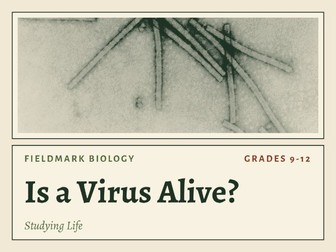
A complete characteristics of life lesson for US high school biology, grades 9-12, built around one question: is a virus alive? Students follow tobacco mosaic virus from Ivanovsky’s filtering experiments in 1892 to Stanley’s virus crystals in 1935. They use the traits living things share to decide why most biologists classify viruses as non-living, and what a virus needs from a host cell. A bar graph compares the approximate size of a TMV particle, an E. coli bacterium and a human red blood cell, in nanometers, and is labeled sample data for teaching. Vocabulary: virus, metabolism, homeostasis, natural selection and host cell. Open with First Look, teach with the slides and Field Notes, and use the Field Study for the reading and evidence-based reasoning. Close with Last Look. A home educator can work through it with one student. The download has 6 PDFs (13 pages) and one editable PowerPoint file. NGSS: HS-LS1-3. Part of Fieldmark Biology’s Studying Life unit. Included in the ZIP download: First Look (bell ringer): a one-page opening activity. Field Notes (guided notes): 3 pages of student notes to use with the slides. Field Study (reading and activity): a 3-page packet with the reading, comprehension questions, vocabulary and figure analysis. Last Look (exit ticket): a 1-page closing check. Teacher Key: 3 pages of answers plus the Lesson at a Glance plan. PowerPoint: 10 slides with speaker notes. Start Here: a 2-page introduction and terms of use.
Halloween Biology Lesson: Zombie Ant Fungus Parasite ActivityQuick View
MoreLessonsLessPlanning

Halloween Biology Lesson: Zombie Ant Fungus Parasite Activity

(0)
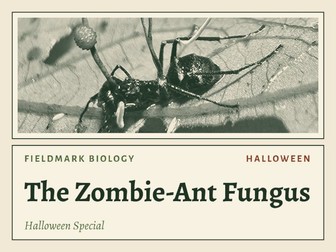
A Halloween special for US high school biology, grades 9-12: a complete lesson on the zombie-ant fungus, a parasite that changes how its host behaves. Students read how Ophiocordyceps fungi make a dying carpenter ant bite a leaf and hold on, and what a 2017 lab study found when researchers looked inside the heads and legs of infected ants. They use the evidence to describe how the fungus changes ant behavior and to explain why it is unlikely to threaten people. The figure shows the number of dead infected ants found in each height band above the soil, and it is labeled sample data for teaching. Vocabulary includes parasite, host, spore, host specificity and sensu lato. Open with the First Look, teach with the slides and Field Notes, then assign the Field Study. Close with the Last Look. A home educator can run the same sequence with one student. The download contains 6 PDFs (14 pages) and one editable PowerPoint file. The PDFs are printable. NGSS: HS-LS2-8 and HS-LS2-2. This lesson is a Halloween special and is not part of a Fieldmark Biology unit. Included in the ZIP download: First Look (bell ringer): 1 page, an opening question Field Notes (guided notes): 3 pages of student notes to use with the slides Field Study (reading and activity): 3 pages with the reading, comprehension questions, vocabulary and figure analysis Last Look (exit ticket): 1 page, a closing check with recall, application and reflection questions Teacher Key: 4 pages with answers and a Lesson at a Glance plan Start Here: 2 pages, an introduction and terms of use PowerPoint: 9 slides with speaker notes