 Quick View
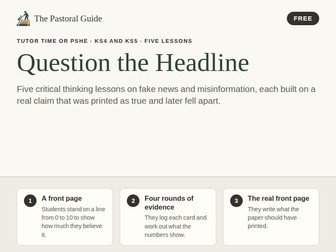
Fake news and critical thinking: five lessons on questioning a headline, KS4 and KS5
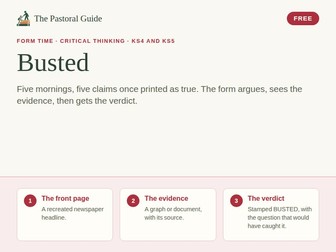
Five free critical thinking lessons on fake news and misinformation. Each one is built around a real claim that was printed as true and later fell apart. Each lesson takes 45 minutes to an hour, stands alone, and works in tutor time, PSHE or citizenship.
The five claims
Who Paid for the Science? A 1967 review blamed fat, not sugar, for heart disease. The sugar industry paid for it.
Complete Safety. Thalidomide, sold in the 1950s as safe in pregnancy, and the US official who refused to approve it.
Doctors’ Orders. “More doctors smoke Camels than any other cigarette”, set against a study of 40,000 British doctors.
No Real Evidence. Leaded petrol, approved in 1926 because nobody had proved it was harmful.
It’s All Vegetable. Crisco, sold as healthier than butter, and a 1990 experiment on what it did to cholesterol.
How each lesson works
The claim. It appears as a recreated newspaper front page. Students stand on a line from 0 to 10 to show how much they believe it.
Five questions to ask of any headline: Who is saying it? Who gains if I believe it? Who paid for it? What is the evidence? Has it been tested, and by whom? The same five come back in every lesson.
The evidence, one card at a time over four rounds: an advert, a document, a graph and a scientist. After each card, students log it on their evidence sheet, note which question it answers, and move on the line. The graph card has three maths questions, with the answers on the next slide.
The front page. Students write the front page the paper should have printed, using at least two cards and one number. Another group marks it against three checks. Then the verdict goes up, with the one question that would have caught the claim.
What you get
Five PowerPoint decks, 19 slides each, with a teacher slide, editable charts, and the sources on the last slide.
An 18-page printable PDF: a one-page guide, a poster of the five questions, the front page writing sheet, and for each lesson a teacher page with timings and answers, four evidence cards and a student evidence sheet.
Good to know
Every quote and number is real, and each teacher page lists its sources. Lesson 2 covers thalidomide and lesson 3 covers smoking, so keep the discussion on the claims and the evidence. Lessons 1 and 5 are about how food was marketed, not what anyone should eat.
This is Volume One. For Year 10 to Year 13, and it works in Year 9. Written by a secondary form tutor. More free tutor time lessons are in this shop.